


Fort Worth Delayed or Prolonged Surgery Lawyer
Written by: Hastings Law Firm | Reviewed by: Gabe Sassin | Updated: July 27, 2026
Delayed or prolonged surgery can turn a treatable problem into lasting harm, especially when a procedure is not performed within the medically appropriate timeframe or runs far longer than expected. The risks can include worsening illness, irreversible injury, systemic infection, and fatal outcomes, with added complications that go beyond the original condition. Some delays are medically justified, but others stem from scheduling failures, missed urgency, or other breakdowns in care. If you or a loved one were harmed or worse due to delayed or prolonged surgery in Fort Worth, Texas, contact Hastings Law Firm for a free, confidential case review.

Trusted Legal Representation for Surgical Delays in Fort Worth
What You Should Know About Operating Room Delay Claims in Fort Worth:
- Harm can become life threatening when surgery is unreasonably delayed and a treatable condition progresses into irreversible injury or systemic infection.
- Outcomes can be fatal when delayed emergency surgery or prolonged surgery is associated with higher illness and mortality rates.
- Liability can turn on whether additional injuries were caused by the delay rather than the underlying illness.
- Negligence may be indicated when delays stem from logistical failures such as operating room overbooking or administrative scheduling errors.
- Options can be limited if procedural requirements for Texas medical malpractice claims are not met.
- Recovery can depend on showing measurable losses such as added medical expenses, lost income, pain, and reduced quality of life.
- Serious complications can increase when surgery runs significantly longer than expected due to extended anesthesia exposure.
- Severe outcomes can follow prolonged surgical time when risks rise for blood clots, infection, and tissue injury.
- Disputes often depend on whether records such as surgical logs, nursing notes, and scheduling data show avoidable delays.
- Case strength can hinge on expert opinions about whether a competent surgeon would have operated sooner under similar circumstances.

A Healthcare Focused Law Firm
When a surgery is delayed or takes far longer than expected, the consequences can be severe and life-altering. If you or a loved one suffered harm because a procedure was not performed in time, or because an operation extended well beyond what was medically appropriate, you may have grounds for a medical malpractice claim.
At Hastings Law Firm, we focus exclusively on medical malpractice cases. Our legal team includes former defense attorneys and in-house nurse consultants who know how to investigate surgical timelines, identify where the standard of care was breached, and build a case that holds the responsible parties accountable.
As an experienced Fort Worth delayed or prolonged surgery lawyer, we can review what happened, explain your legal options, and help you understand whether negligence played a role. Contact us for a free, confidential case evaluation.
Severe Health Consequences of Unreasonable Surgical Delays
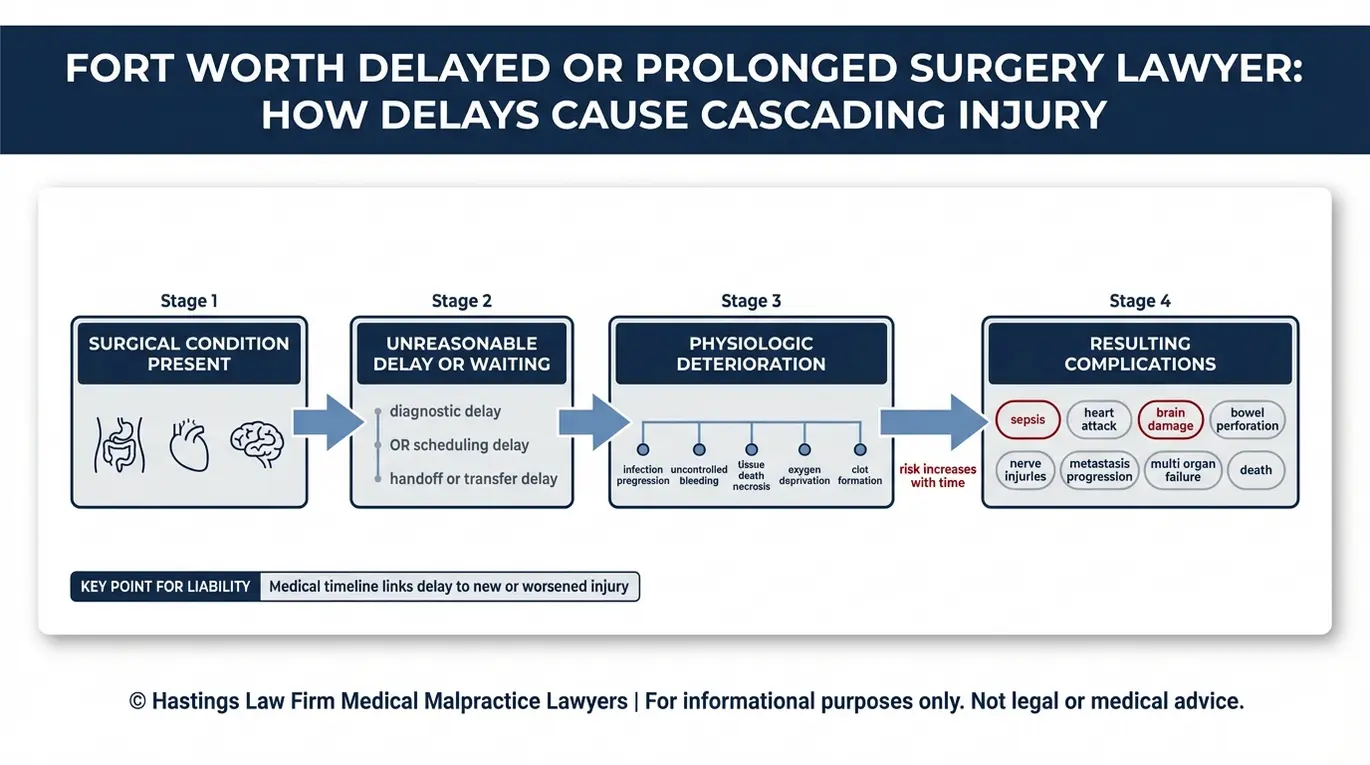
Unreasonable delays in surgical intervention can allow conditions to metastasize, cause tissue death (necrosis), or lead to systemic infection (sepsis), turning a treatable condition into a life-threatening emergency.
The human body operates on biological timelines that do not wait for scheduling issues or administrative decisions to resolve. When a condition requires surgery, there is often a critical window during which treatment can prevent irreversible damage. Once that window closes, the patient may face outcomes that were entirely preventable.
Research published through the National Library of Medicine confirms that delayed emergency general surgery procedures and prolonged surgery are associated with increased morbidity and mortality (higher rates of illness and death). The HHS Office of Inspector General has also documented the scope of preventable adverse events in hospital settings, many of which stem from failures to act within appropriate timeframes.
The specific medical complications of delayed surgical treatment depend on the underlying condition, but they often include:
- Sepsis, a dangerous, body-wide response to infection that can lead to organ failure and death when an infected area is not surgically treated in time
- Metastasis, the spread of cancer to other organs when a tumor is not removed promptly
- Bowel perforation, which may occur when an inflamed appendix or obstructed bowel is left untreated
- Brain damage from conditions like bleeding or swelling that require immediate decompression
- Heart attack or cardiovascular collapse in patients whose surgical needs are tied to vascular emergencies
- Uncontrolled bleeding that worsens the longer intervention is withheld
- Nerve injuries resulting from prolonged pressure or swelling left unaddressed
Each of these surgical complications represents harm that is separate from the original medical condition. That distinction matters in a medical malpractice case because the question is not whether the patient was already sick. The question is whether timely surgery could have prevented the additional harm. Consulting a delayed surgery attorney can help families understand if these outcomes were avoidable.
Why Surgeries Are Delayed or Prolonged and When It Is Negligence
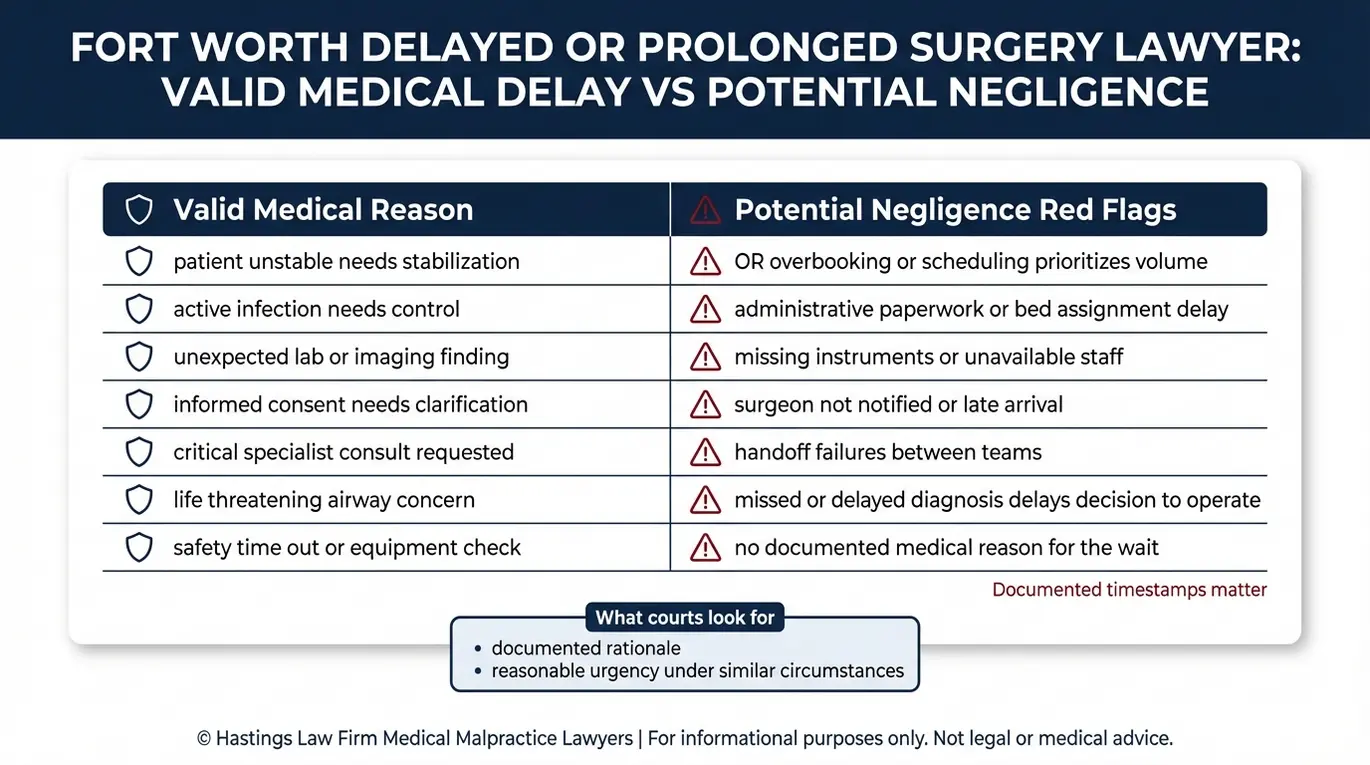
While some delays are medically necessary for patient stability, negligence occurs when delays are caused by logistical failures, such as overbooking the operating room, administrative errors, or a surgeon’s failure to recognize the urgency of the condition.
A delayed surgery, meaning a procedure that is not performed within the medically indicated timeframe, is not automatically malpractice. Surgeons sometimes need to stabilize a patient, manage blood pressure, or address clotting issues before operating safely. These decisions reflect sound clinical judgment.
But when surgery is postponed because the operating room was overbooked, a diagnosis was missed, or staff failed to recognize the urgency of a patient’s condition, the delay may constitute a breach of duty. A study on outcomes of boarding critically ill patients in U.S. emergency departments highlights how system-level bottlenecks can directly contribute to worsened patient outcomes.
The same principle applies to surgical errors such as misdiagnosis. If a provider fails to identify a condition that requires immediate surgical intervention, the resulting delay in treatment may form the basis of a medical negligence claim. If the issue involves a start delay or prolonged surgery, an experienced prolonged surgery lawyer can determine if the provider violated their duty of care.
| Valid Medical Reason for Delay | Potential Negligence |
|---|---|
| Stabilizing the patient’s vitals before surgery | Overbooking the operating room or surgical suite |
| Managing a blood clotting disorder pre-operatively | Administrative scheduling errors or understaffing |
| Awaiting essential diagnostic results already ordered | Failure to order necessary tests in a timely manner |
| Coordinating a specialist for a complex procedure | Surgeon’s failure to recognize the urgency of a condition |
| Patient requires medical clearance for safe anesthesia | Missed or delayed diagnosis that postpones needed treatment |
High-volume scheduling patterns at hospitals can also contribute to delays when patient flow is prioritized over timely individual care. We examine facility records and staffing logs to determine whether operational decisions played a role.
The Dangers of Prolonged Anesthesia and Surgical Time
A prolonged surgery, one that extends significantly beyond its expected duration, carries its own set of serious risks. Even when the procedure eventually begins on time, complications can arise if the operation itself takes far longer than it should.
Extended general anesthesia, meaning a patient remains under anesthesia for a longer period than planned, places significant stress on the body. The longer a patient is under, the greater the risk of cardiovascular strain, respiratory complications, and complications from extended anesthesia such as adverse neurological effects.
Prolonged time on the operating table also increases the risk of deep vein thrombosis (DVT), a condition in which blood clots form in the deep veins, typically in the legs. If one of those clots breaks free and travels to the lungs, it can cause a pulmonary embolism, a sudden blockage of a lung artery that can be fatal.
Extended surgical time can also lead to tissue death (necrosis) from prolonged pressure on certain body areas, increased blood loss, and a higher likelihood of post-operative infection. When a surgery runs significantly longer than the established standard, we work with medical experts to determine whether the extended duration resulted from surgical errors or a failure to manage the procedure competently.
The Hastings Law Firm Difference
Results matter, but what truly sets us apart is how we achieve them. Every verdict, every settlement, and every Fort Worth courtroom victory comes from one guiding promise: To treat each client’s fight for justice as if it were our own.
This balance of skill, experience, and empathy reflects our core philosophy that justice should not only compensate the injured, but also make healthcare safer nationwide.

Proving Liability and Malpractice in Fort Worth Surgical Cases
To win a delayed surgery case in Texas, a plaintiff must prove that a competent surgeon would have operated sooner under similar circumstances and that the delay directly caused specific, quantifiable damages.
Texas medical malpractice claims are governed by Texas Civil Practice and Remedies Code Chapter 74, which sets procedural requirements including mandatory expert reports. Our founder, Tommy Hastings, is board-certified in Personal Injury Trial Law and has spent over 20 years handling these specialized medical cases.
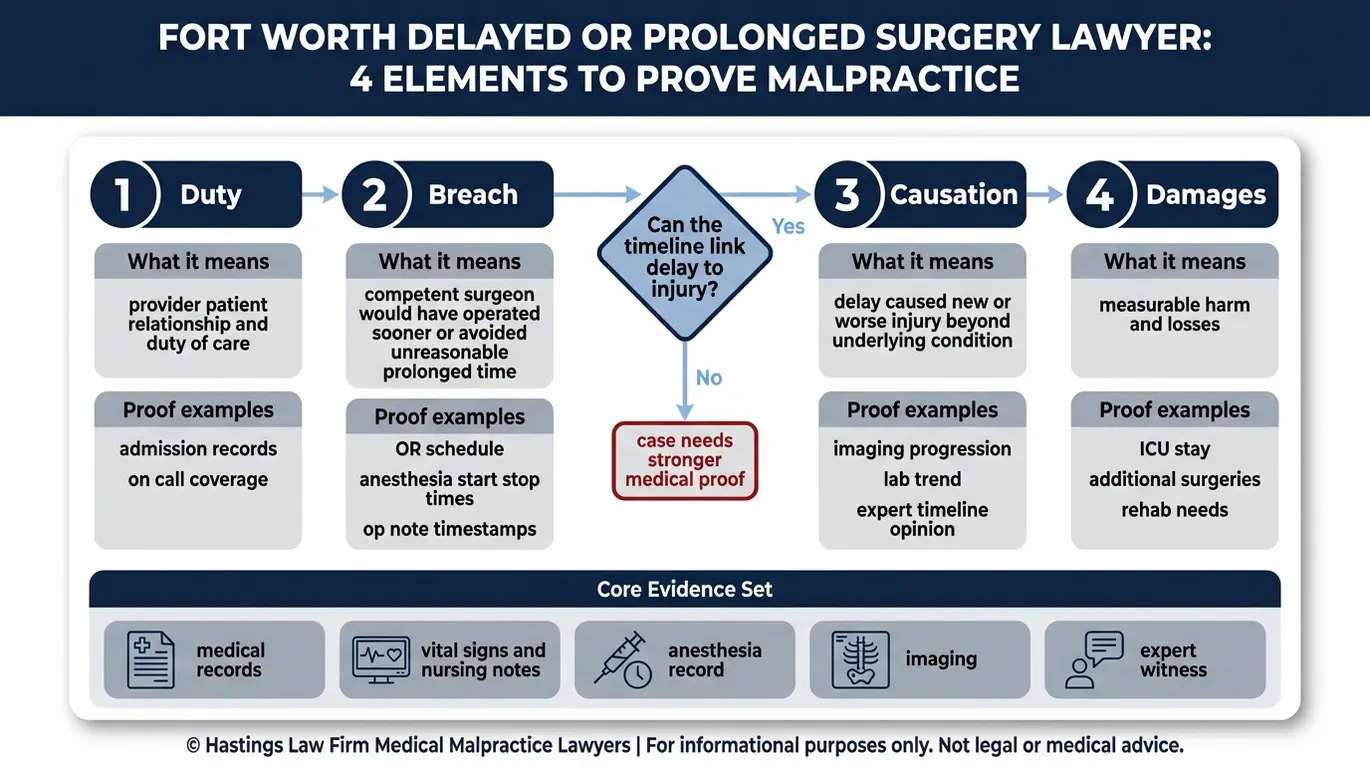
As a Fort Worth medical malpractice lawyer, our team manages every step of this process. Here are the four legal elements we must establish:
- Duty of care: The healthcare provider had a professional obligation to treat the patient according to accepted medical standards. This is typically established through the doctor-patient relationship.
- Breach of duty: The provider failed to meet the standard of care. In delayed surgery cases, this means demonstrating when the surgical intervention should have occurred based on the patient’s condition and comparing that to when it actually happened.
- Causation: The delay, not the underlying illness, caused additional harm. This is often the most difficult element to prove. We use qualified medical experts to establish that timely surgery would have prevented the specific injuries the patient suffered, whether that involves metastasis, the spread of cancer to distant organs, or complications from extended general anesthesia, a state of prolonged sedation.
- Damages: The patient experienced measurable losses. In a medical malpractice lawsuit, these damages may include additional medical expenses, lost income, physical pain, and reduced quality of life.
Our team builds a minute-by-minute timeline using medical records, surgical logs, nursing notes, and facility scheduling data. Expert witnesses then testify about whether the documented delays fell below the standard of care and directly caused the patient’s injuries. This is the foundation of every case we prepare, and we build it from day one with trial-level rigor.
Contact the Fort Worth Surgical Error Attorneys at Hastings Law Firm Today for Help
You should not bear the financial and physical burden of harm caused by a hospital’s scheduling failures or a provider’s failure to act. Since 2005, our firm has focused exclusively on medical malpractice, ensuring our clients receive specialized advocacy from a team that understands the healthcare system from the inside.
If a surgical delay or an unreasonably prolonged procedure caused you or your loved one additional injury, our team is ready to investigate what happened. Hastings Law Firm prepares every case as though it will go to trial.
This trial-ready approach, backed by in-house medical professionals and a national network of expert witnesses, puts us in a strong position to pursue the full scope of your damages. There is no upfront cost to work with us. We handle delayed and prolonged surgery cases on a contingency fee basis, meaning you pay no attorney fees unless we recover compensation on your behalf. Call us today or request a free case evaluation online to take the first step.
Frequently Asked Questions About Delayed or Prolonged Surgery in Fort Worth


This content was researched and written by the Hastings Law Firm editorial team, which includes attorneys, medical professionals, and experienced researchers. Our writing is informed by internal knowledge and practical experience, and we cross-check critical details against authoritative sources cited throughout. Every piece undergoes human-led fact-checking and legal review. Because legal and medical information can change, if you spot an error, please contact us. Learn more about our content standards and review process on our editorial policy page.

Gabe Sassin has focused exclusively on medical malpractice law since 2007. After spending more than a decade as a malpractice defense attorney, he knows exactly how the other side works. He has seen firsthand how healthcare providers, insurers, corporate defendants, and their legal teams think, prepare, and build their defense against claims. That knowledge works for the people who need it most today, injured patients and their families. His unique experience shapes everything he writes, giving readers a look at how these cases actually work from someone who has handled them from both sides.
