


Fort Worth Gallbladder Surgery Error Lawyer
Written by: Hastings Law Firm | Reviewed by: Gabe Sassin | Updated: July 27, 2026
Gallbladder removal is often expected to be routine, but preventable surgical mistakes can leave patients facing serious complications and a long recovery. Errors during laparoscopic surgery can involve limited visibility and misidentification of anatomy, which can lead to bile duct injury, infection, repeated hospitalizations, and life threatening consequences. Understanding how these injuries happen and how negligence is evaluated can help patients make informed decisions while seeking clarity and stability after a frightening outcome. If you or a loved one were harmed or worse due to a gallbladder surgery error in Fort Worth, Texas, contact Hastings Law Firm for a free, confidential case review.

Trusted Fort Worth Medical Attorneys for Surgical Negligence Claims
What You Should Know About Cholecystectomy Malpractice Claims in Fort Worth:
- Long term recovery can be shaped by whether a bile duct injury occurred, since severe injuries may require major reconstructive surgery and repeated hospitalizations.
- Life threatening outcomes can develop when a bile leak or bowel perforation goes unrecognized, including sepsis and organ failure.
- Disputes over responsibility can turn on whether the surgeon clearly identified key anatomy before cutting or clipping during laparoscopic cholecystectomy.
- Options can be lost if a Texas filing deadline is missed, even when the evidence of surgical error is strong.
- Recovery for pain and suffering can be limited in Texas medical malpractice cases due to caps on non economic damages.
- Financial recovery can still reflect full measurable losses because economic damages such as medical bills and lost wages are not capped.
- Case viability can depend on obtaining qualified expert support early, since Texas requires an expert report in medical malpractice claims.
- Clarity about what happened can depend on operative reports, anesthesia records, post operative notes, and imaging studies that document the course of care.

A Healthcare Focused Law Firm
Gallbladder removal is one of the most common surgeries in the United States, and most patients expect it to be routine. When something goes wrong, the aftermath can be confusing. This may involve a severed bile duct, a perforated bowel, or sepsis, which is the body’s life-threatening response to infection.
You may be dealing with additional surgeries, mounting medical bills, and the unsettling feeling that something happened in the operating room that should not have. If that sounds familiar, you are not alone, and you have the right to get answers.
As a Fort Worth gallbladder surgery error lawyer, Hastings Law Firm focuses exclusively on medical malpractice. Our team of trial attorneys, former defense lawyers, and in-house medical professionals knows how to investigate what went wrong and build a case that holds the responsible parties accountable. If you or a loved one suffered a serious complication after gallbladder surgery, we can review what happened and explain your options in a free, confidential consultation in a free, confidential consultation.
Common Gallbladder Surgery Errors: Understanding Laparoscopic Risks
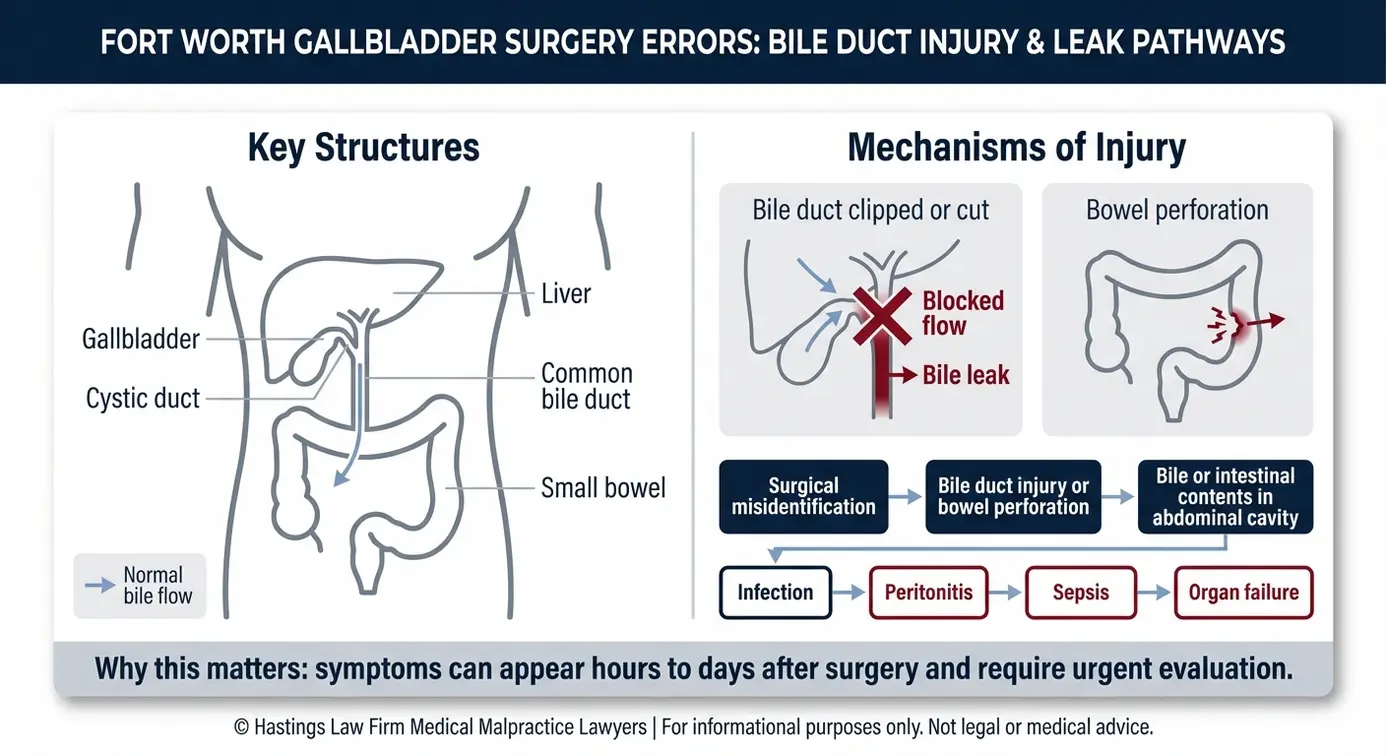
Gallbladder surgery errors often involve the accidental cutting or clipping of the common bile duct, bowel perforation, or a failure to identify anatomical variations during laparoscopic cholecystectomy. Most gallbladder removals are performed to treat gallstones or inflammation through minimally invasive techniques. While these procedures are standard, they sometimes involve preventable mistakes.
Laparoscopic cholecystectomy is a procedure used to remove the gallbladder through small incisions using a camera and specialized instruments. While it offers faster recovery times than open surgery, it also presents a significant challenge: limited visibility. The surgeon operates by viewing a screen rather than looking directly at the tissue, which means even small errors in identifying anatomy can lead to serious harm.
The most common severe error is a bile duct injury. During surgery, the common bile duct can be mistaken for the cystic duct (the smaller duct connecting the gallbladder) and accidentally cut, clipped, or burned. According to a systematic review on bile duct injuries after cholecystectomy published in PubMed Central, these injuries remain a persistent problem despite advances in surgical technique. The consequences range from a bile leak, where bile seeps into the abdominal cavity, to a complete transection that requires major reconstructive surgery.
Other gallbladder surgery errors include:
- Bowel perforation, a puncture or tear in the intestinal wall caused by a surgical instrument, which can allow bacteria to leak into the abdominal cavity
- Uncontrolled bile leak leading to infection, inflammation, and chemical damage to surrounding organs
- Peritonitis, a dangerous infection of the abdominal lining, often caused by leaking bile or intestinal contents
- Sepsis and organ failure, which can develop rapidly when infection from a perforation or leak goes unrecognized
The CDC’s guidance on sepsis signs and symptoms underscores how quickly an undetected surgical complication can become life-threatening. Fever, confusion, rapid heart rate, and extreme pain after gallbladder surgery should never be dismissed.
Bile Duct Perforation: A Preventable Catastrophe
A bile duct injury, damage to the common bile duct during surgery, is often the result of a failure to properly identify key anatomical structures before making any cuts. The common bile duct, the primary channel that moves bile from the liver into the digestive system, sits dangerously close to the surgical field during a cholecystectomy.
There is an important distinction between a minor bile leak and a major severing of the duct. A small leak may cause pain and infection but can sometimes be managed with drainage procedures. A complete transection, however, often requires complex reconstructive surgery and can lead to life-threatening complications including liver damage, chronic digestive problems, and repeated hospitalizations.
In gallbladder surgery malpractice cases, we examine whether the surgeon took the steps necessary to avoid this injury. Medical negligence may be present when the surgeon failed to establish a clear view of the anatomy or rushed the procedure.
Proving Medical Negligence in Gallbladder Procedures
To prove negligence, a patient must demonstrate that the surgeon deviated from the accepted medical standard of care, directly causing an injury that would not have occurred under competent surgical management. The legal standard of care represents the level of skill and care that a reasonably competent surgeon would provide under similar circumstances. This is the foundation of any medical malpractice claim involving a gallbladder procedure.
The standard of care for a general surgeon performing a laparoscopic cholecystectomy requires specific safety steps. One of the most important is achieving the critical view of safety (CVS). This is a surgical technique where the surgeon clearly identifies the cystic duct, the small tube connecting the gallbladder to the common bile duct, and the cystic artery before cutting or clipping anything.
When pursuing a claim, we must establish specific legal elements. To prove negligence, a patient must demonstrate:
- That the surgeon deviated from the accepted medical standard of care
- That this deviation directly caused an injury
- That the injury would not have occurred under competent surgical management
Under Texas Civil Practice and Remedies Code, Section 74.351, medical malpractice claims require an expert report early in the litigation process. This means a qualified expert witness must review the case and provide a written opinion on causation and that the surgeon breached the standard of care.
A gallbladder surgery error lawyer at Hastings Law Firm works closely with our national network of surgical experts to build these cases. Our team examines operative reports, anesthesia records, post-operative notes, and imaging studies to construct a detailed timeline of surgical errors. You also have the right to obtain your own records; the Texas Medical Board provides guidance on how to request copies of your medical records.
Proving that a complication was negligence rather than a “known risk” requires showing the surgeon either lacked sufficient training, failed to follow established protocols, or continued with a technique when patient safety demanded a different approach. Our experts evaluate whether the error was avoidable, and our former defense attorneys know exactly how the other side will try to frame it as an acceptable outcome.

The Hastings Law Firm Difference
Results matter, but what truly sets us apart is how we achieve them. Every verdict, every settlement, and every Fort Worth courtroom victory comes from one guiding promise: To treat each client’s fight for justice as if it were our own.
This balance of skill, experience, and empathy reflects our core philosophy that justice should not only compensate the injured, but also make healthcare safer nationwide.

Why Choose Hastings Law Firm for Your Fort Worth Surgical Injury Claim
Hastings Law Firm brings a distinct advantage to Fort Worth gallbladder surgery lawyer cases: the combination of board-certified trial attorneys and an in-house medical team that works together from day one. Our firm was founded by Tommy Hastings, a board-certified trial lawyer with over 20 years of experience who is dedicated exclusively to medical negligence cases. Unlike general practice firms, our entire firm focuses solely on medical malpractice litigation.
Our trial-ready philosophy means we investigate and build each case as though it will go before a jury. This level of preparation, including expert analysis and detailed medical reconstruction, sends a clear message to insurance carriers and defense counsel. Our team includes former defense attorneys who provide a strategic advantage in anticipating the tactics hospital systems use to challenge a claim.
We also handle wrongful death claims for families who have lost a loved one due to a surgical error. We understand that no amount of money can replace a family member, but we work to secure the financial stability you need to move forward.
We also understand that after a gallbladder removal surgery gone wrong, the last thing you need is financial stress from legal fees. Hastings Law Firm works on a contingency fee basis, which means you pay no attorney fees or costs unless we recover compensation for you. Your first step is a free, confidential case evaluation with a patient advocate who can help determine whether your case has merit.
Damages Available to Victims of Surgical Negligence
Victims of botched gallbladder surgeries in Texas may recover economic damages for medical bills and lost wages, as well as non-economic damages for pain, suffering, and physical impairment.
Patients in Texas may recover economic damages for measurable financial losses, such as additional surgeries and lost income. Non-economic damages address the personal toll that no receipt or invoice can capture. Together, they are intended to account for the full scope of resulting damages caused by the negligence.
| Economic Damages | Non-Economic Damages |
|---|---|
| Corrective and reconstructive surgeries | Physical pain and suffering |
| Hospital stays and emergency care | Emotional distress and anxiety |
| Medications and ongoing treatment | Loss of enjoyment of life |
| Lost wages and reduced earning capacity | Physical impairment or disfigurement |
| Long-term care and rehabilitation | Loss of consortium (impact on family relationships) |
Texas law does place limits on non-economic damages in medical malpractice cases. This is often referred to as the Texas damage cap. Under Texas Civil Practice and Remedies Code Section 74.301, non-economic damages are capped at $250,000 against all individual physicians or health care providers, with a separate cap of $250,000 per health care institution (up to $500,000 across all institutions), for a combined maximum of $750,000. Economic damages, however, have no cap. That is why accurately calculating the full cost of additional surgeries and future medical needs is essential.
When a gallbladder surgery error leads to a bile leak, peritonitis, or other life-threatening complications resulting in death, surviving family members may pursue a wrongful death claim to recover damages for their loss.
Texas Statute of Limitations for Surgical Error Lawsuits
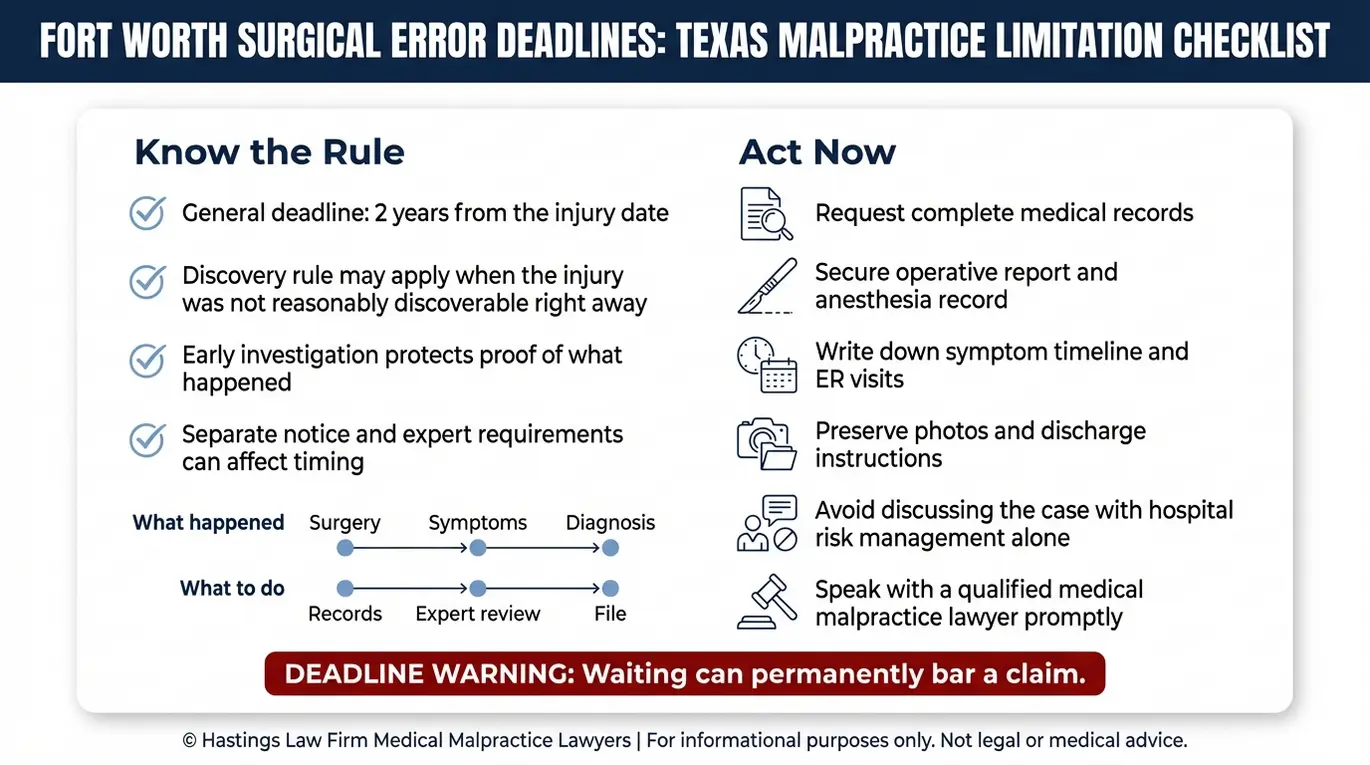
In Texas, the Texas medical malpractice statute of limitations gives you generally two years from the date of the injury, or the date the injury could reasonably have been discovered, to file a lawsuit. The statute of limitations is the strict legal deadline for filing a claim in court. Missing this 2-year deadline can permanently bar your claim, regardless of how strong your evidence may be.
The discovery rule can extend the filing window in certain situations. Some gallbladder surgery complications, such as a slow bile leak or internal scarring, may not become apparent until weeks or months after the procedure. In those cases, the statute may begin running from the date you knew, or should have known, that the injury was connected to a surgical error.
Texas law also imposes an absolute ten-year statute of repose under Civil Practice and Remedies Code Chapter 74, meaning no claim can be filed more than ten years after the date of the act or omission. This statute of repose is strict and applies even if the injury was not discovered until after the ten-year period passed.
⚠️ Important Deadline: Texas requires an expert report to be served within 120 days after each defendant’s original answer is filed. Contacting an attorney early gives your legal team the time needed to investigate your case and secure expert opinions before deadlines expire.
Contact the Fort Worth Surgical Error Attorneys at Hastings Law Firm Today for Help
Recovering from a gallbladder surgery complication is difficult enough without carrying the added weight of unanswered questions. If you believe a surgical error caused your injury, you deserve to know what happened and whether you have a path to compensation.
Hastings Law Firm was built to restore trust for patients who feel let down by the healthcare system. Our team of trial lawyers, in-house medical professionals, and patient advocates is ready to listen, review your records, and give you an honest assessment of your case.
You do not have to take on the hospital system alone. As an experienced Fort Worth gallbladder surgery error lawyer, we handle every aspect of the legal process so you can focus on your health. Contact us today for a free, confidential case evaluation. There is no fee unless we win.
Frequently Asked Questions About Gallbladder Surgery Error in Fort Worth


This content was researched and written by the Hastings Law Firm editorial team, which includes attorneys, medical professionals, and experienced researchers. Our writing is informed by internal knowledge and practical experience, and we cross-check critical details against authoritative sources cited throughout. Every piece undergoes human-led fact-checking and legal review. Because legal and medical information can change, if you spot an error, please contact us. Learn more about our content standards and review process on our editorial policy page.

Gabe Sassin has focused exclusively on medical malpractice law since 2007. After spending more than a decade as a malpractice defense attorney, he knows exactly how the other side works. He has seen firsthand how healthcare providers, insurers, corporate defendants, and their legal teams think, prepare, and build their defense against claims. That knowledge works for the people who need it most today, injured patients and their families. His unique experience shapes everything he writes, giving readers a look at how these cases actually work from someone who has handled them from both sides.
