


Fort Worth Prostate Surgery Error Lawyer
Written by: Hastings Law Firm | Reviewed by: Brady D. Williams | Updated: July 27, 2026
Unexpected complications after prostate surgery can leave patients and families unsure whether the outcome was an unavoidable risk or a preventable surgical mistake. Prostate procedures require precise technique because nearby nerves, the rectum, and urinary structures can be injured during planning or execution. When errors occur, the impact can involve lasting pain, loss of function, additional procedures, serious infection, or fatal outcomes. Understanding how negligence is evaluated and what damages may be available can help clarify next steps. If you or a loved one were harmed or worse due to prostate surgery errors in Fort Worth, Texas, contact Hastings Law Firm for a free, confidential case review.

Trusted Fort Worth Medical Attorneys for Negligent Urological Procedures
What You Should Know About Prostatectomy Malpractice Claims in Fort Worth:
- Long term harm can follow a preventable prostate surgery mistake, including permanent disability, the need for corrective surgery, and major quality of life changes.
- Recovery can turn on whether the injury is treated as a known complication or a departure from the standard of care.
- Severe outcomes can occur when surgical injuries lead to serious infection, including life threatening sepsis.
- Compensation can include economic losses such as medical bills and lost wages and non economic losses such as pain, suffering, and loss of enjoyment of life.
- Options can be limited if Texas filing deadlines or expert report requirements are missed.
- Responsibility may extend beyond the surgeon when hospital staffing, equipment failures, or anesthesia mistakes contribute to the injury.
- Case outcomes can depend on expert review of operative notes to identify technique that deviated from accepted practice.
- Evidence can be harder to preserve if complete medical records are not obtained and symptoms are not documented soon after the event.

A Healthcare Focused Law Firm
If you or someone you love has experienced unexpected complications after prostate surgery, the uncertainty you feel right now is understandable. Prostate procedures, including radical prostatectomy (the complete surgical removal of the prostate gland), carry inherent risks. But when outcomes fall far outside what was discussed or expected, it is reasonable to ask whether something went wrong during the operation itself.
Hastings Law Firm focuses exclusively on medical malpractice. Our team includes in-house nurse consultants and former defense attorneys who understand how hospitals and surgical teams operate from the inside. Founded by Tommy Hastings, a board-certified trial attorney who is among the less than 2% of Texas lawyers certified in Personal Injury Trial Law, our firm is dedicated to providing a voice for patients who have been harmed by medical negligence. As an experienced Fort Worth prostate surgery error lawyer, we know how to examine what happened in the operating room and determine whether your injury was the result of negligence rather than an unavoidable complication.
If you have questions, we are here to listen. Contact us for a free, confidential case evaluation so we can review the details and explain your options.
Common Types of Prostate Surgery Errors and Urological Malpractice
Prostate surgery errors occur when a surgeon deviates from the standard of care, resulting in preventable injuries such as severed nerves, perforated bowels, or damage to the urinary sphincter. These are not the same as the known risks that accompany any operation. They represent failures in surgical technique, planning, or execution that a Fort Worth prostate surgery error lawyer would identify as negligence.
The two most common prostate procedures are transurethral resection of the prostate (TURP) and radical prostatectomy. TURP is a minimally invasive procedure where tissue is removed through the urethra, while a radical prostatectomy involves surgically removing the entire prostate gland. Both require precise technique, especially given the prostate’s proximity to critical nerves, the rectum, and the urinary sphincter. In many cases today, surgeons perform robot-assisted procedures, which demand specialized training and careful instrument control. A lawyer for prostate surgery errors understands these complexities.
When a Fort Worth prostate surgery error lawyer reviews these cases, the types of surgical errors that most commonly arise include:
- Nerve damage: The neurovascular bundles, the delicate nerve structures running alongside the prostate that control erectile function, can be severed or cauterized when nerve-sparing techniques should have been used. This can result in permanent erectile dysfunction.
- Rectal perforation: An accidental puncture of the rectal wall during surgery can lead to serious infection or life-threatening sepsis. A study published in PubMed on the incidence of rectal injury after radical prostatectomy confirms this is a recognized but preventable complication when proper technique is followed.
- Sphincter damage: Negligent surgical technique can injure the external urethral sphincter, leading to stress urinary incontinence or total loss of bladder control. A systematic review in PubMed Central on urinary continence rates after robot-assisted laparoscopic radical prostatectomy documents the range of continence outcomes and what patients should reasonably expect.
- Retained surgical instruments: Sponges, clips, or other surgical materials left inside the patient cavity after closure can cause pain, infection, and the need for additional surgery to remove them.
Each of these errors, along with wrong-site surgery, can cause permanent disability, require corrective surgery, and dramatically alter a patient’s quality of life. A prostate surgery error attorney in Fort Worth can evaluate your medical records to determine whether the injury you experienced was preventable. Contact our prostate surgery error attorney team to discuss your claim.
Proving Negligence in Prostatectomy Cases
To prove a claim, your attorney must demonstrate that the urologist breached the accepted standard of care and that this breach directly caused your specific injury, distinct from known surgical risks. A prostatectomy is the surgical removal of all or part of the prostate, a procedure that requires high precision to avoid damaging nearby organs.
The legal framework involves four connected elements. First, your Fort Worth prostate surgery error lawyer must establish that the surgeon owed you a duty of care. Second, we must identify how the surgeon breached that duty. Third, your prostate surgery error attorney must prove causation, the direct connection between the error and the harm. And fourth, we must document the resulting damages.
Expert testimony is essential. A qualified urologist reviews the operative notes to identify where technique deviated from accepted practice. A lawyer for prostate surgery errors at Hastings Law Firm uses this analysis to build your case.
Distinguishing Surgical Errors from Known Complications
One of the most common defenses is the claim that the patient’s injury was simply a “known complication” covered by informed consent. A prostate surgery error attorney in Fort Worth knows that signing a consent form does not give a surgeon permission to perform negligently.
A rectourethral fistula may be a recognized risk. However, it is a surgical error if that fistula resulted from a technical failure during the vesicourethral anastomosis (the reconnection of the bladder neck to the urethra after prostate removal). Damaging the external urethral sphincter (the muscle controlling urine release) is also a sign of negligence. If the fistula leads to sepsis, a dangerous whole-body infection triggered by bacteria entering the bloodstream, the consequences become even more severe.
| Known Complication | Surgical Negligence | |
|---|---|---|
| Definition | A recognized risk that can occur even with proper technique | An injury caused by a departure from the standard of care |
| Consent | Typically disclosed and signed off on before surgery | Consent does not cover errors in execution |
| Example | Mild, temporary incontinence after prostatectomy | Permanent incontinence from sphincter damage due to improper dissection |
| Legal outcome | Generally not grounds for a malpractice claim | May support a medical malpractice claim if causation is established |
Our Fort Worth prostate surgery error lawyer works with experts to identify whether the injury resulted from a recognized risk or from a preventable error.

The Hastings Law Firm Difference
Results matter, but what truly sets us apart is how we achieve them. Every verdict, every settlement, and every Fort Worth courtroom victory comes from one guiding promise: To treat each client’s fight for justice as if it were our own.
This balance of skill, experience, and empathy reflects our core philosophy that justice should not only compensate the injured, but also make healthcare safer nationwide.

Compensation for Damages After a Botched Prostate Procedure
Victims of negligent prostate surgery may recover economic damages for medical bills and lost wages, as well as non-economic damages for pain, suffering, and loss of enjoyment of life. These damages are designed to compensate the patient for the financial and physical impact of a surgical mistake.
Economic damages cover the measurable financial costs of the error. These often include expenses for corrective surgery, future medical expenses, ongoing treatment such as catheterization, and lost income. In cases involving stress urinary incontinence (SUI), a condition where physical activity or pressure causes involuntary urine leakage, the long-term costs can be substantial. A prostate surgery error attorney ensures all these needs are met.
Non-economic damages address the less tangible consequences. Physical pain, mental anguish, and loss of consortium, the impact on intimacy and companionship within a marriage, all factor into the calculation. A lawyer for prostate surgery errors works with experts to present the full picture of how the injury has changed your daily life.
In the most tragic situations, a surgical error can lead to fatal complications. When a patient dies as a result of negligence, surviving family members may pursue a wrongful death claim. A prostate surgery error attorney in Fort Worth can guide families through this process. Hastings Law Firm has recovered millions for families in cases involving catastrophic medical errors. Contact our Fort Worth prostate surgery error lawyer team to discuss settlement negotiations.
Liability in Urology and Suing for Medical Negligence
Liability may extend beyond the primary surgeon to include the hospital for inadequate staffing, the anesthesiologist for medication errors, or the surgical team for equipment failures. Liability is the legal responsibility a healthcare provider or facility carries for injuries caused by a failure to follow the standard of care.
Potential defendants in a prostate surgery error case can include:
- The surgeon: Individually liable for technical mistakes.
- The hospital or surgical center: Liable for hospital negligence, such as credentialing an underqualified surgeon, or vicarious liability for staff actions. In cases involving robot-assisted laparoscopic radical prostatectomy (RALP), a procedure where the surgeon controls robotic instruments through a console, the facility may bear responsibility for equipment failures.
- The anesthesiologist: Liable for anesthesia errors or improper monitoring.
Our prostate surgery error attorney team, which includes former defense counsel, knows how to anticipate defense strategies. Consult a lawyer for prostate surgery errors to determine who is responsible.
Texas Statute of Limitations and Legal Requirements
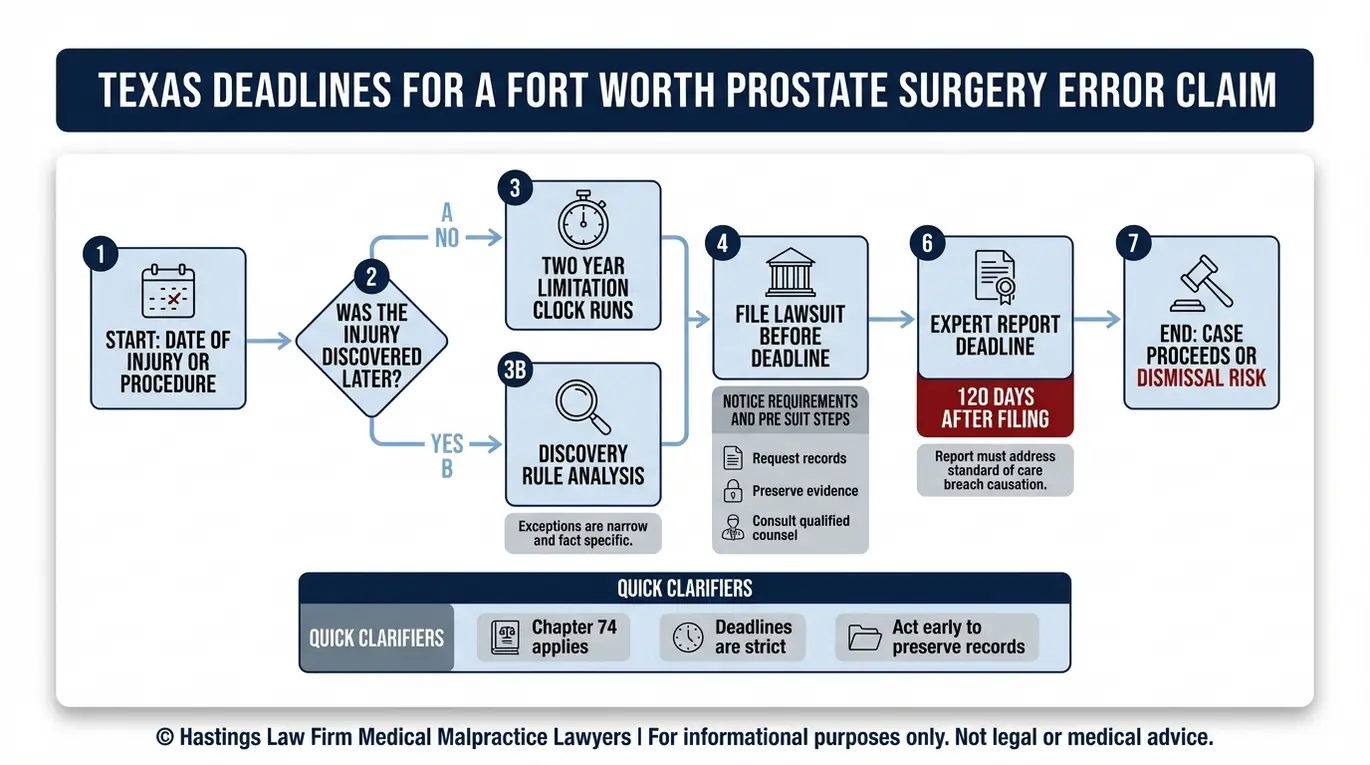
Texas law generally requires medical malpractice claims to be filed within two years from the date of the injury, with strict requirements for expert reports to validate the claim. The statute of limitations is a strict legal deadline that prevents a patient from filing a lawsuit once the time period has expired.
⚠️ Critical Deadline: Under the Texas Civil Practice and Remedies Code Chapter 74, you must file your lawsuit within two years of the date of injury. In limited circumstances, the discovery rule may apply if the injury was not immediately apparent, but Texas also imposes a 10-year statute of repose as an outer boundary.
Texas-Specific Legal Procedures and Expert Reports
Texas medical malpractice law imposes strict procedural requirements. Within 120 days of each defendant’s original answer, you must serve a qualified expert report. Failure to meet this deadline can result in dismissal. Legislative efforts such as 87(R) HB 3984 reflect the complexity of these requirements.
A Fort Worth prostate surgery error lawyer ensures you meet every deadline. We retain a qualified medical expert immediately to validate your claim. Contact a prostate surgery error attorney at Hastings Law Firm to begin this process.
What to Do After a Surgical Error in Fort Worth
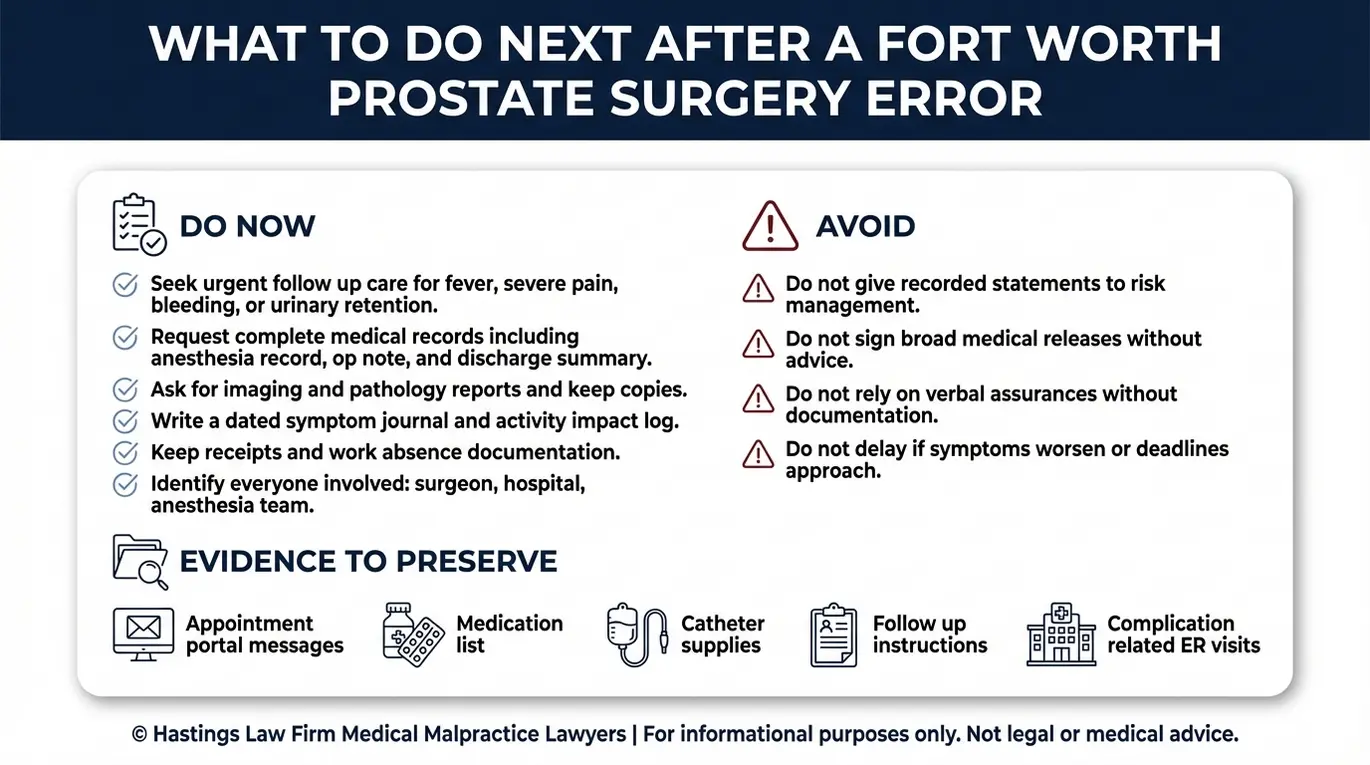
Immediate steps include obtaining complete medical records, seeking a second opinion for corrective care, and contacting a specialized malpractice attorney to preserve evidence. Acting quickly helps ensure that crucial evidence is not lost or altered by the facility where the surgery took place.
- Request your complete medical records. The Texas Medical Board’s guidance on patient information and medical records outlines your rights.
- Seek a second medical opinion. An independent evaluation can guide corrective treatment.
- Document your symptoms. Keep a daily journal of pain levels and limitations.
- Do not discuss the situation with hospital risk managers.
- Contact a Fort Worth prostate surgery error lawyer. Proper evidence preservation is vital. A prostate surgery error attorney can protect your rights while the evidence is fresh.
Contact the Fort Worth Surgical Error Attorneys at Hastings Law Firm Today for Help
Hastings Law Firm was built for cases like yours. We are a trial-ready medical malpractice firm with in-house medical professionals, a national network of expert witnesses, and former defense attorneys who know how the other side thinks. Every member of our team is focused on one thing: holding negligent healthcare providers accountable and securing the compensation our clients need to move forward.
If you believe your prostate surgery injury was caused by a preventable error, we want to hear from you. Our Fort Worth prostate surgery error lawyer team offers free, confidential case evaluations, and you pay no attorney fees unless we recover on your behalf.
Call Hastings Law Firm today or request your evaluation online. Let us review your records, explain your options, and help you take the first step toward answers.
Frequently Asked Questions About Prostate Surgery Error in Fort Worth


This content was researched and written by the Hastings Law Firm editorial team, which includes attorneys, medical professionals, and experienced researchers. Our writing is informed by internal knowledge and practical experience, and we cross-check critical details against authoritative sources cited throughout. Every piece undergoes human-led fact-checking and legal review. Because legal and medical information can change, if you spot an error, please contact us. Learn more about our content standards and review process on our editorial policy page.

Brady D. Williams is a nationally recognized medical malpractice attorney who has spent his career handling high-stakes litigation for injured patients and families across the country. Licensed in both Texas and California, Brady draws on experience from hundreds of resolved medical cases to break down complex legal and medical topics for the people who need that information most. His writing reflects the same attention to detail and commitment to clarity that he brings to every case he handles.
