


Fort Worth Robotic Surgery Malpractice Lawyer
Written by: Hastings Law Firm | Reviewed by: Gabe Sassin | Updated: July 27, 2026
Robotic assisted surgery can feel reassuring, yet serious injuries can occur when training is inadequate, equipment malfunctions, or hospitals fail to maintain the system. Because the surgeon operates from a console without tactile feedback, errors and device problems may be harder to recognize in real time and can lead to complications that worsen later. Responsibility may involve the surgeon, the hospital, the device maker, or more than one party, which can leave patients and families uncertain about what happened. If you or a loved one were harmed or worse due to robotic surgery malpractice in Fort Worth, Texas, contact Hastings Law Firm for a free, confidential case review.

Trusted Fort Worth Medical Attorneys for Surgical Robot Injury Claims
What You Should Know About Robot-Assisted Surgical Injury Claims in Fort Worth:
- Accountability can be unclear after a robotic surgery injury because fault may involve a surgeon error, a hospital failure, a device defect, or a combination.
- Serious harm can occur without immediate detection because robotic platforms remove tactile feedback and can limit what is visible during the procedure.
- Recovery options can change based on whether the injury is tied to medical negligence, a defective product, or both.
- Severe complications can develop days later when internal damage goes unnoticed during the operation and later leads to infection or sepsis.
- Liability can extend beyond the operating surgeon when a hospital allows insufficiently trained surgeons to operate or fails to maintain the robotic system.
- Outcomes can hinge on whether the manufacturer provided adequate warnings or sold a device with known defect risks.
- Case resolution can depend on whether device performance data shows a malfunction such as uncommanded movement.
- Options can be lost if legal time limits are missed under Texas rules that restrict how long a claim can be filed.
- Compensation can include economic losses and non economic harms tied to added medical care, lost wages, pain, suffering, and impairment.
- Evidence can be supported by adverse event reporting data that documents problems associated with robotic surgical systems.

A Healthcare Focused Law Firm
When a procedure described as “minimally invasive” leads to serious harm, the confusion and frustration can be overwhelming. Robotic-assisted surgery (RAS), a technique where surgeons operate through small incisions using a computer-controlled robotic platform, is often presented as a safer alternative. But when something goes wrong, patients and families are frequently left without clear answers about what happened or why.
These cases sit at a difficult intersection of medicine, technology, and the law. Determining whether the injury resulted from a surgeon’s error, an equipment failure, or both requires a legal team with deep medical knowledge and the resources to investigate every angle. As a Fort Worth Robotic Surgery Malpractice Lawyer, Hastings Law Firm brings that level of focus to every case we handle.
If you or a loved one was injured during a robotic procedure, we can review what happened and explain your options at no cost and no obligation.
Understanding the Risks of Robotic Surgery Malpractice
Robotic surgery malpractice occurs when a surgeon lacks adequate training on the device, the equipment malfunctions, or the hospital fails to maintain the system, resulting in preventable patient injury.
What separates these cases from traditional surgical malpractice is the technology itself. In a conventional procedure, the surgeon’s hands are in direct contact with the patient’s tissue. With a robotic platform, the surgeon sits at a console and controls instrument arms remotely. That separation removes something called haptic feedback, the physical sensation of resistance that tells a surgeon how much pressure is being applied. Without it, a surgeon may apply too much force without realizing it, leading to tears, punctures, or other surgical errors.
Patients who experience complications from robotic procedures are sometimes told that injury was an unavoidable risk of surgery. That explanation may satisfy the “White Coat Effect,” a natural tendency to trust a doctor’s assessment without question. But many of these injuries are not simply known risks; they are often valid grounds for lawsuits seeking compensation. They can be the result of negligence, inadequate preparation, or outright equipment failure, such as uncommanded instrument movement, a malfunction where the robotic arm moves without any input from the surgeon.
That distinction matters because it changes the legal landscape. A case may involve a medical malpractice claim against the surgeon, a products liability claim against the manufacturer, or both. Research published by PubMed Central on the learning curve of robotic cardiac surgery confirms that proficiency with these systems develops slowly and varies significantly among surgeons. Experienced robotic surgery malpractice attorneys understand how to identify whether the standard of care was met and who should be held accountable, whether that is a person, a corporation, or a combination.

The da Vinci Surgical System and Device Defects
The da Vinci Surgical System is the most common robotic platform, but it has faced scrutiny for issues like insulation failure and uncommanded instrument movement that can damage healthy tissue. Manufactured by Intuitive Surgical, it is the most widely used robotic surgical platform in the United States and has been adopted across Texas hospitals for procedures ranging from prostatectomies to hysterectomies.
One reason these issues, often central to products liability claims regarding defective design, reach patients ties back to how the device was cleared for market. The U.S. Food and Drug Administration’s Premarket Notification 510(k) process allows medical devices to bypass more rigorous clinical testing if they are deemed “substantially equivalent” to a device already on the market. That pathway was designed for simpler tools, not complex robotic platforms that operate inside the human body. Critics argue it creates a gap in safety oversight.
Specific defects reported with the da Vinci system include:
- Monopolar energy leaks: Stray electrical current escaping through damaged insulation and burning tissue outside the surgeon’s field of view
- Video imaging lag: A delay between the surgeon’s movements and the visual display, creating a dangerous mismatch during delicate maneuvers
- Instrument tip breakage: Fragments of instruments detaching inside the patient during a procedure
- Uncommanded movements: The robotic arms moving or jerking without surgeon input
As a Fort Worth robotic surgery lawyer, Hastings Law Firm works with biomedical engineers and surgical specialists to determine whether a device defect caused or contributed to a patient’s injury.
The Hastings Law Firm Difference
Results matter, but what truly sets us apart is how we achieve them. Every verdict, every settlement, and every Fort Worth courtroom victory comes from one guiding promise: To treat each client’s fight for justice as if it were our own.
This balance of skill, experience, and empathy reflects our core philosophy that justice should not only compensate the injured, but also make healthcare safer nationwide.

Common Injuries and Complications from Robotic Failures
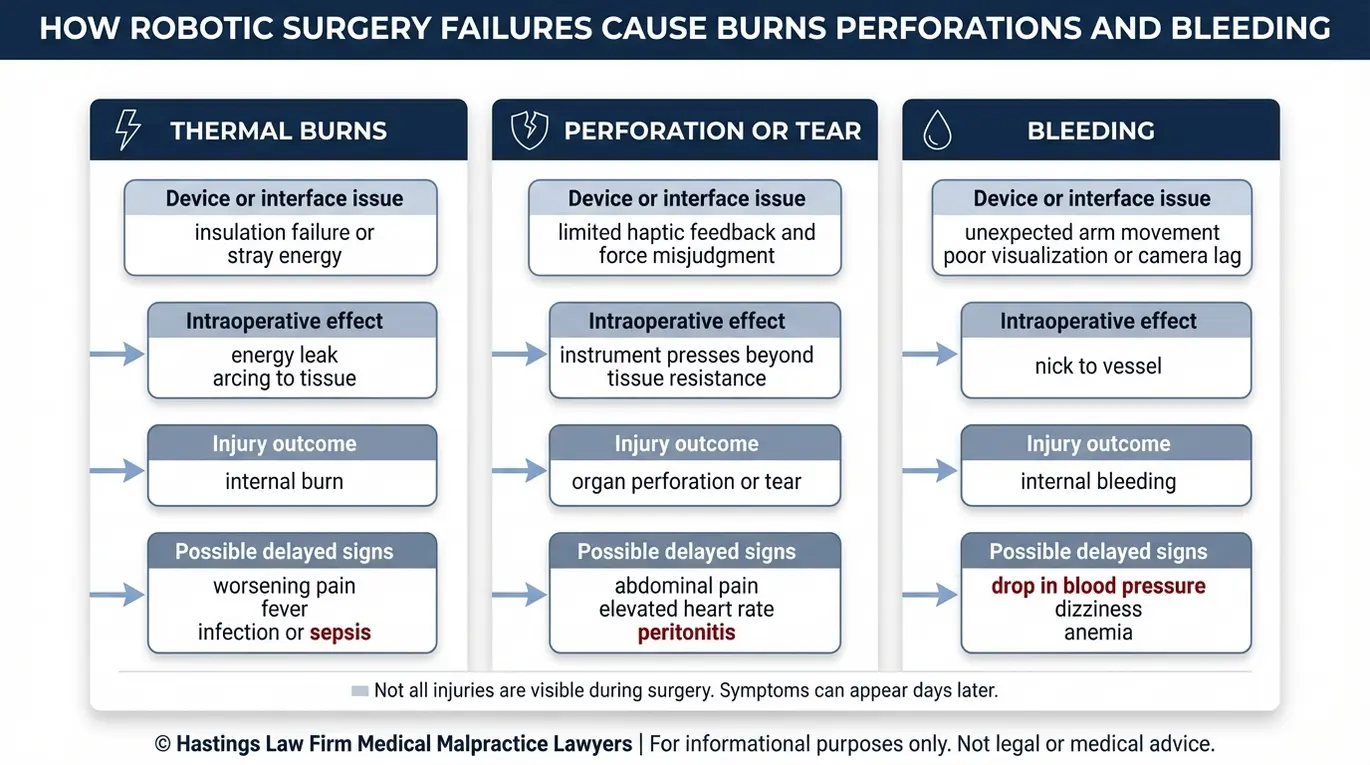
Injuries from robotic surgery often involve internal burns, punctured organs, or severed vessels that may go unnoticed during the procedure, leading to severe infection or sepsis days later. Because the surgeon is operating remotely and without direct tactile contact, damage can occur in areas outside the camera’s view.
The types of injuries vary based on the specific failure, but they tend to follow recognizable patterns. A thermal injury, tissue damage caused by heat, is one of the most reported. Insulation failure, a breakdown in the protective coating around electrosurgical instruments, allows electrical current to arc to nearby organs without the surgeon’s awareness. Severe bleeding also often occurs when a robotic arm inadvertently nicks a major artery. Because the surgeon relies on a camera feed rather than physical touch, they may not immediately realize a vessel has been compromised, allowing blood loss to reach critical levels before intervention occurs.
| Injury | How It Happens |
|---|---|
| Internal burns | Insulation failure or electrical arcing sends current to tissue outside the surgical site |
| Organ perforation or tears | Lack of haptic feedback causes the surgeon to apply excessive force or misjudge tissue depth |
| Uncontrolled bleeding | Robotic arm nicks a major artery or vessel during repositioning or uncommanded movement |
| Delayed infection or sepsis | Undetected bowel or organ perforation leaks contents into the abdominal cavity |
| Need for additional surgeries | Conversion to open surgery or follow-up procedures to repair damage from the initial operation |
Many of these complications are documented through the FDA’s Medical Device Reporting system. The FDA’s MDR Data Files contain thousands of adverse event reports linked to robotic surgical systems, including cases resulting in wrongful death. These reports can be important evidence in building a claim.
Determining Liability in Robotic Surgery Cases
Liability in these cases is complex and may be shared among the surgeon for lack of skill, the hospital for inadequate credentialing, and the manufacturer for selling a defective product or failing to warn of risks. Sorting out who is responsible requires a detailed investigation into the people, the institution, and the technology involved.
Our robotic malpractice legal team examines each potential source of liability through a structured process that includes medical record analysis, device event logs, and expert testimony. Device event logs, sometimes called “black box” data, record the robotic system’s performance during surgery and can reveal whether a malfunction occurred. Establishing causation is critical to securing a fair settlement.
Here is what we evaluate when determining who may be at fault:
- The surgeon: Did they complete the manufacturer’s required training? Were they experienced enough with the specific procedure performed on the robotic platform? Did they respond appropriately to system warnings?
- The hospital: Did the facility conduct proper credentialing and privileging for robotic surgery, the formal process of verifying a surgeon’s qualifications and granting permission to use specific equipment? Did they maintain the device according to manufacturer specifications?
- The manufacturer: Did Intuitive Surgical provide adequate warnings about known risks? Did they overstate the system’s safety profile or understate the learning curve required for proficiency?
Causation analysis ties the identified failure, whether human or mechanical, to the specific injury. That connection is established through expert testimony from qualified surgeons and, when a defective design is suspected, biomedical engineers.
The Learning Curve Gap
One of the most concerning issues in robotic surgery is the gap between the training surgeons receive and the proficiency they actually need. Proctoring, the practice of having an experienced surgeon supervise a less experienced one during live cases, is the primary method for building competency. But the manufacturer’s certification programs may require only a handful of proctored cases before a surgeon is cleared to operate independently, often resulting in inadequate training for complex real-world scenarios.
For complex procedures, that is often not enough. The standard of care requires that a surgeon possess adequate skill and experience with the specific technology being used. When a hospital allows a surgeon with limited robotic experience to perform unsupervised procedures, both the surgeon and the institution may bear responsibility for the outcome. Our team works with expert testimony to evaluate whether the surgeon’s training was sufficient for the procedure that caused harm.

Contact the Fort Worth Surgical Error Attorneys at Hastings Law Firm Today for Help
If you or a loved one was harmed during a robotic surgical procedure, you deserve answers about what went wrong and who is responsible. These cases require a legal team that understands both the medicine and the technology, and that is prepared to hold every responsible party accountable.
Hastings Law Firm focuses exclusively on medical malpractice. Our team includes in-house medical professionals, former defense attorneys, and access to a national network of surgical and engineering experts. Every case we accept is prepared from day one as if it will go to trial, because that level of preparation is what drives fair results.
As your Fort Worth Robotic Surgery Malpractice Lawyer, we charge no fees unless we recover compensation for you.
Contact us today for a free, confidential case evaluation. Let us review your records and help you understand your options.
Frequently Asked Questions About Robotic Surgery Malpractice in Fort Worth


This content was researched and written by the Hastings Law Firm editorial team, which includes attorneys, medical professionals, and experienced researchers. Our writing is informed by internal knowledge and practical experience, and we cross-check critical details against authoritative sources cited throughout. Every piece undergoes human-led fact-checking and legal review. Because legal and medical information can change, if you spot an error, please contact us. Learn more about our content standards and review process on our editorial policy page.

Gabe Sassin has focused exclusively on medical malpractice law since 2007. After spending more than a decade as a malpractice defense attorney, he knows exactly how the other side works. He has seen firsthand how healthcare providers, insurers, corporate defendants, and their legal teams think, prepare, and build their defense against claims. That knowledge works for the people who need it most today, injured patients and their families. His unique experience shapes everything he writes, giving readers a look at how these cases actually work from someone who has handled them from both sides.
