


Fort Worth Bowel Perforation Lawyer
Written by: Hastings Law Firm | Reviewed by: Brady D. Williams | Updated: July 27, 2026
A bowel perforation during surgery can turn a routine procedure into a medical crisis with infection, emergency treatment, and lasting changes to daily life. Harm often becomes severe when a cut or thermal injury is not recognized and repaired before the surgery ends or when warning signs after surgery are dismissed. Delayed diagnosis can lead to peritonitis, sepsis, organ failure, and fatal outcomes, and some people face long term ostomy care, repeated surgeries, and emotional distress. If you or a loved one were harmed or worse due to a bowel perforation during surgery in Fort Worth, Texas, contact Hastings Law Firm for a free, confidential case review.

Trusted Malpractice Attorneys in Fort Worth for Surgical Injuries
What You Should Know About Intestine Surgical Perforation Claims in Fort Worth:
- Outcomes can become life threatening when a bowel injury is missed or not repaired before the surgery ends.
- Recovery can worsen when post surgery warning signs are dismissed or imaging is delayed.
- Long term quality of life can be altered by emergency surgery, chronic pain, ongoing wound care, and permanent ostomy needs.
- Disputes often focus on whether the event was a known risk that was promptly addressed or a preventable failure to identify and treat the injury.
- Severe complications can include peritonitis, sepsis, organ failure, extended ICU care, and death.
- Compensation can cover medical bills, lost wages, pain and suffering, and the ongoing costs of ostomy care when negligence is proven.
- A claim can be lost if Texas deadlines and expert report requirements are not met.
- Case evaluation can depend on operative notes, surgical logs, nursing records, and post operative monitoring documentation.

A Healthcare Focused Law Firm
A bowel perforation during surgery can change everything in an instant. What may have been a routine procedure can lead to life-threatening infection, emergency operations, and long-term consequences like a colostomy (a surgically created opening in the abdomen to reroute the colon) or an ileostomy (a similar opening created from the small intestine). Both can require months or years of adjustment, additional surgeries, and daily care that most patients never expected.
Founded by board-certified trial attorney Tommy Hastings, our firm focuses exclusively on medical malpractice. If you or a loved one is dealing with the aftermath of a perforated bowel in Fort Worth, you deserve answers about what happened and why. Our in-house medical staff and attorneys can review your records, explain your options, and help you understand whether negligence played a role.
Identifying Negligence in Bowel Perforation and Obstruction Cases
Medical malpractice in bowel perforation cases often comes down to one critical failure: a surgeon cuts, nicks, or thermally injures the bowel and does not recognize or repair the damage before closing. The perforation itself may occur during an otherwise competent surgery. But when the injury goes undetected or untreated, what could have been a manageable complication becomes a dangerous medical emergency. Identifying these technical failures requires a deep understanding of surgical procedures and the timelines for infection development.
The “Known Complication” Defense
Doctors and hospitals frequently argue that a bowel perforation is a “known risk” of abdominal surgery. That statement, on its own, can be accurate. The standard of care, the level of treatment a reasonably competent surgeon would provide under similar circumstances, does not require perfection.
Surgeons must follow proper technique, monitor for signs of injury, and act quickly when something goes wrong. The presence of a complication does not automatically absolve the physician. The law requires that they adhere to the standard of care by promptly identifying the issue.
A negligent medical care provider is not one who simply encounters a complication. Negligence occurs when they fail to identify or repair it. It can also involve careless technique, such as a blind trocar insertion.
A trocar is a sharp instrument used during laparoscopic surgery. Other injuries involve electrocautery, which is a thermal burn caused by electrical surgical instruments used to cut or seal tissue.
Failure to Diagnose After Surgery
Failure to diagnose complications after surgery accounts for many of the most serious bowel perforation outcomes. Patients may develop fever, worsening abdominal pain, nausea, or a rigid abdomen in the hours or days following a procedure. According to Northwest Community Healthcare’s post-surgical guidelines, patients should be monitored for these warning signs after abdominal surgery.
When a care team dismisses these symptoms as “normal recovery pain” or delays imaging, it causes a delay in diagnosis that can escalate into sepsis or organ failure. In many cases, nursing logs reveal that a patient complained of severe pain for hours before a physician was notified. This gap in communication constitutes a breach of the professional duty of care.
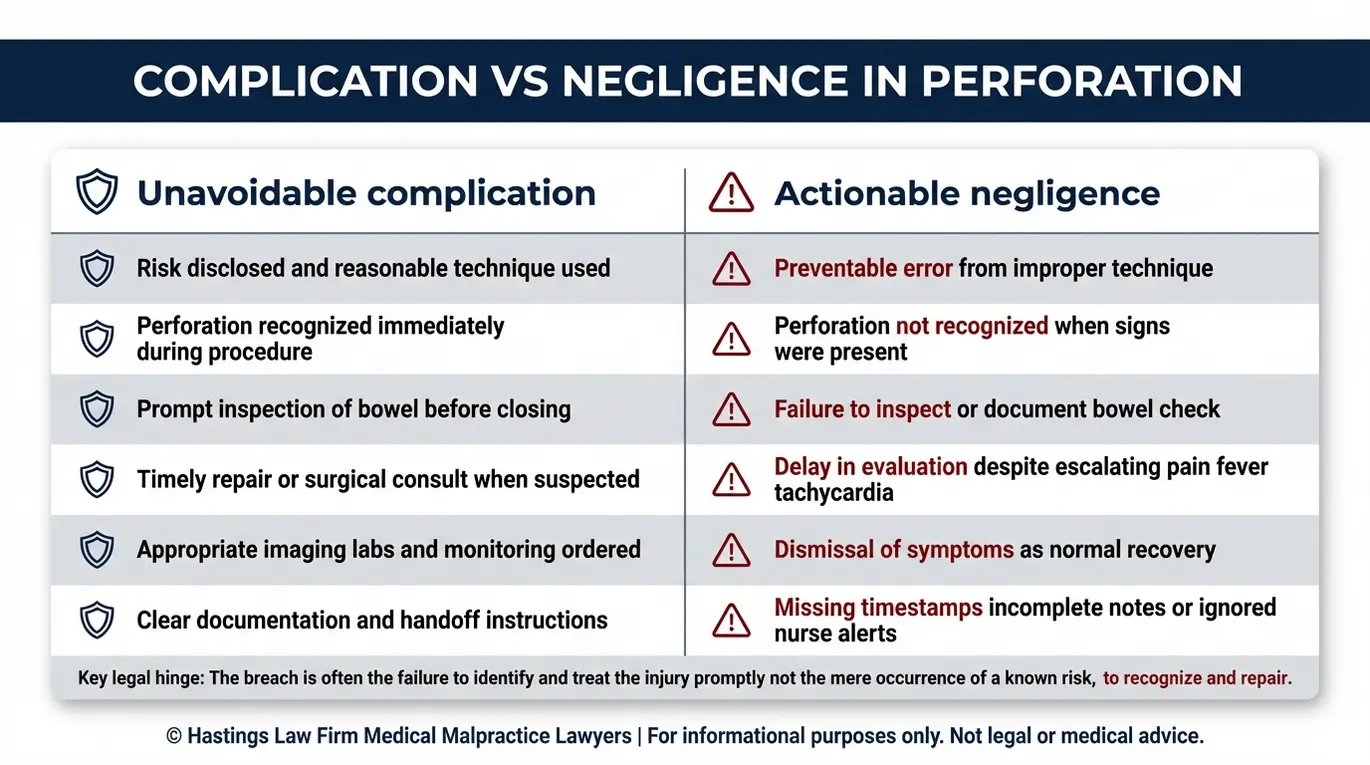
Distinguishing Between Unavoidable Risks and Actionable Malpractice
The legal question in these cases is specific: how quickly should the surgeon have noticed the perforation, and what should they have done about it? Under Texas law, including the requirements of Texas Civil Practice and Remedies Code Chapter 74, a qualified medical expert must review the case. They must provide a report explaining how the surgeon’s actions fell below the professional duty of care. Medical expert testimony is what separates a recognized complication from actionable negligence.
| Recognized Complication | Actionable Malpractice | |
|---|---|---|
| The Injury | Bowel is nicked or perforated during surgery | Bowel is nicked or perforated during surgery |
| Surgeon’s Response | Perforation is identified and repaired during the procedure | Perforation is missed, ignored, or repair is delayed |
| Technique | Proper instrument handling and standard precautions followed | Improper trocar placement, thermal burn from electrocautery, or reckless dissection |
| Post-Op Monitoring | Symptoms are promptly evaluated with imaging and intervention | Symptoms are dismissed; delay in diagnosis leads to deterioration |
| Outcome | Patient recovers with expected surgical risks managed | Patient develops peritonitis, sepsis, organ failure, or requires emergency surgery |
A bowel perforation attorney reviews surgical logs, operative notes, and post-operative records to determine which side of this line your case falls on.
Common Surgical Procedures Leading to Perforated Bowel Injuries
Bowel perforations frequently occur during laparoscopic abdominal surgeries, colonoscopies, hysterectomies, and gallbladder removal procedures. Each of these operations involves instruments or tissue manipulation near the intestines. Surgical errors during any of them can cause a colon perforation or small bowel injury. Surgeons must take care to avoid unintended cuts during these common procedures.
- Colonoscopy: A colonoscopy is a diagnostic procedure where a flexible scope is inserted into the colon to screen for polyps or cancer. Perforation can occur during scope advancement or polyp removal. While considered safe, the thin wall of the colon can be easily perforated if the physician forces the scope through a stricture or loop. A systematic review and meta-analysis published through PubMed on iatrogenic colonic perforation during colonoscopy confirms that these injuries carry significant morbidity and mortality when not promptly identified.
- Hysterectomy and Cesarean Section: Because the uterus sits directly adjacent to the bowel, surgeons performing these procedures must take care to avoid accidental cuts or thermal injury to the intestines. Adhesions from previous C-sections can adhere the bowel to the uterus, making dissection particularly hazardous. Surgeons must meticulously visualize the surgical field to avoid unintended cuts. A single misplaced instrument can cause a perforation that goes unnoticed until infection sets in.
- Cholecystectomy (Gallbladder Surgery): This is one of the most frequently performed laparoscopic abdominal surgeries in the country. The close proximity of the gallbladder to the small intestine and colon creates a risk of bowel injury, particularly during trocar entry or when adhesions from prior surgeries are present.
- Other Abdominal Surgeries: Hernia repairs, appendectomies, and bariatric procedures also carry a risk of perforated bowel injury when instrument handling or tissue dissection is not performed carefully.
A surgical injury attorney evaluates the operative report, anesthesia records, and nursing notes to determine whether the surgeon followed the expected standard of care for the specific procedure. Our team at Hastings Law Firm includes in-house medical staff who understand these procedures and can identify where a deviation may have occurred.
The Hastings Law Firm Difference
Results matter, but what truly sets us apart is how we achieve them. Every verdict, every settlement, and every Fort Worth courtroom victory comes from one guiding promise: To treat each client’s fight for justice as if it were our own.
This balance of skill, experience, and empathy reflects our core philosophy that justice should not only compensate the injured, but also make healthcare safer nationwide.

Severe Consequences and Damages Recoverable in Fort Worth Courts
Patients can recover compensation for medical bills, lost wages, pain and suffering, and the life-altering costs of permanent ostomy care when a bowel perforation results from negligence.
The Medical Reality
An undetected bowel perforation allows intestinal contents to leak into the abdominal cavity. This triggers peritonitis, a severe infection of the abdominal lining that causes intense pain and rapid physical decline. Once the bowel is breached, bacteria flood the sterile abdominal cavity. The resulting infection requires aggressive antibiotic therapy and often multiple washout surgeries to cleanse the abdomen.
Without emergency intervention, peritonitis can progress to sepsis, the body’s overwhelming and life-threatening response to infection. Research published in PubMed Central on risk factors for mortality in abdominal infection patients highlights that patients who develop abdominal sepsis in the ICU face significant mortality risk, particularly when diagnosis and treatment are delayed. In the most serious cases, sepsis leads to organ failure, extended ICU stays, and death.
Long-Term Impact
Patients who survive may require a colostomy or ileostomy, either temporarily or permanently. Living with an ostomy bag affects physical activity, body image, relationships, and mental health. For many, the psychological trauma of an emergency surgery and the lifestyle changes associated with an ostomy bag are just as debilitating as the physical injury. Many patients also face repeated surgeries, chronic pain, and ongoing wound care that can last years.
Wrongful Death
When a patient dies from untreated sepsis caused by an undiagnosed perforation, surviving family members may have a wrongful death claim. These cases seek to address not only the financial loss but the profound emotional harm caused by a preventable death.
Damages in a Fort Worth bowel injury case may include:
- Past and future medical expenses, including surgeries, ICU care, and ostomy supplies
- Lost wages and diminished earning capacity
- Physical pain and suffering
- Emotional distress and loss of quality of life
- Wrongful death damages for surviving spouses, children, or parents
Every case is different, and the value of compensation for a surgical error depends on the severity of the injury and its long-term effects on the patient’s life.

Understanding Texas Medical Malpractice Laws and Chapter 74
Texas law requires a specialized expert report to be served within 120 days after the date a defendant files an original answer in a medical malpractice lawsuit. This requirement, established by Texas Civil Practice and Remedies Code Chapter 74, means your case can be dismissed if a qualified medical expert does not submit a written opinion confirming that the claim has merit within that window.
The statute of limitations for most Fort Worth injury claims involving medical malpractice is two years from the date of the injury or the date the injury was reasonably discovered. Missing either deadline can permanently bar your claim.
These strict timelines are one reason why working with an experienced medical malpractice lawyer matters early. Hastings Law Firm maintains a national network of medical experts across multiple specialties, allowing us to secure qualified medical expert testimony quickly and meet Chapter 74’s strict expert report requirements without scrambling at the last minute.
Contact the Fort Worth Surgical Error Attorneys at Hastings Law Firm Today for Help
If you or a loved one suffered a bowel perforation that was missed, mishandled, or caused by a surgical error, you do not have to face the hospital’s legal team alone. Hastings Law Firm is a trial-ready medical malpractice firm, and we prepare every case from day one as if it will go before a jury. That preparation gives our clients real leverage during settlement negotiations.
Our team includes former defense attorneys who know how hospitals and insurers build their cases, along with in-house nurses and patient advocates who can analyze your medical records and identify where the standard of care may have been broken.
There is no cost to get started. We charge no attorney fees unless we recover compensation for you. If you are looking for a Fort Worth bowel perforation lawyer, contact us for a free, confidential case evaluation. Let us help you find the answers you deserve.
Frequently Asked Questions About Bowel Perforation in Fort Worth


This content was researched and written by the Hastings Law Firm editorial team, which includes attorneys, medical professionals, and experienced researchers. Our writing is informed by internal knowledge and practical experience, and we cross-check critical details against authoritative sources cited throughout. Every piece undergoes human-led fact-checking and legal review. Because legal and medical information can change, if you spot an error, please contact us. Learn more about our content standards and review process on our editorial policy page.

Brady D. Williams is a nationally recognized medical malpractice attorney who has spent his career handling high-stakes litigation for injured patients and families across the country. Licensed in both Texas and California, Brady draws on experience from hundreds of resolved medical cases to break down complex legal and medical topics for the people who need that information most. His writing reflects the same attention to detail and commitment to clarity that he brings to every case he handles.
