


Fort Worth Hysterectomy Malpractice Lawyer
Written by: Hastings Law Firm | Reviewed by: Brady D. Williams | Updated: July 27, 2026
Hysterectomy malpractice can involve preventable surgical injuries, delayed recognition of complications, or a procedure that was not medically justified. The impact can be long lasting, affecting physical health, emotional wellbeing, fertility, and daily functioning, with severe outcomes possible when internal injuries or infections go untreated. Concerns often center on whether the surgeon met the standard of care and whether risks and alternatives were fully explained before surgery. If you or a loved one were harmed or worse due to hysterectomy malpractice in Fort Worth, Texas, contact Hastings Law Firm for a free, confidential case review.
Trusted Fort Worth Medical Attorneys for Negligent Surgical Errors
What You Should Know About Uterine Removal Surgery Negligence Claims in Fort Worth:
- Long term harm can follow when a hysterectomy injury is not recognized and corrected during surgery.
- Severe complications can develop when postoperative warning signs are missed or infections are not addressed promptly.
- Liability can turn on the difference between a known complication and negligence when an injury is overlooked or not repaired.
- A claim can arise from an unnecessary hysterectomy when less invasive options were not discussed.
- Recovery options can be limited when informed consent was incomplete even if a consent form was signed.
- Compensation can include financial losses and quality of life impacts when surgical harm changes work, relationships, or fertility.
- Available recovery can be constrained by Texas limits on non economic damages in medical malpractice cases.
- Case outcomes can depend on whether pathology results supported that organ removal was medically justified.
- Disputes can hinge on whether operative documentation and postoperative records show timely recognition and response to complications.
- Proof can rely on qualified expert input to connect a deviation from the standard of care to the resulting harm.

A Healthcare Focused Law Firm
A hysterectomy, the surgical removal of the uterus and sometimes surrounding organs like the ovaries or cervix, is one of the most common major surgeries performed on women in the United States. Most patients trust that their surgeon will perform the procedure safely and that the decision to operate was medically justified. When that trust is broken by a preventable error or a surgery that should never have happened, the physical and emotional consequences can be severe and lasting.
If you or a loved one suffered harm during or after a hysterectomy, you may be dealing with complications you were never warned about. These can range from chronic pain and organ damage to conditions like vaginal vault granulation (vaginal cuff granulation). This condition involves the formation of inflamed tissue at the surgical site that can cause bleeding and discomfort long after surgery. A Fort Worth hysterectomy malpractice lawyer at Hastings Law Firm can review your medical records, explain what went wrong, and help you understand your legal options. Contact us for a free, confidential case evaluation.
Common Surgical Errors During Hysterectomy Procedures
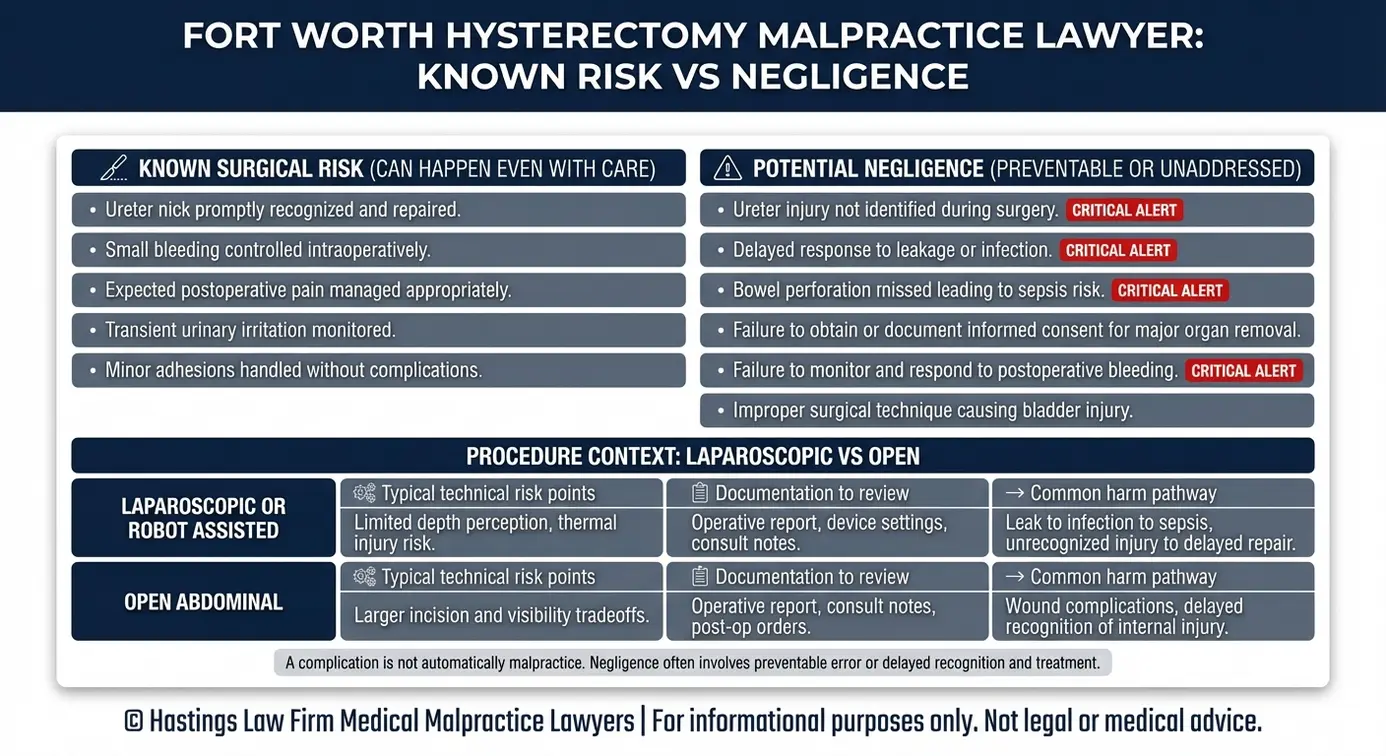
Hysterectomy malpractice often involves preventable surgical errors such as cutting the ureter, perforating the bowel, or failing to address postoperative infections immediately. While every surgery carries some degree of risk, there is an important distinction between a known complication and negligence. A known risk becomes actionable negligence when the surgeon fails to recognize the injury during the procedure, fails to repair it, or fails to respond to warning signs afterward. This distinction is critical in a legal setting.
While a gynecological surgeon cannot guarantee a perfect outcome, they must adhere to the standard of care. If a ureter is nicked, the clinical protocols usually dictate immediate recognition and repair. Negligence occurs when that injury is overlooked, allowing urine to leak into the abdomen, causing severe chemical peritonitis, which is a dangerous inflammation of the abdominal lining. Our legal team includes former hospital nurses who use their insider knowledge to help identify where these safety protocols broke down.
Laparoscopic hysterectomy, a minimally invasive technique where the surgeon operates through small incisions using a camera and specialized instruments, has grown in popularity over the past two decades. Robot-assisted versions of this approach can reduce recovery time, but they also introduce specific dangers. Limited visibility and the physical separation between the surgeon’s hands and the patient’s tissue can increase the chance of accidental cuts to the ureter or nearby structures. When these injuries go undetected during surgery, patients may develop serious infections or organ failure in the days that follow.
Open hysterectomy surgery, performed through a larger abdominal incision, provides the surgeon with direct visualization of the surgical field. Errors during open procedures more commonly involve excessive bleeding, damage to the bladder, or retained surgical instruments. Regardless of the approach, a surgeon who fails to identify and correct an injury occurring during surgery has likely fallen below the expected medical benchmark.
A systematic review published through the National Library of Medicine on the long-term risks of hysterectomy for benign indications confirms that these procedures carry measurable risks of urinary tract injury, pelvic floor complications, and other long-term consequences, reinforcing the need for careful surgical technique and thorough postoperative monitoring.
The table below outlines common injury categories associated with negligent hysterectomy procedures:
| Injury Category | Specific Injuries | Potential Consequences if Undetected |
|---|---|---|
| Urological | Ureter injury, bladder laceration | Urine leakage, kidney damage, repeat surgery |
| Intestinal | Bowel or intestinal perforation | Sepsis, peritonitis, emergency colostomy |
| Vascular | Severed blood vessels, postoperative bleeding | Hemorrhage, organ failure, death |
| Surgical Site | Vaginal vault granulation, infection | Chronic pain, bleeding, delayed healing |
If any of these injuries sound familiar, a hysterectomy malpractice lawyer in Fort Worth can help determine whether negligence played a role in your outcome.
Unnecessary Hysterectomies and Lack of Informed Consent
Not all hysterectomy malpractice involves a surgical mistake during the operation itself. In some cases, the surgery should not have been performed at all. An unnecessary hysterectomy occurs when a surgeon recommends removal of the uterus for a condition that could have been managed through less invasive treatments.
Conditions like uterine fibroids and endometriosis are common reasons for hysterectomy, but they can often be treated with medication or conservative surgical procedures that preserve the uterus. When a surgeon moves directly to hysterectomy without discussing these alternatives, the patient may have been denied the chance to make a fully informed choice about her own body.
Informed consent, the process where the doctor explains the risks, benefits, and alternatives of a proposed treatment so the patient can agree based on that information, is legally required. A consent form signed before surgery does not protect a provider who withheld important details about the risks or who recommended a procedure that was not medically justified. If your pathology results (lab tests of the removed tissue) later showed no disease, or if you were never told about conservative treatments, these are issues our medical team can evaluate.
Proving Medical Negligence in Gynecological Surgery
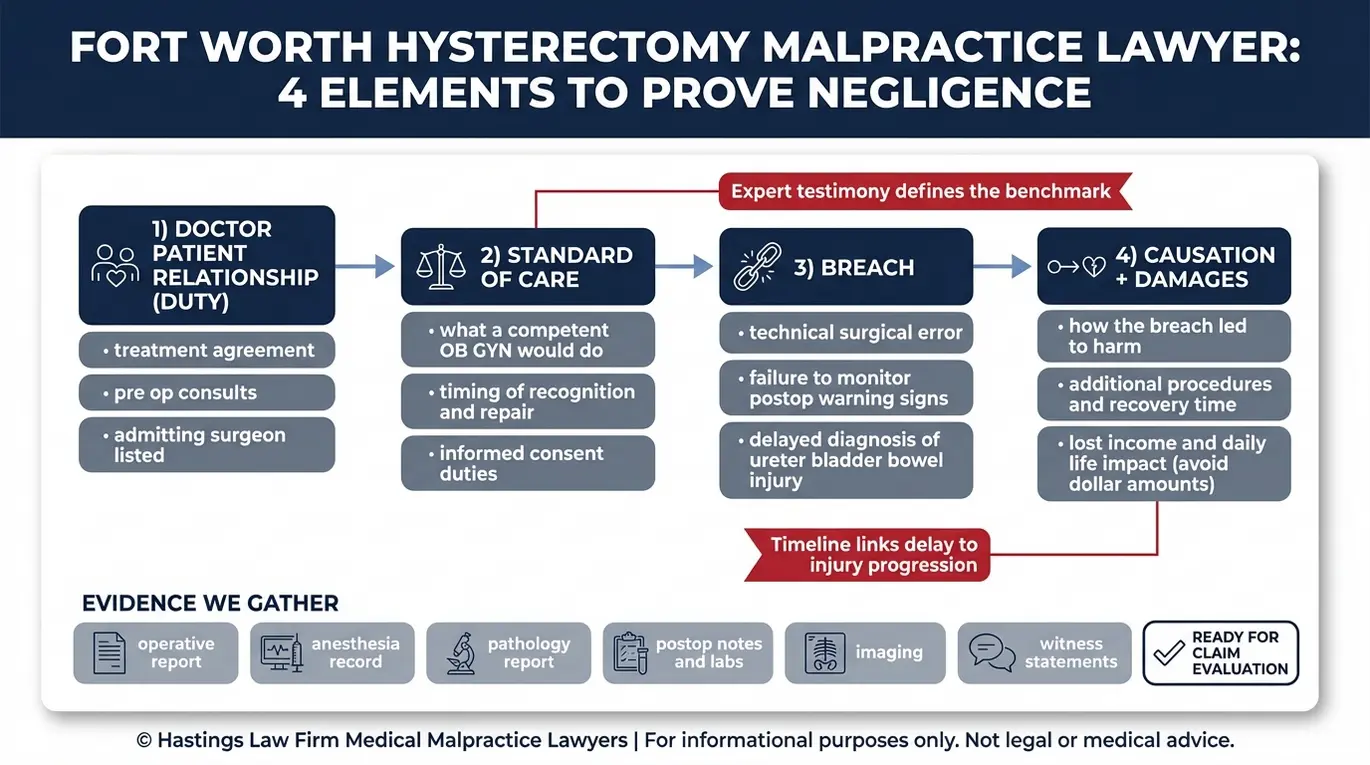
Proving negligence requires demonstrating that the OB-GYN deviated from the accepted standard of care and that this deviation directly caused specific physical or financial harm. The standard of care is the level of treatment a reasonably competent gynecological surgeon would have provided under similar circumstances. Falling short of that benchmark is what separates an unfortunate outcome from actionable medical negligence.
The first step in any medical malpractice case is confirming the doctor-patient relationship, which establishes that the surgeon owed you a duty of care. Tommy Hastings, a board-certified trial lawyer, founded our firm to ensure patients have a voice after being harmed by medical errors. We work with our in-house medical staff, including nurse practitioners and board-certified patient advocates, to reconstruct exactly what happened before, during, and after surgery.
We then turn to our national expert network to secure expert testimony from top-tier gynecological surgeons who can define the standard of care and explain how the treating surgeon deviated from it. These experts are critical because jurors often rely on their explanation to understand complex surgical techniques. By illustrating how a reasonably prudent surgeon would have acted, our experts clarify the breach of duty. Under Texas Civil Practice and Remedies Code, Chapter 74, medical malpractice claims require a qualified expert report early in the case, making this step essential.
Medical records are the foundation of every claim we build. Here is a summary of the key evidence we gather during our investigation:
- Operative reports (operative notes), detailed accounts written by the surgeon describing each step of the procedure and any complications encountered.
- Pathology reports, lab analyses of tissue removed during surgery, which confirm whether the organ showed disease that justified removal.
- Anesthesia and nursing logs, minute-by-minute records of the patient’s vitals and the surgical team’s actions.
- Pre-operative imaging and consultations, records showing what the surgeon knew about the patient’s anatomy and condition before operating.
- Postoperative records, documentation of follow-up care, including how quickly complications were identified and treated.
- Witness statements, accounts from nurses, surgical assistants, or other providers present during the procedure.
Each piece of evidence helps us evaluate whether the surgeon ignored warning signs, failed to recognize an injury, or deviated from established protocols.
The Hastings Law Firm Difference
Results matter, but what truly sets us apart is how we achieve them. Every verdict, every settlement, and every Fort Worth courtroom victory comes from one guiding promise: To treat each client’s fight for justice as if it were our own.
This balance of skill, experience, and empathy reflects our core philosophy that justice should not only compensate the injured, but also make healthcare safer nationwide.

Recovering Compensation for Hysterectomy Injuries
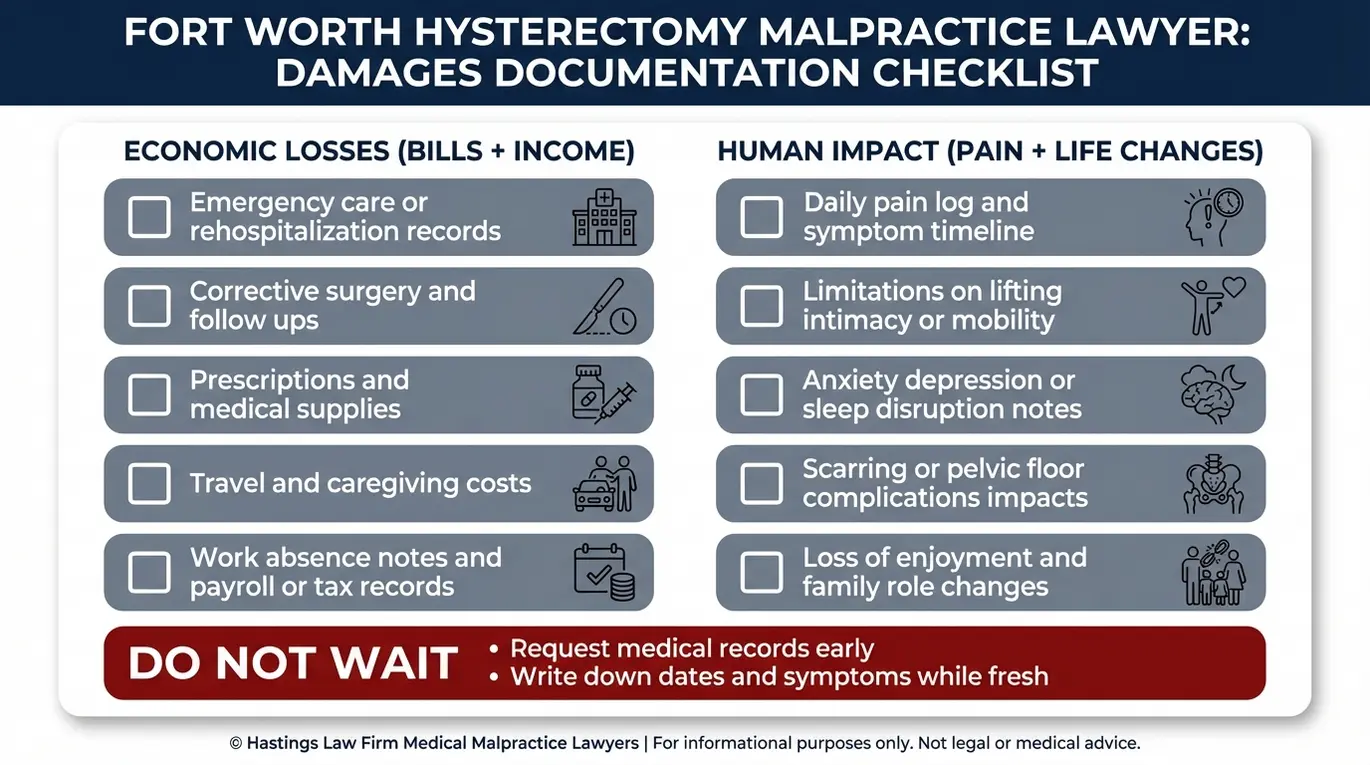
Patients harmed by surgical errors may recover economic damages for medical bills and lost wages, as well as non-economic damages for pain, suffering, and loss of quality of life. The specific value of a claim depends on the severity of the injury, the treatment required to correct it, and how deeply it has affected your daily life.
Economic damages in a surgical error claim cover the financial losses you can measure directly. These include the cost of corrective surgeries, hospital stays, rehabilitation, and ongoing medical care. In complex medical malpractice lawsuits, we also account for incidental costs, such as medical equipment or travel expenses for specialized treatment, ensuring that every dollar you have spent on recovery is included in the demand.
If a bowel or intestinal perforation leads to sepsis, a life-threatening condition in which the body’s response to an infection causes organ dysfunction, the resulting emergency treatment and extended recovery can generate significant medical expenses. Lost wages and reduced earning capacity are also recoverable when a surgical injury prevents you from returning to work on your previous timeline.
Non-economic damages address the losses that are harder to quantify but no less real. Chronic pain, emotional distress, loss of fertility, and the impact on personal relationships all fall into this category. A malpractice lawyer for hysterectomy errors can help document these losses thoroughly so that the full scope of harm is presented, whether during settlement negotiations or at trial.
Future medical care often forms a large portion of the claim. If you require reconstructive surgery or long-term management for a urological injury, we calculate those projected costs to ensure the settlement covers your needs for years to come.
Contact the Fort Worth Surgical Error Attorneys at Hastings Law Firm Today for Help
If you believe you were harmed by a negligent hysterectomy, Hastings Law Firm is here to help you find answers. Since 2005, we have focused exclusively on medical malpractice litigation to provide patients with dedicated expertise. Our team of attorneys, nurse consultants, and medical experts investigates every case with the same level of preparation we would bring to a jury trial, because that readiness is what drives fair results.
We operate on a contingency fee basis, which means you pay no attorney fees or costs unless we recover compensation on your behalf. Many of our clients come to us motivated not only by their own recovery, but by a desire to prevent the same mistake from happening to someone else. That commitment to accountability is something we share.
You deserve to know what happened and what your options are. Contact us today for a free, confidential case evaluation. Let us review your records and explain the path forward.
Frequently Asked Questions About Hysterectomy Malpractice in Fort Worth


This content was researched and written by the Hastings Law Firm editorial team, which includes attorneys, medical professionals, and experienced researchers. Our writing is informed by internal knowledge and practical experience, and we cross-check critical details against authoritative sources cited throughout. Every piece undergoes human-led fact-checking and legal review. Because legal and medical information can change, if you spot an error, please contact us. Learn more about our content standards and review process on our editorial policy page.

Brady D. Williams is a nationally recognized medical malpractice attorney who has spent his career handling high-stakes litigation for injured patients and families across the country. Licensed in both Texas and California, Brady draws on experience from hundreds of resolved medical cases to break down complex legal and medical topics for the people who need that information most. His writing reflects the same attention to detail and commitment to clarity that he brings to every case he handles.
