


Baylor Scott & White Surgical Hospital Fort Worth Malpractice Lawyer
After harm during care at Baylor Scott & White Surgical Hospital Fort Worth in Fort Worth, Texas, Hastings Law Firm represents patients and families in hospital malpractice claims. Those claims can name the hospital, members of its staff, and each physician whose care contributed to the injury. When medical care goes wrong, a patient and their family can be left with a serious injury, a longer recovery, or the loss of a loved one. Finding out what happened and who should be held accountable takes attorneys who understand medicine as well as they understand the courtroom. At Hastings Law Firm, medical malpractice is all we do!

Last Updated: September 28, 2026
Trial-Ready Hospital Negligence Attorneys for Baylor Scott & White Surgical Hospital Fort Worth Patients and Families
Hastings Law Firm’s hospital negligence lawyers bring experienced representation to Baylor Scott & White Surgical Hospital Fort Worth patients and families in Fort Worth, Texas. The firm’s founder, Tommy Hastings, is Board Certified in Personal Injury Trial Law and has represented injured patients since 2001. Our attorneys also include former malpractice defense attorneys who know how the medical industry defends claims.
Knowing the defense from the inside changes how our lawyers prepare. We draw on a nationwide network of medical experts who can show what safe care called for and where it fell short. Each case is readied as if it were headed to trial, and that preparation has earned multimillion-dollar settlements and record-setting verdicts for injured patients and families. Those results come from a firm that has been dedicated exclusively to medical malpractice since 2005.
Contact us now for a free, confidential case review. Our team will listen to your story, investigate your claim, and explain your options.

The Types of Baylor Scott & White Surgical Hospital Lawsuits Our Hospital Malpractice Attorneys Handle
Hastings Law Firm represents patients in Fort Worth, Texas, in lawsuits against Baylor Scott & White Surgical Hospital Fort Worth over surgical, anesthesia, and post-operative care errors. Our hospital malpractice lawyers build each claim from the operative, anesthesia, and nursing records. We then show where care fell below the accepted standard and what the injury has cost the patient.
The cases we see most often at a specialty surgical hospital like Baylor Scott & White Surgical Hospital include:
- Surgical errors. A nerve, blood vessel, organ, or the spinal cord can be damaged during general, orthopedic, spine, bariatric, gynecological, urological, or ENT surgery, including robotic procedures. Operating on the wrong site, performing the wrong procedure, or leaving an instrument behind can mean another operation and additional recovery time. Our Fort Worth surgical error lawyers compare the operative report with the surgical counts and the imaging that followed.
- Anesthesia and monitoring errors. A dosing mistake, trouble with the breathing tube or airway, or a patient’s oxygen level and blood pressure going unwatched during or just after surgery can lead to a brain injury or other permanent harm. Our Fort Worth anesthesia error attorneys set the vital signs charted in the anesthesia record beside the drugs given and the recovery room notes.
- Post-operative care failures, including infection. A leak, bleeding, a blood clot, or an infection after surgery can be recognized or treated too late, or a patient can be sent home before a warning sign was addressed. A delay at that stage can bring readmission, more surgery, or the loss of a loved one. Our Fort Worth postoperative care attorneys trace the nursing notes, lab results, and discharge instructions to pinpoint when the first warning sign appeared.
While these are common claim types, our hospital malpractice attorneys handle any valid medical negligence case that arises at this hospital.
The Hastings Law Firm Difference
Results matter, but what truly sets us apart is how we achieve them. Every verdict, every settlement, and every Fort Worth courtroom victory comes from one guiding promise: To treat each client’s fight for justice as if it were our own.
This balance of skill, experience, and empathy reflects our core philosophy that justice should not only compensate the injured, but also make health care safer nationwide.

About Baylor Scott & White Surgical Hospital on Park Place Avenue in Fort Worth
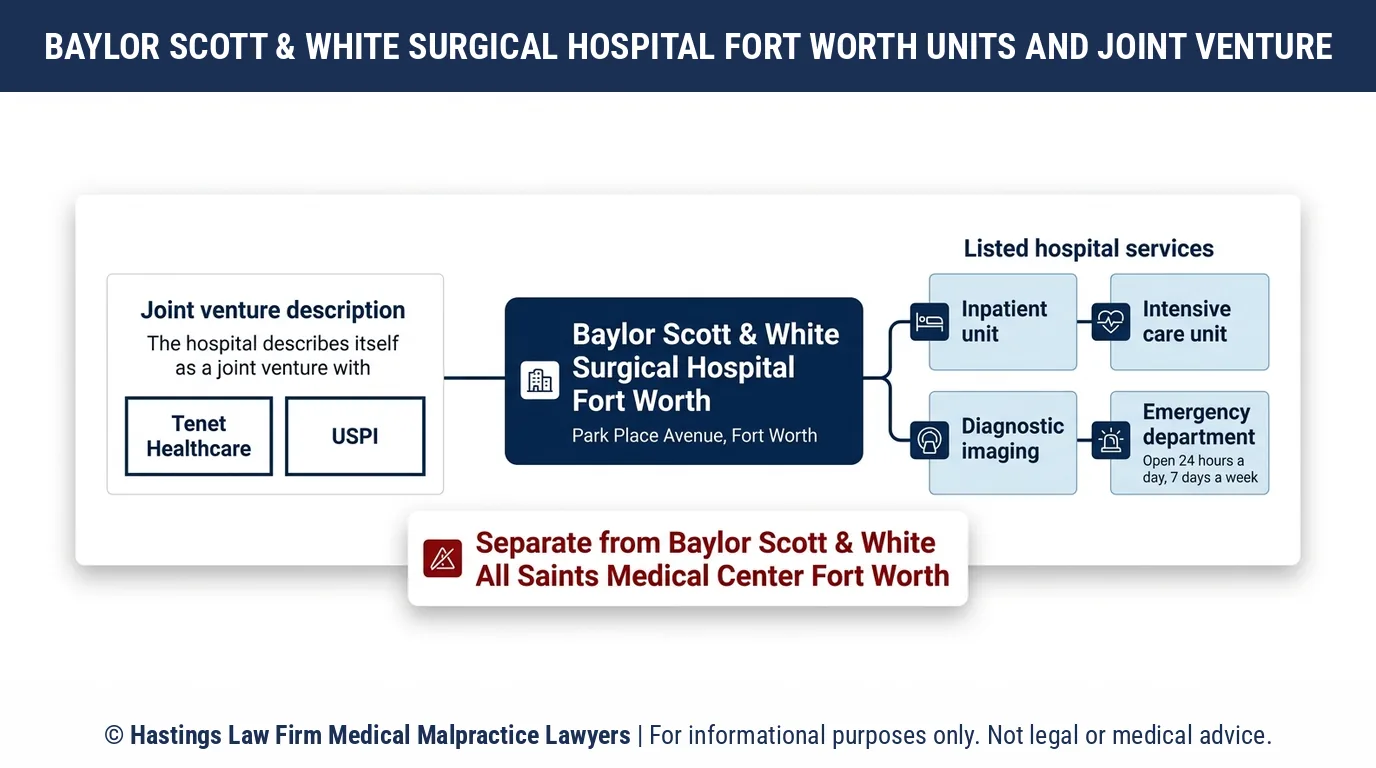
Baylor Scott & White Surgical Hospital Fort Worth is a surgical hospital at 1800 Park Place Avenue in Fort Worth, Texas. The hospital has an inpatient unit, an intensive care unit, diagnostic imaging, and an emergency department open 24 hours a day, 7 days a week. Its listed surgical specialties include orthopedics and orthopedic spine, general, bariatric, gynecology, urology, and ENT surgery.
The hospital describes itself as “a joint venture with Tenet Healthcare and USPI” on its own website. The same page adds neurosurgery, pulmonary, oral, plastics, podiatry, and pain management to its specialties, and says its services are not limited to those it lists. It also names the robotic and navigation systems it uses, among them da Vinci, Mako, Stealth Navigation, TruDi Navigation, and Hydros Aquablation.
Some patients arrive through the emergency department and others for a scheduled operation. One course of surgical care can pass through several units, from the pre-operative assessment to intensive care, and each unit charts its own part.
Baylor Scott & White Surgical Hospital is separate from Baylor Scott & White All Saints Medical Center – Fort Worth, a Baylor Scott & White Health hospital in Fort Worth. Our Fort Worth medical malpractice lawyers also handle claims at Texas Health Harris Methodist Hospital Fort Worth, a Texas Health Resources hospital in the same city.
Can You File a Lawsuit Against Baylor Scott & White Surgical Hospital Fort Worth, the Doctor, or Both?
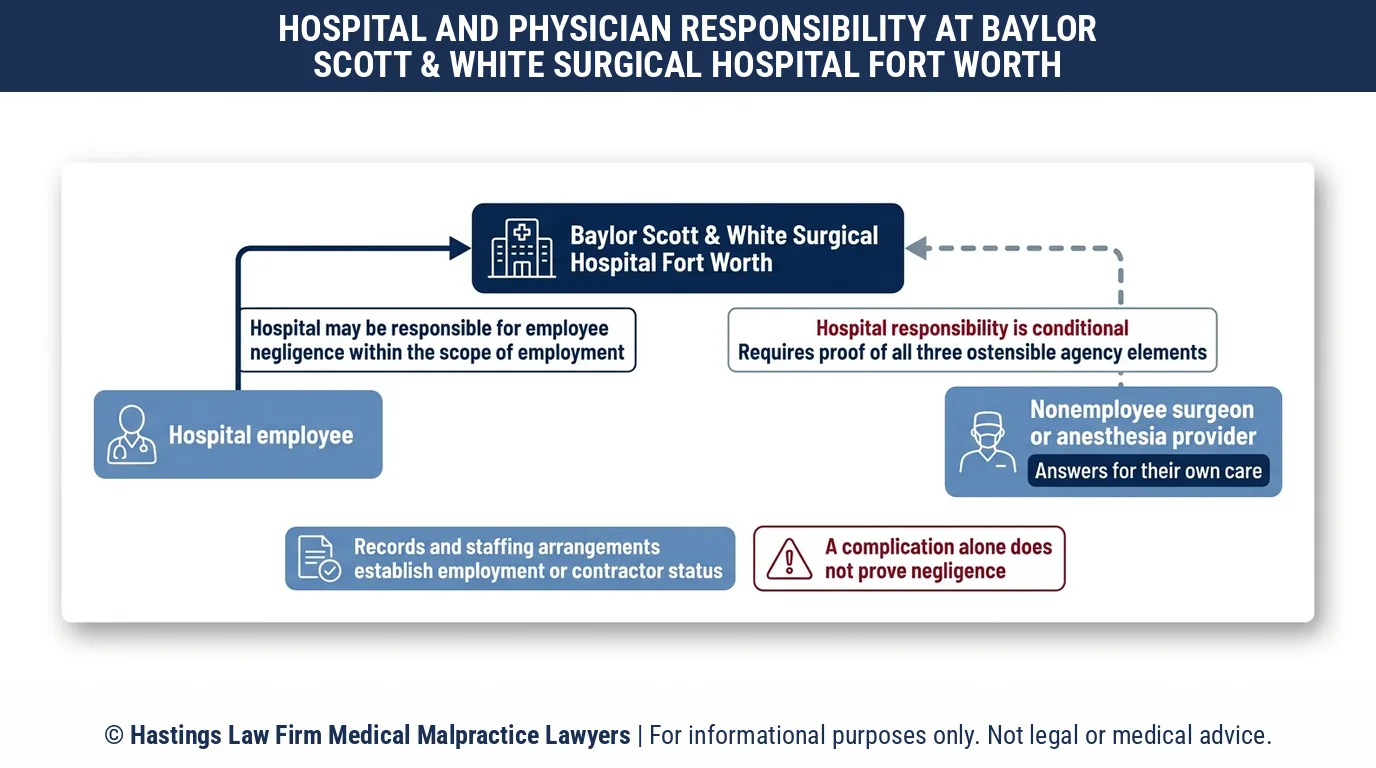
A patient can sue Baylor Scott & White Surgical Hospital Fort Worth, the doctor, or both, depending on who provided the harmful care and who employed that provider. Under Baptist Memorial Hospital System v. Sampson, a Texas hospital can be responsible for negligence by an employee acting within the scope of employment. A surgeon or anesthesia provider who is not a hospital employee answers for their own care.
Who employed or contracted each member of the surgical team is a question of fact, and the records and staffing arrangements answer it. A contractor physician’s negligence can be imputed to the hospital only on proof of all three elements of ostensible agency. Whether a lawsuit against Baylor Scott & White Surgical Hospital names the hospital, a surgeon, or both depends on those answers.
Sorting out those arrangements from the records is the first job of a lawyer to sue a hospital. A claim under Chapter 74 of the Texas Civil Practice and Remedies Code requires written notice to each provider at least 60 days before filing. It also requires a qualified expert’s report within 120 days after each defendant answers.
Surgery carries real risk, and a complication is not proof of negligence on its own. When harm was preventable, the providers responsible should be held accountable. Our Fort Worth hospital malpractice lawyers explain how responsibility is divided among a hospital, its staff, and the physicians who operate there.
Who Must Explain the Risks Before an Operation at a Fort Worth Surgical Hospital Under Texas Law?
Under Texas law, the physician or health care provider must disclose the listed risks before a patient consents to an operation on the Texas Medical Disclosure Panel’s list. Section 74.104 of the Texas Civil Practice and Remedies Code sets that duty, and the rule applies only to procedures the panel has listed. Under Section 74.102, the panel itself decides which risks and hazards must be disclosed.
Informed consent means a patient hears what could go wrong with a procedure and then agrees to it. The statute gives the task of disclosure to the physician or health care provider, while the panel decides what that disclosure has to cover. For a listed procedure, Section 74.105 treats consent as effective if it is given in writing, signed as the statute requires, and states the specific risks.
Before an operation, the risk conversation usually takes place with the surgeon and with the anesthesia provider. The hospital’s guide to what to expect for surgery says a nurse conducts a pre-operative assessment and that the anesthesia provider will also speak with the patient. Those conversations, and the forms that follow them, become part of the chart.
The signed form records which risks were written down and who signed it. The operative and anesthesia records show what the surgical team did afterward, and a consent question is read against both.
Our attorneys collect the consent forms, the pre-operative assessment, and the operative and anesthesia records. We then compare what the patient was told with what the panel’s list requires for that procedure.
How We Work With Injured Baylor Scott & White Surgical Hospital Patients and Their Families
Hastings Law Firm’s hospital malpractice lawyers represent patients and families in Fort Worth, Texas, after injuries at Baylor Scott & White Surgical Hospital Fort Worth. We work with each family from the first call through settlement or trial. A spouse, parent, or other family member can make that call for a patient who cannot.
Your first call reaches a member of our intake team, and your account of what happened is where our review begins. Our team then requests the pre-operative assessment, consent forms, operative and anesthesia records, recovery room notes, imaging, and medication administration records. We also gather nursing notes, emergency department records where the care began there, admission and discharge dates, billing statements, and discharge papers. If our hospital negligence lawyers accept your case, we build it on that file and on medical experts who can explain it.
From then on, our lawyers handle every exchange with the hospital and the companies and attorneys defending it. Our board-certified patient advocates keep in contact as the case moves and put each new development into plain terms. We press for a settlement that reflects what the injury has cost your family, and when an offer falls short, we are prepared to take your case to a jury.
If You or a Loved One Were Injured at Baylor Scott & White Surgical Hospital, Speak With Our Medical Attorneys Today
Hastings Law Firm handles hospital malpractice claims for patients injured at Baylor Scott & White Surgical Hospital Fort Worth and for their families across Fort Worth, Texas. Our attorneys examine the surgical and recovery care and identify who may be responsible for the harm.
Our team is here for you. We perform a free case review to find out whether you have a valid claim, and everything you share with us stays confidential. You pay no fee unless we win. Contact us to understand your options.
Baylor Scott & White Surgical Hospital Fort Worth Malpractice FAQs


This content was researched and written by the Hastings Law Firm editorial team, which includes attorneys, medical professionals, and experienced researchers. Our writing is informed by internal knowledge and practical experience, and we cross-check critical details against authoritative sources cited throughout. Every piece undergoes human-led fact-checking and legal review. Because legal and medical information can change, if you spot an error, please contact us. Learn more about our content standards and review process on our editorial policy page.

Brady D. Williams is a nationally recognized medical malpractice attorney who has spent his career handling high-stakes litigation for injured patients and families across the country. Licensed in both Texas and California, Brady draws on experience from hundreds of resolved medical cases to break down complex legal and medical topics for the people who need that information most. His writing reflects the same attention to detail and commitment to clarity that he brings to every case he handles.
