


Fort Worth Anesthesia Error Lawyer
Written by: Hastings Law Firm | Reviewed by: Brady D. Williams | Updated: July 27, 2026
Anesthesia errors can turn a routine procedure into a sudden medical crisis with lasting physical and psychological harm. Problems like incorrect dosing, inadequate monitoring, airway mistakes, or missed allergy risks can lead to serious complications, including permanent brain injury, coma, or fatal outcomes. These events are often confusing for patients and families because the critical details are recorded in technical anesthesia and monitoring records. Understanding who was responsible and what went wrong can be difficult when multiple clinicians and a facility share roles in care. If you or a loved one were harmed or worse due to an anesthesia error in Fort Worth, Texas, contact Hastings Law Firm for a free, confidential case review.
Top-Rated Fort Worth Malpractice Attorneys for Anesthesia-Related Injuries
What You Should Know About Anesthesiologist Malpractice Claims in Fort Worth:
- Harm can be sudden and severe when anesthesia care breaks down during surgery or recovery.
- Long term outcomes can be life altering, including permanent brain injury, coma, and wrongful death.
- Psychological injury can be significant after anesthesia awareness, including post traumatic stress disorder, severe anxiety, and depression.
- Accountability can extend beyond the anesthesiologist to a supervising surgeon, a nurse anesthetist, or the hospital depending on who held the duty of care.
- Recovery can be limited for pain and suffering in Texas because non economic damages are subject to caps regardless of injury severity.
- Compensation can still cover measurable financial losses in Texas because economic damages are not capped in medical malpractice cases.
- Additional compensation may be possible when conduct is grossly negligent because punitive damages may be available with a higher burden of proof.
- Options can be lost if procedural requirements are missed because Texas requires a qualified medical expert report and missing the deadline can lead to dismissal.
- Clarity about what happened can depend on anesthesia records and monitoring data because they document drugs given, vital signs, and interventions.
- Disputes often focus on whether the injury was a known risk or preventable negligence because hospitals may point to informed consent or underlying health conditions.

A Healthcare Focused Law Firm
Anesthesia is supposed to protect you during a medical procedure. When something goes wrong, whether during surgery or in a recovery room, the consequences can be sudden and severe. If you or someone in your family has been harmed by an anesthesia error, you may be dealing with new medical problems, mounting bills, and a deep sense of confusion about what happened and why.
These cases are medically and legally complex. Founded by Tommy Hastings, who is board-certified in Personal Injury Trial Law, our firm focuses exclusively on medical negligence cases. Our team includes former hospital defense attorneys and nurse practitioners who know how to investigate what went wrong. We use our experience with hospital protocols to determine where the standard of care was breached.
If you need a Fort Worth anesthesia error lawyer, we are here to listen. Contact us for a free, confidential case evaluation so we can review your situation and explain your options.
Common Causes of Anesthesiologist Malpractice in Fort Worth Hospitals
Anesthesia malpractice occurs when a provider deviates from the standard of care, the level of treatment a reasonably competent anesthesia professional would deliver under similar circumstances, through dosage errors, intubation mistakes, equipment failure, or failure to monitor vital signs, resulting in preventable patient harm.
Every anesthesia plan should be tailored to the individual patient. The anesthesiologist or nurse anesthetist must account for body weight, medical history, current medications, and known allergies before any sedation begins. When those steps are skipped or performed carelessly, the results can be devastating. An anesthesia error attorney in Fort Worth can help determine whether the care you received fell below accepted medical standards.
The most common types of anesthesia errors we investigate include:
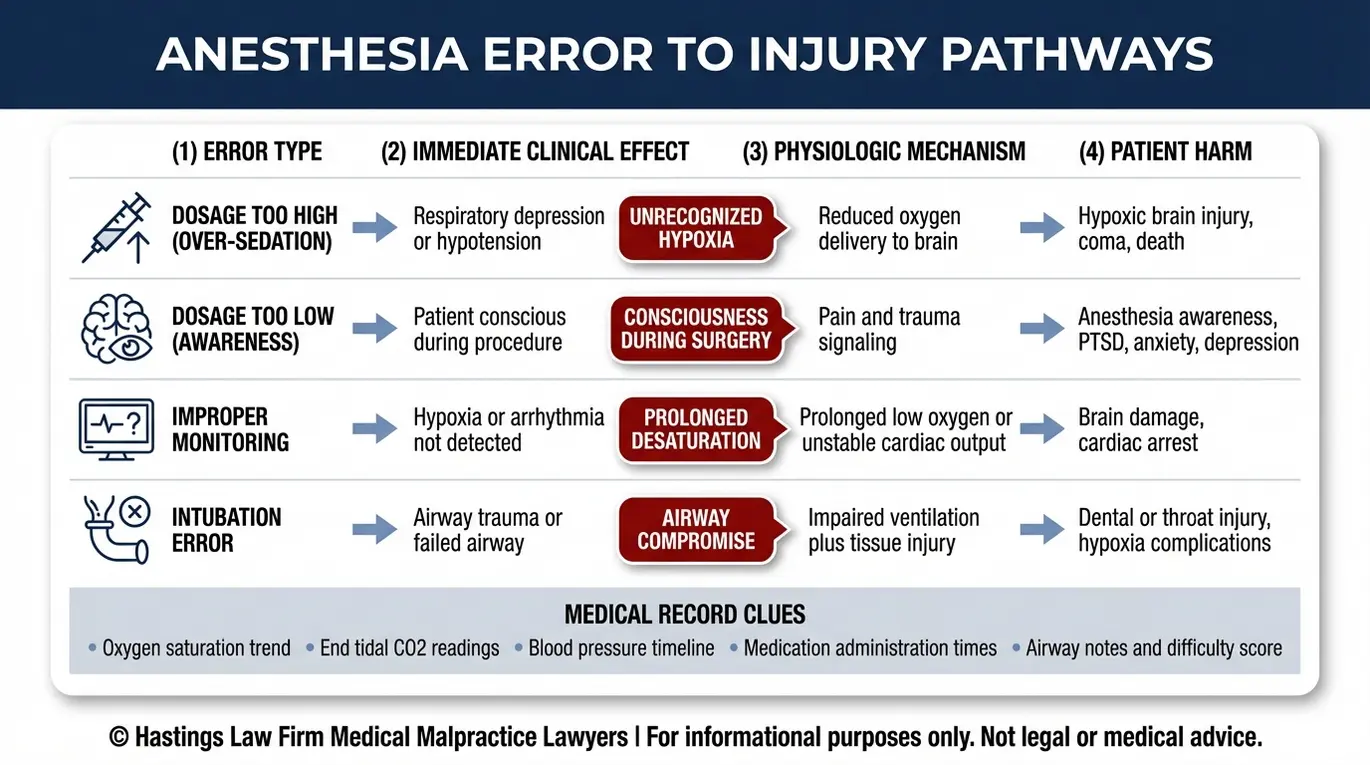
- Dosage mistakes: Administering too much anesthetic can lead to an anesthetic overdose, which is a dangerous suppression of heart rate, blood pressure, and breathing. Too little anesthesia can result in a patient regaining consciousness during surgery.
- Improper monitoring: Failing to continuously track oxygen saturation, heart rate, blood pressure, or carbon dioxide levels during a procedure. Even a brief lapse in monitoring can allow hypoxia or cardiac distress to go undetected.
- Intubation errors: Endotracheal intubation, the process of inserting a breathing tube through the mouth and into the trachea, requires precision. Improper technique can fracture teeth, tear soft tissue, or damage the airway.
- Communication breakdowns: Failing to review a patient’s chart for drug allergies, prior adverse reactions to anesthesia, or medications that interact with anesthetic agents. These are avoidable errors rooted in preparation, not complexity.
Each of these failures involves a specific, identifiable departure from what the standard of care requires during surgical procedures. A Fort Worth anesthesia malpractice lawyer can work with qualified medical experts to pinpoint where the breakdown occurred and connect it to the injury you suffered.
Catastrophic Injuries Resulting From Anesthesia Negligence
Anesthesia errors can cause life-altering injuries ranging from temporary nerve damage to permanent brain injury, hypoxic-ischemic encephalopathy, coma, and wrongful death.
The severity of the outcome often depends on how quickly the error is recognized and corrected. In some cases, seconds matter. When an anesthesia provider fails to act in time, the physical consequences can be irreversible.
| Injury Type | Mechanism | Potential Long-Term Outcome |
|---|---|---|
| Brain damage | Hypoxia (oxygen deprivation to the brain) during surgery or recovery | Permanent cognitive decline, memory loss, personality changes |
| Hypoxic-ischemic encephalopathy (HIE) | Prolonged lack of oxygen and blood flow to the brain | Seizures, developmental disability, persistent vegetative state |
| Nerve damage | Improper patient positioning or needle placement during regional anesthesia | Chronic pain, weakness, partial or full paralysis |
| Dental and throat injuries | Forceful or improper intubation | Fractured teeth, vocal cord damage, chronic swallowing difficulty |
| Cardiac arrest and death | Overdose, undetected allergic reaction, or unmanaged airway obstruction | Wrongful death |
Research published by the National Institutes of Health confirms that brain changes due to hypoxia during light anaesthesia can be detected by positron emission tomography, underscoring how even brief oxygen deprivation during anesthesia can cause measurable neurological harm. For families dealing with these outcomes, a Fort Worth anesthesia injury lawyer can help quantify the full scope of losses and pursue accountability.
The Psychological Toll of Anesthesia Errors
Not all anesthesia injuries are visible. Anesthesia awareness, a condition where a patient becomes conscious during surgery but cannot move or speak due to paralytic agents, is one of the most psychologically damaging complications resulting from an anesthesia error. Patients who experience it often develop post-traumatic stress disorder, recurring nightmares, severe anxiety, mental anguish, and depression.
The pain and suffering caused by anesthesia awareness during surgery can persist long after the physical procedure is over. These psychological injuries are real, documented, and compensable. If you are experiencing symptoms like these after a procedure, legal help for anesthesia errors is available.
The Hastings Law Firm Difference
Results matter, but what truly sets us apart is how we achieve them. Every verdict, every settlement, and every Fort Worth courtroom victory comes from one guiding promise: To treat each client’s fight for justice as if it were our own.
This balance of skill, experience, and empathy reflects our core philosophy that justice should not only compensate the injured, but also make healthcare safer nationwide.

Determining Liability for Anesthesia Errors in Texas
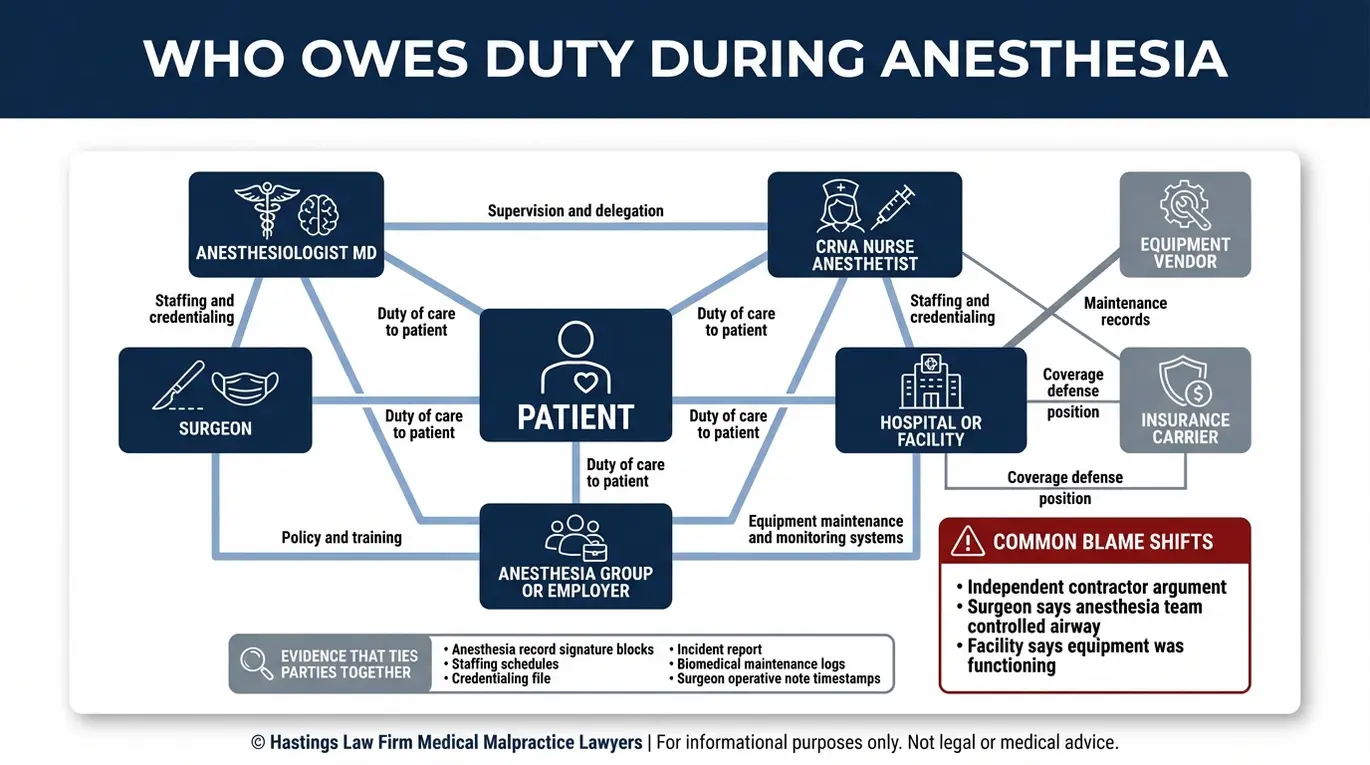
Liability may extend beyond the anesthesiologist to include the supervising surgeon, the hospital itself, or the nurse anesthetist, depending on who held the duty of care at the time of injury.
Anesthesia is rarely delivered by a single person acting alone. It typically involves an anesthesia care team, the group of professionals responsible for planning, administering, and monitoring sedation throughout a procedure. Identifying the right defendant requires a careful review of who did what, when, and under whose supervision.
Here is how responsibility is typically distributed:
- The anesthesiologist (M.D. or D.O.): Holds primary responsibility for designing the anesthesia plan, selecting agents and dosages, and overseeing execution. If the plan itself was flawed or the physician failed to intervene when monitoring showed problems, the anesthesiologist may bear direct liability.
- The certified registered nurse anesthetist (CRNA): A CRNA, an advanced-practice nurse licensed to administer anesthesia, often works under the supervision of an anesthesiologist or surgeon. If a CRNA made an error during sedation, both the CRNA and the supervising physician may have shared liability.
- The hospital or surgical facility: Facilities can be held liable for negligence in maintaining equipment, staffing decisions, or failing to enforce safety protocols. If a malfunctioning monitor or an understaffed operating room contributed to the error, the institution may be a proper defendant, and we will handle all communications with their insurance companies.
The Advisory Committee on Dental Anesthesia March 2025 Report and Recommendations from the Texas State Board of Dental Examiners reflects the evolving regulatory oversight of anesthesia administration in Texas, highlighting how supervision standards and safety requirements continue to be refined.
If you are preparing to sue an anesthesiologist in Fort Worth, our attorneys can investigate these relationships and determine where negligence occurred. Our team reviews operative reports, supervision logs, and equipment maintenance records to identify every responsible party.
Recovering Compensation and Understanding Texas Damages
Patients harmed by anesthesia negligence can recover economic damages for medical bills and lost wages, as well as non-economic damages for pain and suffering, subject to specific caps under Texas law.
Texas divides malpractice damages into distinct categories, each with its own rules:
Economic damages cover the measurable financial losses tied to your injury. These include past and future medical bills, rehabilitation costs, lost wages, and diminished earning capacity. There is no statutory cap on economic damages in Texas medical malpractice cases, which means compensation reflects the actual cost of the harm. Our team uses medical records to document every economic loss.
Non-economic damages compensate for pain and suffering, mental anguish, disfigurement, and loss of companionship. Under the Texas Civil Practice and Remedies Code Chapter 74, non-economic damages are subject to Texas damage caps of $250,000 per claimant against all individual physicians or providers and $250,000 per health care institution, up to $500,000 total if multiple institutions are involved. These caps apply regardless of the severity of the injury.
Punitive damages may be available in cases involving gross negligence, where the provider’s conduct was so reckless that it demonstrated a conscious disregard for patient safety. These claims require a higher burden of proof but can result in additional compensation for an anesthesia error in Fort Worth.
Understanding how Texas damage caps affect your case is essential to building a recovery strategy. A Fort Worth anesthesia error lawyer can help you identify every category of loss and build a claim that reflects the true impact on your life.
How Hastings Law Firm Proves Malpractice in Court
We use a trial-ready approach that combines expert witness testimony, detailed medical record reconstruction, and thorough litigation to prove the provider breached the standard of care.
Texas law requires that a qualified medical expert submit a report within 120 days after the date each defendant’s original answer is filed. Under Civil Practice and Remedies Code Section 74.351, this expert report must identify the applicable standard of care, explain how the provider deviated from it, and establish a causal link between the deviation and the patient’s injury. Failing to meet this deadline can result in dismissal of the case.
Here is how we build each anesthesia malpractice case:
- Immediate investigation: We begin preparing for trial from day one. Our in-house medical staff, including nurse practitioners and board certified patient advocates, review the anesthesia record, operative notes, and monitoring data to identify breakdowns in care.
- Expert analysis: We connect with our national expert network to retain anesthesiologists and other specialists who can provide objective, credible opinions on whether the care met accepted medical standards. These experts review technical data such as capnography readings (end-tidal CO2 monitoring that tracks breathing function) and pulse oximetry data (SpO2 monitoring that measures blood oxygen levels).
- Proving causation: Identifying an error is only the first step. We must also demonstrate that the specific error directly caused the injury. Our team constructs a detailed clinical timeline, linking each deviation from the standard of care to a measurable physiological consequence.
As an anesthesia malpractice law firm with former defense attorneys on staff, we anticipate the arguments the other side will raise and prepare to counter them with evidence. This is what it means to be a Fort Worth anesthesia error lawyer who is ready for trial.
Steps to Take If You Suspect an Anesthesia Error
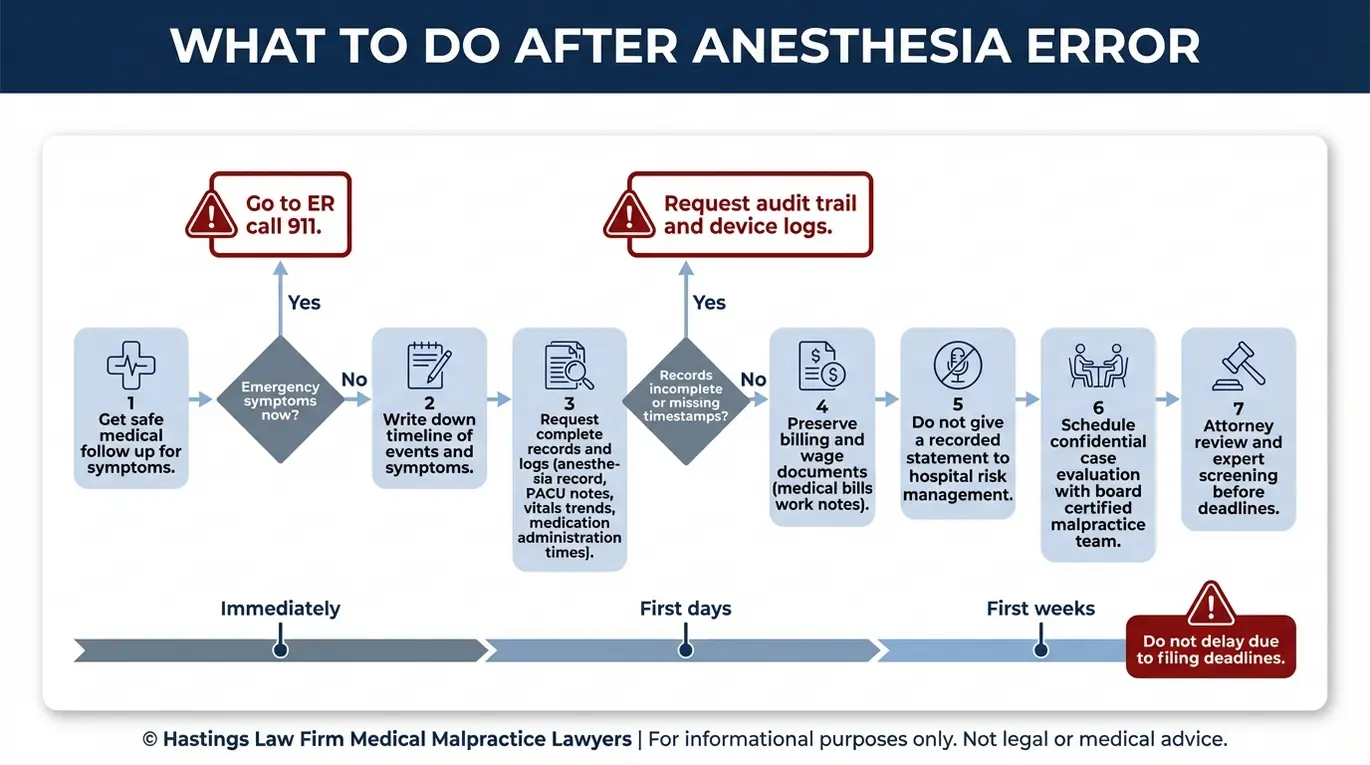
Secure your medical records immediately, do not speak to hospital risk managers, and contact a board-certified malpractice attorney for a case evaluation before the statute of limitations expires.
- Request your complete medical records immediately after a medical injury. Ask the hospital or surgical center for your full chart, including the anesthesia record (also called the anesthesia chart), which documents every drug administered, every vital sign reading, and every intervention during the procedure. You are legally entitled to these records.
- Document your symptoms. Keep a written log of all new or worsening symptoms, side effects, follow-up appointments, and how the injury affects your daily life. This record can become important evidence.
- Do not give recorded statements to hospital risk management. Risk managers work for the facility, not for you. Anything you say may be used to minimize the hospital’s liability.
- File a complaint if appropriate. You can submit a report through the Texas Medical Board Licensee Complaint Form if you believe a licensed provider acted negligently.
- Contact a Fort Worth anesthesia error attorney for a free case evaluation. The statute of limitations in Texas limits the time you have to file a claim. Speaking with an experienced malpractice attorney early gives you the best chance of preserving evidence and receiving proper legal advice.
Contact the Fort Worth Healthcare Malpractice Attorneys at Hastings Law Firm Today for Help
Anesthesia injury cases demand a legal team that understands the medicine as well as the law. General personal injury firms are not equipped to handle the clinical complexity these claims involve. At Hastings Law Firm, medical malpractice is all we do, and our team of attorneys, nurse consultants, and former defense lawyers is built specifically for cases like these.
We work on a contingency fee basis, which means you pay no attorney fees or costs unless we recover compensation for you. There is no financial risk in reaching out.
If you or a loved one suffered harm because of an anesthesia error, a Fort Worth anesthesia error lawyer at Hastings Law Firm can review your medical records, consult with qualified experts, and give you honest answers about what happened and what comes next. Contact us today for a free, confidential consultation.
Frequently Asked Questions About Anesthesia Error in Fort Worth


This content was researched and written by the Hastings Law Firm editorial team, which includes attorneys, medical professionals, and experienced researchers. Our writing is informed by internal knowledge and practical experience, and we cross-check critical details against authoritative sources cited throughout. Every piece undergoes human-led fact-checking and legal review. Because legal and medical information can change, if you spot an error, please contact us. Learn more about our content standards and review process on our editorial policy page.

Brady D. Williams is a nationally recognized medical malpractice attorney who has spent his career handling high-stakes litigation for injured patients and families across the country. Licensed in both Texas and California, Brady draws on experience from hundreds of resolved medical cases to break down complex legal and medical topics for the people who need that information most. His writing reflects the same attention to detail and commitment to clarity that he brings to every case he handles.
