


Fort Worth Hospital Malpractice Lawyer
Written by: Hastings Law Firm | Reviewed by: Gabe Sassin | Updated: July 27, 2026
Hospital malpractice claims often involve more than a single clinical mistake, since breakdowns in staffing, communication, and safety practices can allow preventable harm to reach patients. Understanding whether an injury stems from an individual error, a systemic failure, or negligent credentialing can shape who may be responsible and what recovery may be available. Texas rules on notice, expert support, and damage limits can also affect options and expectations. If you or a loved one were harmed or worse due to hospital negligence in Fort Worth, Texas, contact Hastings Law Firm for a free, confidential case review.

Trusted Fort Worth Malpractice Attorneys for Hospital Injury Claims
What You Should Know About Medical Facility Negligence Claims in Fort Worth:
- Accountability can depend on whether the harm arose from a systemic hospital failure or an individual clinical error.
- Recovery options can change based on whether the negligent clinician was a hospital employee or an independent contractor.
- Hospital liability can still be possible for an independent contractor when the patient reasonably believed the doctor was part of the hospital care team.
- Patient harm can be tied to negligent credentialing when a hospital grants privileges to an unqualified physician despite warning signs.
- A claim can be lost before reaching court if Texas notice and expert support requirements are not met.
- Compensation expectations can be limited by Texas caps on non economic damages even when economic losses remain recoverable.
- The ability to pursue a claim can be cut off by filing deadlines, including an outside limit that can bar claims even when an injury is discovered later.
- The filing timeline can differ for minors and legally incapacitated patients due to specific exceptions.
- Disputes over responsibility can involve anesthesia team supervision and failure to recognize and respond to complications.
- Proof of administrative negligence can depend on internal hospital materials such as staffing logs and credentialing files.

A Healthcare Focused Law Firm
When a hospital fails you or someone you love, the experience can feel deeply personal. You trusted a system designed to heal, and something went wrong. That sense of betrayal is real, and so is the confusion about what to do next.
Hospital injury cases are rarely about a single mistake by one person. More often, they involve systemic failures (often called latent errors). These are institutional breakdowns in staffing, communication, or safety protocols that allow preventable harm to reach patients. Identifying what went wrong requires a team that understands both the medicine and the law.
As a Fort Worth hospital malpractice lawyer, Hastings Law Firm focuses exclusively on medical malpractice. Our legal team includes former defense attorneys who once represented hospitals and in-house nursing professionals who understand clinical operations from the inside. If you believe a hospital’s negligence caused harm, we can review what happened and explain your options in a free, confidential consultation.
Common Types of Hospital Negligence in Fort Worth
Hospital negligence occurs when a facility fails to maintain adequate staffing, sanitation, or safety protocols, resulting in preventable patient harm such as surgical errors or medication mistakes. These failures can be broadly divided into two categories: individual clinical errors and systemic institutional breakdowns.
An individual error might involve a single provider making a mistake during a procedure. A systemic failure points to problems with how the hospital itself operates. Chronic understaffing, poor infection control, or inadequate training can all create conditions where errors become more likely. Both types of failure can support a medical malpractice claim, but the investigation looks different depending on which is involved.
The Texas Department of State Health Services tracks healthcare safety data by facility, offering insight into patterns of harm across Texas hospitals. A hospital negligence attorney examines these patterns alongside the specific facts of each case.
Common examples of hospital negligence include:
- Surgical errors: Wrong-site surgery, nerve damage during a procedure, or instruments and sponges left inside the body after an operation (known as a retained surgical item, or RSI)
- Medication administration errors: A patient receiving the wrong drug, the wrong dose, or a medication intended for another patient, often caused by staffing shortages or charting mistakes
- Hospital-acquired infections: Post-operative infections or sepsis resulting from unsanitary conditions, improper sterilization, or failure to follow established protocols
- Anesthesia errors: Over-sedation, failure to monitor vitals during a procedure, or allergic reactions that were not screened for in advance
- Birth injuries: Delayed C-sections, improper use of forceps or vacuum extractors, or failure to monitor fetal distress
- Failure to treat or diagnose: Discharging a patient prematurely, ignoring worsening symptoms, or failing to order appropriate tests
Medical malpractice lawyers in Fort Worth evaluate whether these errors resulted from an individual provider’s lapse or a broader failure in hospital administration and oversight.
Who Can Be Held Liable for Patient Injuries
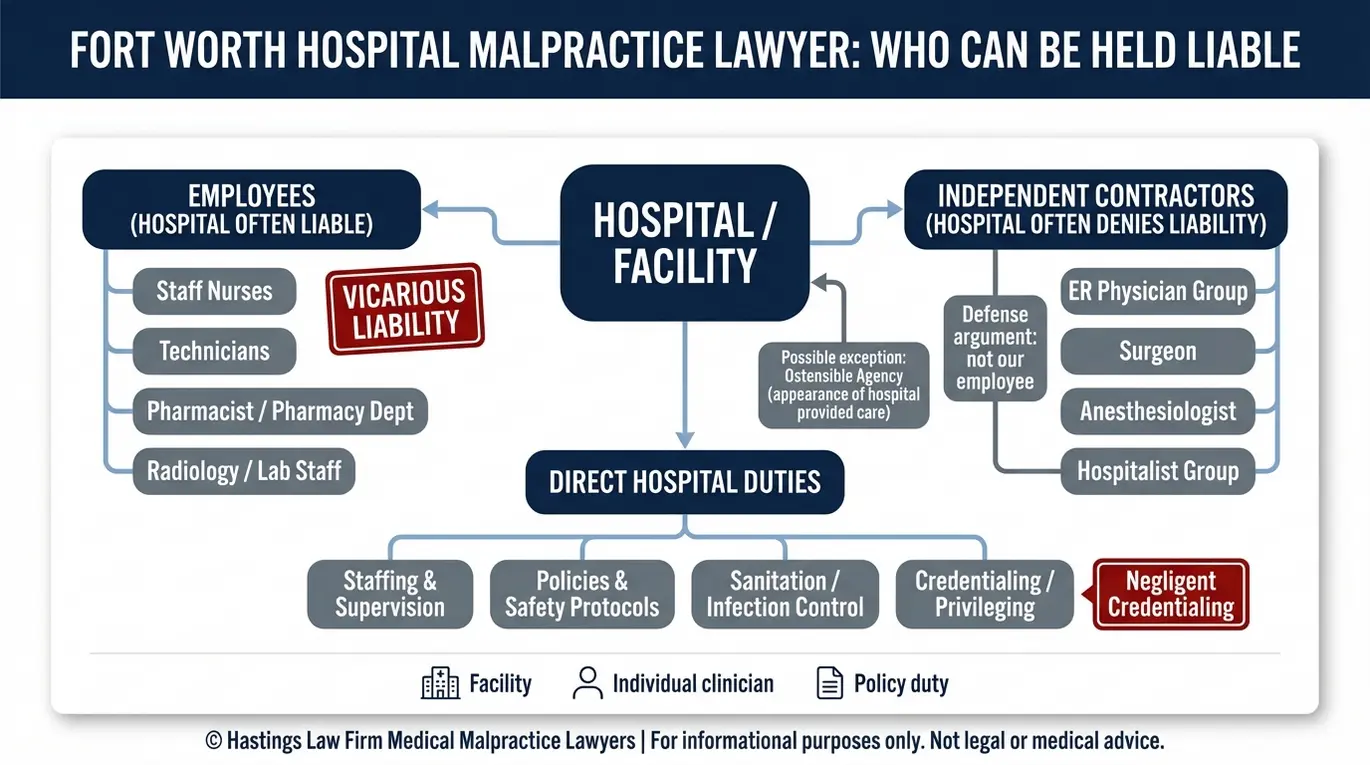
Liability depends on whether the negligent party is a direct hospital employee or an independent contractor. Hospitals are typically responsible for the actions of their employed staff, but they often claim exemption for physicians who hold independent contractor status. This distinction determines which insurance policies and legal standards apply to your claim.
This distinction matters because of a legal doctrine called vicarious liability, which holds an employer responsible for the negligent acts of its employees performed within the scope of their duties. When nursing staff or a surgical technician makes an error, the hospital generally bears legal responsibility. But when a surgeon or emergency room physician is classified as an independent contractor, the hospital may argue it has no liability for that doctor’s conduct, shifting the focus solely to physician liability.
Detailed liability questions also arise regarding the anesthesia care team. This model involves an anesthesiologist supervising a Certified Registered Nurse Anesthetist (CRNA). We also look for cases involving failure to rescue, which is the inability of providers to recognize and respond to a patient’s complications.
| Hospital Employees (Nurses, Techs, Aides) | Independent Contractors (ER Doctors, Surgeons, Specialists) | |
|---|---|---|
| Typical Liability | Hospital is liable under vicarious liability | Doctor is individually liable |
| Hospital’s Defense | Limited; employment relationship is clear | Hospital claims no control over medical decisions |
| Exception | N/A | Ostensible agency: if the patient had no meaningful choice or notice that the doctor was independent, the hospital may still be liable |
There is an important exception. Under the doctrine of ostensible agency, a hospital can still be held liable for an independent contractor if the patient reasonably believed the doctor was part of the hospital’s care team. Research published through SMU Scholar on Health Care Law examines how Texas courts have applied these principles. Suing a hospital in Texas often means identifying every entity and individual involved in the chain of care.
Negligent Credentialing and the Dr. Death Precedent
Hospitals also face direct liability when they grant clinical privileges to a physician who is unqualified or has a documented history of patient harm. These clinical privileges are the authorization to practice and perform procedures within a facility. This form of negligence is known as negligent credentialing.
Hospital credentialing is the internal process by which a facility reviews a doctor’s training, licensure, disciplinary history, and competency before allowing them to treat patients. When that process fails, the consequences can be severe. The case of neurosurgeon Christopher Duntsch, widely known as “Dr. Death,” brought national attention to what happens when hospitals fail to investigate or act on clear warning signs. Multiple facilities granted Duntsch privileges despite a pattern of catastrophic surgical outcomes.
In cases like these, our team examines credentialing files, peer review records, and internal complaints to determine whether the hospital administration knew, or should have known, about the risk a physician posed to patients.
The Hastings Law Firm Difference
Results matter, but what truly sets us apart is how we achieve them. Every verdict, every settlement, and every Fort Worth courtroom victory comes from one guiding promise: To treat each client’s fight for justice as if it were our own.
This balance of skill, experience, and empathy reflects our core philosophy that justice should not only compensate the injured, but also make healthcare safer nationwide.

Navigating Texas Chapter 74 Requirements
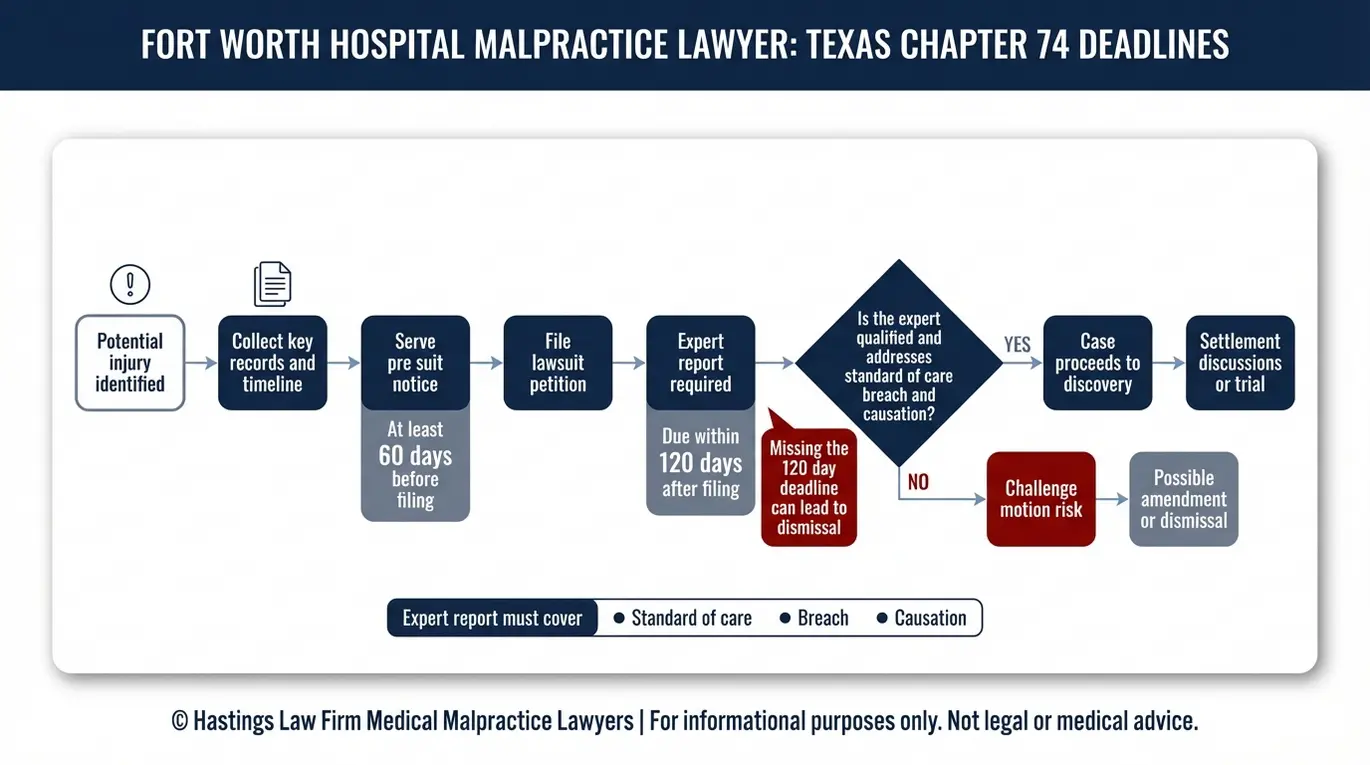
Texas Civil Practice and Remedies Code Chapter 74 requires plaintiffs to provide a pre-suit written notice and a comprehensive expert report within 120 days of each defendant’s original answer being filed to avoid dismissal. Chapter 74 represents the specific set of Texas laws that govern all healthcare liability claims. Missing any of these deadlines can result in your case being rejected before it ever reaches a courtroom.
A Fort Worth medical injury attorney familiar with these requirements will manage each step, but understanding the process can help you see why specialized representation matters. The key procedural steps include:
- Pre-suit written notice: Under Texas Civil Practice and Remedies Code §74.051, you must send written notice to each healthcare provider you intend to sue at least 60 days before filing your lawsuit. This notice triggers a brief period during which the parties may attempt to resolve the claim.
- Filing the lawsuit: After the 60-day notice period expires, your attorney files the formal petition in court.
- 120-day expert report deadline: Within 120 days of each defendant’s original answer being filed, you must serve that defendant with a written report from a qualified medical expert. This report must identify the applicable standard of care, explain how it was breached, and connect that breach to the injury. This expert report is a mandatory step in Texas to prove the case has medical merit early in the litigation process. If the report is late, incomplete, or authored by an unqualified expert, the court can dismiss the case with prejudice.
The expert report requirement is where many claims handled by general practice firms fall apart. The expert must practice in a field involving the same type of care or treatment as the defendant, and the report must demonstrate specific, detailed knowledge of the standard of care. A hospital malpractice law firm with an established national network of medical experts is positioned to meet this standard reliably.
Recoverable Damages and Texas Statutory Caps
Texas law caps non-economic damages at $250,000 per claimant against all individual physicians and providers combined (and $250,000 per healthcare institution), but there is no cap on economic damages. These damages represent the financial compensation paid to an injured person for their losses. Understanding this distinction is essential to setting realistic expectations for your case.
Economic damages cover the measurable financial losses caused by the injury. These include past and future medical bills, lost income, reduced earning capacity, rehabilitation costs, and the expense of ongoing care. Because these damages are tied to documented costs, Texas does not impose a statutory limit on them.
Non-economic damages compensate for losses that are harder to quantify, such as physical pain, emotional suffering, loss of companionship, and diminished quality of life. Texas law applies damage caps that limit non-economic recovery to $250,000 per claimant against each qualifying healthcare institution. In cases involving multiple defendants, the total non-economic cap can be higher, but the per-entity limit still applies.
In wrongful death cases arising from hospital negligence, the family may pursue both economic and non-economic damages. A medical negligence lawyer evaluates the full scope of harm, including future costs that may not be immediately obvious, to build the strongest possible case for fair compensation in Tarrant County courts or through settlement negotiation.
Statute of Limitations for Hospital Negligence
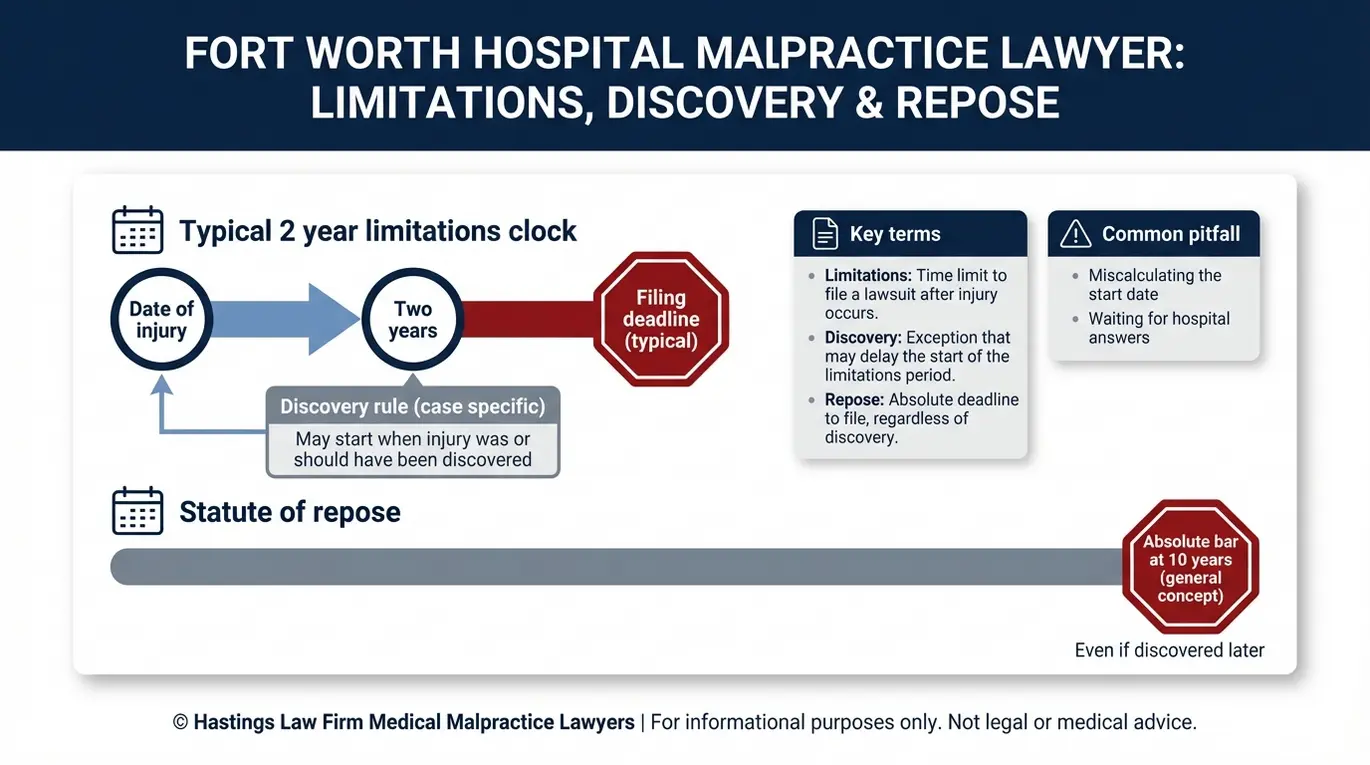
The statute of limitations for medical malpractice in Texas is generally two years from the date of the injury or the date the injury could have reasonably been discovered. This statute of limitations is the strict legal deadline for filing a lawsuit. This second part, known as the discovery rule, exists because some injuries caused by hospital negligence are not immediately apparent.
For example, a retained surgical instrument or a misdiagnosis may not produce symptoms until months or years after the original treatment. The discovery rule allows the two-year clock to start when the patient knew, or reasonably should have known, that an injury occurred.
Texas also imposes what is called a statute of repose. Regardless of when the injury is discovered, no healthcare liability claim may be filed more than 10 years after the date of the treatment in question. This is an absolute bar with very limited exceptions. If you suspect hospital negligence, the safest course is to consult a Fort Worth hospital malpractice lawyer as soon as possible so that critical deadlines are not missed.
Exceptions for Minors and Incapacitated Patients
Texas law provides specific minor exceptions regarding the statute of limitations. Under Texas Civil Practice and Remedies Code §74.251(a), minors under the age of 12 at the time of the alleged negligence have until their 14th birthday to file a claim. For birth injury cases, this exception can be the difference between having a viable path to recovery and having none at all. Similar tolling provisions may apply to patients who are legally incapacitated and unable to act on their own behalf during the limitations period.
Contact the Fort Worth Hospital Malpractice Attorneys at Hastings Law Firm Today for Help
If you believe a hospital’s negligence caused harm to you or someone in your family, you do not have to face this alone. Hastings Law Firm is a Fort Worth medical malpractice law firm that handles nothing but medical negligence cases. Our team includes attorneys, former defense counsel, and in-house medical professionals built to investigate institutional failures and hold hospitals accountable.
Our founder, Tommy Hastings, is board-certified in personal injury trial law, a distinction held by less than 2% of attorneys in the state, and was recently inducted into the American Board of Trial Advocates (ABOTA). We operate on a contingency fee basis, which means you pay no attorney fees or costs unless we secure a recovery for you. The consultation is free and confidential.
You deserve answers about what happened, and you deserve a team that knows how to find them. Contact Hastings Law Firm today for a risk-free case evaluation.
Frequently Asked Questions About Hospital Malpractice in Fort Worth


This content was researched and written by the Hastings Law Firm editorial team, which includes attorneys, medical professionals, and experienced researchers. Our writing is informed by internal knowledge and practical experience, and we cross-check critical details against authoritative sources cited throughout. Every piece undergoes human-led fact-checking and legal review. Because legal and medical information can change, if you spot an error, please contact us. Learn more about our content standards and review process on our editorial policy page.

Gabe Sassin has focused exclusively on medical malpractice law since 2007. After spending more than a decade as a malpractice defense attorney, he knows exactly how the other side works. He has seen firsthand how healthcare providers, insurers, corporate defendants, and their legal teams think, prepare, and build their defense against claims. That knowledge works for the people who need it most today, injured patients and their families. His unique experience shapes everything he writes, giving readers a look at how these cases actually work from someone who has handled them from both sides.
