


Texas Health Fort Worth Hospital Malpractice Lawyer
After an injury during care at Texas Health Fort Worth in Fort Worth, Texas, Hastings Law Firm represents patients and families in hospital malpractice claims. Our lawyers can name the hospital, members of its staff, and the physicians who cared for the patient, depending on who was responsible for each part of the care. When medical care goes wrong, a patient and their family can be left with a serious injury, a longer recovery, or the loss of a loved one. Finding out what happened and who should be held accountable takes attorneys who understand medicine as well as they understand the courtroom. At Hastings Law Firm, medical malpractice is all we do!
Last Updated: September 28, 2026
Trial-Ready Hospital Negligence Attorneys for Texas Health Fort Worth Patients and Families
Hastings Law Firm’s hospital negligence lawyers bring experienced representation to Texas Health Fort Worth patients and families in Fort Worth, Texas. The firm’s founder, Tommy Hastings, is Board Certified in Personal Injury Trial Law and has represented injured patients since 2001. Our team also includes former malpractice defense attorneys who know how the medical industry defends claims.
That background gives each claim a strong footing. We draw on a nationwide network of medical experts to show what the standard of care called for and how the care departed from it. Every case is prepared as if it were headed to trial, and that preparation has earned multimillion-dollar settlements and record-setting verdicts for injured patients and families. Those results come from a firm that has been dedicated exclusively to medical malpractice since 2005.
Contact us now for a free, confidential case review. We will listen to what happened, investigate your claim, and explain your options.

The Types of Texas Health Fort Worth Lawsuits Our Hospital Malpractice Attorneys Handle
Hastings Law Firm’s hospital malpractice lawyers handle Texas Health Fort Worth lawsuits in Fort Worth, Texas, over stroke and heart care, trauma care, and pregnancy emergencies. We build every case from the patient’s own chart, following each decision in the order it was made. Our team then uses that chart to prove where treatment departed from accepted practice and what the injury took from the patient.
The cases we see most often at a Level I trauma hospital like Texas Health Fort Worth include:
- Stroke and heart attack care delays. The signs of a stroke or heart attack can go unrecognized, imaging or treatment can begin too late, or a patient can go without reassessment as symptoms change. Lost minutes can mean lasting brain or heart damage, or the loss of a loved one. Our Fort Worth failure to diagnose lawyers line up the arrival and triage times against the moment imaging was ordered and treatment started.
- Trauma and emergency care errors. An internal injury or bleed can be missed after an accident, imaging or surgery can be delayed, or a patient whose condition is changing can go unmonitored. An injury that was treatable on arrival can become permanent. In claims over missed injuries and misdiagnosis in Fort Worth, we rebuild the visit from the trauma notes, the imaging reports, and the timing of each surgical decision.
- Pregnancy and delivery emergencies. Warning signs such as bleeding, high blood pressure, or fetal distress can go unanswered, the decision to deliver can come too late, or a newborn’s distress can be missed. The harm can reach a mother, a baby, or both, and shape the rest of a family’s life. Our Fort Worth birth injury attorneys read the fetal heart tracings beside the obstetric emergency notes and the delivery record.
While these are common claim types, our hospital malpractice attorneys handle any valid medical negligence case that arises at this hospital.
The Hastings Law Firm Difference
Results matter, but what truly sets us apart is how we achieve them. Every verdict, every settlement, and every Fort Worth courtroom victory comes from one guiding promise: To treat each client’s fight for justice as if it were our own.
This balance of skill, experience, and empathy reflects our core philosophy that justice should not only compensate the injured, but also make health care safer nationwide.

About Texas Health Fort Worth on Pennsylvania Avenue
Texas Health Fort Worth is a Level I Trauma Center at 1301 Pennsylvania Ave in Fort Worth, Texas, and part of the Texas Health Resources system. The hospital’s own welcome text and the state trauma roster still use its full name, Texas Health Harris Methodist Hospital Fort Worth. Its services span emergency and trauma care, stroke and cardiac care, obstetric emergencies, and surgery.
The Texas Department of State Health Services (DSHS) trauma list confirms the Level I designation. The hospital names its Advanced Certification for Comprehensive Stroke Centers and its Comprehensive Cardiac Center Certification among its credentials.
Alongside its Emergency Center, the hospital runs an Obstetrics Emergency Department for pregnancy emergencies. The hospital describes care there from a physician on the medical staff, with the patient’s own OB/GYN provider involved. DSHS lists the hospital among its Level IV maternal facilities and Level III neonatal facilities.
The hospital’s Justin Tower expansion added patient beds, surgical suites, and women’s services. Its tower page names trauma, neuroscience, transplant, and heart and vascular care as specialty services.
A single course of care there can pass from the emergency and trauma teams to specialists, surgeons, and nurses on the inpatient floors. Each of those teams keeps its own record, and read together they show who made each decision and when. Our Fort Worth medical malpractice lawyers handle claims involving hospitals throughout the city.
Can You File a Lawsuit Against Texas Health Fort Worth, the Doctor, or Both?
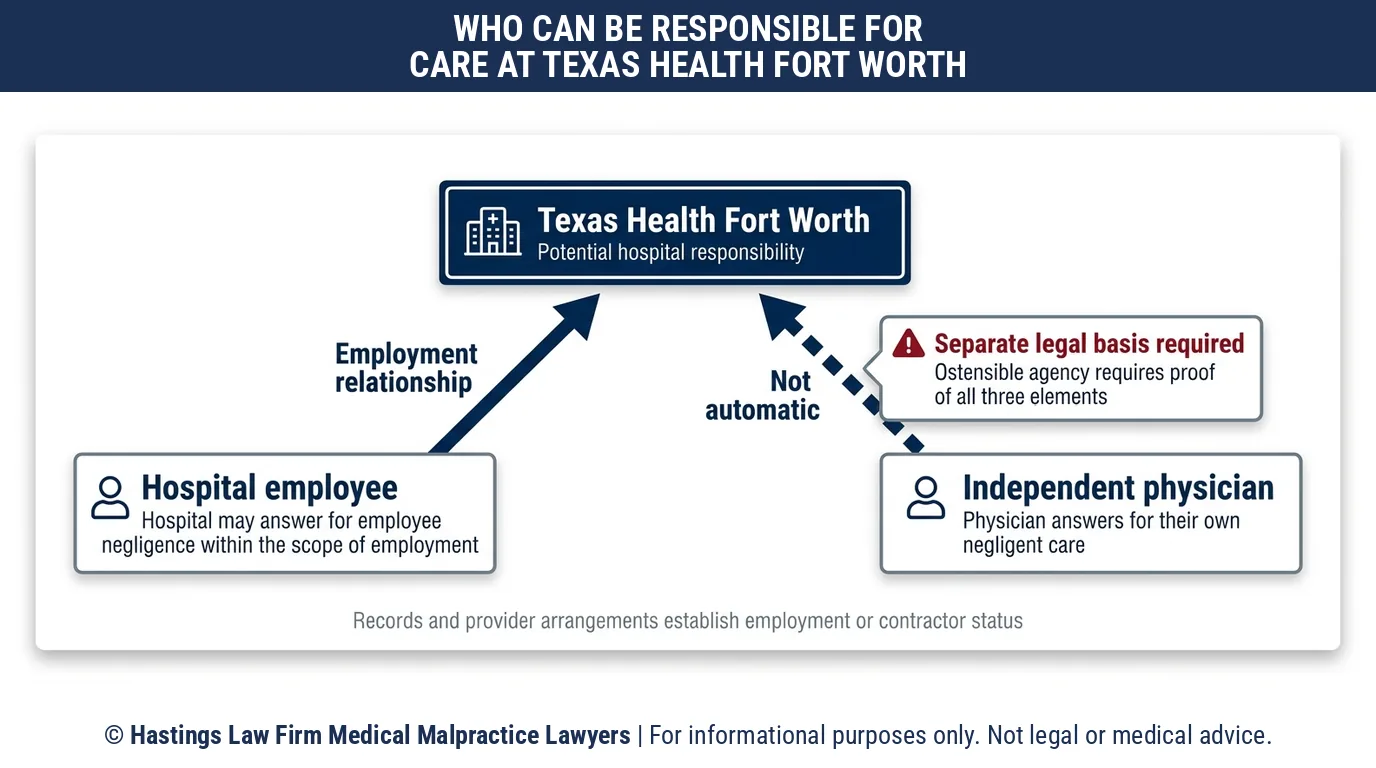
You can sue Texas Health Fort Worth, the doctor, or both, depending on who employed each provider and whose care caused the harm. Under Baptist Memorial Hospital System v. Sampson, a hospital can be responsible for an employee’s negligence within the scope of employment. A physician answers for their own care.
A hospital’s responsibility for a physician who is not its employee needs a separate legal basis. Who employed or contracted each provider comes from the records and the hospital’s own arrangements, and that answer decides who is named in the claim. An independent physician’s negligence can be charged to a hospital under ostensible agency only when the patient proves all three elements of that doctrine.
Sorting out those relationships is where any lawyer to sue a hospital has to begin. A claim against the hospital or a physician is also governed by Chapter 74 of the Texas Civil Practice and Remedies Code. It generally requires a qualified medical expert’s report within 120 days after each defendant files an answer. Our Fort Worth hospital malpractice lawyers explain how employment, contractor status, and the expert report shape these claims. Our firm also represents patients injured at other Fort Worth hospitals, including Texas Health Harris Methodist Hospital Alliance and Texas Health Harris Methodist Hospital Southwest Fort Worth.
Medicine carries risk, and a bad outcome is not always negligence. When an injury was preventable, the providers responsible should be held accountable.
Can a Family Recover When a Delay at Texas Health Fort Worth Reduced a Patient’s Chance of Survival in Texas?
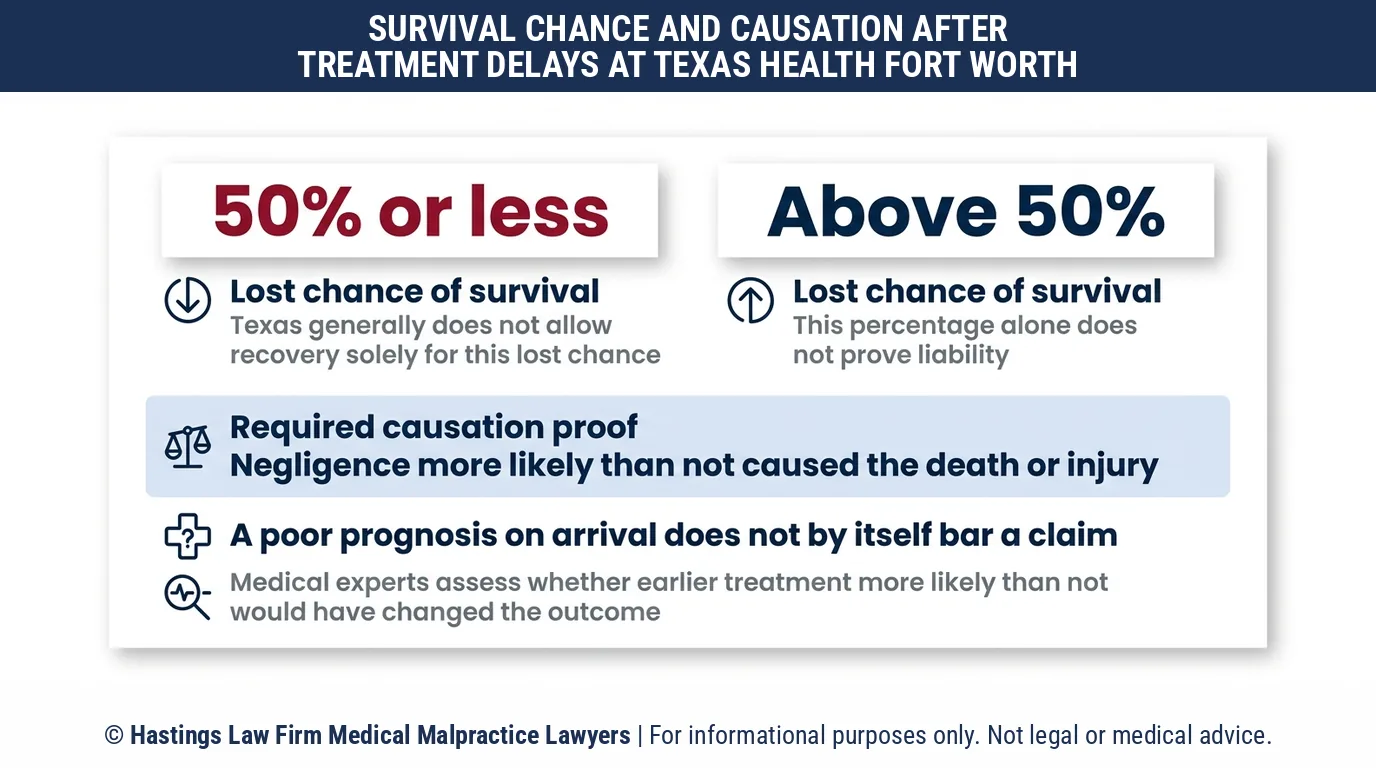
A family can recover when a hospital delay reduced a patient’s chance of survival in Texas only if the delay more likely than not caused the death or injury. Under Kramer v. Lewisville Memorial Hospital, Texas generally does not allow recovery solely for a lost chance of 50 percent or less.
The rule has limits in both directions. A poor prognosis on arrival does not by itself bar a claim, and a lost chance above 50 percent does not by itself prove liability.
That question tends to arise where treatment is measured in minutes, such as a stroke, a heart attack, or a serious injury from an accident. The medical records in those cases hold a timeline. It shows when the patient arrived, when triage took place, when imaging was ordered and read, and when the decision to treat was made. Each entry shows how much of the treatment window was left.
Qualified medical experts read that timeline against the patient’s condition at every point. They explain whether earlier treatment more likely than not would have changed the outcome, which is the proof the Kramer rule calls for.
When a patient dies, Chapter 71 of the Texas Civil Practice and Remedies Code provides two distinct claims. A wrongful death claim is brought for the benefit of the surviving spouse, children, and parents, while the patient’s own injury claim survives to the heirs, legal representatives, and estate. Our Texas wrongful death guide explains how each claim works.
How We Work With Injured Texas Health Fort Worth Patients and Their Families
Hastings Law Firm’s hospital malpractice lawyers represent Fort Worth, Texas, families in claims over care at Texas Health Fort Worth. That work begins with a call to our intake team, which a spouse, parent, or adult child can make for a patient unable to call. We ask what happened and who treated the patient, and our team works to make sure you are heard.
Our firm then requests the full chart. Our attorneys and medical professionals go through the emergency and trauma records, stroke or cardiac timelines, imaging, and operative records. Nursing notes, discharge papers, and any obstetric emergency records are part of that review. When our hospital negligence lawyers accept a case, those records and the physicians who interpret them become its foundation.
We handle every exchange with the hospital and its defense lawyers. Our board-certified patient advocates keep in touch with you and put each new development into plain language when it occurs. Our goal is a settlement that matches what the family has lost, and we are prepared to take your case to a jury if the hospital’s offer does not.
If You or a Loved One Were Injured at Texas Health Fort Worth, Speak With Our Medical Attorneys Today
Hastings Law Firm’s hospital malpractice lawyers perform a free case review for patients and families harmed by care at Texas Health Fort Worth in Fort Worth, Texas. That review traces what happened during the patient’s treatment and identifies which providers may be responsible for the harm.
Our team is here for you. The review tells you whether you have a valid claim, and everything you share with us is kept confidential. There is no fee unless we win. Contact us to understand your options.
Texas Health Fort Worth Malpractice FAQs


This content was researched and written by the Hastings Law Firm editorial team, which includes attorneys, medical professionals, and experienced researchers. Our writing is informed by internal knowledge and practical experience, and we cross-check critical details against authoritative sources cited throughout. Every piece undergoes human-led fact-checking and legal review. Because legal and medical information can change, if you spot an error, please contact us. Learn more about our content standards and review process on our editorial policy page.

Brady D. Williams is a nationally recognized medical malpractice attorney who has spent his career handling high-stakes litigation for injured patients and families across the country. Licensed in both Texas and California, Brady draws on experience from hundreds of resolved medical cases to break down complex legal and medical topics for the people who need that information most. His writing reflects the same attention to detail and commitment to clarity that he brings to every case he handles.
