


Fort Worth Medical Misdiagnosis Lawyer
Written by: Hastings Law Firm | Reviewed by: Gabe Sassin | Updated: July 27, 2026
A wrong, delayed, or missed diagnosis can derail treatment and allow a serious condition to worsen, sometimes leading to permanent injury or fatal outcomes. These cases often turn on whether a reasonably competent provider would have recognized the warning signs sooner based on the symptoms and test results available at the time. Misdiagnosis can also reflect broader system problems such as communication failures or lab errors that affect patient safety. If you or a loved one were harmed or worse due to medical misdiagnosis in Fort Worth, Texas, contact Hastings Law Firm for a free, confidential case review.

Trusted Medical Attorneys for Wrong Diagnosis Claims in Fort Worth
What You Should Know About Wrong Medical Diagnosis Claims in Fort Worth:
- Long term health outcomes can worsen when a wrong, delayed, or missed diagnosis causes a lost treatment window.
- A malpractice claim can fail even after a clear diagnostic mistake if an earlier correct diagnosis would not have changed the outcome.
- Liability can extend beyond the diagnosing clinician when hospital systems, radiology, or laboratory errors contribute to the diagnostic failure.
- Recovery can be limited by Texas restrictions on non economic damages even when the medical harm is severe.
- Legal options can be lost if a claim is not filed within the applicable Texas time limits.
- Severe harm can result when time sensitive emergencies are mistaken for less serious problems.
- Patient safety can be compromised by communication breakdowns and understaffing that lead to rushed or incomplete evaluations.
- A wrong diagnosis can be reinforced across multiple providers when an initial label is accepted without re evaluation.
- Case outcomes can depend on what the medical record shows about symptoms reported, tests ordered, and results that were not followed up.
- Compensation can include financial losses and personal harm such as medical costs, lost earning capacity, physical pain, and mental anguish.

A Healthcare Focused Law Firm
When a doctor gets it wrong, the consequences reach far beyond the exam room. A missed or incorrect diagnosis can mean lost time, unnecessary treatments, and a condition that grows more serious with every passing day. If you or someone you love has been harmed by a diagnostic error, you deserve clear answers about whether the care you received fell below the medical standard you were owed.
At Hastings Law Firm, we focus exclusively on medical malpractice. Led by founder Tommy Hastings, a board-certified trial lawyer, our team of attorneys, nurse consultants, and in-house medical staff has the specialized knowledge to evaluate diagnostic failures. As your Fort Worth medical misdiagnosis lawyer, we prepare every case for a jury trial because that level of preparation is what drives fair results.
If you feel something is wrong with the diagnosis you received, we can review your medical records and explain your legal options at no cost.
Understanding Medical Misdiagnosis and Delayed Diagnosis Claims
Medical misdiagnosis occurs when a healthcare provider fails to accurately identify a patient’s condition, leading to incorrect treatment, delayed care, or a complete lack of intervention that causes preventable harm. These diagnostic errors take different forms, and understanding the distinctions matters because each one affects your health and your legal claim in different ways.
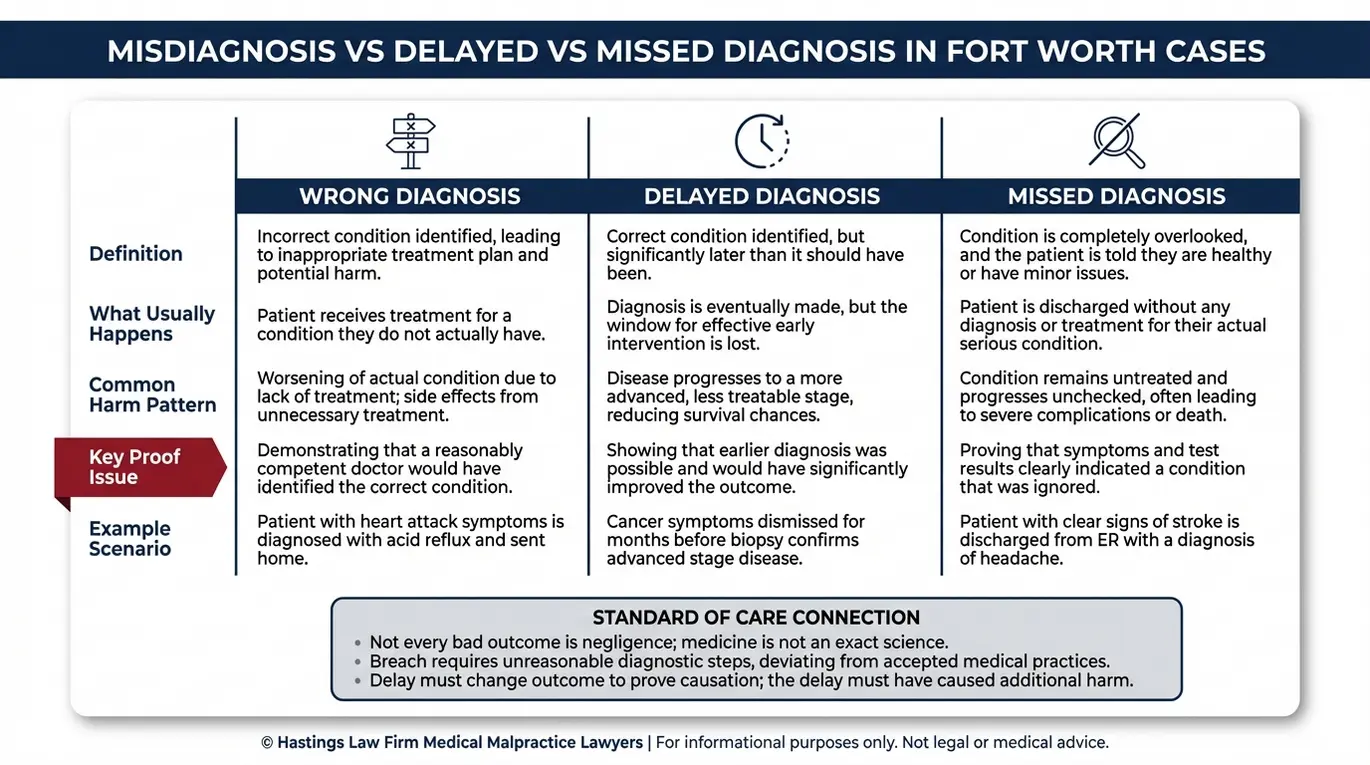
A wrong diagnosis, or misdiagnosis, occurs when a doctor identifies the incorrect condition. You may have been treated for acid reflux, for example, when the actual problem was cardiac. A delayed diagnosis, where the provider eventually reaches the correct conclusion but too late, implies the delay allowed the condition to progress. A missed diagnosis, sometimes called a failure to diagnose, means the condition was never identified at all and went entirely untreated.
| Type | What Happened | Potential Consequence |
|---|---|---|
| Wrong Diagnosis | The doctor identified the incorrect condition | Patient receives unnecessary or harmful treatment while the real condition worsens |
| Delayed Diagnosis | The correct condition was identified, but too late | The treatment window narrows or closes, reducing the chance of recovery |
| Missed Diagnosis | The condition was never identified | The disease progresses without any intervention |
Not every bad medical outcome is malpractice. A diagnostic error becomes medical negligence only when the provider failed to meet the standard of care, the level of skill and attention a reasonably competent doctor in the same specialty would have applied under similar circumstances. The critical question is whether a qualified physician, facing the same symptoms and test results, would have reached the correct diagnosis sooner.
The real harm in many of these cases is the lost treatment window. A cancer caught at Stage I may be highly treatable. That same cancer, left undetected because of a diagnostic error, can advance to Stage IV. In these advanced stages, medical options are far more limited and outcomes are far worse. A Fort Worth medical misdiagnosis lawyer evaluates whether that lost opportunity directly changed the course of your health.
Common Conditions Mishandled by Texas Healthcare Providers
While any condition can be misdiagnosed, the most frequently litigated cases in Texas involve heart attacks, strokes, aggressive cancers, and severe infections like sepsis or meningitis. These are conditions where a narrow treatment window means even a short delay can cause permanent injury or death.
- Cancer: A provider may fail to order a biopsy, a procedure where tissue is removed and examined for disease, after imaging reveals a suspicious mass. Abnormal radiology findings that go without follow-up are one of the most common paths to a delayed cancer diagnosis.
- Heart attack: Patients, particularly women and younger adults, are sometimes discharged from emergency rooms with a diagnosis of indigestion or anxiety while actively experiencing a cardiac event. The symptoms can overlap, but the standard of care requires providers to rule out the most dangerous possibilities first.
- Stroke: Stroke symptoms such as sudden confusion, difficulty speaking, or one-sided weakness are sometimes attributed to migraines or intoxication. According to the 2026 Guideline for the Early Management of Patients With Acute Ischemic Stroke, timely administration of clot-dissolving medication is critical. Misidentifying stroke symptoms can push a patient past the treatment window, the limited period during which medical intervention is most effective.
- Sepsis and meningitis: These fast-moving infections can be mistaken for the flu or a common virus. When a doctor fails to recognize the signs early, the infection can spread rapidly, leading to organ failure or death.
In each of these scenarios, the core legal issue involves causation and proximate cause: did the failure to diagnose directly lead to a worse outcome than what a timely, correct diagnosis would have produced? Establishing the doctor-patient relationship and showing what a competent provider should have done under the same circumstances is central to every case a Fort Worth medical misdiagnosis lawyer investigates.
The Hastings Law Firm Difference
Results matter, but what truly sets us apart is how we achieve them. Every verdict, every settlement, and every Fort Worth courtroom victory comes from one guiding promise: To treat each client’s fight for justice as if it were our own.
This balance of skill, experience, and empathy reflects our core philosophy that justice should not only compensate the injured, but also make healthcare safer nationwide.

Proving Negligence and The Standard of Care
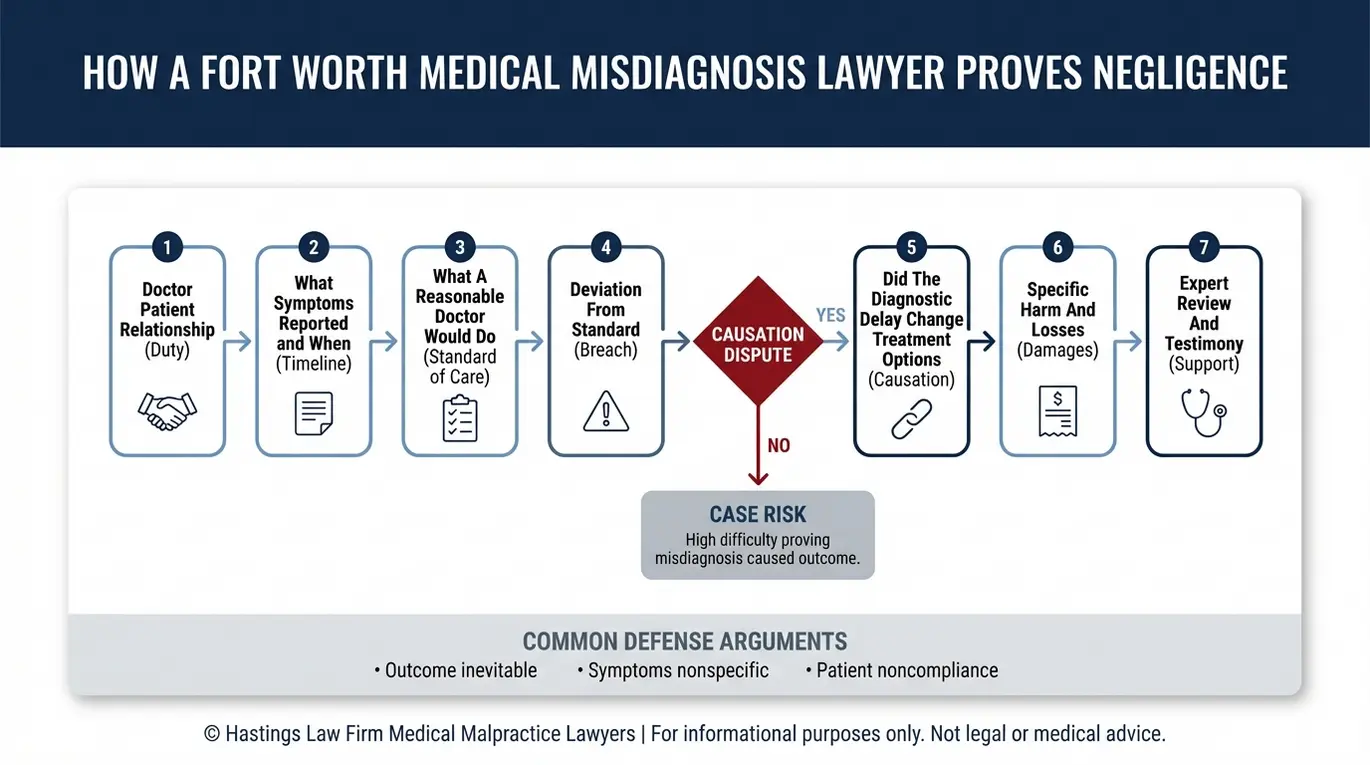
To prove negligence, a plaintiff must demonstrate that a reasonably competent doctor in the same field would have correctly diagnosed the condition under similar circumstances, and that this failure directly caused specific harm. Texas law Texas Civil Practice and Remedies Code, Chapter 74 governs how these claims are filed and what a patient must prove.
Every medical malpractice case rests on four elements. First, the provider owed you a duty of care, which is established the moment a doctor-patient relationship exists. Second, there must be a breach of duty, meaning the provider’s actions fell below what a competent physician in the same specialty would have done. Third, you must prove causation: the breach directly caused or worsened your condition. Fourth, you must show actual damages, whether that means additional medical costs, physical suffering, or lost income.
The hardest part of a misdiagnosis claim is often proving causation. It is not enough to show the doctor was wrong. You must demonstrate that an earlier, correct diagnosis would have led to a meaningfully different outcome. Expert testimony becomes essential to determine whether a differential diagnosis, the systematic method doctors use to compare possible conditions against a patient’s symptoms, was properly conducted.
At Hastings Law Firm, our in-house medical staff, including nurse practitioners and board-certified patient advocates, works alongside our attorneys to reconstruct the clinical timeline. As your Fort Worth medical misdiagnosis lawyer, we use a qualified medical expert to identify exactly where the standard of care was breached and connect that breach to the harm you suffered.
Why Diagnostic Errors Occur in Hospital Systems
Diagnostic errors often stem from systemic failures such as poor communication between departments, lab mix-ups, or cognitive biases where a doctor fixates on a single incorrect theory and ignores contradictory evidence. Research published by the National Academy of Medicine highlights how mapping the diagnostic process can reveal recurring breakdowns that lead to patient harm.
These failures are not always the result of a single person making a single mistake. They often reflect deeper problems or hospital negligence within the system.
- Communication breakdowns: Lab results may not reach the attending physician in time. A radiologist’s findings may sit in a queue while a patient is discharged. Shift changes can mean critical observations are lost in handoffs between providers.
- Understaffing and time pressure: Overcrowded emergency rooms can push physicians to make faster decisions with less information. When providers are managing too many patients at once, the risk of a rushed or incomplete evaluation increases.
- Laboratory specimen mislabeling: Laboratory specimen mislabeling, sometimes called a lab mix-up, occurs when blood samples, tissue specimens, or other materials are incorrectly labeled or attributed to the wrong patient, leading to a diagnosis based on someone else’s results entirely.
- Diagnostic momentum: This phenomenon, occurring when an initial (incorrect) diagnosis is passed from one provider to the next without being re-evaluated, creates a situation where subsequent doctors may accept the label without question.
The Role of Cognitive Biases in Misdiagnosis
Cognitive biases are mental patterns or shortcuts that can cause a physician to overlook critical symptoms or arrive at an incorrect conclusion early in the process. Two cognitive biases drive a significant number of diagnostic failures. Anchoring bias, occurring when a physician locks onto an initial impression early in the evaluation and interprets all later information through that lens, can blind providers to new test results pointing in a different direction. Confirmation bias, a closely related error where the doctor unconsciously seeks out information that supports the working theory while dismissing symptoms or findings that contradict it, further compounds the problem.
These biases are not signs of bad intent. They are well-documented patterns in clinical decision-making. But when they lead to a wrong diagnosis that causes harm, they can form the basis of a medical malpractice claim. As a Fort Worth medical misdiagnosis lawyer, we examine the medical records for evidence of these patterns, looking at what tests were ordered, what results were ignored, and whether the provider considered alternative diagnoses.
Steps to Take If You Suspect a Wrong Diagnosis
If you suspect a misdiagnosis, immediately seek a second opinion from an unrelated physician, request a full copy of your medical records, and document all symptoms and interactions with providers before contacting an attorney.
Here is a practical checklist:
- Prioritize your health first. Get treatment for the condition that may have been missed or misidentified. Your well-being comes before any legal consideration.
- Seek a second opinion. See a different physician, preferably one with no connection to the original provider or facility. A fresh evaluation can confirm or correct the initial diagnosis.
- Request your complete medical records. You have a legal right to your health information, which includes doctor’s notes, lab results, and imaging. The Assistant Secretary for Technology Policy (ASTP) provides guidance on how to obtain your health information. Request these medical records promptly, before any entries can be amended or supplemented.
- Start a personal journal. Write down what you were told by the doctor, when you were told it, what symptoms you reported, and how those symptoms changed over time. This kind of contemporaneous documentation can be valuable evidence later.
- Contact a Fort Worth medical misdiagnosis lawyer for a case evaluation. Early legal screening allows our medical team to begin evidence collection and review the records while the evidence is fresh. We then determine whether negligence occurred. At Hastings Law Firm, this initial consultation is free and confidential.

Liability and Who Can Be Sued for Misdiagnosis
Liability may extend beyond the individual physician to include the hospital, laboratory technicians, radiologists, or the healthcare network if systemic policies contributed to the diagnostic failure.
In many cases, more than one party bears responsibility. A physician who fails to order the right tests may be directly liable, but the hospital that employed or credentialed that physician may also share responsibility. This can occur if the hospital failed to enforce safe diagnostic protocols or maintained unsafe staffing levels. Liability may rely on concepts of vicarious liability, which is a legal doctrine that holds an employer responsible for the actions of its employees, or hospital negligence to hold these entities accountable.
Radiologists and lab technicians can be named in a claim when their errors contributed to the wrong diagnosis. A radiology interpretation error, where a radiologist misreads an X-ray, CT scan, or MRI, can mean a tumor or fracture goes undetected. Research published in Dove Press documents the types and frequency of errors that occur in diagnostic laboratories, from specimen mislabeling to result transcription mistakes.
Our team at Hastings Law Firm includes former defense attorneys who understand how hospitals and their insurers structure these relationships to limit exposure. A physician’s status as either an employee or an independent contractor affects how liability is assigned. As your Fort Worth medical misdiagnosis lawyer, we identify every potentially liable party so that your claim reflects the full scope of what went wrong.
Recoverable Damages in Fort Worth Misdiagnosis Cases
Victims of misdiagnosis may recover compensation for additional medical bills, lost earning capacity, physical pain, mental anguish, and in tragic cases, wrongful death damages for the loss of a loved one.
Texas law recognizes two broad categories of damages in medical malpractice cases:
- Economic damages cover the financial losses you can calculate: past and future medical expenses, rehabilitation costs, lost wages, and reduced earning capacity. There is no cap on economic damages in Texas.
- Non-economic damages address the harder-to-quantify harm: physical pain and suffering, emotional distress, disfigurement, loss of enjoyment of life, and loss of consortium.
In rare cases involving gross negligence, punitive damages may also be available. These are intended to address conduct that goes beyond ordinary negligence.
A delayed cancer diagnosis, for example, may result in the need for more aggressive and expensive treatment than what would have been required if the cancer had been caught earlier. The difference between those two treatment paths, both in cost and in suffering, is the measure of your damages. A Fort Worth medical misdiagnosis lawyer evaluates the full impact of the diagnostic error on your life, not just the immediate medical bills.
Statute of Limitations and The Discovery Rule
In Texas, the general statute of limitations for medical malpractice is two years from the date of the negligent act or the last day of the relevant course of treatment, but certain tolling doctrines may extend this deadline in limited circumstances if the injury could not have been discovered through reasonable diligence.
The two-year rule is the starting point. In most cases, you have two years from the date the negligent act occurred, or from the completion of the related course of treatment, to file a lawsuit. Miss that deadline, and the court will almost certainly bar your claim regardless of its merits.
Tolling doctrines exist because misdiagnosis cases are different from other types of malpractice. If your doctor failed to diagnose cancer in 2022, but you had no reason to know the cancer existed until 2024, the two-year clock may not start until 2024 under certain circumstances. However, the availability of these exceptions in Texas medical malpractice cases is limited, and you should not assume the deadline will be extended without consulting an attorney. This is why early legal advice is essential.
The statute of repose is an absolute 10-year hard stop. Texas law prohibits any medical malpractice lawsuit filed more than 10 years after the date of the original negligent act. There are very limited exceptions, so waiting is never in your interest.
Because these time limits are strict and the consequences for missing them are permanent, speaking with a Fort Worth medical misdiagnosis lawyer as soon as you suspect an error is one of the most important steps you can take to protect your legal rights.
Contact the Fort Worth Misdiagnosis Attorneys at Hastings Law Firm Today for Help
No amount of money can undo the harm caused by a missed or wrong diagnosis. But holding the responsible parties accountable matters, both for your future and for the safety of other patients who trust the same providers and systems.
At Hastings Law Firm, our entire practice is dedicated to medical malpractice. Our team includes attorneys, nurse consultants, and in-house medical professionals who understand both the medicine and the law behind diagnostic failures. We prepare every case with the same rigor whether it settles or goes to trial.
You pay no attorney fees or costs unless we recover compensation for you because we work on a contingency fee basis. If you believe a diagnostic error caused harm to you or someone in your family, contact our team for a free, confidential case evaluation. As your Fort Worth medical misdiagnosis lawyer, we will review what happened, explain your options, and help you understand the path forward.
Frequently Asked Questions About Medical Misdiagnosis in Fort Worth


This content was researched and written by the Hastings Law Firm editorial team, which includes attorneys, medical professionals, and experienced researchers. Our writing is informed by internal knowledge and practical experience, and we cross-check critical details against authoritative sources cited throughout. Every piece undergoes human-led fact-checking and legal review. Because legal and medical information can change, if you spot an error, please contact us. Learn more about our content standards and review process on our editorial policy page.

Gabe Sassin has focused exclusively on medical malpractice law since 2007. After spending more than a decade as a malpractice defense attorney, he knows exactly how the other side works. He has seen firsthand how healthcare providers, insurers, corporate defendants, and their legal teams think, prepare, and build their defense against claims. That knowledge works for the people who need it most today, injured patients and their families. His unique experience shapes everything he writes, giving readers a look at how these cases actually work from someone who has handled them from both sides.
