


Fort Worth Failure To Diagnose Lawyer
Written by: Hastings Law Firm | Reviewed by: Brady D. Williams | Updated: July 27, 2026
A missed, delayed, or wrong diagnosis can leave a patient facing more advanced illness, more intensive treatment, and lasting harm, including fatal outcomes. These situations are often hard to untangle because diagnostic decisions happen across multiple visits, tests, and providers, and important details may be buried in records. Understanding whether the care met the standard expected of a reasonably competent physician can be central to making sense of what happened. If you or a loved one were harmed or worse due to failure to diagnose in Fort Worth, Texas, contact Hastings Law Firm for a free, confidential case review.

Trusted Legal Representation for Diagnosis Failures in Fort Worth
What You Should Know About Delayed or Missed Diagnosis Claims in Fort Worth:
- Long term health outcomes can worsen when a condition is missed, delayed, or incorrectly diagnosed and treatment is not started in time.
- Options for recovery can depend on whether the care fell below the standard expected of a reasonably competent physician in the same specialty.
- Disputes often focus on whether the harm was caused by the diagnostic lapse rather than by an unavoidable medical outcome.
- The most severe consequences can include a patient death, which can shift the claim to wrongful death for surviving family members.
- Recovery in Texas can be limited for non economic damages even when the personal impact is significant.
- Financial recovery can be driven by economic losses such as added medical expenses and lost income because Texas does not cap economic damages.
- The ability to pursue compensation can be lost if a claim is not filed within the applicable Texas time limits.
- The filing deadline can be affected when the diagnostic error was not reasonably discoverable at the time it occurred.
- Evidence can become harder to obtain over time, especially when care is fragmented across multiple providers and record systems.
- Clarity about what happened can depend on complete documentation such as imaging materials and radiology interpretations.

A Healthcare Focused Law Firm
When a doctor misses something that should have been caught, the consequences can change your life. You may be dealing with a condition that has progressed further than it should have, facing treatments that could have been less aggressive, or grieving a loss that did not have to happen. These situations raise difficult questions, and getting clear answers can feel impossible when you are up against a healthcare system that holds the records, the expertise, and the resources.
At Hastings Law Firm, we focus exclusively on medical malpractice. Our team includes in-house medical professionals and former defense attorneys who understand how hospitals and insurers operate from the inside. If you believe a diagnostic error caused you or a loved one harm, a Fort Worth failure to diagnose lawyer at our firm can review what happened, explain your legal options, and help you decide on a path forward. Contact us for a free, confidential case evaluation.
Defining Failure to Diagnose Under Medical Malpractice Law
Failure to diagnose, the situation where a physician does not identify a medical condition that a reasonably competent doctor would have recognized, leads to delayed treatment and significantly worse outcomes for the patient. This type of diagnostic error is distinct from a known complication.
Not every unfavorable medical result qualifies as medical malpractice. Medicine involves uncertainty, and sometimes a condition is genuinely difficult to identify. The legal question is whether the doctor met the standard of care, which is the level of treatment and attention that a qualified physician in the same specialty would have provided given the patient’s symptoms, history, and available information. When a doctor falls below that standard and the patient suffers harm as a direct result, it may constitute medical negligence establishing doctor liability.
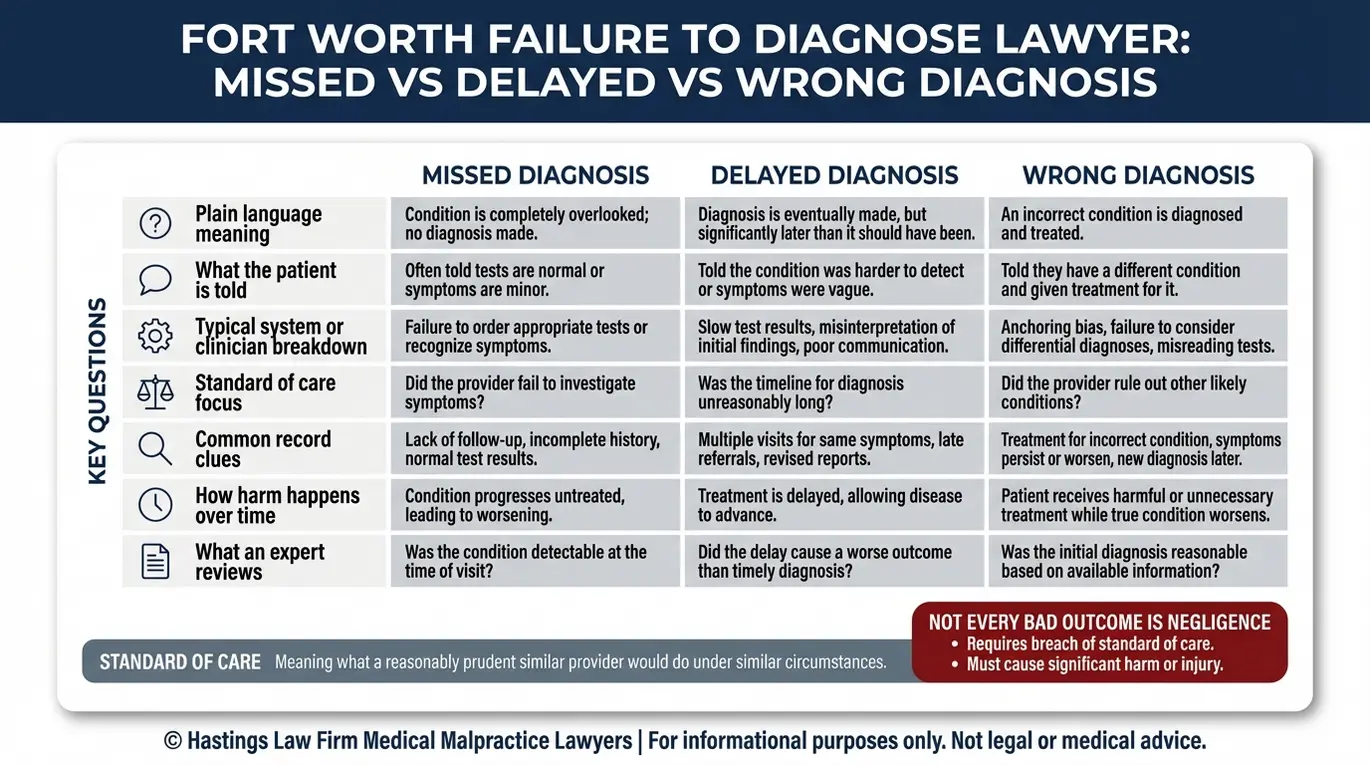
A failure to diagnose attorney evaluates these cases by examining whether the doctor’s conduct represented a true breach of standard of care or simply an unfortunate outcome. A misdiagnosis attorney can determine if the facts support a claim. There are three distinct types of diagnostic failures that can form the basis of a claim:
- Missed Diagnosis: The doctor gives the patient a clean bill of health despite an underlying condition being present. The illness goes entirely undetected.
- Delayed Diagnosis: The doctor eventually identifies the correct condition, but the delay allowed the disease to progress beyond what timely treatment could have addressed.
- Wrong Diagnosis (Misdiagnosis): Wrong diagnosis, where the doctor diagnoses the patient with a different condition entirely, leads to incorrect treatment while the actual illness continues to worsen untreated.
Each type carries its own set of risks. A misdiagnosis lawyer looks at whether the diagnostic process itself was flawed, such as whether the doctor failed to consider likely conditions, skipped appropriate testing, or ignored symptoms that pointed toward a specific diagnosis. A diagnostic error counsel at Hastings Law Firm works alongside our in-house nursing staff and medical consultants to reconstruct the clinical timeline and determine where the standard of care was breached.
Immediate Steps to Take After a Diagnostic Error
Victims should immediately request a copy of their complete medical records, seek a second opinion from an independent specialist, and consult a specialized attorney to preserve evidence.
Get a second opinion right away. A second opinion, an independent evaluation by a different physician, ideally a specialist, to confirm or correct your original diagnosis, is not just a legal consideration. It is a medical priority. Getting accurate treatment as soon as possible can limit the damage caused by the initial error and improve your long-term prognosis. According to the Florida Agency for Health Care Administration’s patient safety resources, patients are encouraged to take an active role in their care by seeking additional input from qualified providers.
Avoid discussing the situation with the original treating doctor or hospital administration. You may feel the urge to confront the provider or ask for an explanation. Anything you say can potentially be used later by the defense. Direct those conversations to your attorney instead, as statements made by a potential patient can be used by the defense. A Fort Worth failure to diagnose lawyer ensures your rights are protected during this phase.
Document everything you can. Keep a written log of your symptoms, when they started, what you reported to your doctors, and how those reports were handled. Save copies of all correspondence, discharge papers, and prescription information.
Here is a checklist of immediate actions to consider:
- Request a complete copy of your medical records from every provider involved
- Schedule an independent evaluation with a specialist outside the original care team
- Do not sign any documents from the hospital or insurer without legal review from a failure to diagnose attorney in Fort Worth
- Preserve all medications, pill bottles, imaging discs, and lab results
- Begin a personal symptom journal with dates, descriptions, and any witnesses
- Contact a medical negligence attorney in Fort Worth before critical deadlines pass
Preserving Critical Physical Evidence
Physical evidence can disappear. Radiology reports, the written interpretations of diagnostic imaging such as CT scans or MRIs, should be obtained directly from the facility. Imaging discs, discharge summaries, and even prescription bottles can become difficult to retrieve once a facility becomes aware of a potential claim. Fragmented care, where your treatment is split across multiple providers or facilities, makes this even more challenging because records may be stored in separate systems that do not communicate with one another. Request copies early and store them in a secure location. Your Fort Worth medical malpractice lawyer can also issue formal preservation demands to ensure the preservation of evidence and prevent records from being altered or destroyed.

The Hastings Law Firm Difference
Results matter, but what truly sets us apart is how we achieve them. Every verdict, every settlement, and every Fort Worth courtroom victory comes from one guiding promise: To treat each client’s fight for justice as if it were our own.
This balance of skill, experience, and empathy reflects our core philosophy that justice should not only compensate the injured, but also make healthcare safer nationwide.

Common Medical Reasons for Delayed Diagnosis
Diagnostic delays often result from systemic breakdowns rather than a single obvious mistake. Errors can stem from something as specific as checking the wrong boxes on a lab order form, failing to schedule follow-up imaging, or dismissing a patient’s reported symptoms without adequate investigation, resulting in a failure to treat.
A delayed diagnosis, meaning the correct condition is eventually identified but only after the window for optimal treatment has narrowed, is one of the most common forms of diagnostic error. Unlike surgical errors or birth injury cases where the mistake is often visible, diagnostic failures are subtle. A diagnostic error attorney knows how to uncover these hidden lapses. Research published by the National Academies of Sciences, Engineering, and Medicine on Improving Diagnosis in Health Care found that most people will experience at least one diagnostic error in their lifetime, often with serious consequences.
Systemic factors contribute significantly to these failures. Fragmented care across multiple providers can cause test results to fall through the cracks. High patient volumes and time-pressured environments may lead to incomplete evaluations. Physician burnout, a state of chronic physical and emotional exhaustion among healthcare workers, can impair cognitive function and lead doctors to rely on mental shortcuts rather than working through a full differential diagnosis.
Certain conditions carry a particularly high risk of being missed or misidentified:
| Condition | Why It Is Frequently Missed |
|---|---|
| Cancer (breast, lung, colon) | Symptoms overlap with benign conditions; screening gaps |
| Heart attacks in women | Atypical presentation; symptoms often attributed to anxiety or stress |
| Stroke | Symptoms can be subtle or transient, especially in younger patients |
| Sepsis | Early signs mimic flu or general infection; rapid progression |
As documented in a study on Addressing the Bias in Cardiovascular Care, women face disproportionate rates of missed and delayed cardiovascular diagnoses due to longstanding clinical biases. A misdiagnosis attorney or delayed diagnosis lawyer investigates whether these known risk factors contributed to the patient’s evaluation. A failure to diagnose counsel can help you understand if these factors played a role in your case.
Establishing Negligence in Failure to Diagnose Lawsuits
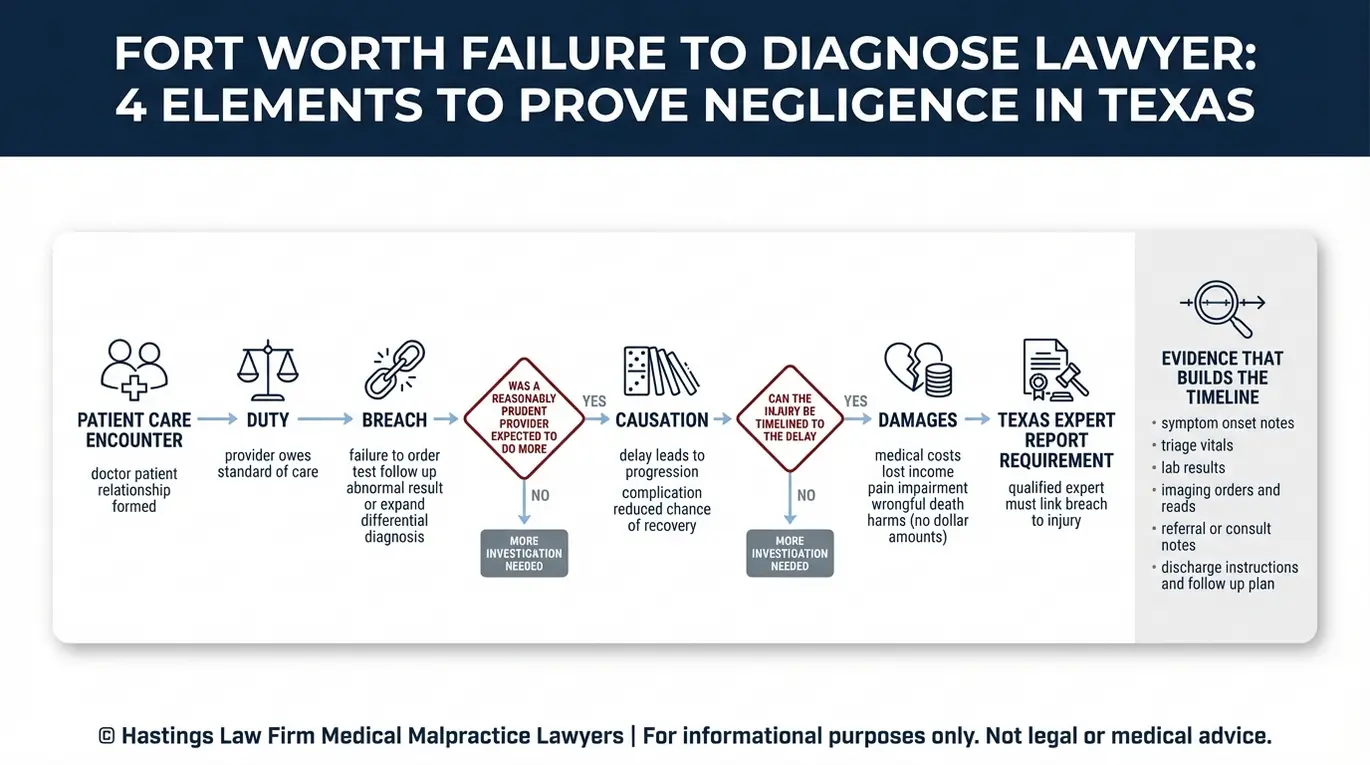
Proving negligence requires clear evidence that a doctor breached the standard of care and that this specific breach directly caused a worsening of the patient’s condition or reduced their chance of recovery. A diagnosis error attorney knows that proving negligence is complex.
Texas health care liability claims follow a four-part framework. Each element must be established:
- Duty: A doctor-patient relationship existed, creating a legal obligation to provide competent care. This is typically the simplest element to prove.
- Breach: The doctor failed to do what a qualified peer in the same specialty would have done. This could mean not ordering appropriate tests, ignoring abnormal results, or failing to consider a condition that belonged on the differential diagnosis, the process of systematically ruling out possible conditions based on a patient’s symptoms.
- Causation: The breach must be directly linked to the patient’s harm. For example, if a missed diagnosis, a situation where a doctor fails to identify an existing illness, allowed cancer to advance from an early, treatable stage to a late stage requiring aggressive intervention, causation connects the delay to the worsened outcome.
- Damages: The patient suffered actual, measurable harm as a result, whether physical, financial, or both.
Texas law imposes a specific procedural requirement that distinguishes these cases from general personal injury claims. Under the Texas Civil Practice and Remedies Code Chapter 74, a plaintiff must serve an expert report within 120 days after the defendant files an original answer. This report, prepared by a qualified medical expert, must identify the standard of care, explain how it was breached, and connect that breach to the patient’s injuries.
This is why expert testimony is essential from the start. At Hastings Law Firm, our failure to diagnose law firm maintains a national network of expert witnesses across specialties who provide objective case reviews and, when needed, courtroom testimony.
Our in-house medical staff, including nurse practitioners and board-certified patient advocates, works alongside our medical negligence attorneys and Fort Worth failure to diagnose lawyer team to build the clinical timeline and identify exactly where the diagnostic process broke down.
Calculating Damages in Misdiagnosis Cases
Patients harmed by diagnostic errors in Texas may recover both economic and non-economic damages, though state law places caps on certain categories. A medical malpractice lawyer can explain how these apply to you.
Economic damages cover the financial losses directly caused by the diagnostic failure. These have no cap under Texas law and may include:
- Past and future medical expenses related to additional treatment made necessary by the delay
- Lost wages from missed work during treatment and recovery
- Reduced earning capacity if the injury results in long-term disability
Non-economic damages address the personal toll of the injury. Texas caps on damages apply to this category in medical malpractice cases.
| Damage Type | Description | Texas Cap |
|---|---|---|
| Economic damages | Medical bills, lost wages, future care costs | No cap |
| Non-economic damages (all individual providers) | Pain and suffering, mental anguish, disfigurement | $250,000 |
| Non-economic damages (per healthcare institution) | Cap per single institution | $250,000 |
| Non-economic damages (total, all defendants) | Aggregate across all physicians and institutions | $750,000 |
While the cap on non-economic damages is a real limitation, it does not diminish the value of your claim. A Fort Worth misdiagnosis lawyer structures the case to fully document every category of economic loss, which is often where the majority of compensation for failure to diagnose is recovered. Contact a failure to diagnose attorney to discuss your potential recovery.
If the diagnostic failure resulted in the patient’s death, surviving family members may pursue a wrongful death claim. These cases can include compensation for loss of companionship, loss of future household income, and funeral and burial expenses.
Texas Statute of Limitations for Diagnostic Claims
In Texas, the statute of limitations for medical malpractice is generally two years from the date of the negligent act. Filing a claim in Fort Worth after this deadline typically means losing the right to pursue compensation entirely. Consulting a statute of limitations attorney is critical.
However, the discovery rule may extend this deadline in cases where the diagnostic error was not immediately apparent. If a patient could not reasonably have known about the missed condition until a later date, the two-year clock may begin when the error was discovered or should have been discovered. Your Fort Worth diagnosis lawyer can determine if this applies.
Texas also enforces a statute of repose, which sets an absolute 10-year outer boundary. Regardless of when the error is found, no medical malpractice claim can be filed more than 10 years after the date of the negligent act, with limited exceptions such as for minor children under existing tolling provisions.
Contact the Fort Worth Diagnosis Failure Attorneys at Hastings Law Firm Today for Help
A diagnostic error can leave you with more questions than answers. You deserve to know what happened, why it happened, and what options are available to you now.
Hastings Law Firm is dedicated exclusively to medical malpractice. Our legal team includes former defense attorneys, in-house nursing professionals, and a national network of medical experts. Our founder, Tommy Hastings, is a board-certified trial lawyer who has focused his career on representing patients harmed by medical errors.
We work on a contingency fee basis, which means you pay no attorney fees or costs unless we recover compensation on your behalf. If you or a loved one suffered harm because of a missed, delayed, or incorrect diagnosis, contact us today for a free, confidential case evaluation. Let us help you find the answers you deserve.
Frequently Asked Questions About Failure To Diagnose in Fort Worth


This content was researched and written by the Hastings Law Firm editorial team, which includes attorneys, medical professionals, and experienced researchers. Our writing is informed by internal knowledge and practical experience, and we cross-check critical details against authoritative sources cited throughout. Every piece undergoes human-led fact-checking and legal review. Because legal and medical information can change, if you spot an error, please contact us. Learn more about our content standards and review process on our editorial policy page.

Brady D. Williams is a nationally recognized medical malpractice attorney who has spent his career handling high-stakes litigation for injured patients and families across the country. Licensed in both Texas and California, Brady draws on experience from hundreds of resolved medical cases to break down complex legal and medical topics for the people who need that information most. His writing reflects the same attention to detail and commitment to clarity that he brings to every case he handles.
