


Baylor Scott & White All Saints Medical Center Fort Worth Malpractice Lawyer
Hastings Law Firm handles hospital malpractice claims for patients and families hurt during care at Baylor Scott & White All Saints Medical Center in Fort Worth, Texas. Our lawyers bring those claims against the hospital, members of its staff, the physicians who treated the patient, or more than one of them. When medical care goes wrong, a patient and their family can be left with a serious injury, a longer recovery, or the loss of a loved one. Finding out what happened and who should be held accountable takes attorneys who understand medicine as well as they understand the courtroom. At Hastings Law Firm, medical malpractice is all we do!

Last Updated: September 28, 2026
Trial-Ready Hospital Negligence Attorneys for Baylor Scott & White All Saints Patients and Families
Hastings Law Firm’s hospital negligence lawyers bring experienced representation to Baylor Scott & White All Saints patients and families in Fort Worth, Texas. Tommy Hastings, our founder, is Board Certified in Personal Injury Trial Law and has represented injured patients since 2001. Our team includes former malpractice defense attorneys who understand the tactics hospitals use to deny liability.
What those attorneys learned about the defense guides how every claim is prepared. A nationwide network of medical experts helps us show what the standard of care asked of each provider and how the care fell short of it. We prepare every case as if it were going to trial, and that work has brought multimillion-dollar settlements and record-setting verdicts for injured patients and families. Those results come from a firm that has been dedicated exclusively to medical malpractice since 2005.
Contact us now for a free, confidential case review. Our team will hear what happened, investigate your claim, and explain your options.

The Types of Baylor Scott & White All Saints Lawsuits Our Hospital Malpractice Attorneys Handle
Hastings Law Firm’s hospital malpractice lawyers handle lawsuits against Baylor Scott & White All Saints in Fort Worth, Texas, involving childbirth, emergency and trauma care, and surgery. Our attorneys build each case from the patient’s hospital records. We use those records and the opinions of qualified medical experts to prove where care departed from accepted practice and what that cost the patient and family.
The cases we see most often at a full-service hospital like Baylor Scott & White All Saints include:
- Labor, delivery, and newborn care errors. Fetal distress can go unanswered, the decision to deliver can come too late, or a mother’s bleeding or high blood pressure can be missed. A newborn’s breathing trouble or low blood sugar can also go unrecognized in the hours after birth. The harm can follow a mother and child for years, through therapy, specialists, and changes to family life. Our Fort Worth birth injury lawyers compare the fetal monitoring strips with the labor notes and the newborn’s chart.
- Emergency and trauma care errors. Bleeding inside the body or an internal injury from a crash or fall can go unrecognized, and the scans or surgery a patient needs can be delayed. A patient can also be discharged before a serious condition has been ruled out, and what was treatable on arrival can become a permanent injury. When a claim involves missed or delayed diagnoses, we reconstruct the visit from triage times, imaging orders and reads, and the emergency physician’s notes.
- Surgical errors. A nearby organ or blood vessel can be injured during an operation, a bleed or infection afterward can go unnoticed, or anesthesia and monitoring can fail. Repairing that damage can mean more surgery and additional recovery time. Our Fort Worth surgical error lawyers read the operative report against the anesthesia record and the post-operative nursing notes.
While these are common claim types, our hospital malpractice attorneys handle any valid medical negligence case that arises at this hospital.
The Hastings Law Firm Difference
Results matter, but what truly sets us apart is how we achieve them. Every verdict, every settlement, and every Fort Worth courtroom victory comes from one guiding promise: To treat each client’s fight for justice as if it were our own.
This balance of skill, experience, and empathy reflects our core philosophy that justice should not only compensate the injured, but also make health care safer nationwide.

About Baylor Scott & White All Saints on Eighth Avenue in Fort Worth
Baylor Scott & White All Saints Medical Center in Fort Worth, Texas, is a not-for-profit hospital within Baylor Scott & White Health at 1400 8th Ave in Tarrant County. Its services include emergency care, labor and delivery, surgical services, cardiology, and women’s and children’s services. The hospital also lists transplant services for liver, kidney, living donor kidney, islet cell, and pancreas transplants.
The Texas Department of State Health Services (DSHS) lists the hospital as a Level III trauma facility. DSHS also places it among the Level IV maternal facilities, the comprehensive care level for mothers, and the Level III neonatal facilities, the level for newborn intensive care.
Physicians in training also care for patients there. TCU’s Burnett School of Medicine lists the hospital as a clinical partner for an ACGME-accredited physician resident training program. Residents are doctors who have finished medical school and are completing their training under supervising physicians, so a resident and a supervising physician can both appear in a patient’s chart.
A single course of care there can pass through emergency, surgical, obstetric, and nursing teams. Each team documents its own part of that care, so the chart holds a separate account from every group that treated the patient. Our Fort Worth medical malpractice lawyers also represent patients of other Fort Worth hospitals, such as John Peter Smith Hospital and Texas Health Fort Worth.
Can You File a Lawsuit Against Baylor Scott & White All Saints, the Doctor, or Both?
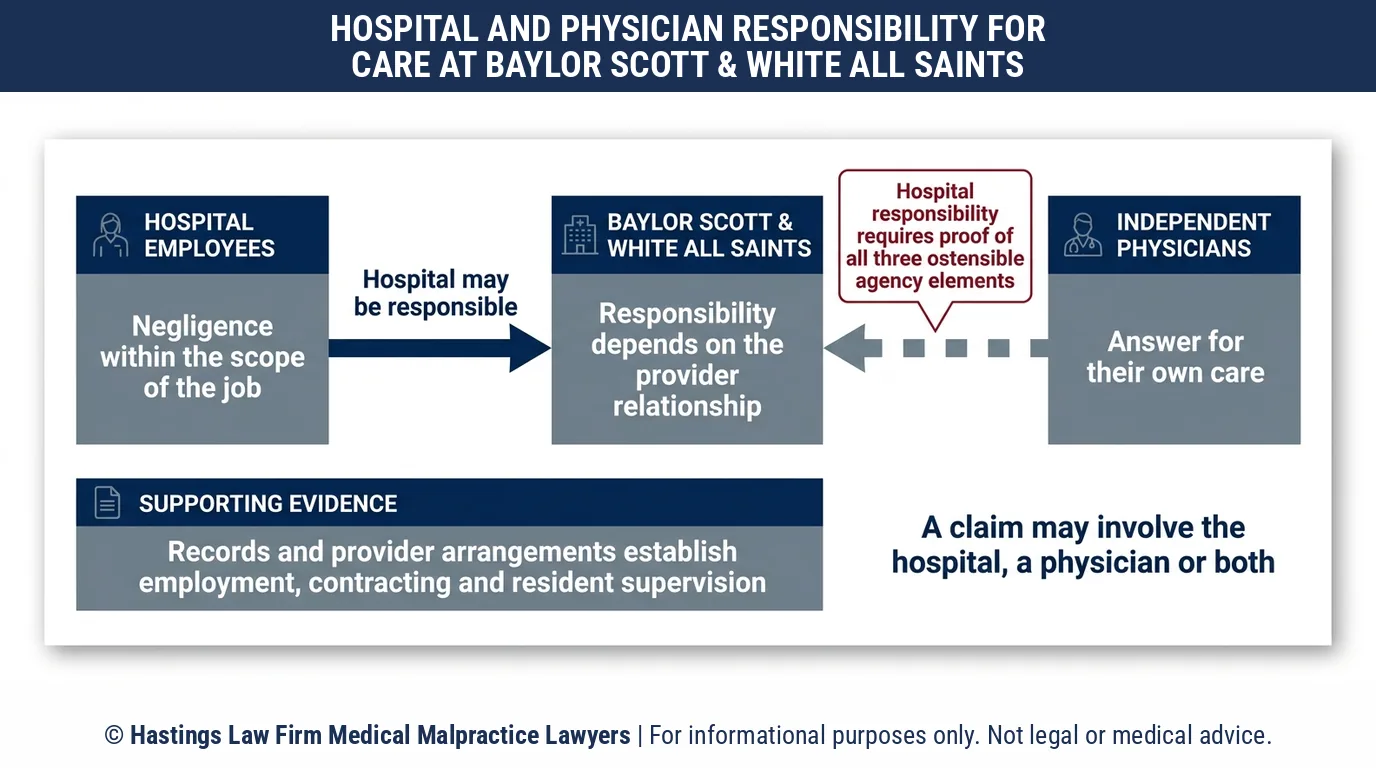
A patient harmed at Baylor Scott & White All Saints may have claims against the hospital, a physician, or both, depending on who employed each provider. Under Baptist Memorial Hospital System v. Sampson, a Texas hospital can be responsible for an employee’s negligence when the employee was acting within the scope of the job. Each physician also answers for their own care.
A family cannot tell from the bedside who employed or contracted each provider. That answer comes from the medical records and from the arrangements between the hospital, its physician groups, and its training program, including who supervised each resident. An independent physician’s negligence can be charged to a hospital under ostensible agency, but only on proof of all three elements Sampson sets out.
Anyone looking for a lawyer to sue a hospital should expect that question to come first. It decides who is named in a lawsuit against Baylor Scott & White All Saints. Texas then requires a qualified medical expert’s report on each of them by a firm deadline. Our Fort Worth hospital malpractice lawyers can explain how these rules apply to a particular course of care.
Medical care carries real risk, and a poor outcome does not by itself mean anyone was negligent. When an injury could have been prevented, the providers responsible should be held accountable.
What Happens if the Expert Report Is Late in a Lawsuit Against Baylor Scott & White All Saints in Texas?
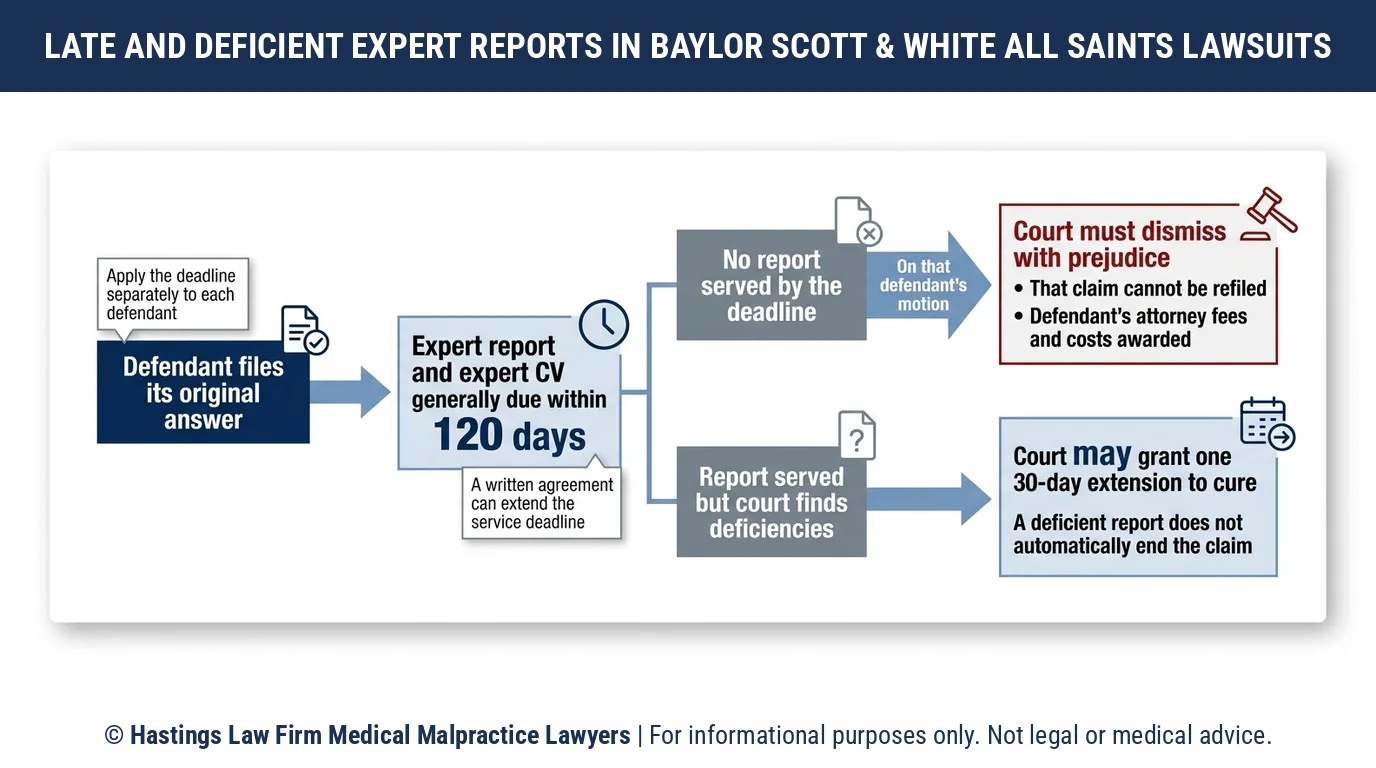
Under Section 74.351 of the Texas Civil Practice and Remedies Code, a late expert report can end a claim against Baylor Scott & White All Saints. The report and each expert’s CV are generally due 120 days after each defendant files its original answer. If none is served by then, the court must dismiss that claim with prejudice on the defendant’s motion and award its attorney’s fees and costs.
Dismissal with prejudice bars the patient from refiling that claim. The fee award means the patient’s side can end up paying the defendant’s attorney’s fees and court costs. A CV, or curriculum vitae, is the expert’s record of training and practice.
The deadline has some flexibility built in. The parties can extend the date for serving the report by written agreement. When a report was served but a court finds parts of it deficient, the court may grant one 30-day extension to cure the problem. A deficient report does not automatically end the case.
The defense faces a deadline of its own. Each defendant whose conduct a report implicates must object to its sufficiency within 21 days, counted from the later of the report’s service or that defendant’s answer. Objections not raised in that window are waived.
The report speaks to each defendant’s own care, so a claim naming the hospital and a physician needs a report that reaches each of them. Who is qualified to write it depends on the defendant and the issue under Sections 74.401 to 74.403. That is why our attorneys have the records reviewed by qualified medical experts before a suit is filed, so the report can be prepared well before the deadline.
How We Work With Injured Baylor Scott & White All Saints Patients and Their Families
Hastings Law Firm’s hospital malpractice lawyers work with Fort Worth, Texas, patients and families on negligence claims over care at Baylor Scott & White All Saints. The first call goes to a member of our intake team, and a relative can place it when the patient is unable to. Our team works to make sure you are heard from that first conversation.
Our team then requests the complete chart. Our attorneys and medical professionals review the labor and delivery records, fetal monitoring strips, and NICU records. They also read the emergency and trauma records, imaging, operative and anesthesia records, nursing notes, and discharge papers to establish what was done and when. If our hospital negligence lawyers accept the case, it is built on what those records show and on the physicians qualified to explain them.
From then on, we deal with the hospital, its insurer, and its lawyers for you. Our board-certified patient advocates stay in contact with you and explain each development in plain language as it happens. Our hospital malpractice attorneys push for a settlement that matches what the injury has taken from your family. When an offer falls below that, we are prepared to take your case to a jury.
If You or a Loved One Were Injured at Baylor Scott & White All Saints, Speak With Our Medical Attorneys Today
For patients and families harmed at Baylor Scott & White All Saints in Fort Worth, Texas, Hastings Law Firm’s hospital malpractice lawyers perform a free case review. That review looks at the care the patient received, identifies who may be responsible, and tells you whether you have a valid claim.
Our team is here for you. What you share with us stays confidential, and there is no fee unless we win. Let us help you find the answers you deserve.
Baylor Scott & White All Saints Malpractice FAQs


This content was researched and written by the Hastings Law Firm editorial team, which includes attorneys, medical professionals, and experienced researchers. Our writing is informed by internal knowledge and practical experience, and we cross-check critical details against authoritative sources cited throughout. Every piece undergoes human-led fact-checking and legal review. Because legal and medical information can change, if you spot an error, please contact us. Learn more about our content standards and review process on our editorial policy page.

Brady D. Williams is a nationally recognized medical malpractice attorney who has spent his career handling high-stakes litigation for injured patients and families across the country. Licensed in both Texas and California, Brady draws on experience from hundreds of resolved medical cases to break down complex legal and medical topics for the people who need that information most. His writing reflects the same attention to detail and commitment to clarity that he brings to every case he handles.
