


Austin Birth Injury Lawyer
Written by: Hastings Law Firm | Reviewed by: Tommy Hastings | Updated: May 6, 2026
Preventable harm during labor or delivery can leave families facing lifelong medical needs, financial strain, and uncertainty about what went wrong. Some outcomes are unavoidable, but others stem from missed warning signs, delayed intervention, or improper use of delivery tools. Understanding the difference between a birth injury tied to medical negligence and a birth defect that developed during pregnancy can shape what options exist. If your child suffered harm due to birth injuries from medical negligence in Austin, Texas, contact Hastings Law Firm for a free, confidential case review.

Trusted Legal Representation for Preventable Birth-Related Injuries
What You Should Know About Labor & Delivery Negligence Claims in Austin:
- Recovery options can turn on whether the harm is classified as a preventable birth injury rather than a birth defect that developed during pregnancy.
- Long term needs can be extensive when birth related trauma leads to permanent disabilities that require ongoing care and specialized equipment.
- Accountability can depend on whether fetal distress signals were monitored and acted on with appropriate urgency.
- Severe outcomes can follow when oxygen deprivation is not recognized or addressed during or around delivery.
- Lasting arm and shoulder impairment can result when excessive force is used during a difficult delivery.
- Compensation can be shaped by projected lifetime care needs, since future medical costs and support services can be central to valuation.
- Recovery can be limited for non economic harms in Texas, even when economic losses like medical bills and care costs remain fully claimable.
- Options can be lost if key deadlines are missed, since Texas rules can bar recovery when timing requirements are not met.
- Case strength can be affected when records become harder to obtain, since monitoring data and staffing logs may be purged or lost over time.
- Disputes often focus on causation, since hospitals may argue the outcome was unavoidable or due to a birth defect rather than negligent care.

A Healthcare Focused Law Firm
When your child has been harmed during labor or delivery, the weight of that experience can feel impossible to carry. You may be dealing with unexpected diagnoses, mounting medical bills, and a deep sense that something went wrong. These feelings are valid, and you deserve honest answers about what happened.
Founded by board-certified trial attorney Tommy Hastings, our firm focuses exclusively on medical malpractice. Our team includes experienced trial attorneys, former defense counsel, and in-house medical professionals who understand both the clinical and legal dimensions of birth injury cases. If your family is facing this situation, we are here to review what happened and explain your options in a free, confidential consultation.
Understanding the Distinction Between Birth Injuries and Birth Defects
A birth injury is preventable harm caused by medical negligence during labor or delivery, whereas a birth defect is a genetic or structural abnormality that formed during pregnancy. This distinction matters because it determines whether a legal claim exists.
For many parents, separating these two categories is one of the hardest parts of the process. You may have been told that your child’s condition was “unavoidable” or “just one of those things.” Sometimes that is true. But in other cases, what gets labeled as an unavoidable complication was actually the result of a preventable medical error. According to research published by the National Library of Medicine on Medical Error Reduction and Prevention, medical errors remain a significant and often underreported cause of patient harm.
As an Austin birth injury attorney, our job is to investigate that question. In legal terms, this comes down to causation, which means proving that a specific action or failure by a medical provider directly caused your child’s injury. A birth injury law firm with medical professionals on staff can analyze records, timelines, and clinical decisions to determine whether the harm was preventable.
Distinguishing between a birth injury, a preventable harm caused by provider negligence, and a birth defect, a genetic or developmental abnormality unrelated to delivery, is the first step in seeking recovery. We meticulously review medical history to identify preventable injuries that hospitals may try to categorize as natural defects.
| Feature | Birth Injury (Preventable) | Birth Defect (Genetic/Developmental) |
|---|---|---|
| Cause | Medical error during labor or delivery | Genetic, chromosomal, or environmental factors during pregnancy |
| Timing | Occurs during or immediately surrounding birth | Develops during fetal growth |
| Preventability | Could have been avoided with proper medical care | Generally not preventable through delivery-room decisions |
| Legal Action | May support a malpractice claim if negligence is proven | Typically not actionable unless linked to a provider’s failure |

Severe Conditions Caused by Birth Trauma and Medical Errors
Common conditions resulting from birth trauma include Cerebral Palsy caused by oxygen deprivation, Erb’s Palsy from shoulder dystocia, and various forms of intracranial hemorrhaging. Some of these injuries are temporary, healing with time and minor intervention. Others result in permanent disabilities that will shape a child’s entire life, requiring around-the-clock care and specialized equipment.
These medical conditions often require significant legal investigation to determine if healthcare providers followed the proper standard of care. While some trauma is immediately visible, other symptoms may not appear until the child begins to miss developmental milestones.
One of the most concerning outcomes is intracranial hemorrhage, bleeding within the skull that can cause pressure on the brain tissue. This can occur due to the rupture of blood vessels during a difficult delivery, often involving the use of mechanical instruments. Subarachnoid hemorrhages and cephalohematomas are variations that parents may encounter in medical reports.
The long-term impact of these bleeds varies; some resolve without issue, while others lead to cognitive deficits or seizure disorders. An Austin malpractice attorney can help families understand if these injuries were the result of excessive force or improper technique.
Cerebral Palsy and Oxygen Deprivation
Cerebral Palsy is one of the most serious outcomes linked to birth-related medical errors. It often develops after a child experiences Hypoxic Ischemic Encephalopathy (HIE), a condition where the brain does not receive enough oxygen during or around the time of delivery. This oxygen deprivation, sometimes called fetal hypoxia, can occur when signs of fetal distress go unrecognized or unaddressed.
Perinatal asphyxia, a broader term for oxygen deprivation occurring near the time of birth, can cause lasting brain damage depending on how long the brain went without adequate blood flow. In some cases, medical teams may miss or delay responding to warning signs on the fetal heart rate monitor. In others, an emergency C-section may not be performed quickly enough to prevent injury.
A birth injury lawyer in Austin can work with medical experts to review fetal monitoring strips and delivery records to determine whether earlier intervention could have changed the outcome. The consequences of HIE can include:
- Impaired motor function and muscle coordination
- Cognitive and developmental delays
- Seizure disorders
- Difficulty with speech, vision, or hearing
- Need for lifelong assistive care
Erb’s Palsy and Brachial Plexus Injuries
Erb’s Palsy results from damage to the brachial plexus, the network of nerves running from the neck through the shoulder and into the arm. This type of injury most commonly occurs during shoulder dystocia, a delivery complication where the baby’s shoulder becomes lodged behind the mother’s pelvic bone.
When a provider applies excessive force, whether manually or with tools like a vacuum extractor or forceps delivery, the nerves in the brachial plexus can stretch, tear, or detach entirely. Mild cases may heal over time with physical therapy. Severe cases can result in permanent loss of movement, sensation, or function in the affected arm.
Shoulder injuries, skull fractures (breaks in the bones of the infant’s skull typically caused by pressure or instrument use), and spinal cord injuries can also result from traumatic deliveries. An Austin malpractice attorney experienced in these cases will examine the delivery notes, instrument logs, and provider decision-making to evaluate whether the standard of care was met.
The Hastings Law Firm Difference
Results matter, but what truly sets us apart is how we achieve them. Every verdict, every settlement, and every Austin courtroom victory comes from one guiding promise: To treat each client’s fight for justice as if it were our own.
This balance of skill, experience, and empathy reflects our core philosophy that justice should not only compensate the injured, but also make healthcare safer nationwide.

Identifying Medical Negligence in Labor and Delivery
Negligence in labor and delivery often involves the failure to monitor fetal distress signals, delayed performance of C-sections, or improper use of extraction tools like forceps. Identifying where things went wrong requires a detailed review of what happened, when, and what the medical team should have done differently.
The standard of care in a delivery room refers to the level of skill and attention that a reasonably competent medical provider would exercise under similar circumstances. This standard is not aspirational; it reflects the minimum baseline of acceptable medical practice. When a provider falls below that baseline, and a child is injured as a result, a birth injury claim may exist. A deviation from this standard constitutes a breach of duty, a core component of any malpractice case.
One common failure involves what is sometimes called a “failure to rescue.” Electronic fetal monitoring (EFM), a technology that continuously tracks the baby’s heart rate during labor, can reveal early signs of fetal distress. Fetal distress, a physiological state indicating the fetus is compromised or oxygen-deprived, requires immediate attention.
According to clinical practice guidelines published by the American College of Obstetricians and Gynecologists through Washington University in St. Louis, proper interpretation and response to fetal heart rate patterns is a core component of intrapartum care. When concerning patterns appear and the medical team does not respond with appropriate urgency, such as ordering an emergency C-section, the delay can lead to oxygen deprivation and lasting harm.
Medication errors can also contribute to birth injuries. Pitocin, a drug used to induce or strengthen contractions, can cause dangerously intense uterine activity known as tachysystole if administered improperly. This can reduce blood flow to the baby, leading to distress.
Umbilical cord complications, including compression or prolapse, also require immediate recognition and intervention. A medical malpractice lawyer will examine every decision point in the delivery timeline to evaluate whether the care provided met the accepted standard or if negligence occurred.
Proving Liability and The Role of Expert Witnesses
Proving liability requires demonstrating that a physician owed a duty of care, breached that duty through action or inaction, and directly caused the infant’s injury as a result. These four legal elements, known as duty, breach, causation, and damages, form the foundation of every medical negligence case. Our firm has specialized in medical malpractice for over 20 years, bringing a deep understanding of complex clinical evidence to every case.
In Texas, the law sets a high bar for these claims. Under the Texas Civil Practice and Remedies Code Section 74.351, a plaintiff must serve a qualified expert report within 120 days after the filing of each defendant’s original answer. This report must be authored by a medical professional with relevant experience and must outline how the standard of care was violated and how that violation caused the injury.
This is one reason our team at Hastings Law Firm prepares every case as though it will go to trial from the very first day. Our approach to proving birth injury liability follows a clear path:
- Investigation: We obtain and review all medical records, fetal monitoring strips, nursing logs, and hospital protocols.
- Expert Review: We work with qualified medical experts from across the country to evaluate whether the care met the standard. Because local physicians are sometimes reluctant to testify against colleagues in their own community, our national expert network provides independent, objective analysis.
- Filing: We prepare and file the lawsuit along with the required expert report within the statutory deadline.
- Discovery: We conduct depositions, request internal hospital records, and build a detailed timeline of every clinical decision.
As Austin birth injury counsel, our legal team includes former defense attorneys who understand how hospitals and insurers build their case. That experience allows us to anticipate opposing arguments and prepare a stronger response. This trial-ready posture often leads to more favorable settlement discussions because the other side knows we are prepared to present the evidence to a jury.

Recovering Compensation for Lifetime Care Costs
Recoverable compensation includes economic damages for past and future medical bills, lifetime care costs, and therapy, as well as non-economic damages for pain, suffering, and physical impairment. In birth injury cases, the financial scope of a child’s future needs can be enormous, and any settlement or verdict must account for decades of care.
One of the most important tools in seeking compensation for birth injury is a Life Care Plan. This is a detailed, professionally prepared projection of everything a child will need over the course of their lifetime. It is not just about medical bills; it covers the holistic needs of the child to ensure they have the highest possible quality of life. It may include:
- Ongoing medical treatment and specialist visits
- Physical, occupational, and speech therapy
- Medications and medical equipment such as wheelchairs or braces
- Home modifications for accessibility, such as ramps and widened doorways
- In-home nursing care or assisted living support
- Educational accommodations and vocational support
- Transportation needs related to the disability, including modified vehicles
These costs can reach into the millions of dollars over 50 or more years. Economic damages cover all of these quantifiable expenses, and there is no cap on economic damages in Texas. This category often represents the largest portion of a birth injury settlement.
Non-economic damages address the human cost of the injury: the child’s physical pain, mental anguish, disfigurement, and the loss of the ability to enjoy life as they otherwise would have. Parents may also seek compensation for the emotional toll of caring for a child with severe disabilities, including the impact on family life, relationships, and mental health.
During settlement negotiations, insurance carriers may try to minimize these projections. Our team works closely with life care planners, economists, and medical experts to present a thorough, evidence-based picture of what your child’s future truly requires.
Filing a Birth Injury Lawsuit in Texas
In Texas, the statute of limitations generally allows parents two years to file a claim, but minors typically have until age 14 to file on their own behalf regarding specific claims. This means the timeline works differently depending on who is bringing the claim. Texas law typically allows a minor child to file certain claims on their own behalf until the age of 14, though this tolling provision, which pauses the limitations clock, applies specifically to the child’s claims, not the parents’.
This distinction between the parents’ claim and the child’s claim is significant. Parents may seek recovery for medical expenses they have already incurred, while the child’s claim covers their own pain, suffering, and future care needs. The deadlines for each can differ, and missing either one can permanently bar recovery.
Texas medical malpractice laws also impose procedural requirements under Chapter 74 of the Civil Practice and Remedies Code. A qualified expert report must be served within 120 days after the filing of each defendant’s original answer. Meeting this deadline requires early preparation, which is why filing a birth injury lawsuit should begin with a prompt investigation. While the law may allow a statute of limitations tolling for a child, waiting is rarely advisable because evidence degrades over time.
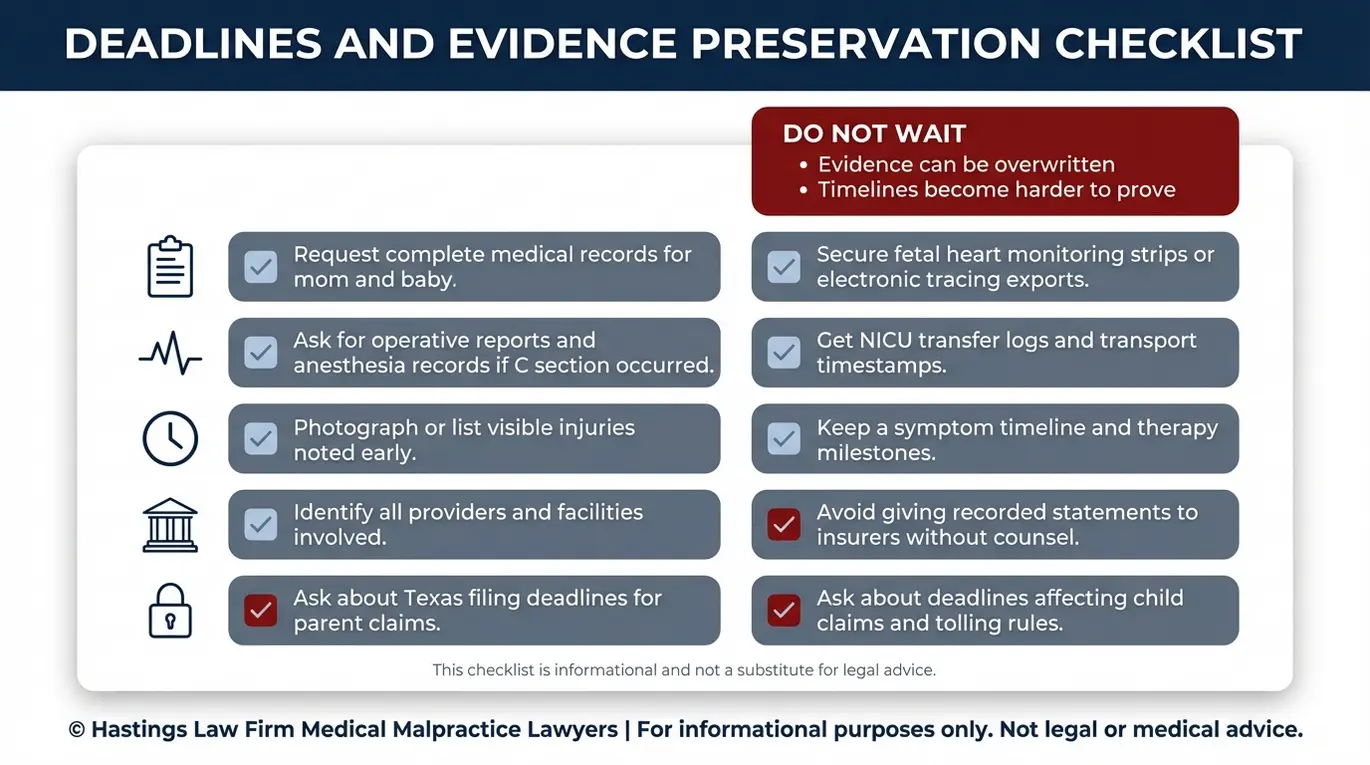
⚠️ Important: Do not wait to seek legal guidance. * Medical records can be archived or become difficult to retrieve. * Electronic fetal monitoring data may be purged from hospital systems. * Staffing logs can be lost, making it hard to identify witnesses. * Memories fade, and key medical personnel may move or retire.
Acting quickly also allows your legal team to identify and retain the right medical experts before critical details fade. If you are considering a claim under Texas birth injury laws, speaking with an attorney early gives you the best chance of protecting your child’s rights and your family’s future.
Contact the Austin Birth Injury Attorneys at Hastings Law Firm Today for Help
At Hastings Law Firm, our mission is to enforce accountability and restore trust for families who have been failed by the medical system. Every consultation begins with a review led by our team of attorneys, nurse consultants, and patient advocates who understand the medicine behind your case, not just the law.
We handle birth injury cases on a contingency fee basis, which means you pay no attorney fees or costs unless we recover compensation for your family. The initial evaluation is free and confidential.
If your child was harmed during labor or delivery and you believe medical negligence may be involved, we encourage you to take the first step. Contact Hastings Law Firm today to schedule a confidential consultation with our specialized team. Let us help you find the answers you deserve and begin securing your child’s future.
Frequently Asked Questions About Birth Injury in Austin

Key Birth Injury Terms:
- Birth injury
- A birth injury is physical harm or trauma that occurs to a baby during labor and delivery, often as a result of medical errors, improper use of delivery tools, or delayed response to complications. Unlike birth defects, which are genetic or developmental conditions present before labor, birth injuries are typically preventable and may be caused by negligence. Examples include nerve damage, brain injury from oxygen deprivation, or broken bones during a difficult delivery.
- Birth defect
- A birth defect is a structural or functional abnormality present in a baby at birth that develops during pregnancy due to genetic factors, environmental exposures, or unknown causes. Birth defects are typically not caused by actions taken during labor and delivery, which distinguishes them from birth injuries. In medical malpractice cases, it is crucial to determine whether a child’s condition was an unavoidable birth defect or a preventable birth injury caused by medical error.
- Intracranial hemorrhage
- Intracranial hemorrhage is bleeding that occurs inside the skull or brain tissue, often caused by excessive pressure on the baby’s head during a difficult delivery, improper use of forceps or vacuum extractors, or trauma during birth. This type of bleeding can lead to permanent brain damage, developmental delays, seizures, or cerebral palsy. In a birth injury case, proving that the hemorrhage resulted from medical negligence rather than an unavoidable complication is essential to establishing liability.
- Skull fracture
- A skull fracture is a break or crack in one or more of the bones of the baby’s skull, typically caused by excessive force during delivery, improper use of forceps or vacuum devices, or traumatic handling. While some skull fractures may heal without complications, others can lead to brain damage, bleeding, or long-term neurological problems. In medical malpractice claims, a skull fracture may indicate that the delivery was managed improperly or that excessive force was used.
- Oxygen deprivation (fetal hypoxia)
- Oxygen deprivation, also called fetal hypoxia, occurs when a baby does not receive adequate oxygen before or during birth. This can result from umbilical cord problems, placental issues, prolonged labor, or failure to perform a timely cesarean section when the baby is in distress. Even brief periods of oxygen deprivation can cause permanent brain damage, developmental delays, or cerebral palsy. In malpractice cases, proving that medical staff failed to recognize or respond to signs of oxygen deprivation is key to establishing negligence.
- Perinatal asphyxia
- Perinatal asphyxia is a serious condition in which a baby experiences a lack of oxygen and blood flow to the brain and other vital organs shortly before, during, or immediately after birth. It can result from complications such as umbilical cord compression, placental abruption, or delayed emergency intervention. Perinatal asphyxia can cause brain damage, seizures, organ failure, and conditions like cerebral palsy. In birth injury lawsuits, demonstrating that medical providers failed to prevent or promptly treat asphyxia is critical to proving liability.
- Shoulder dystocia
- Shoulder dystocia is a birth complication that occurs when a baby’s shoulder becomes stuck behind the mother’s pelvic bone during delivery, preventing the baby from being born. This emergency requires immediate and skilled intervention to avoid serious injury to the baby, including nerve damage, broken bones, or oxygen deprivation. If medical staff fail to recognize risk factors, respond promptly, or use improper techniques to free the baby, it may constitute medical negligence and lead to permanent injuries such as Erb’s palsy.
- Brachial plexus injury
- A brachial plexus injury is damage to the network of nerves that runs from the spine through the neck and into the arm, controlling movement and sensation in the shoulder, arm, and hand. In newborns, this injury often occurs when excessive force is applied to the baby’s head or neck during a difficult delivery, particularly in cases of shoulder dystocia. Brachial plexus injuries can range from temporary weakness to permanent paralysis of the arm. In medical malpractice cases, these injuries may indicate improper delivery techniques or failure to perform a timely cesarean section.
- Electronic fetal monitoring (EFM)
- Electronic fetal monitoring (EFM) is a method used during labor to continuously track the baby’s heart rate and the mother’s contractions, helping medical staff identify signs of fetal distress. The monitor produces a printout called a fetal monitoring strip that provides a real-time record of the baby’s condition. In medical malpractice cases, these strips are critical evidence. If medical staff fail to recognize warning signs on the monitor or delay necessary interventions like an emergency cesarean section, it may constitute negligence that led to a birth injury.
- Fetal distress
- Fetal distress refers to signs that a baby is not tolerating labor well and may not be receiving enough oxygen, typically indicated by abnormal heart rate patterns on electronic fetal monitoring. Warning signs include a slow, fast, or irregular heartbeat, or a lack of variability in the heart rate. Fetal distress is a medical emergency that often requires immediate intervention, such as repositioning the mother, providing oxygen, stopping labor-inducing medications, or performing an emergency cesarean section. In malpractice cases, failure to recognize or respond to fetal distress can be evidence of negligence.
- Medical Error Reduction and Prevention | PubMed
- Intrapartum Fetal Heart Rate Monitoring | Washington University in St Louis
- Texas Civil Practice and Remedies Code Section 74.351 | Texas Legislature Online
- Texas Maternal Mortality and Morbidity Review Committee and Department of State Health Services Joint Biennial Report 2024 | Texas Department of State Health Services
Get Answers Today
If you think that medical negligence, a dangerous drug, or a failed medical product caused harm to you or someone you love, our team is standing by to offer guidance. We’ll explain your options under current laws and help you move forward with clarity and understanding. Case reviews are free and 100% confidential.
