


Austin Forcep & Vacuum Birth Injury Lawyer
Forceps and vacuum extractors can be appropriate tools during a difficult vaginal delivery, but improper use can cause serious harm to a baby or a mother. Concerns often involve whether the device was placed correctly, whether excessive force was used, and whether the care team delayed switching to a cesarean section when an assisted delivery was failing. These events can leave families facing long term medical needs, emotional strain, and uncertainty about what happened. If your child suffered harm due to forceps or vacuum birth injury in Austin, Texas, contact Hastings Law Firm for a free, confidential case review.

Last Updated: July 27, 2026
Trusted Medical Attorneys in Austin for Labor and Delivery Instrument Injuries
When your child is injured during delivery by obstetric forceps, the curved metal instruments designed to guide a baby through the birth canal, or by a vacuum extractor, the emotional weight can be overwhelming. You may be searching for answers about what went wrong and whether the care your family received met acceptable medical standards.
An experienced Austin Forcep & Vacuum Birth Injury Lawyer can help you understand what happened and whether the injuries your child suffered were preventable. At Hastings Law Firm, our team of attorneys, in-house nurse consultants, and medical experts focuses exclusively on medical malpractice cases. If your family has been affected, we can review the details of your delivery and explain your legal options at no cost and no obligation.

Understanding Forceps and Vacuum Extractors in Texas Deliveries
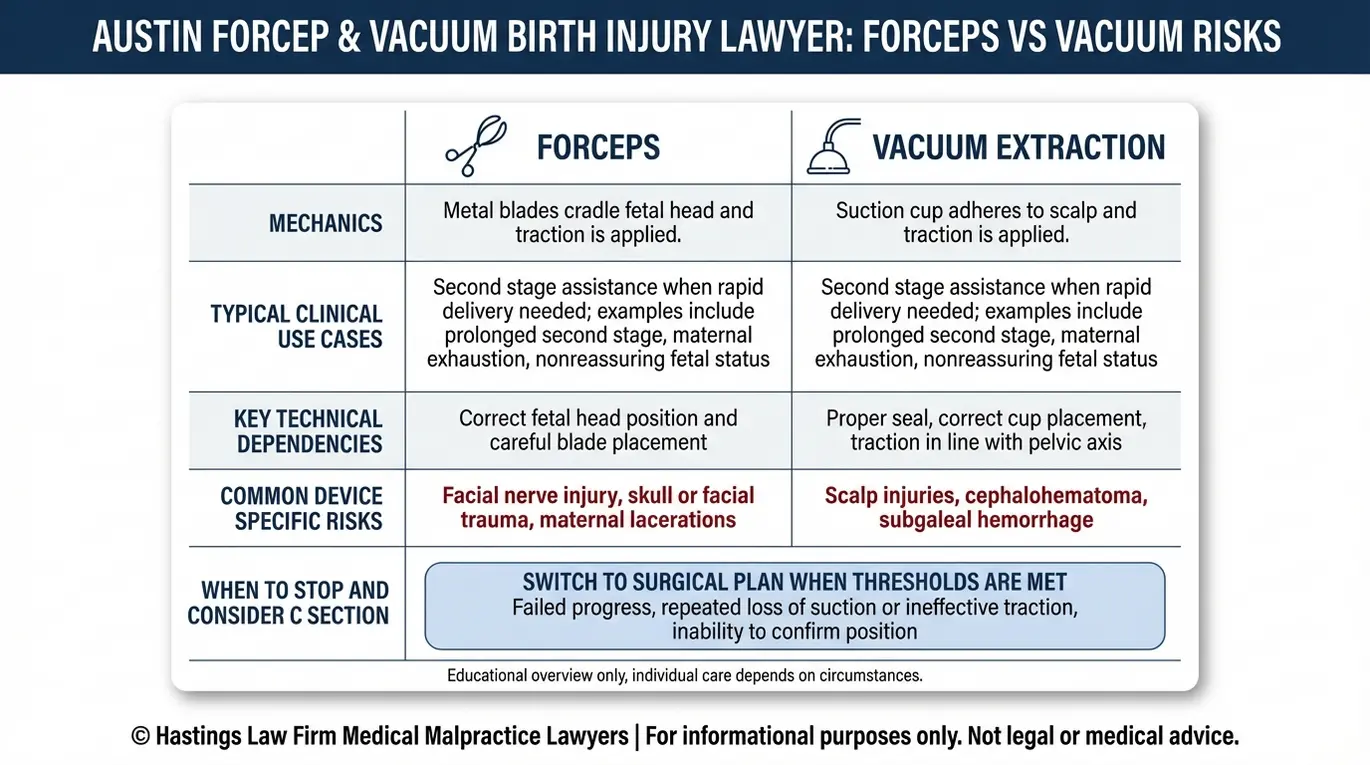
Forceps and vacuum extractors are operative obstetrical tools used to assist vaginal delivery during the second stage of labor, typically when the mother is exhausted or the baby shows signs of fetal distress. Both instruments fall under the category of operative vaginal delivery (OVD), a term that refers to any birth requiring a physician to use tools to help move the baby through the birth canal.
Forceps are two curved metal blades, similar in shape to large tongs, that a physician places on either side of the baby’s head. The doctor uses them to guide the baby’s head downward and outward during contractions. Proper placement requires training and precision because the blades must be positioned symmetrically around the baby’s skull to avoid causing compression injuries.
Vacuum extraction, also known as ventouse delivery, works differently. The physician attaches a soft or rigid suction cup to the top of the baby’s scalp. During contractions, the doctor applies traction through the cup to help ease the baby out. According to the Vanderbilt University Medical Center, both instruments have specific clinical indications and require careful patient selection to reduce the risk of injury.
| Feature | Forceps | Vacuum Extractor |
|---|---|---|
| Mechanism | Metal blades grip sides of the baby’s head | Suction cup attaches to the baby’s scalp |
| Typical Use | Guided rotation and downward traction | Traction applied during contractions |
| Key Risks to Infant | Skull fractures, facial nerve injury, bruising | Cephalohematoma, subgaleal hemorrhage, scalp lacerations |
| Key Risks to Mother | Higher risk of vaginal and rectal tears, pelvic floor damage | Generally lower maternal tissue injury |
| Operator Skill Level | Requires significant hands-on training | Somewhat easier to apply but carries its own risks |
Medical professionals may consider assisted delivery when labor has stalled, the mother cannot push effectively, or when fetal heart rate tracings suggest the baby needs to be delivered quickly. These are legitimate clinical reasons. The concern arises when instruments are used improperly or when the physician continues using them beyond what is medically safe.
Alternatives to Instrumental Delivery Methods
When an attempted forceps or vacuum delivery is not progressing, the standard of care typically requires the physician to move to a cesarean section (C-section). This surgical procedure involves delivering the baby through incisions in the mother’s abdomen and uterus.
Continuing to pull or reapply instruments in the face of clear resistance or signs of fetal compromise can put both the baby and the mother at serious risk. The decision to abandon an instrumental delivery and proceed with a C-section is time-sensitive. Delays in making that transition are a frequent focus in birth injury investigations.
Common Injuries Caused by Negligent Forceps and Vacuum Use
Improper use of extraction tools can cause severe infant trauma, including skull fractures, cephalohematoma, brachial plexus injuries, intracranial hemorrhage, and permanent brain damage that may lead to cerebral palsy. These are not abstract risks but real dangers. They are documented outcomes that occur when instruments are misapplied, used with excessive force, or used for too long.
Research published in Wiley Online Library has documented the range of severe neonatal birth injuries associated with operative vaginal deliveries. The following list details the specific types of physical harm that can occur:
Injuries to the Infant:
- Brachial plexus injuries (including Erb’s Palsy): Damage to the network of nerves controlling the shoulder, arm, and hand. This can result in partial or total paralysis of the affected limb and may require surgery or long-term rehabilitation.
- Skull fractures: Excessive compression from forceps can fracture the infant’s skull, which is still soft and developing at birth.
- Intracranial hemorrhage: Bleeding inside the skull, which can cause lasting brain damage depending on the severity and location.
- Subgaleal hemorrhage: Subgaleal hemorrhage, a dangerous condition where blood collects between the skull’s periosteum and the scalp’s connective tissue, can become life-threatening because the space can hold a significant volume of blood.
- Facial nerve palsy: Pressure from forceps on the facial nerve can cause temporary or permanent weakness on one side of the baby’s face.
- Cerebral palsy: When oxygen deprivation (hypoxia) or direct trauma during delivery damages the developing brain, the result can be cerebral palsy, a group of disorders affecting movement, muscle tone, and coordination for life.
- Spinal cord injuries: Excessive traction or rotational force during extraction can injure the spinal cord, potentially causing permanent motor deficits.
Injuries to the Mother:
- Third- or fourth-degree perineal tears: Third- or fourth-degree perineal tears, severe lacerations that extend through the anal sphincter and into the rectal lining, can cause chronic pain, incontinence, and may require surgical repair.
- Vaginal and cervical lacerations: Tearing of the vaginal walls or cervix caused by the instrument or by the force of the extraction itself.
- Uterine rupture: A rare but catastrophic event where the wall of the uterus tears, which can be life-threatening for both the mother and infant.
- Pelvic organ prolapse: Damage to the pelvic floor muscles and ligaments during a difficult extraction can lead to the bladder, uterus, or rectum dropping from their normal positions.
The immediate physical trauma from a forceps or vacuum injury can be devastating. But the long-term consequences are often what define the family’s future. A child who suffers brain damage at birth may require decades of medical treatment, therapy, adaptive equipment, and specialized education. A vacuum extraction injury attorney can help families understand the full scope of what they are facing and pursue compensation for current and future needs.
The Hastings Law Firm Difference
Results matter, but what truly sets us apart is how we achieve them. Every verdict, every settlement, and every Austin courtroom victory comes from one guiding promise: To treat each client’s fight for justice as if it were our own.
This balance of skill, experience, and empathy reflects our core philosophy that justice should not only compensate the injured, but also make health care safer nationwide.

Identifying Medical Malpractice in Assisted Births
Malpractice occurs when a physician deviates from the standard of care, such as applying excessive force, placing the device incorrectly, or failing to move to a C-section after failed attempts. Not every difficult delivery with a poor outcome is malpractice. When the physician’s actions fall below what a reasonably skilled obstetrician would have done under the same circumstances, that indicates medical negligence.
Our team, which includes former defense attorneys and in-house nurse consultants, examines every detail of the delivery to identify where the standard of care may have been violated. This insider perspective helps us anticipate defense tactics and identify charting inconsistencies. We meticulously analyze the medical records to determine if the physician adhered to safety protocols.
Our process helps identify subtle signs of distress that are often overlooked during the chaos of a difficult labor. We look for the following red flags during our investigation:
Red Flags of Negligence in Assisted Deliveries:
- The vacuum cup detached from the baby’s scalp multiple times. This is known as a vacuum “pop-off,” which is the cup losing its seal and coming free during traction. Multiple pop-offs, particularly three or more, often signal that the extraction is not going to succeed and should be abandoned.
- Forceps were applied asymmetrically or to the wrong part of the skull, such as across the face rather than the parietal bones.
- The physician continued pulling despite a nonreassuring fetal heart rate (NRFHR). This is a pattern on the monitor that suggests the baby is not tolerating the stress of labor or extraction. Ignoring these distress signals is a critical failure.
- No backup plan for a C-section was in place before the extraction was attempted, delaying necessary intervention.
- The operative delivery was performed by an inexperienced resident without adequate attending supervision, which can lead to technical errors.
- The physician used both forceps and vacuum sequentially, which significantly increases the risk of injury.
- There was no documented informed consent discussion about the risks of the procedure. Informed consent means your doctor explained the risks and you agreed to the treatment.
A medical malpractice lawyer in Austin will evaluate the delivery records, fetal monitoring strips, and nursing notes to build a timeline. The key question is always whether the physician should have recognized the signs of trouble and changed course sooner. In many cases we investigate, the decision to persist with an instrument-assisted delivery, rather than proceeding to a safer cesarean delivery, is the central failure.
The distinction between a complication and negligence often comes down to timing, technique, and judgment. Our job is to determine which one applies based on the medical evidence.
We will investigate whether the medical team failed to react to the changing conditions of the labor, resulting in preventable harm. Our nurse consultants review thousands of pages of medical records to find the specific moments where the care team failed your family.
This detailed analysis allows us to build a case on your behalf. We focus on uncovering the facts to provide your family with the clarity you need during this difficult time.
Proving Fault and Liability in Austin Birth Injury Cases
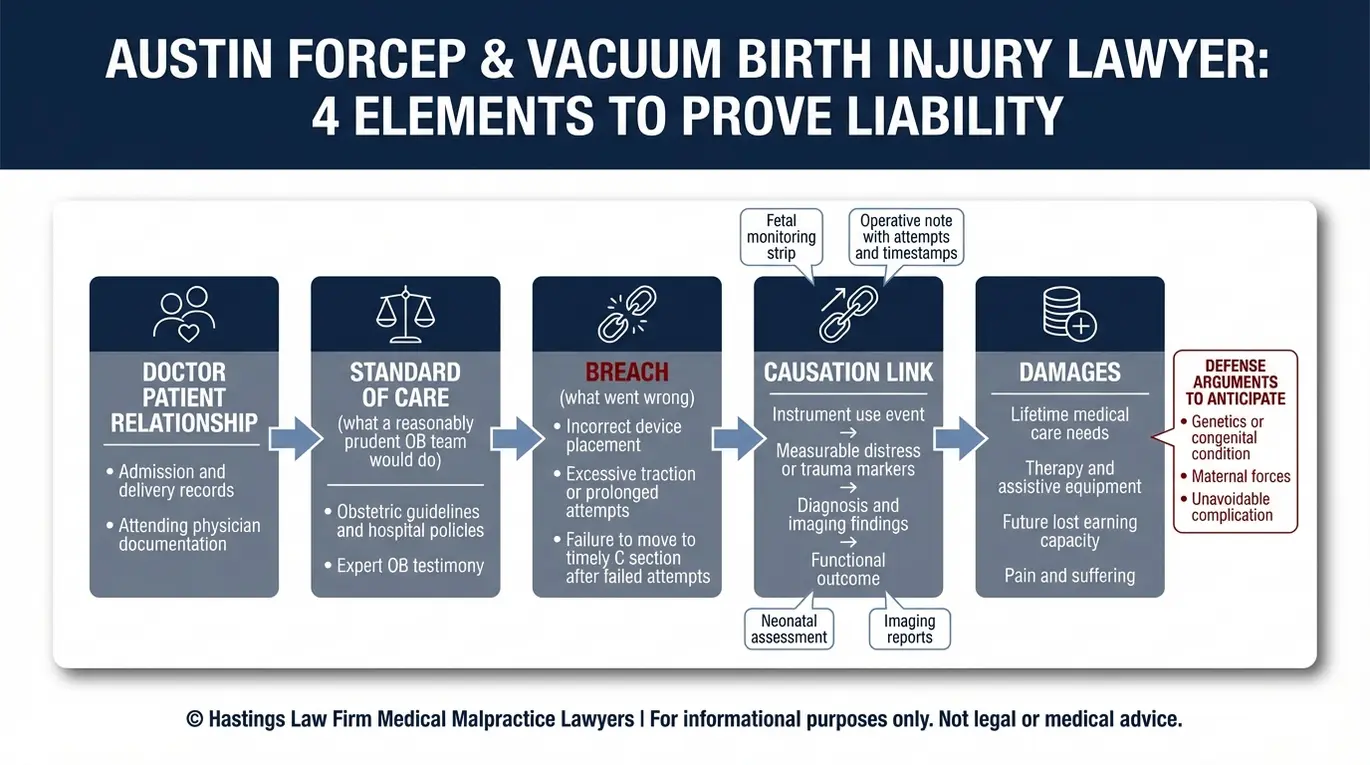
Proving fault in birth injury cases requires establishing four elements: a doctor-patient relationship existed, the physician breached the standard of care, the breach caused the injury, and specific damages resulted from that injury. Each element must be supported by credible evidence, and in birth injury cases, that evidence is heavily medical.
Here is how we approach each step:
Step 1: Establish the Doctor-Patient Relationship This is usually the most straightforward element. If a physician delivered the baby or managed the labor, a legal duty of care existed. Hospital records and admission documentation confirm this relationship.
Step 2: Identify the Breach of the Standard of Care This is the core of any medical malpractice case. We work with qualified obstetric experts to review the delivery records and determine whether the treating physician’s actions met the level of care a reasonably competent obstetrician would have provided under the same circumstances. The electronic fetal monitoring (EFM) strip, the continuous recording of the baby’s heart rate and the mother’s contractions throughout labor, is one of the most important pieces of evidence. EFM is designed to detect signs of fetal distress in real time, meaning the care team should be interpreting and responding to those tracings throughout labor.
Step 3: Prove Causation Proving that the breach of duty actually caused the injury is often the most contested element. Defense experts may argue that the injury was caused by genetic conditions, maternal anatomy, or the natural forces of labor rather than anything the physician did. We counter this by analyzing umbilical cord blood gas results. These are measurements of the arterial pH and base deficit in the baby’s cord blood that indicate whether the baby was deprived of oxygen around the time of delivery. We also rely on the testimony of highly qualified medical professionals who can authoritatively refute these defenses and explain to a judge or jury exactly how the physician’s negligence directly led to the child’s injuries.
Step 4: Document the Damages The final element requires proving that the child and family suffered specific, measurable harm.
Hospital liability can also be part of the case. If the facility allowed an underqualified provider to perform a high-risk extraction or failed to maintain adequate staffing, the institution itself may bear responsibility through what is known as corporate negligence. An Austin forcep and vacuum birth injury lawyer will evaluate whether the hospital’s systemic failures contributed to the outcome. We look for evidence of inadequate policies, failure to credential staff properly, or insufficient resources that endangered patient safety.
Calculating Damages for Traumatic Birth Injuries
Compensation in birth injury cases covers economic damages like lifetime medical care and lost earning capacity, as well as non-economic damages for physical pain, mental anguish, and disfigurement. Because many of these injuries affect a child for their entire life, the financial projections in these cases can be substantial.
Economic Damages
Economic damages are the measurable financial losses caused by the injury. In a birth injury case, these often include:
- Past and future medical expenses (surgeries, hospital stays, medications, therapy)
- Rehabilitation and physical, occupational, or speech therapy costs
- Adaptive equipment such as wheelchairs, communication devices, and home modifications
- Lost earning capacity if the child’s disabilities prevent them from working as an adult
- Special education costs and in-home care needs
To project these expenses accurately, our team works with life care planners and economists who develop detailed forecasts covering 50 or more years of anticipated needs. These life care plans become critical evidence in establishing the true cost of the injury. Thorough documentation of lifetime care costs is therefore essential in birth injury compensation cases.
Non-Economic Damages
Non-economic damages compensate for losses that do not have a specific dollar amount attached to them, such as pain and suffering, mental anguish, physical impairment, and loss of enjoyment of life.
Under the Texas Civil Practice and Remedies Code § 74.301, non-economic damages in medical liability cases are capped. Currently, the cap is $250,000 per claimant against all physicians or individual healthcare providers and up to $500,000 total against hospital or institutional defendants. These caps do not apply to economic damages.
| Type of Damage | Category | Examples |
|---|---|---|
| Medical expenses (past and future) | Economic | Surgeries, therapy, medications, hospitalizations |
| Lost earning capacity | Economic | Projected lifetime income the child cannot earn |
| Adaptive equipment and home modifications | Economic | Wheelchairs, ramps, specialized vehicles |
| In-home care and attendant services | Economic | Full-time or part-time caregivers |
| Pain and suffering | Non-Economic | Physical pain from the injury and ongoing treatment |
| Mental anguish | Non-Economic | Emotional distress experienced by the child and parents |
| Physical impairment and disfigurement | Non-Economic | Loss of bodily function, visible scarring |
| Punitive damages (rare) | Punitive | Awarded only in cases involving gross negligence or willful misconduct |
Punitive damages are uncommon in medical malpractice cases but may apply if evidence shows the provider’s conduct went beyond ordinary negligence into willful or grossly negligent behavior. An Austin forcep and vacuum birth injury lawyer can evaluate which categories of damages apply to your family’s situation.
Navigating Federal Tort Claims for Military Families
Families injured at military hospitals like Brooke Army Medical Center must file claims under the Federal Tort Claims Act (FTCA), which involves strict federal administrative rules different from state court. Austin’s proximity to military installations means many military families deliver at government-run facilities.
Before a military birth injury lawsuit can be filed in federal court, the family must first exhaust the administrative claims process. This means filing a Standard Form 95 (SF-95) with the appropriate federal agency, typically the Department of Defense. According to 28 U.S.C. § 2675, this administrative filing is mandatory. No lawsuit can proceed in federal court until the agency has either denied the claim or failed to respond within six months.
There are several important differences between FTCA cases and standard Texas malpractice cases:
- There is no jury trial in an FTCA case. A federal judge decides both liability and damages.
- The statute of limitations is generally two years from the date of the injury, and there is less flexibility for extensions than in some state court scenarios.
- Damage caps may differ from Texas state law, depending on which state’s substantive law applies.
The U.S. Department of Veterans Affairs provides an overview of how FTCA claims are processed at the agency level.
Hastings Law Firm has the national reach and federal litigation experience to handle these cases. Our firm works with families across the country to manage complex procedural requirements that make federal claims different from state filings. If your child was injured during delivery at a military hospital, a military birth injury lawyer at our firm can walk you through the process and help protect your family’s rights.
Texas Statute of Limitations for Birth Trauma Claims
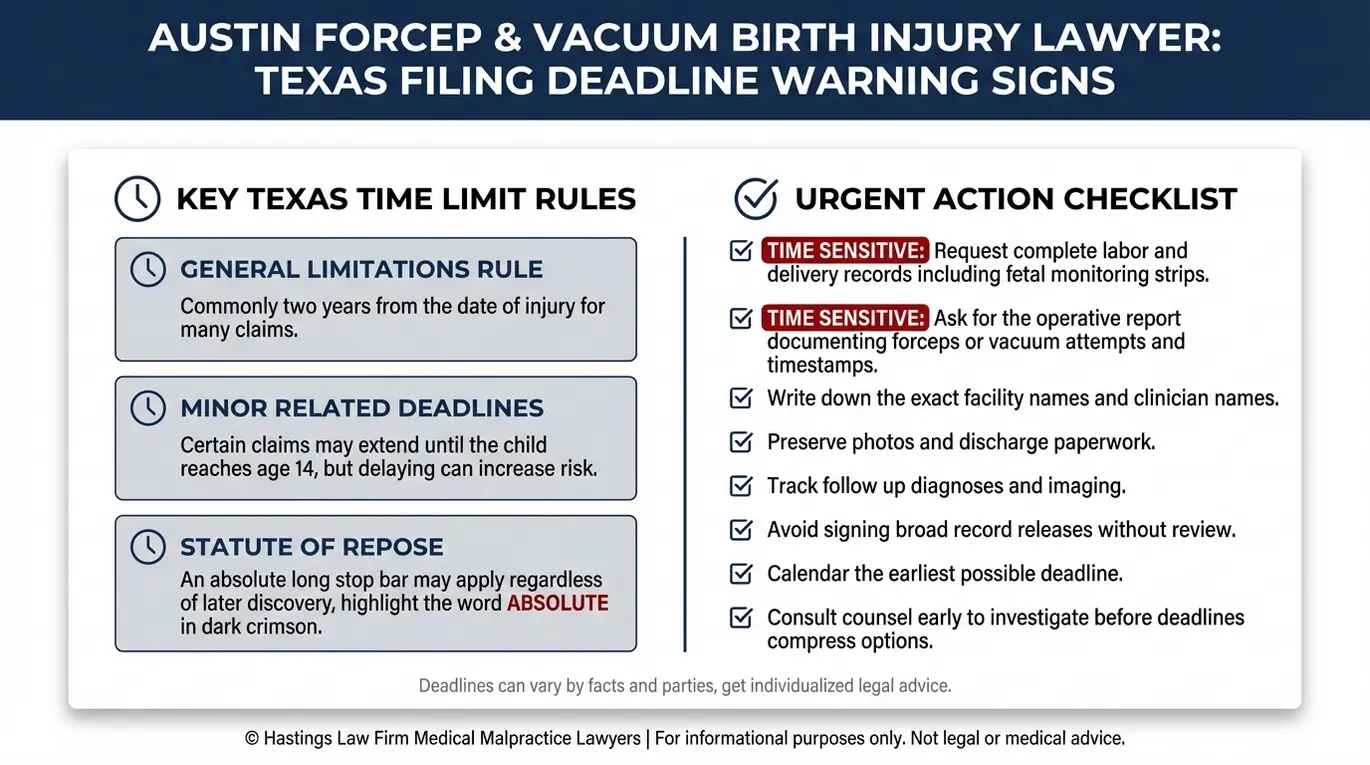
In Texas, birth injury lawsuits must generally be filed within two years of the injury, though exceptions exist for minors that may extend this deadline until the child reaches age 14. Understanding these deadlines is essential because missing them can permanently bar your family’s ability to seek compensation. These time limits are governed by the Texas Civil Practice and Remedies Code.
The General Rule: Two Years for Parents’ Claims
For the parents’ own claims, including the medical bills they have paid and will continue to pay, the statute of limitations is two years from the date the injury occurred or was discovered. This is the same deadline that applies to most medical malpractice cases in Texas. The strict filing deadline starts the clock ticking the moment the injury occurs.
The Minor’s Rule: Extended Deadline for the Child
Texas law provides a tolling provision for minors. The child’s own claims, which include their pain and suffering, future lost earnings, and future medical care, can generally be filed until the child turns 14. While this seems like a generous window, waiting to file carries real risks. Memories fade, medical records can become harder to obtain, and key witnesses may become unavailable.
The Statute of Repose: The Absolute Cutoff
Texas also has a 10-year statute of repose for medical malpractice claims. This means that regardless of when the injury was discovered, no claim can be filed more than 10 years after the act of negligence occurred. There are very limited exceptions to this rule. In some rare instances, the discovery rule may extend the timeline if the injury could not have been discovered immediately, but relying on this exception is dangerous.
Do not wait to explore your options. Even though Texas law may give minor children additional time to file, the strength of your case depends on evidence that can deteriorate over time. If you believe your child was injured during a forceps or vacuum-assisted delivery, contact a Texas statute of limitations birth injury lawyer as soon as possible. Because the law is complex, consulting an attorney immediately is the best way to ensure you do not miss your chance to seek justice.
The Emotional Impact of Pursuing a Lawsuit
Pursuing a lawsuit can be emotionally taxing, and finding the right birth trauma support is crucial. However, taking action often provides families with closure, answers about what actually happened, and the financial means to provide the best quality of life for their child.
Many parents we speak with describe feeling conflicted about questioning the medical professionals who delivered their baby. This hesitation is natural. We are conditioned to trust doctors, and the idea of challenging that authority can bring guilt, anxiety, and self-doubt. At Hastings Law Firm, we want you to know that questioning what happened is not disrespectful. It is a pursuit of justice for your child and sometimes the only way to get the truth.
For many families, compensation is necessary to address the emotional trauma and physical challenges the injury has caused. Parents often tell us they want to understand what went wrong so they can make sense of their child’s injury. They also want to know that what happened to their family will not happen to someone else’s.
Tommy Hastings, a board-certified trial lawyer, founded Hastings Law Firm on the belief that holding negligent providers accountable is the most effective way to improve patient safety. Every case we take is an opportunity to enforce that standard.
We also understand that litigation takes time and emotional energy. Our team prioritizes clear communication and a supportive environment where you and your family are treated as partners. Our in-house nurse consultants and patient advocates help bridge the gap between the legal process and your day-to-day reality. We understand that the legal process can feel like an additional burden, but we are here to shoulder that weight for you.
You do not have to carry this alone.
Contact the Austin Birth Injury Attorneys at Hastings Law Firm Today for Help
No amount of money can undo what happened during your child’s delivery. But compensation is the only tool the legal system offers to secure the medical care, therapy, and support your child needs going forward. It is also the mechanism through which accountability happens, creating a record that can help prevent the same mistakes from affecting another family.
Hastings Law Firm represents families exclusively in medical malpractice cases. Our team of attorneys, former defense counsel, and in-house medical professionals is prepared to review your child’s birth records, consult with qualified experts, and give you honest answers about what we find.
We work on a contingency fee basis, which means you pay no attorney fees or costs unless we recover compensation for your family. If you believe your child was harmed during a forceps or vacuum-assisted delivery in Austin or anywhere in Texas, contact us for a free, confidential case evaluation. Let us help you find the answers you deserve.
Frequently Asked Questions About Forcep & Vacuum Birth Injury in Austin


This content was researched and written by the Hastings Law Firm editorial team, which includes attorneys, medical professionals, and experienced researchers. Our writing is informed by internal knowledge and practical experience, and we cross-check critical details against authoritative sources cited throughout. Every piece undergoes human-led fact-checking and legal review. Because legal and medical information can change, if you spot an error, please contact us. Learn more about our content standards and review process on our editorial policy page.

Gabe Sassin has focused exclusively on medical malpractice law since 2007. After spending more than a decade as a malpractice defense attorney, he knows exactly how the other side works. He has seen firsthand how healthcare providers, insurers, corporate defendants, and their legal teams think, prepare, and build their defense against claims. That knowledge works for the people who need it most today, injured patients and their families. His unique experience shapes everything he writes, giving readers a look at how these cases actually work from someone who has handled them from both sides.
