


Austin C Section Malpractice Lawyer
Negligent C section complications can leave mothers and infants facing serious injuries, long term care needs, and overwhelming uncertainty about what went wrong during delivery. The risks described include surgical trauma, anesthesia related harm, and newborn injury tied to delays or errors during extraction, with outcomes that can be life threatening or worse. Understanding how these injuries happen and how responsibility is evaluated can help families make informed decisions after a traumatic birth experience. If you or a loved one were harmed or worse due to C section malpractice in Austin, Texas, contact Hastings Law Firm for a free, confidential case review.
Last Updated: July 27, 2026
Austin Medical Attorneys for Negligent C-Section Complications
A Cesarean section is one of the most common surgical procedures in the United States, and when performed correctly, it can be lifesaving for both mother and child. But when surgical errors occur during a C-section, the consequences can be devastating. Families may face injuries ranging from iatrogenic bladder injury (cystotomy), an accidental cut to the bladder during surgery, to bowel perforation (enterotomy), unintended damage to the intestines, along with serious harm to the newborn.
If you or your baby suffered harm during a Cesarean delivery in Austin, you may have questions about what went wrong and if the care you received met accepted medical standards. As an Austin C Section Malpractice Lawyer, Tommy Hastings and his medical-legal team focus exclusively on medical malpractice and have the resources to evaluate what happened during your delivery. Contact us for a free, confidential case evaluation so we can review your situation and explain your options.

Common Injuries Resulting from Cesarean Section Errors
Cesarean section errors can result in severe physical trauma to the mother, such as hemorrhage or organ damage, and critical birth injuries to the infant, including brain damage from oxygen deprivation or physical trauma like fractures. A Cesarean section, or C-section, is the surgical delivery of a baby through incisions in the mother’s abdomen and uterus. The type and severity of injury often depends on what went wrong during the procedure or in the decision-making leading up to it.
Maternal injuries from a negligent C-section can include accidental lacerations to the bladder or bowel during the incision, postpartum hemorrhage (excessive bleeding that can become life-threatening if not controlled quickly), and infections caused by surgical complications. Anesthesia errors also pose serious risks. If anesthesia is improperly administered, a mother can experience respiratory arrest, nerve damage, or in rare cases, brain injury. The CDC’s Epidemiologic Notes and Reports on Maternal Deaths Associated with Barbiturate Anesthetics documented how anesthesia mismanagement during delivery has contributed to preventable maternal deaths.
Infant injuries are often tied to delays in performing the C-section or to errors during extraction. When fetal distress signals go unrecognized or unaddressed, the baby can suffer oxygen deprivation, which may lead to hypoxic-ischemic encephalopathy (HIE), which is a type of brain injury caused by reduced blood flow and oxygen to the brain. HIE is one of the leading causes of cerebral palsy in newborns. Improper extraction techniques can also cause physical injuries such as broken bones, skull fractures, or Erb’s palsy, a condition involving nerve damage to the shoulder and arm, which typically results from excessive force during delivery and is often associated with shoulder dystocia.
A C-section injury lawyer in Austin can help determine whether the injuries you or your child sustained were the result of preventable medical errors. As Austin birth injury attorneys, our team works with medical experts to trace each injury back to its cause and evaluate whether the standard of care was met.
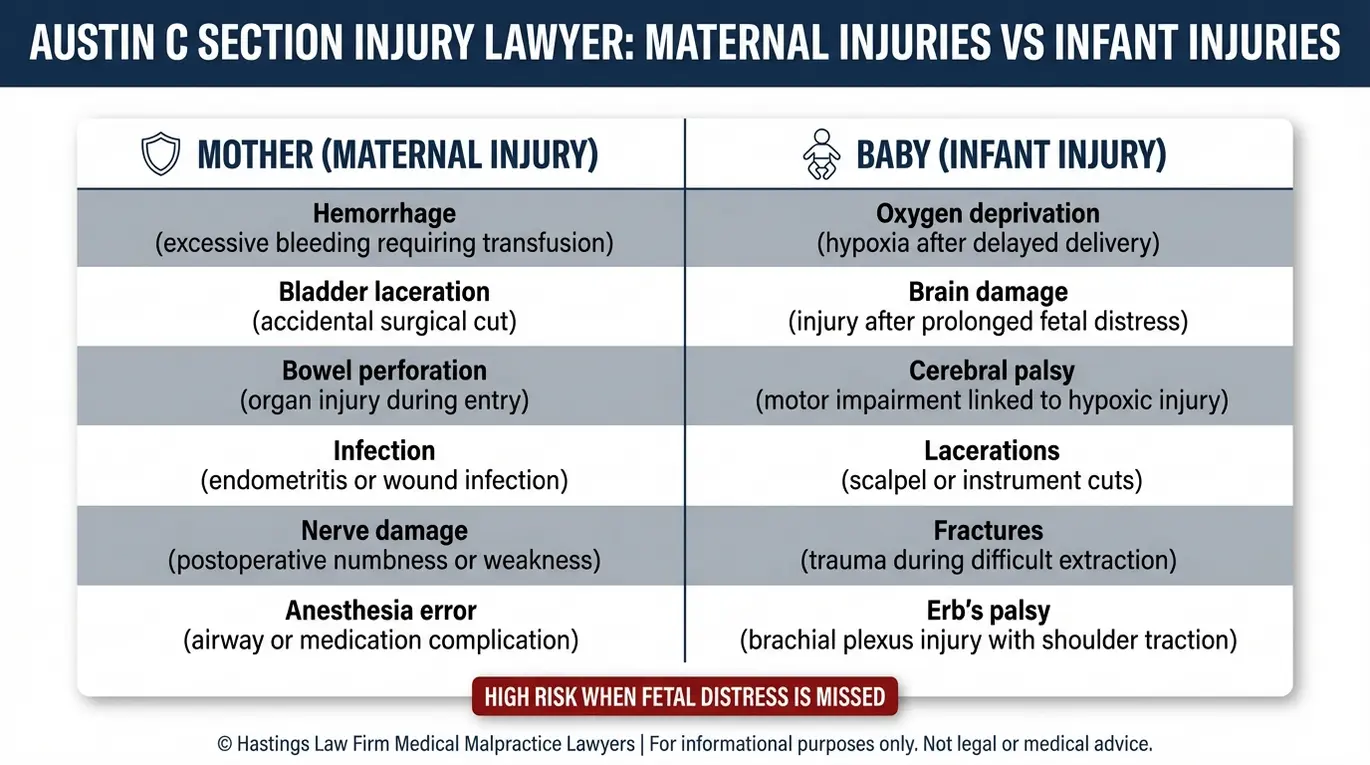
| Maternal Injuries | Infant Injuries |
|---|---|
| Bladder or bowel perforation during incision | Lacerations from surgical instruments |
| Postpartum hemorrhage | Hypoxic-ischemic encephalopathy (HIE) |
| Anesthesia-related respiratory failure | Cerebral palsy from oxygen deprivation |
| Surgical site infection | Erb’s palsy or brachial plexus injury |
| Nerve damage from spinal/epidural errors | Bone fractures from improper extraction |
If your family experienced any of these outcomes, a Cesarean section malpractice lawyer can evaluate whether negligence contributed to the harm.
Establishing Liability in Austin C-Section Malpractice Cases
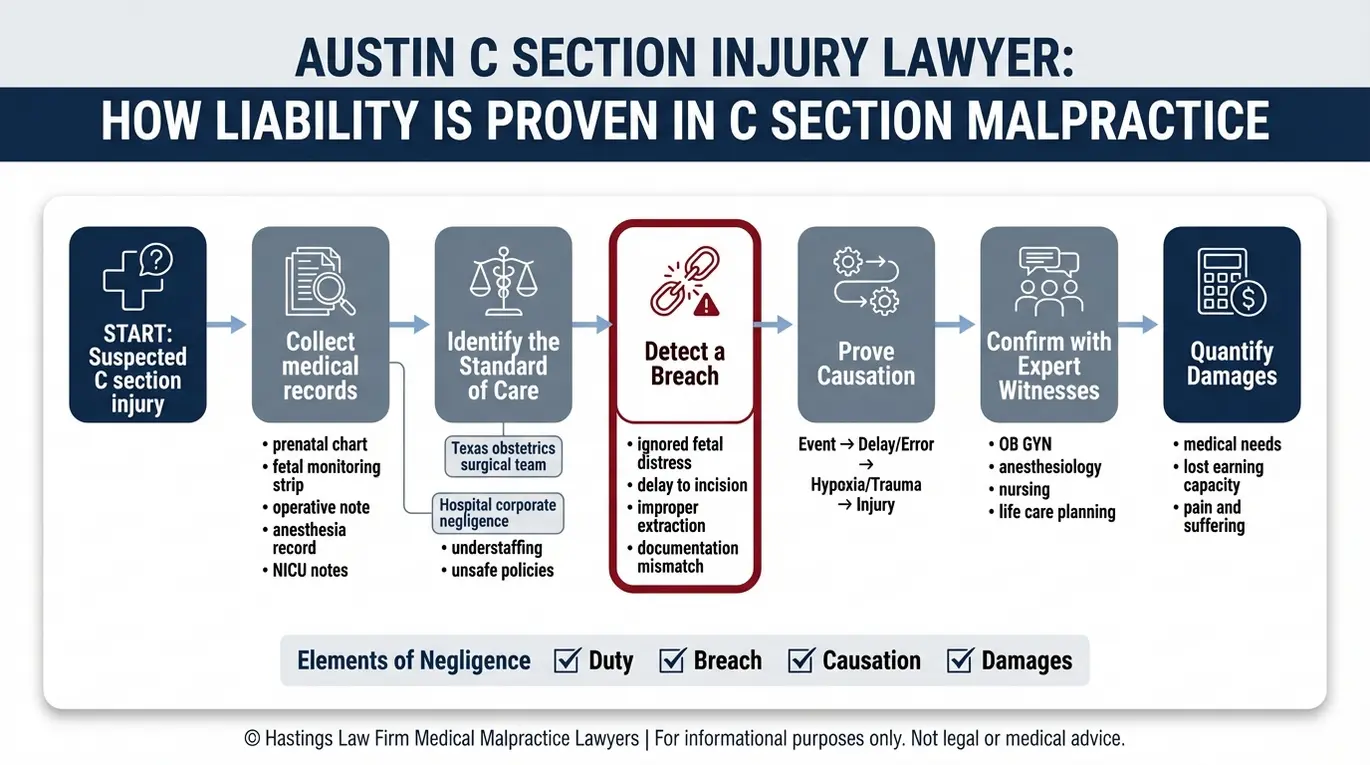
Liability is established by proving the healthcare provider breached the accepted standard of care, demonstrating that this breach directly caused the injury, and quantifying the resulting damages through expert testimony and medical evidence. Liability in medical malpractice refers to the legal responsibility of a healthcare provider for damages caused by negligence. This process requires a detailed medical-legal investigation, which is why working with an Austin C section injury lawyer who understands both the medicine and the law matters so much.
The standard of care for obstetricians and surgical teams in Texas refers to the level of skill and treatment a reasonably competent provider would deliver under similar circumstances. Our team reviews medical records line by line to identify medical negligence, looking for discrepancies between what happened and what was documented. This includes examining fetal heart rate monitoring strips (also called cardiotocography or CTG), which track the baby’s heart rate during labor, and checking for anesthesia complications like a high spinal block, where the anesthetic rises too high and impacts breathing.
Qualified medical professionals review the records and testify about what a competent doctor would have done differently. Their testimony connects the provider’s actions to the injury. In some cases, the hospital itself may share liability through a corporate negligence theory, particularly if understaffing, inadequate training, or flawed policies contributed to the error. Under Texas Civil Practice and Remedies Code, Chapter 74.051, specific pre-suit notice requirements must be met before filing a medical malpractice claim, and our team handles those procedural demands from the start.
If you need legal representation for C-section errors or guidance on having a viable claim, here are the four elements of negligence we must establish:
- Duty: The provider owed a duty of care to the patient
- Breach: The provider failed to meet the accepted standard of care
- Causation: The breach directly caused the injury
- Damages: The patient suffered measurable harm as a result
A lawyer for a negligent C-section builds each of these elements using medical records, hospital protocols, prenatal care documentation, and expert analysis.
The Hastings Law Firm Difference
Results matter, but what truly sets us apart is how we achieve them. Every verdict, every settlement, and every Austin courtroom victory comes from one guiding promise: To treat each client’s fight for justice as if it were our own.
This balance of skill, experience, and empathy reflects our core philosophy that justice should not only compensate the injured, but also make health care safer nationwide.

Challenges in Texas Medical Malpractice Law
Texas has some of the most restrictive medical malpractice laws in the country. Tort reform refers to laws that limit the amount of compensation a person can receive in a lawsuit. Legislation caps non-economic damages (such as pain and suffering) at $250,000 per claimant against all individual healthcare providers and $250,000 per healthcare institution, with a total cap of $500,000 across all institutions. Claimants must also file expert reports early in the litigation process to demonstrate the claim has merit.
These hurdles make it essential to work with a firm that handles medical malpractice exclusively. Our team includes former defense attorneys who understand how hospitals and insurers build their cases, and we prepare every claim from day one as if it will go to trial. That preparation gives us a firm negotiation posture and ensures nothing is overlooked.
Failure to Perform Timely C-Sections vs. Unnecessary Procedures
Medical malpractice can occur when a doctor fails to order an emergency C-section despite signs of fetal distress, or conversely, when they perform an unindicated C-section that subjects the mother and child to unnecessary surgical risks. An emergency C-section is a surgical delivery performed immediately to protect the health of the mother or baby. Both scenarios can give rise to valid legal claims.
In a delayed C-section situation, fetal distress, a condition where the baby shows signs of oxygen deprivation or abnormal heart rate patterns during labor, may go unrecognized or unaddressed. We evaluate whether a prompt C-section was required because a vaginal birth was no longer safe.
The decision-to-incision time, which is the interval between the decision to perform surgery and the first cut, is a critical metric we examine. Unnecessary delays during this window can result in permanent brain injury or death. Accurate documentation and access to health records are important components of building these claims. The Assistant Secretary for Technology Policy’s Get It campaign encourages patients to obtain and review their medical information.
If a patient is not given full informed consent about if the procedure is medically necessary, that may also constitute a basis for a claim. As a C-section negligence attorney, we evaluate both sides of this equation. An Austin malpractice lawyer at our firm examines the medical records to determine whether the timing and necessity of the procedure met the standard of care.
Calculating Damages for Mothers and Infants
Compensation in C-section cases covers economic damages like past and future medical bills and lost wages, as well as non-economic damages for pain, suffering, and physical impairment, often requiring a Life Care Plan for permanently injured infants. Economic damages are measurable financial losses such as medical bills and lost wages.
Recoverable damages in these cases may include:
- Past and future medical expenses: Surgical costs, NICU stays, rehabilitation, therapy, medications, and ongoing specialist visits
- Lost earning capacity: Income the mother has lost or will lose due to her injuries, or future earnings the child may never be able to obtain because of permanent disability
- Pain and suffering: Physical pain, emotional distress, disfigurement, and loss of enjoyment of life
- Life Care Plan costs: For children with cerebral palsy or brain damage, a Life Care Plan maps out every anticipated need across the child’s lifetime, from 24-hour nursing to adaptive equipment and home modifications
Developing a credible Life Care Plan requires collaboration between medical professionals and certified life care planners. Research published by PubMed on certification standards for professionals coordinating life care plans for individuals with acquired brain injury highlights the importance of qualified planning for long-term care needs.
Compensation for C-section injuries must account for the full scope of harm, both immediate and long-term. Our team works with economists, medical experts, and life care planners to document Austin birth injury damages thoroughly, so that any settlement or verdict reflects the real cost of the injury.
Texas Filing Deadlines for Birth Injury Claims
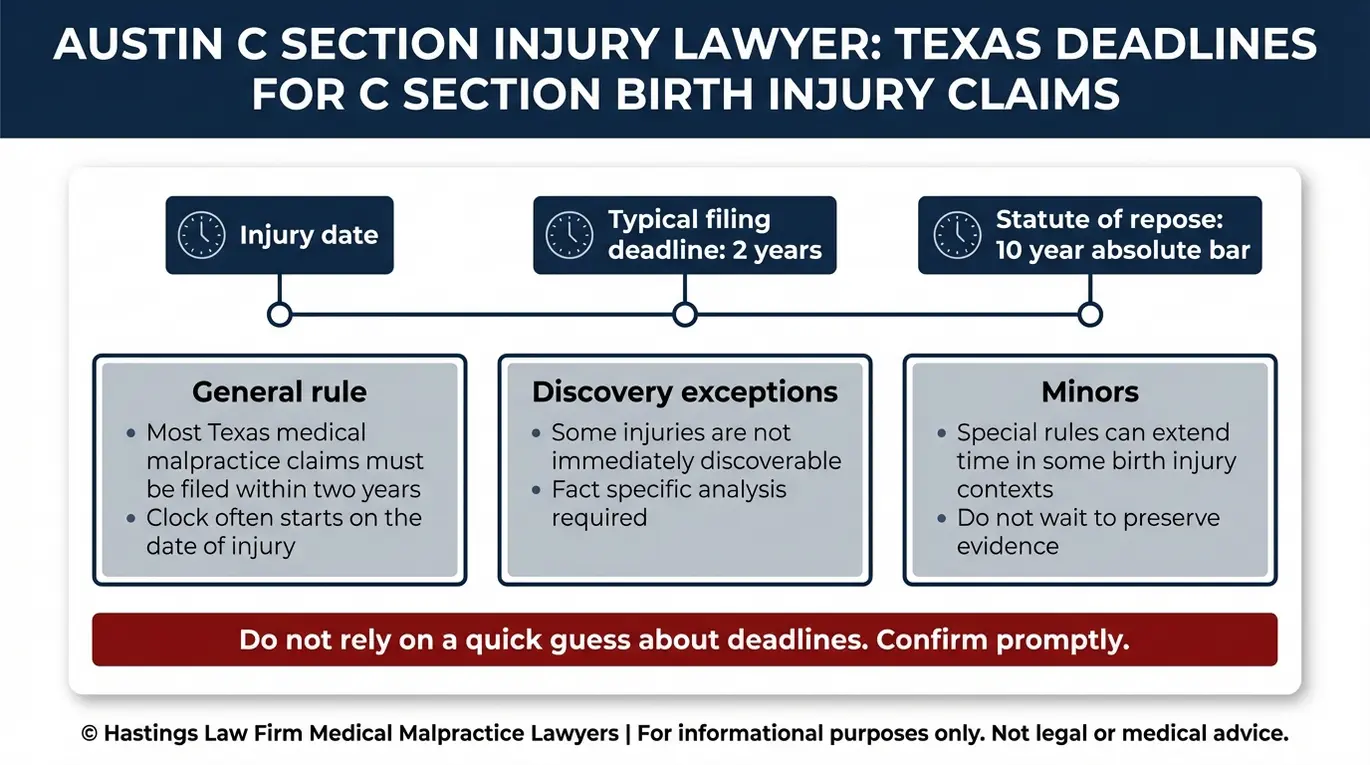
In Texas, the standard statute of limitations for medical malpractice is two years from the date of injury, though the discovery rule may apply if the harm wasn’t immediately apparent. A statute of limitations is a law that sets the maximum time after an event within which legal proceedings may be initiated. Under Texas Civil Practice and Remedies Code Chapter 74, the clock generally starts when the negligent act occurred. However, the statute of repose creates a 10-year absolute bar on legal action regardless of discovery, meaning no claim can be filed after this decade-long window closes.
For minors under the age of 12, Civil Practice and Remedies Code Chapter 74, Section 74.251 allows children until their 14th birthday to file a claim. Consult an Austin C Section Injury Lawyer promptly, as understanding the statute of limitations for C-sections is critical to preserving your rights.
Contact the Austin Birth Injury Attorneys at Hastings Law Firm Today for Help
No amount of money can undo the trauma of a C-section injury, but securing financial stability is essential for the future care of both mother and child. If your family is facing mounting medical bills, long-term therapy, or the uncertainty of a permanent disability, you deserve answers about what happened and if it could have been prevented.
Hastings Law Firm was built to restore trust for families who feel let down by the healthcare system. Our team of attorneys, in-house nurse consultants, and Board Certified Patient Advocates work together to investigate what went wrong, hold the responsible parties accountable, and help prevent the same errors from happening to another family. We handle cases on a contingency fee basis, meaning you pay no attorney fees or costs unless we recover compensation for you.
If you believe your C-section delivery involved preventable errors, contact our Austin office for a free, confidential case evaluation. Let us help you understand your options and take the first step toward protecting your family’s future.
Frequently Asked Questions About C-Section Malpractice in Austin


This content was researched and written by the Hastings Law Firm editorial team, which includes attorneys, medical professionals, and experienced researchers. Our writing is informed by internal knowledge and practical experience, and we cross-check critical details against authoritative sources cited throughout. Every piece undergoes human-led fact-checking and legal review. Because legal and medical information can change, if you spot an error, please contact us. Learn more about our content standards and review process on our editorial policy page.

Gabe Sassin has focused exclusively on medical malpractice law since 2007. After spending more than a decade as a malpractice defense attorney, he knows exactly how the other side works. He has seen firsthand how healthcare providers, insurers, corporate defendants, and their legal teams think, prepare, and build their defense against claims. That knowledge works for the people who need it most today, injured patients and their families. His unique experience shapes everything he writes, giving readers a look at how these cases actually work from someone who has handled them from both sides.
