


Austin Cerebral Palsy Lawyer
A cerebral palsy diagnosis can leave families searching for clarity about what happened during labor and delivery. Some cases are linked to preventable medical errors such as delayed responses to fetal distress, mismanaged oxygen deprivation, or delivery related trauma that can cause lasting brain injury and lifelong care needs. Understanding whether care fell below the standard of care often depends on careful review of delivery records and clinical timelines. If your child suffered harm or worse due to cerebral palsy malpractice in Austin, Texas, contact Hastings Law Firm for a free, confidential case review.

Last Updated: July 27, 2026
Trusted Medical Attorneys for Preventable Birth Injuries in Austin
Learning that your child has cerebral palsy, a condition affecting movement, muscle tone, and coordination, is overwhelming. When that diagnosis may be connected to a birth injury, meaning harm that occurred during labor or delivery due to medical error, the weight of it can feel impossible to carry alone.
You deserve clear answers about what happened, and you deserve a legal team that understands both the medicine and the law. As an Austin cerebral palsy lawyer, Hastings Law Firm focuses exclusively on medical malpractice. Our team of attorneys, in-house nurses, and medical consultants is here to review your child’s case and explain your options at no cost to you.
If you believe your child’s condition was preventable, we welcome the chance to talk with you.

Was Your Child’s Cerebral Palsy Caused by Medical Negligence?
Cerebral palsy is often caused by preventable medical errors during labor or delivery, such as oxygen deprivation or physical trauma, and these errors may constitute medical malpractice if the medical team failed to meet the standard of care.
One of the most common causes of birth-related cerebral palsy is hypoxic-ischemic encephalopathy (HIE). This is a type of brain damage that occurs when a baby’s brain is deprived of adequate oxygen and blood flow, a condition known as perinatal hypoxia, around the time of birth. HIE can develop when medical providers fail to respond to signs of fetal distress or delay a necessary cesarean delivery.
It also occurs when they mismanage complications like birth asphyxia, where the baby struggles to breathe during or after delivery. This lack of oxygen kills brain cells and creates permanent motor function deficits. Understanding the timeline of oxygen delivery is essential to determining if a breach occurred.
Medical negligence in this context means the care provided fell below the standard of care, the level of treatment a competent medical professional would have delivered under similar circumstances. When that standard is breached and a child suffers brain damage as a result, the family may have grounds for a legal claim with a qualified birth injury lawyer.
Austin cerebral palsy attorneys at Hastings Law Firm investigate these cases by examining delivery records, fetal monitoring strips, and clinical timelines to identify where errors may have occurred. Our in-house medical staff helps pinpoint the moments that mattered most, distinguishing between unavoidable complications and preventable errors.
Not every case of cerebral palsy involves negligence. But certain warning signs suggest that something may have gone wrong during delivery. If any of the following occurred, it may be worth having your child’s records reviewed by a cerebral palsy lawyer experienced in birth injury cases:
- Your baby required immediate resuscitation after delivery
- Your baby was admitted to the NICU shortly after birth
- Your baby had low Apgar scores at one or five minutes
- Fetal heart rate monitors showed signs of distress that were not acted upon promptly
- Labor was unusually prolonged, or Pitocin was administered without adequate monitoring
- An emergency C-section was discussed but delayed
These red flags do not automatically prove malpractice, but they are exactly the types of indicators our medical and legal team evaluates when building a case.
Common Medical Errors Leading to Cerebral Palsy
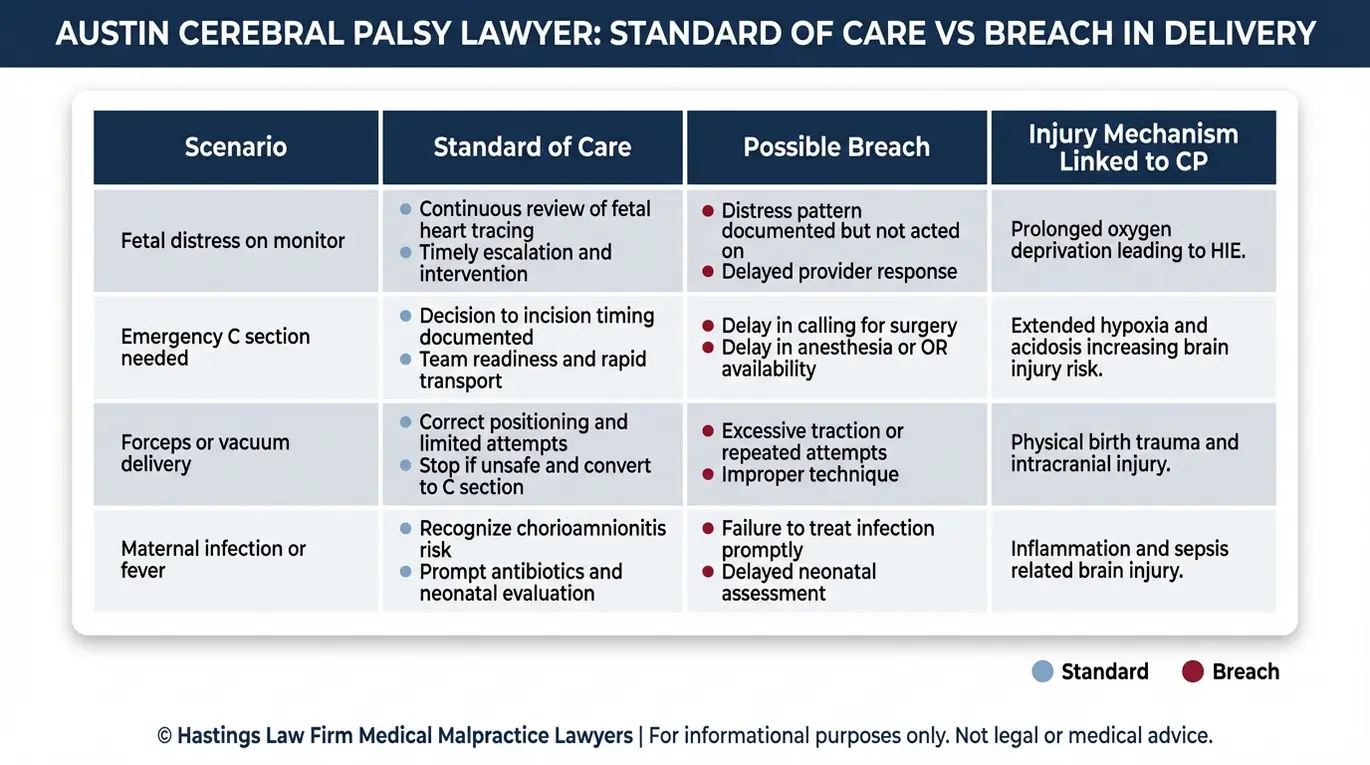
Common errors leading to cerebral palsy include delaying a necessary C-section, improper use of forceps or vacuum extractors, and failing to treat maternal infections or respond to umbilical cord complications in time.
These mistakes often involve a failure to follow safety protocols during labor. Labor and delivery require constant vigilance, and even short delays can lead to devastating outcomes. A delayed emergency cesarean delivery, where a C-section is needed but not performed quickly enough, is one of the most frequently identified failures in cerebral palsy cases.
When fetal distress signals appear on the monitor and the medical team does not act, the window for preventing brain damage at birth can close rapidly. Operative vaginal delivery, the use of forceps or a vacuum extractor to assist in delivery, carries its own risks. When these tools are applied with excessive force or used inappropriately, they can cause direct physical birth trauma to the baby’s skull and brain.
Improper technique or using these instruments when a C-section would have been safer may indicate a breach in the standard of care. Maternal infections such as chorioamnionitis, an infection of the placenta and amniotic fluid, can transfer to the infant and cause inflammation that damages developing brain tissue. Timely diagnosis and treatment of these infections is a basic expectation in obstetric care.
The following table outlines how some of the most common delivery room errors connect to cerebral palsy:
| Medical Error | How It Can Cause CP | What the Standard of Care Requires |
|---|---|---|
| Delayed C-section | Prolonged oxygen deprivation leading to HIE | Timely surgical intervention when fetal distress is identified |
| Improper use of forceps or vacuum | Direct trauma to the baby’s brain or skull | Correct technique; cesarean delivery when instrument use poses excessive risk |
| Failure to monitor fetal heart rate | Missed signs of distress, leading to oxygen deprivation | Continuous monitoring and prompt response to abnormal patterns |
| Untreated maternal infection | Inflammation and infection spreading to the infant’s brain | Early diagnosis, antibiotics, and expedited delivery when indicated |
| Failure to manage umbilical cord prolapse | Complete loss of oxygen supply to the baby | Immediate intervention to relieve cord compression |
If you suspect any of these errors occurred during your child’s delivery, a cerebral palsy attorney in Austin can help you review medical records. We know exactly what to look for when evaluating these files. You also have the right to request your own records directly through the Texas Medical Board. For families still learning about this condition, the Centers for Disease Control and Prevention (CDC) provides helpful background information about cerebral palsy and its causes.
The Hastings Law Firm Difference
Results matter, but what truly sets us apart is how we achieve them. Every verdict, every settlement, and every Austin courtroom victory comes from one guiding promise: To treat each client’s fight for justice as if it were our own.
This balance of skill, experience, and empathy reflects our core philosophy that justice should not only compensate the injured, but also make health care safer nationwide.

Types of Cerebral Palsy and Associated Symptoms
Cerebral palsy is categorized by the type of movement disorder it produces, including Spastic (stiff muscles), Dyskinetic (uncontrollable movements), Ataxic (poor balance and coordination), and Mixed types, all of which may result from injuries sustained during birth.
This condition involves a group of disorders affecting muscle tone and movement. The type of cerebral palsy a child develops often depends on which area of the brain was damaged and how that damage occurred. A severe case of HIE, for example, can lead to spastic quadriplegia, a severe form of the condition affecting all four limbs and the torso.
The severity range is broad; some children experience mild mobility challenges, while others require full-time assistance with every daily activity. Spastic cerebral palsy, a condition involving increased muscle tone that makes movement stiff and difficult, is the most common type.
Dyskinetic cerebral palsy, which causes involuntary, uncontrollable movements in the hands, arms, and legs, makes it hard for a child to sit, walk, or grasp objects. Many children are diagnosed with a combination of these types.
| Type | Primary Symptom | Brain Area Typically Affected |
|---|---|---|
| Spastic | Stiff, tight muscles; difficulty with movement | Motor cortex or white matter pathways |
| Dyskinetic | Involuntary, writhing, or jerky movements | Basal ganglia |
| Ataxic | Poor balance, coordination, and depth perception | Cerebellum |
| Mixed | Combination of symptoms from two or more types | Multiple brain regions |
Understanding the type and severity of your child’s cerebral palsy is an important part of any legal claim. It helps Austin cerebral palsy lawyers and medical experts connect the specific birth injury to the lasting harm your child lives with every day. It also directly shapes the cerebral palsy treatments and therapies, and the level of compensation, your child will need over a lifetime.
Calculating Compensation: The Role of Life Care Plans
Compensation in cerebral palsy cases is designed to cover lifelong medical expenses, therapy costs, assistive technology, and non-economic damages like pain and suffering, and it is often calculated with the help of expert life care plans.
Compensation refers to the financial recovery provided to cover the lifelong costs of a birth injury. Children with cerebral palsy frequently require care that extends across their entire lifetime. Compensation must account not only for past medical bills but for decades of future needs.
An Austin cerebral palsy lawyer experienced in these claims understands how to build a case that reflects the true financial scope of your child’s condition. Economic damages in a birth injury compensation claim may include:
- Future surgeries and medical procedures
- Ongoing physical, occupational, and speech therapy
- Home modifications for wheelchair accessibility
- Assistive devices and adaptive technology
- 24-hour nursing or personal care support
- Special education and vocational support services
Non-economic damages address the harm that cannot be measured with a receipt. These include your child’s physical pain and suffering, emotional distress, and loss of enjoyment of life. For families, the daily toll of managing a preventable condition is immense, and the legal system recognizes that these losses have real value.
To calculate the full extent of these needs, our team works with life-care planners, professionals who develop detailed, evidence-based projections of every cost your child is expected to incur over their lifetime. According to research published by PubMed Central, families caring for a child with a developmental disability face significant economic burdens.
Settlement amounts vary widely depending on the severity of the injury, the strength of the evidence, and the long-term care needs involved. Liability provisions under Chapter 74 of the Texas Civil Practice and Remedies Code can also affect the structure of these claims in Texas.
Texas Statute of Limitations for Birth Injury Claims
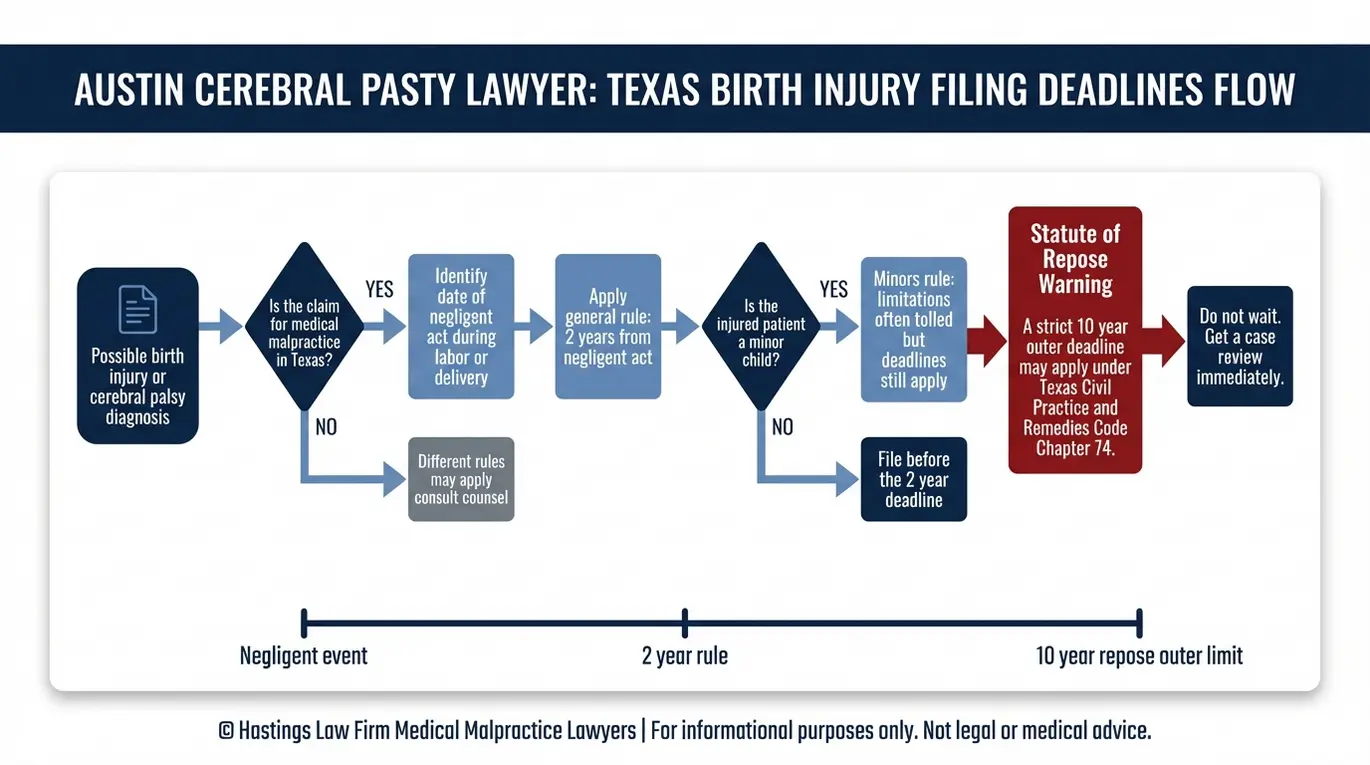
In Texas, medical malpractice claims generally must be filed within two years. But for birth injuries involving minors under 12, the statute provides that the child has until their 14th birthday to file, although a strict 10-year statute of repose still applies.
The general rule under the Texas Civil Practice and Remedies Code Chapter 74 is that a medical malpractice lawsuit must be filed within two years from the occurrence of the breach or tort, or from the date the medical treatment that is the subject of the claim is completed.
For children, the timeline works differently under Texas birth injury laws. Under Section 74.251, minors under the age of 12 have until their 14th birthday to file, or have filed on their behalf, a health care liability claim. This provision offers additional time for families whose children were injured at birth or in early childhood.
However, there is an absolute outer boundary. The statute of repose in Texas sets a hard 10-year deadline from the date of the alleged negligence. This deadline applies regardless of when the injury was discovered or how old the child is. Once this 10-year window closes, the right to file may be permanently lost, even if the child is still young.
This is why families should not wait to have their case evaluated. An Austin cerebral palsy attorney can review your child’s medical records and help determine exactly where you stand in relation to these deadlines. Even if your child was diagnosed years after birth, there may still be time to take action, but the sooner you begin, the more options you preserve.
Why Choose Hastings Law Firm for Your Family?
Hastings Law Firm is a medical malpractice firm that handles nothing else. Every attorney, nurse consultant, and staff member on our team is focused on one thing: holding negligent healthcare providers accountable for the harm they cause.
That exclusive medical malpractice focus matters. Birth injury and cerebral palsy cases require a deep understanding of obstetric medicine, fetal monitoring, and neonatal care. General practice firms rarely have the resources or medical knowledge to take on hospital defense teams and their insurers.
Our founder, Tommy Hastings, is Board Certified in Personal Injury Trial Law by the Texas Board of Legal Specialization, a distinction held by fewer than 2% of Texas attorneys. He is a 2025 inductee into ABOTA, an invitation-only organization for elite trial lawyers.
What sets our firm apart as an Austin cerebral palsy lawyer:
- Exclusive medical malpractice focus: We do not split our attention across unrelated practice areas
- In-house medical staff: Our team includes nurse practitioners and Board Certified Patient Advocates who assist in case evaluation, record analysis, and interpreting clinical data
- Former defense attorneys on staff: We know how hospitals and insurers build their defense because our attorneys used to do it for them. This insider knowledge allows us to anticipate their strategies and dismantle their arguments before they even make them.
- National expert network: We work with top-tier medical experts across the country to provide credible, objective testimony. Finding the right expert, someone who is respected in their field and can explain complex medical concepts to a jury, is often the difference between winning and losing.
- Contingency fee structure: You pay no attorney fees or costs unless we recover compensation for your family
- Local presence, national reach: Our Austin office gives your family direct access to a team backed by resources across the country
We prepare every case as if it will go to trial. That level of preparation sends a clear message to the other side and consistently positions our clients for stronger outcomes, whether at the negotiation table or in front of a jury.
Contact the Austin Birth Injury Attorneys at Hastings Law Firm Today for Help
Your child’s future should not be defined by someone else’s mistake. Our team helps families understand if their child’s condition was caused by medical negligence.
Remember that Texas imposes a strict 10-year statute of repose on medical malpractice claims. The sooner you reach out, the more time our team has to investigate, gather evidence, and build the strongest possible case.
Your initial free case evaluation is completely confidential. Our Austin birth injury lawyers will review your child’s medical records, explain whether you have a viable claim, and outline what comes next. There is no fee unless we win.
Let your family focus on your child. Let us carry the legal burden. Contact Hastings Law Firm today to schedule your consultation.
Frequently Asked Questions About Cerebral Palsy Malpractice in Austin


This content was researched and written by the Hastings Law Firm editorial team, which includes attorneys, medical professionals, and experienced researchers. Our writing is informed by internal knowledge and practical experience, and we cross-check critical details against authoritative sources cited throughout. Every piece undergoes human-led fact-checking and legal review. Because legal and medical information can change, if you spot an error, please contact us. Learn more about our content standards and review process on our editorial policy page.

Tommy Hastings, founder of Hastings Law Firm, is a board-certified personal injury trial lawyer dedicated exclusively to healthcare injury cases. Since 2001, he has represented injured patients and families in litigation against major hospital systems, pharmaceutical companies, and negligent healthcare providers nationwide. He has handled numerous high-profile cases that have drawn national media attention and resulted in multi-million dollar recoveries. He draws on that experience in his writing, helping readers understand how these cases work and what options may be available to them.
