


Austin OB-GYN Malpractice Lawyer
Obstetric negligence during pregnancy, labor, or delivery can leave families facing lasting medical needs, financial strain, and uncertainty about whether preventable mistakes occurred. The risks described range from oxygen deprivation and brain injury in infants to severe maternal complications that can become life threatening. Common problems involve missed warning signs, medication dosing errors, and delayed emergency intervention, especially when fetal distress is present. Clear medical documentation and timely action can shape what options remain. If your child suffered harm due to obstetric negligence in Austin, Texas, contact Hastings Law Firm for a free, confidential case review.

Last Updated: July 27, 2026
Trusted Austin Medical Attorneys for Obstetrics Negligence Claims
When your child or a loved one has been harmed during pregnancy or delivery, the weight of that experience can feel impossible to carry alone. You may be facing unexpected medical bills, a difficult recovery, and questions about whether something went wrong that should not have. Those questions deserve honest answers.
At Hastings Law Firm, we focus exclusively on medical malpractice, including cases involving obstetric and birth-related injuries. Founded by board-certified trial attorney Tommy Hastings in 2005, our firm understands both the medical and legal details these cases demand. We recognize the emotional toll these injuries take on families.
If you believe your family was affected by negligent care during pregnancy, labor, or delivery, we are here to listen. Contact us for a free, confidential case evaluation. You pay nothing unless we recover compensation on your behalf.

Common Errors Committed by Obstetricians and Labor Teams
Obstetric malpractice occurs when a healthcare provider deviates from the accepted standard of care, the level of treatment a reasonably competent provider would deliver under similar circumstances, during pregnancy, labor, or delivery, resulting in preventable injury or death. These errors can happen at any stage, and they often follow recognizable patterns. Our team identifies these through a careful review of medical records to determine if a provider met the standard of care.
Prenatal Negligence
Some Prenatal Negligence mistakes happen before labor even begins. When conditions like preeclampsia, which is dangerously high blood pressure during pregnancy, or gestational diabetes go unmanaged, both mother and baby face escalating risks.
Routine screening exists to catch these conditions early. A failure to diagnose an ectopic pregnancy, where the fertilized egg implants outside the uterus, can lead to life-threatening internal bleeding for the mother. Timely medical intervention is the only way to prevent these outcomes.
Medication Errors
Pitocin, a synthetic form of the hormone oxytocin, is one of the most commonly used drugs in labor and delivery. Medication Errors involving this drug can lead to severe complications. According to the Mayo Clinic’s drug information on oxytocin, it must be carefully dosed and monitored.
Pitocin errors, such as administering too high a dose, can cause uterine hyperstimulation. This puts extreme stress on the baby and can restrict oxygen flow. When Pitocin causes the uterus to contract too forcefully, the placenta may not have enough time to refill with oxygen-rich blood. This type of error often requires immediate cessation of the drug and potential emergency surgical intervention to prevent permanent brain injury.
Monitoring Failures
During labor, fetal monitoring strips, also called fetal heart rate (FHR) tracings, provide a continuous record of the baby’s heart rate alongside the mother’s contractions. These fetal heart rate tracings help medical teams track a baby’s oxygen levels and stress during labor. They are designed to reveal signs of fetal distress.
When labor teams ignore or misread warning patterns on these strips, critical minutes pass without intervention. Our team examines these records closely because they often contain the earliest evidence that something was going wrong. Specific patterns, such as late decelerations, are clear indicators that the baby is not tolerating labor well. Medical standards require nurses and physicians to recognize these red flags immediately and take corrective action.
| Stage | Common Errors | Potential Consequences |
|---|---|---|
| Prenatal | Failure to diagnose preeclampsia, gestational diabetes mismanagement, missed HELLP syndrome | Uncontrolled maternal complications, premature delivery, organ damage |
| Labor & Delivery | Pitocin dosing errors, failure to interpret fetal monitoring strips, delayed response to fetal distress | Oxygen deprivation, emergency interventions, preventable brain injury |

Consequences of Negligence for Mothers and Infants
Negligent obstetric care can lead to catastrophic, permanent injuries, including cerebral palsy in infants and hemorrhage or organ failure in mothers. For many families, these daily life consequences are permanent. Our legal team includes former defense attorneys and hospital nurses who provide insider insight into the medical systems we now challenge.
Infant Brain Injuries
When a baby is deprived of oxygen during labor or delivery, the result can be Hypoxic ischemic encephalopathy (HIE). This is a specific type of brain damage caused by insufficient oxygen or blood flow around the time of birth. Research published in PubMed Central confirms that birth asphyxia is associated with increased risk of cerebral palsy, a group of permanent movement disorders that can affect muscle control, posture, and coordination.
Children diagnosed with cerebral palsy after a birth injury may require neonatal intensive care (NICU) stays immediately after delivery. This is followed by years of therapy, adaptive equipment, and specialized medical support. Families should watch for signs of developmental delays, such as difficulty feeding, abnormal muscle tone, or seizures. We evaluate whether the oxygen deprivation was the result of a preventable failure, such as a delayed delivery, or whether it occurred despite appropriate care.
Physical Trauma
Shoulder dystocia, a complication where the baby’s shoulder becomes lodged behind the mother’s pelvic bone during delivery, requires specific maneuvers to resolve safely. When those maneuvers are performed incorrectly or with excessive force, the infant can sustain a brachial plexus injury.
This is damage to the network of nerves controlling movement in the arm and hand. In mild cases, sensation and strength may return over time. In severe cases, the child may experience permanent loss of function.
Maternal Harm
Mothers also face serious risks when the standard of care is not met. Placental abruption, where the placenta separates from the uterine wall prematurely, can cause life-threatening hemorrhage if not identified and treated quickly.
Other maternal complications linked to obstetrician negligence include uncontrolled bleeding, infection, and failure to manage vital signs. Uterine rupture, often a result of prior C-section scar failure or induction drug overuse, is another devastating event that demands immediate surgical attention. Our team can help determine whether the harm was avoidable and what legal options may be available.
Texas Maternal Mortality Context
Texas has one of the highest maternal mortality rates in the country, a reality that reflects systemic gaps in obstetric care. These statistics underscore the importance of holding providers accountable.
When a family brings a wrongful death claim or injury case, the case is not only about one family. It is about identifying patterns of failure that continue to put other patients at risk.
The Hastings Law Firm Difference
Results matter, but what truly sets us apart is how we achieve them. Every verdict, every settlement, and every Austin courtroom victory comes from one guiding promise: To treat each client’s fight for justice as if it were our own.
This balance of skill, experience, and empathy reflects our core philosophy that justice should not only compensate the injured, but also make health care safer nationwide.

Surgical Mistakes During C-Sections and Delivery
Surgical malpractice in the delivery setting involves errors such as delayed emergency C-sections, surgical nicks to surrounding organs, or improper use of extraction tools like forceps and vacuum devices. These are time-sensitive situations where minutes can determine outcomes.
Delayed C-Sections
An emergency cesarean section (C-section) follows what is known as a decision-to-incision timeline. According to a systematic review published in PubMed Central on decision-to-delivery intervals for emergency cesarean sections, delays beyond the recommended window are associated with worse outcomes.
When fetal distress is evident, such as in cases of placenta previa or umbilical cord prolapse, waiting too long to deliver can result in oxygen deprivation. Medical guidelines generally recommend that the interval between the decision to operate and the delivery should not exceed 30 minutes in emergent cases. Delays caused by unavailable operating rooms or slow communication are often unjustifiable when a baby’s life hangs in the balance. We review the medical records to establish whether the decision to proceed with surgery was made in a timely manner.
Instrument Misuse
Vacuum-assisted delivery, a technique where a suction device is attached to the baby’s head, and forceps delivery each carry inherent risks. When applied with excessive force or incorrect positioning, these instruments can cause skull fractures, intracranial hemorrhage, or nerve damage.
Forceps delivery errors often leave visible trauma, but some injuries, like internal bleeding, may not become apparent for hours. Improper technique can lead to cephalohematoma, a pooling of blood under the scalp. These injuries are frequently the result of a physician applying force that exceeds safe limits.
Surgical Complications
During the C-section procedure itself, accidental lacerations to the bladder, bowel, or uterus can occur. While some surgical risks are inherent, failure to identify and repair these injuries promptly falls below the standard of care. Uterine rupture, whether caused by excessive Pitocin use or surgical error, is a life-threatening emergency for both mother and baby.
Proving Liability with Medical Evidence and Experts
Proving liability in an obstetric malpractice case requires an expert report establishing that the physician breached the standard of care and that this breach directly caused the injury. In Texas, these cases rely on specific medical proof and formal legal reports to proceed. Filing an expert report is a mandatory preliminary step to prove a medical lawsuit has merit.
Here is how we approach building these cases:
- Gathering and analyzing medical records. We obtain the complete medical chart, including prenatal records, nursing logs, and pharmacy records. Our in-house medical staff, which includes nurse practitioners, reviews this data to identify potential deviations from protocols.
- Defining the standard of care. We work with qualified OB-GYN experts to establish what a competent provider should have done. This becomes the benchmark for the case.
- Meeting the 120-day expert report deadline. Under Texas Civil Practice & Remedies Code § 74.351, the plaintiff must serve a written expert report within 120 days after the defendant’s original answer is filed. Missing this deadline results in automatic dismissal.
- Establishing causation. We connect the specific error, such as a delayed delivery, to the specific outcome, such as HIE. Evidence like umbilical cord blood gas analysis can be critical in establishing when and how oxygen loss occurred.
- Presenting credible expert testimony. Our firm maintains a national network of medical experts who provide objective testimony. These experts are practicing or teaching physicians in the relevant specialty, which is required under Texas law.
Liability in Military or Government Facilities
If the injury occurred at a military hospital or government-run facility, such as those serving veteran families in the Austin area, the legal path is different. Cases involving military hospital malpractice or injuries at government-run facilities fall under the Federal Tort Claims Act (FTCA), which has its own filing requirements. These cases cannot be filed directly in state court. Instead, an administrative claim must be submitted to the appropriate federal agency before a lawsuit can proceed.
Similarly, claims against state-run or county hospitals in Texas are governed by the Texas Tort Claims Act, which imposes specific notice requirements and liability limits. The timelines and procedural rules differ from standard Texas medical malpractice claims. This makes early legal guidance especially important for your family.

Recovering Resources for Your Child’s Future
Compensation in birth injury cases typically includes coverage for past and future medical bills, life care planning costs, lost earning capacity, and non-economic damages for pain and suffering. The goal is to secure the financial resources your child will need for the rest of their life.
Life Care Plans
Children with conditions like cerebral palsy or permanent brachial plexus injuries often require around-the-clock care and therapy. A life care plan is a document that outlines the medical and financial needs of an injured child for the rest of their life.
Developed with input from medical professionals, it projects these costs over the child’s expected lifetime. This comprehensive document accounts for inflation and the rising cost of healthcare. These figures often reach into the millions of dollars and form the foundation of the economic damages claim.
Understanding Texas Damage Caps
Under Texas Civil Practice & Remedies Code § 74.301, non-economic damages are capped at $250,000 per claimant against all individual physicians or healthcare providers, with additional caps of up to $500,000 against healthcare institutions. But economic damages, which cover actual financial losses, are not capped.
This distinction is critical in Austin birth injury compensation cases, where the lifetime cost of care far exceeds any statutory limit on non-economic recovery. Key categories of recoverable damages include:
- Past and future medical expenses
- Life care planning costs for ongoing therapy and attendant care
- Lost earning capacity for the child
- Parental claims for lost wages and emotional distress
- Non-economic damages for the child’s physical pain
Every birth injury case is different. We work with medical and financial experts to build a damages model that reflects the true long-term impact on your family.
Statute of Limitations for Texas Obstetric Cases
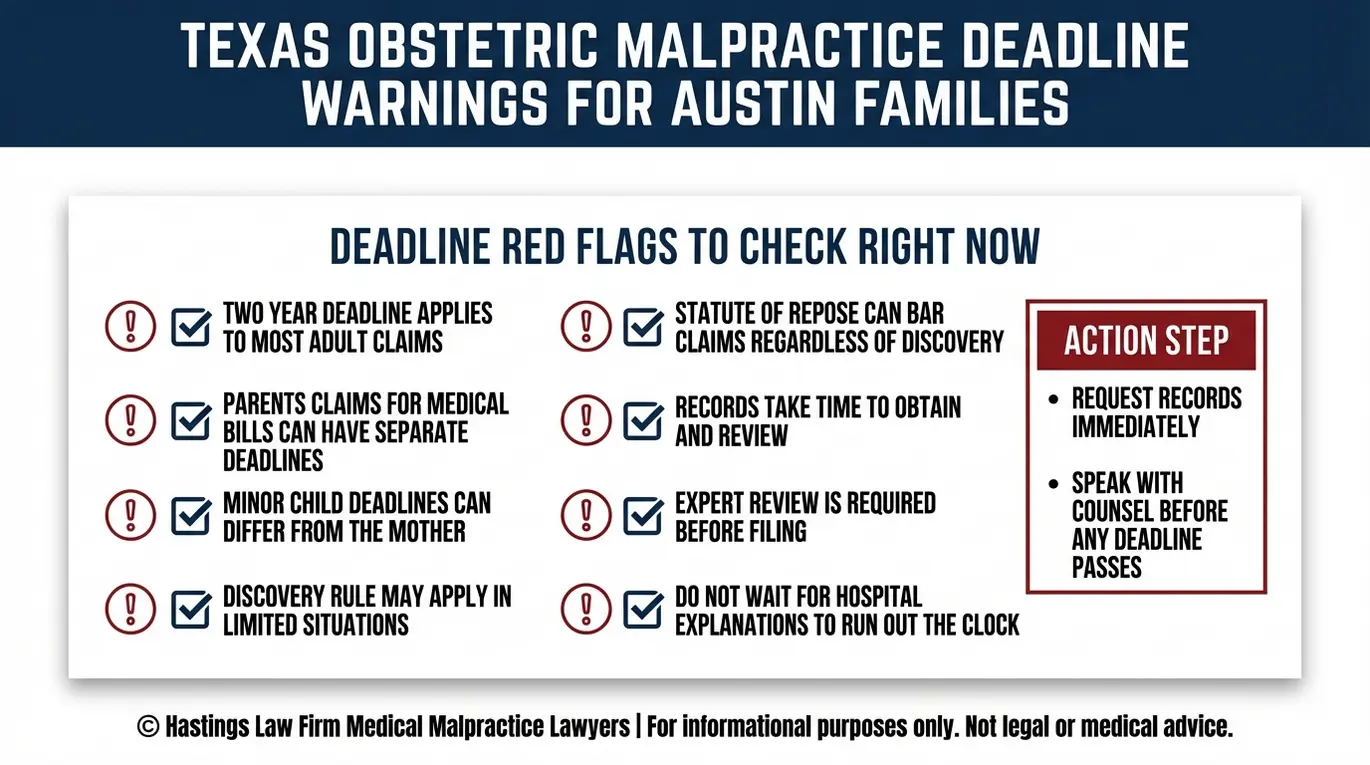
Texas law generally requires medical malpractice claims to be filed within two years of the date the negligence occurred, but exceptions exist for minors and cases where the injury was not immediately discoverable.
The Two-Year Rule
For adult patients, including mothers who were injured during delivery, the two-year statute of limitations begins running on the date of the negligent act. This deadline applies regardless of when the full extent of the injury becomes apparent. One exception is the discovery rule, which may extend the filing period if the injury could not reasonably have been discovered at the time it occurred.
The 10-Year Statute of Repose
Even with the discovery rule, Texas imposes an absolute 10-year statute of repose on medical malpractice claims. No case can be filed more than 10 years after the date of the alleged negligence. This outer boundary applies to all claimants, including minors. Texas courts apply this rule strictly.
Why Timing Matters
Medical malpractice investigations take time. Obtaining records, retaining qualified experts, and preparing the required report under Chapter 74 cannot be done overnight.
Waiting until the deadline is close puts your case at risk. The earlier we begin reviewing the records, the stronger the foundation we can build. If you believe your child or a loved one was harmed during delivery, do not wait to seek legal guidance.
Contact the Austin Birth Injury Attorneys at Hastings Law Firm Today for Help
At Hastings Law Firm, we exist for one reason: to hold negligent healthcare providers accountable and to help families move forward with the resources they need. Our entire team, including attorneys, nurse consultants, and in-house medical professionals, is dedicated exclusively to medical malpractice cases.
If your family has been affected by a birth injury or obstetric complication that you believe was preventable, we want to hear from you. Our founder, Tommy Hastings, is a board-certified trial attorney and a recognized authority in medical malpractice law. He has built this firm around the belief that every family deserves the truth about what happened.
Contact us today for a free, confidential case evaluation. There is no fee unless we recover compensation for you. Let us review what happened and explain your options.
Frequently Asked Questions About OB-GYN Malpractice in Austin


This content was researched and written by the Hastings Law Firm editorial team, which includes attorneys, medical professionals, and experienced researchers. Our writing is informed by internal knowledge and practical experience, and we cross-check critical details against authoritative sources cited throughout. Every piece undergoes human-led fact-checking and legal review. Because legal and medical information can change, if you spot an error, please contact us. Learn more about our content standards and review process on our editorial policy page.

Gabe Sassin has focused exclusively on medical malpractice law since 2007. After spending more than a decade as a malpractice defense attorney, he knows exactly how the other side works. He has seen firsthand how healthcare providers, insurers, corporate defendants, and their legal teams think, prepare, and build their defense against claims. That knowledge works for the people who need it most today, injured patients and their families. His unique experience shapes everything he writes, giving readers a look at how these cases actually work from someone who has handled them from both sides.
