


Fort Worth Birth Injury Lawyer
Written by: Hastings Law Firm | Reviewed by: Brady D. Williams | Updated: May 6, 2026
A preventable error during labor or delivery can leave a child with serious injuries and a family facing overwhelming medical and financial strain. Understanding how medical negligence is identified, how severe birth injuries are evaluated, and how responsibility may extend from individual clinicians to hospital systems can help families make informed decisions. The evidence often turns on fetal monitoring, medication records, staffing, and whether timely interventions occurred when warning signs appeared. If your child suffered harm or worse due to birth related medical negligence in Fort Worth, Texas, contact Hastings Law Firm for a free, confidential case review.

Trusted Legal Representation for Preventable Birth-Related Injuries
What You Should Know About Labor & Delivery Negligence Claims in Fort Worth:
- Long term care needs can be extensive when a birth injury causes permanent neurologic harm or disability.
- Accountability can extend beyond the delivering physician when nursing errors, hospital understaffing, equipment failures, or defective products contribute to the injury.
- Options to pursue a claim can be lost if Texas filing time limits are missed, even when evidence of negligence is strong.
- Recovery for non economic losses can be limited by Texas damage caps, while economic losses are not capped.
- Disputes over causation are common because hospitals may attribute harm to genetic factors, maternal conditions, or unavoidable complications.
- Proof can hinge on whether the care team recognized and responded to warning signs shown in fetal monitoring and clinical documentation.
- Severe outcomes can follow when key interventions are delayed, including responding to fetal distress or performing a cesarean delivery.
- The strength of the evidence can depend on preserving complete prenatal and delivery records before data is lost or overwritten.
- Compensation planning can depend on a life care plan that projects medical, therapeutic, and support needs over a child’s lifespan.

A Healthcare Focused Law Firm
When your child has been hurt during labor or delivery, and you suspect that a medical error is to blame, the weight of that realization can feel impossible to carry alone. You may be balancing your child’s immediate medical needs with a growing list of questions that no one at the hospital seems willing to answer. That confusion and frustration are completely understandable.
At Hastings Law Firm, our team of attorneys, in-house nurse consultants, and board-certified patient advocates focuses exclusively on medical malpractice. As a Fort Worth birth injury lawyer team, we exist to help families like yours find out what happened, why it happened, and what can be done about it. If you believe your child was harmed by preventable medical negligence, we invite you to contact us for a free, confidential case evaluation. There is no fee unless we recover compensation on your behalf.
Identifying Medical Negligence in Labor and Delivery Rooms
Medical negligence occurs when a healthcare provider deviates from the accepted standard of care, leading to preventable injuries such as oxygen deprivation or physical trauma during birth. To put it plainly, the standard of care is the level of treatment a reasonably competent medical professional would provide under similar circumstances. In a legal setting, establishing this standard for a birth injury case is not a guessing game; it is established through expert testimony comparing the actions taken against accepted clinical guidelines. When a doctor, nurse, or hospital falls below that standard and a child is injured as a result, the family may have grounds for a medical malpractice claim.
Under the Texas Civil Practice and Remedies Code, Section 74.001, a medical malpractice case requires proof that a provider’s actions (or failure to act) departed from accepted medical practices and directly caused harm. That legal threshold shapes every birth injury claim we evaluate.
During labor and delivery, the margin for error is narrow. A baby’s condition can change rapidly, and the medical team is expected to monitor those changes in real time and respond appropriately. When warning signs go unrecognized or get ignored, the consequences can be life-altering.
Here are some of the red flags our team looks for when reviewing labor and delivery records:
- Failure to monitor or respond to fetal distress, which refers to abnormal changes in the baby’s heart rate that may signal the baby is not getting enough oxygen. The electronic fetal monitor provides a continuous record of the baby’s status, and ignoring deceleration patterns is a critical breach of duty.
- Delayed or refused cesarean section when labor stalls or complications arise. Medical guidelines provide specific timeframes for intervention when natural delivery becomes dangerous, and ignoring these protocols can lead to catastrophic results.
- Improper management of shoulder dystocia, a condition where the baby’s shoulder becomes lodged behind the mother’s pubic bone during delivery.
- Medication errors, including incorrect dosing of labor-inducing drugs like Pitocin.
- Failure to identify or act on signs of umbilical cord compression or prolapse, which can cut off oxygen supply instantly if not addressed immediately.
As a birth injury attorney in Fort Worth, our focus is on building a clear, evidence-based timeline. We review every minute of the delivery record to determine whether the care team met the standard of care or fell short. Our in-house medical staff, including nurses who previously worked in hospital labor and delivery units, knows exactly what those records should reflect and what gaps in charting may reveal.
A medical malpractice lawyer handling these cases must understand not just the law, but the medicine. That dual understanding is central to how we evaluate every potential claim.
Classifying Severe Birth Injuries and Their Long-Term Impact
Birth injuries range from temporary physical trauma to permanent neurological conditions, with the most severe cases involving brain damage caused by oxygen deprivation or physical force. Understanding the type and mechanism of a birth injury is critical to building a strong case. This information determines how we establish causation and calculate the lifetime cost of care. The impact of these injuries extends far beyond the delivery room. Families must often manage a complex new reality involving specialists, surgeries, and educational accommodations.
Hypoxic-Ischemic Encephalopathy (HIE) is one of the most serious birth injuries we see. HIE occurs when a baby’s brain is deprived of adequate oxygen and blood flow, a condition known as perinatal hypoxia, during or near the time of delivery. If the oxygen deprivation is prolonged or severe, it can cause permanent brain damage. According to the American College of Obstetricians and Gynecologists (ACOG), neonatal encephalopathy linked to oxygen deprivation events is a recognized and studied cause of long-term neurologic disability.
HIE is closely associated with cerebral palsy, a group of disorders affecting movement, muscle tone, and coordination. When a baby’s brain is injured during delivery due to hypoxia, the resulting cerebral palsy may require lifelong therapy, adaptive equipment, and around-the-clock care. For families, the diagnosis often marks the beginning of a permanent shift in daily life, finances, and emotional well-being.
Physical trauma during delivery can also cause lasting harm. A brachial plexus injury, which is damage to the network of nerves controlling the arm and hand, often results from excessive force applied during a difficult delivery. The most well-known form is Erb’s palsy, which can cause weakness or paralysis in the affected arm. Spinal cord injuries, though less common, carry even more severe consequences and may result in partial or full paralysis.
Fort Worth birth injury attorneys at our firm evaluate each case by identifying the specific injury mechanism, because that mechanism points directly to what went wrong and who is responsible. The following table provides a general framework for how we categorize these injuries:
| Injury Mechanism | Common Injuries | Potential Cause |
|---|---|---|
| Oxygen Deprivation | Cerebral Palsy, HIE, Hypoxia-related brain injury | Delayed C-section, cord compression, placental abruption |
| Physical Trauma | Erb’s Palsy (brachial plexus), spinal cord injuries, bone fractures | Excessive traction, improper delivery technique, shoulder dystocia mismanagement |
| Instrument Misuse | Skull fractures, nerve damage, lacerations, intracranial hemorrhage | Improper use of forceps or vacuum extractor |
Legal representation for birth injuries requires more than familiarity with legal procedure. It demands the ability to connect a specific clinical failure to a specific injury. That connection, known as causation, is the foundation of every claim. Our law firm for birth trauma builds that connection using independent medical experts, hospital records, and fetal monitoring data.

The Hastings Law Firm Difference
Results matter, but what truly sets us apart is how we achieve them. Every verdict, every settlement, and every Fort Worth courtroom victory comes from one guiding promise: To treat each client’s fight for justice as if it were our own.
This balance of skill, experience, and empathy reflects our core philosophy that justice should not only compensate the injured, but also make healthcare safer nationwide.

Liability for Obstetricians and Hospital Systems in Tarrant County
Liability can extend beyond the delivering physician to include nurses for medication errors, the hospital for inadequate staffing, or pharmaceutical companies for defective drugs. Determining responsibility for a labor and delivery error requires a careful review of what each party did or failed to do during the course of care.
Physician liability often involves errors in clinical judgment. An obstetrician who fails to recognize the signs of fetal distress, delays ordering a cesarean section, or improperly uses delivery instruments like forceps or a vacuum extractor may be held accountable for the resulting injuries. These cases also sometimes involve complications like placental abruption, the premature separation of the placenta from the uterine wall, or uterine rupture, a tear in the uterus that can be catastrophic for both mother and baby. When a physician fails to diagnose or respond to these emergencies in time, the consequences can be devastating.
Nursing staff also carry significant responsibility. Nurses are typically the first to observe changes in the mother’s or baby’s condition. If a nurse administers the wrong medication, gives an incorrect dosage, or fails to alert the physician to signs of distress, that failure may independently support a negligence claim. Through the legal doctrine of vicarious liability, a hospital may be held responsible for the negligence of its employee nurses or technicians.
Hospital and institutional liability is governed by Texas Civil Practice and Remedies Code Chapter 74, which establishes the framework for medical liability claims in the state. Hospitals can be held responsible for systemic failures, including understaffing during high-risk deliveries, failure to maintain functioning equipment, or credentialing physicians who lack the qualifications to manage obstetric emergencies. While often associated with nursing home abuse & neglect cases, failures in basic hygiene and monitoring standards are equally unacceptable in a labor and delivery unit. Claims may also involve pharmaceutical injury from unsafe drugs or harm caused by defective medical devices used during the procedure.
As a birth injury lawyer serving Fort Worth, we examine every level of the care chain. Our team includes former defense attorneys who previously represented hospitals, which means we understand how these institutions build their defense. That perspective allows us to identify where the breakdowns occurred and hold the right parties accountable. We approach claims involving single providers or multiple defendants as a hospital negligence attorney would: with a focus on the evidence, the timeline, and the systemic context surrounding the injury.
The Forensic Approach to Investigating Birth Injury Claims
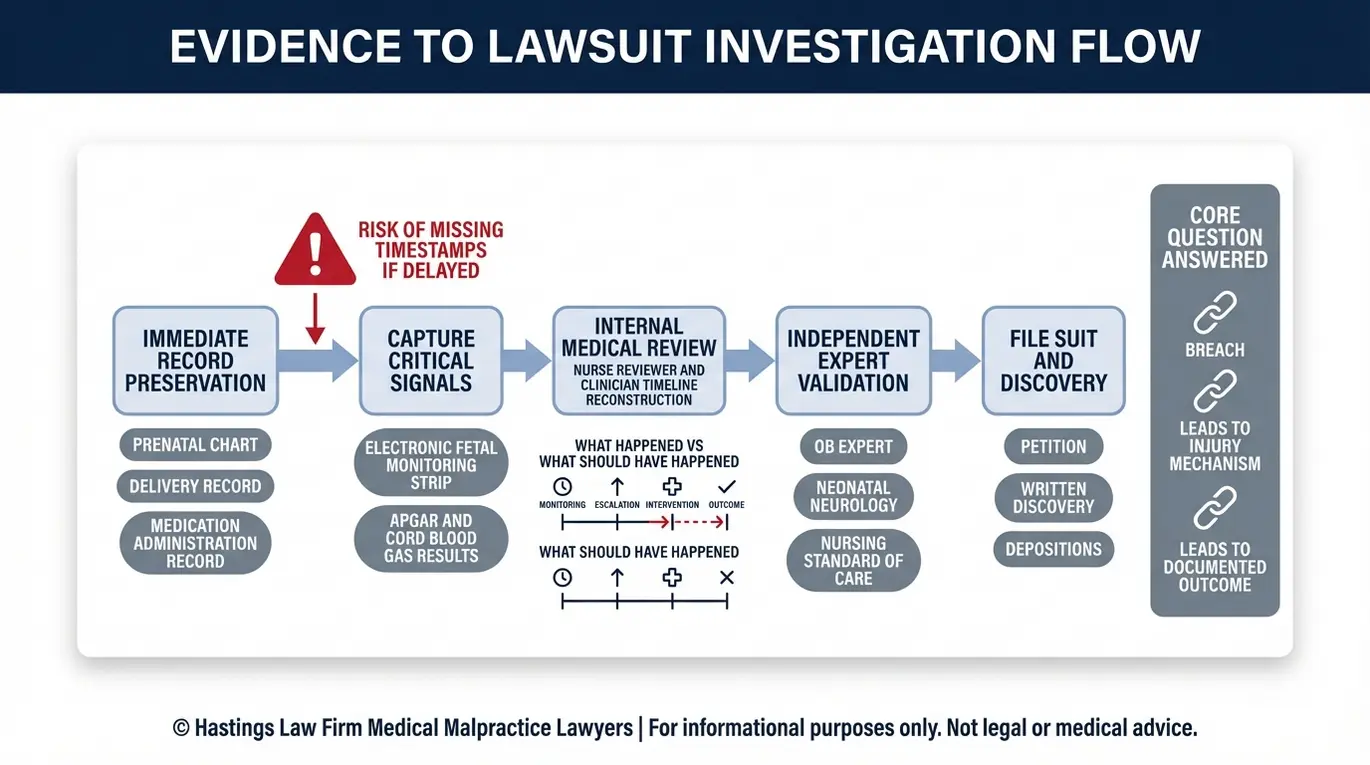
A thorough investigation involves securing all prenatal and delivery records, electronic fetal monitoring strips, and staffing logs to be analyzed by independent medical experts. This process begins immediately because records can be altered, overwritten, or lost if there is a delay.
Our Fort Worth birth injury counsel follows a structured, step-by-step process for every medical malpractice investigation:
Step 1: Immediate Record Preservation. The first priority is securing the complete medical file. This includes admission records, physician and nursing notes, medication administration records, and electronic fetal monitoring (EFM) strips. We also request staffing schedules, chain-of-command logs, and communication records between nurses and physicians.
Hospitals typically have strict retention policies, but critical data like EFM metadata can sometimes be harder to access later. Prompt action ensures the digital footprint of the delivery is preserved intact.
Step 2: In-House Medical Review. Once the records are secured, our in-house medical staff, including nurse practitioners and board-certified patient advocates, conducts a detailed clinical review. They analyze the EFM strips minute by minute, looking for patterns of fetal distress that should have prompted intervention. They also review whether operative vaginal delivery, the use of forceps or a vacuum extractor, was performed appropriately and whether the decision-making timeline aligns with accepted clinical protocols. The Agency for Healthcare Research and Quality (AHRQ) provides standardized evaluation frameworks that inform how clinical workflows and documentation are assessed.
Step 3: Independent Expert Validation. After the internal review, we consult our national network of medical experts. These are practicing physicians, maternal-fetal medicine specialists, and neonatologists who can offer an objective opinion on whether the standard of care was breached and whether that breach caused the injury. Their role is to validate the causation link between the clinical failure and the outcome and provide the necessary expert testimony should the case proceed to trial.
Step 4: Filing and Litigation. With the medical evidence assembled, we draft and file the petition, then move into formal discovery. This phase involves the legal exchange of evidence between parties, including depositions of the treating physicians and nurses, requests for internal hospital communications, and additional expert analysis as needed.
Here is a summary checklist of evidence we typically secure and review:
- Complete prenatal and delivery medical records
- Electronic fetal monitoring strips
- Nursing shift notes and staffing logs
- Medication administration records
- Physician orders and progress notes
- Internal hospital incident reports (if available)
- Equipment maintenance and calibration records
- Expert medical opinions on standard of care and causation
Guidance on Choosing Between Settlement and Litigation
Some birth injury medical malpractice cases resolve through negotiated settlement. Others require a jury trial to achieve fair value. A settlement is an agreement to end the case for a specific amount, whereas litigation involves the formal legal process of taking a case through the court system.
Because Hastings Law Firm prepares every case from day one as if it will go to trial, we approach settlement negotiations from a position of strength. Defense attorneys and insurance carriers can tell the difference between a firm that is ready to try a case and one that is looking for a quick resolution. That preparation gives our clients a real advantage at the negotiation table.
When the other side refuses to offer fair compensation, we are fully prepared to present the case to a jury to seek a just verdict. The decision between settlement and litigation is always made in partnership with the client, based on a clear understanding of the risks, the costs, and the potential outcomes.
Calculating Damages and Securing Your Child’s Future
Compensation in birth injury cases is calculated to cover lifetime medical needs, lost earning capacity, and non-economic damages like pain, suffering, and loss of quality of life. Because many birth injuries result in permanent disability, the financial scope of these medical malpractice claims can be substantial. The goal of civil litigation in these matters is to help the family manage long-term needs.
While no amount of compensation can undo a physical injury, it can ensure that a child has access to the best possible care without bankrupting the family.
Economic damages represent the measurable financial losses a family will face over the child’s lifetime. This category is not speculative; it is based on hard numbers and expert projections regarding the cost of inflation and medical advancements. These include:
- Past and future medical expenses, including surgeries, hospitalizations, and specialist care
- Physical, occupational, and speech therapy
- Specialized equipment such as wheelchairs, communication devices, and adaptive technology
- Home modifications to accommodate mobility limitations
- In-home nursing or attendant care, which is often required for children with severe CP
- Lost future earning capacity if the child’s disability prevents them from working as an adult
Non-economic damages address the human cost of the injury. These are harder to quantify but no less real:
- Physical pain and suffering
- Mental anguish experienced by the child and, in some cases, the parents
- Physical impairment and disfigurement
- Loss of enjoyment of life and diminished quality of daily experience
In the most tragic situations, where a birth injury results in the death of a child, families may also pursue a wrongful death claim to recover funeral costs, loss of companionship, and other related damages.
The Life Care Plan is one of the most important tools in a birth injury case. The Life Care Plan, a detailed, professionally prepared document that projects every medical, therapeutic, and support need the child will have over their expected lifespan, often spans 40 to 50 years or more. According to the Journal of Life Care Planning, these plans are developed by certified professionals who assess current medical status, future care requirements, and associated costs in a structured, defensible format.
As a Fort Worth medical malpractice lawyer, we work closely with life care planners, forensic economists, and medical specialists to build a damages model that reflects the true cost of the injury. Presenting this evidence effectively is what separates an adequate settlement from one that actually protects your child’s future. Compensation for birth injuries must account not only for what has been lost, but for every resource your child will need going forward. We approach damages in birth injury cases with that long-term perspective, because a number that sounds large today may fall short decades from now without careful, expert-driven projections.
Understanding Texas Time Limits for Filing a Lawsuit
In Texas, the general statute of limitations for medical malpractice is two years, but specific tolling rules apply to minors, often allowing claims to be filed until the child reaches age 14. Missing these deadlines can permanently bar your family from pursuing a claim, regardless of how strong the evidence is. Understanding these legal deadlines is complex, and mistakes can be fatal to the case.
The Two-Year Rule for Parents’ Claims. If you, as a parent, suffered harm during the delivery or incurred medical expenses on behalf of your child, your personal claims are generally subject to a two-year statute of limitations. That clock typically starts on the date of the injury or, in some circumstances, the date the injury was discovered or should have been discovered. For parents, this deadline can arrive quickly, especially when the early months and years are consumed by the child’s medical care.
The Tolling Rule for Minors. Texas law provides an important exception for injured children. Because a minor cannot file a lawsuit on their own behalf, the statute of limitations for birth injuries is “tolled,” or paused, until the child turns 12 years old. The child then has two years from that date, meaning the claim must typically be filed before the child’s 14th birthday. This extended window applies only to the child’s own claims, such as pain and suffering or future lost earnings, not to the parents’ separate claims.
The Ten-Year Statute of Repose. Even with tolling, Texas imposes a hard outer boundary. The statute of repose is 10 years from the date of the alleged negligence. This is an absolute cutoff.
No matter when the injury was discovered or how old the child is, no medical malpractice claim can be filed after this 10-year window closes. This deadline applies regardless of other tolling provisions and cannot be extended.
The statute of limitations for birth injuries is one of the most common reasons families lose the right to pursue a claim. Even if you are unsure about the strength of your case, consulting with an attorney early protects your options. Waiting until the last minute can be detrimental to the case, as evidence may degrade and memories fade.
Early consultation ensures that all procedural requirements are met well before these critical dates arrive. At Hastings Law Firm, our initial case evaluation is designed to identify applicable deadlines so your family does not lose the opportunity to seek answers.

Contact the Fort Worth Birth Injury Attorneys at Hastings Law Firm Today for Help
If your child was injured during labor or delivery, and you believe the care your family received fell below the standard you deserved, Hastings Law Firm is here to help you understand what happened and what your legal options are.
Our firm is built around a single mission: restoring trust for families who have been let down by the medical system. We are led by Tommy Hastings, a board-certified trial attorney (a distinction held by less than 2% of Texas lawyers), and supported by a team of attorneys, nurse consultants, and patient advocates who focus exclusively on medical malpractice. We do not divide our attention across unrelated areas of law. Every resource in our firm is directed toward investigating medical negligence and holding responsible parties accountable.
Contact us today for a free, confidential case evaluation. There is no obligation and no fee unless we secure a recovery for your family. Let us review what happened and explain your options.
Frequently Asked Questions About Birth Injury in Fort Worth

Key Birth Injury Terms:
- Fetal distress
- A condition during labor where the unborn baby shows signs of not getting enough oxygen or experiencing other stress, typically detected through abnormal heart rate patterns on monitoring equipment. In a medical malpractice case, failing to recognize or respond to fetal distress can lead to permanent injury or death.
- Shoulder dystocia
- A delivery complication that occurs when the baby’s shoulder becomes stuck behind the mother’s pelvic bone after the head has already been delivered. This emergency requires immediate and proper maneuvers by the medical team to prevent nerve damage or oxygen deprivation to the baby.
- Perinatal hypoxia (oxygen deprivation)
- A condition where a baby receives insufficient oxygen during the period immediately before, during, or after birth. This oxygen deprivation can cause permanent brain damage, cerebral palsy, or other serious neurological conditions if not prevented or promptly treated.
- Brachial plexus injury
- Damage to the network of nerves that sends signals from the spine to the shoulder, arm, and hand, often caused by excessive pulling or stretching during a difficult delivery. This injury can result in weakness, loss of movement, or paralysis of the affected arm, with Erb’s Palsy being the most common type.
- Placental abruption
- A serious pregnancy complication where the placenta separates from the uterine wall before delivery, potentially cutting off the baby’s oxygen and nutrient supply. This medical emergency requires immediate intervention, and failure to recognize warning signs or act quickly can result in severe harm to mother and baby.
- Uterine rupture
- A rare but catastrophic event where the muscular wall of the uterus tears during pregnancy or labor, most commonly occurring in women with prior cesarean sections. This emergency threatens the lives of both mother and baby and requires immediate surgical intervention.
- Electronic fetal monitoring (EFM) strips
- Printed or digital records that continuously track the baby’s heart rate and the mother’s contractions during labor. These strips provide critical evidence in birth injury cases, showing whether medical staff properly monitored the baby and responded appropriately to warning signs of distress.
- Operative vaginal delivery (forceps or vacuum extractor)
- A delivery method where the doctor uses medical instruments to assist in pulling the baby through the birth canal when labor is not progressing or the baby is in distress. Improper use of forceps or vacuum extractors can cause skull fractures, brain bleeding, nerve damage, or other serious injuries.
- Life care plan
- A detailed document prepared by medical and economic experts that projects all future medical needs, therapies, equipment, medications, and care costs for an injured child over their entire lifetime. In a birth injury case, this plan is essential for calculating the full amount of compensation needed to provide for the child’s future.
- Texas Civil Practice and Remedies Code, Section 74.001 | Texas Legislature Online
- Neonatal Encephalopathy and Neurologic Outcome | ACOG
- Texas Civil Practice and Remedies Code Chapter 74 | Texas Legislature Online
- Checklist | Digital Healthcare Research
- A Comparison of the Definition of a Life Care Plan The Impact on Life Care Planners | Journal of Life Care Planning
- Patient Information and Medical Records | Texas Medical Board
Get Answers Today
If you think that medical negligence, a dangerous drug, or a failed medical product caused harm to you or someone you love, our team is standing by to offer guidance. We’ll explain your options under current laws and help you move forward with clarity and understanding. Case reviews are free and 100% confidential.
