


Fort Worth OB-GYN Malpractice Lawyer
Written by: Hastings Law Firm | Reviewed by: Brady D. Williams | Updated: July 27, 2026
OB GYN negligence during pregnancy, delivery, or gynecological care can leave families facing lasting harm, unanswered questions, and overwhelming uncertainty. Common concerns involve missed warning signs, delayed emergency decisions, surgical mistakes, and failures to diagnose serious pregnancy related complications. These events can affect both mother and child, sometimes leading to permanent injury or fatal outcomes, and the details often turn on what the medical record shows about monitoring, communication, and timely treatment. If you or a loved one were harmed or worse due to OB GYN malpractice in Fort Worth, Texas, contact Hastings Law Firm for a free, confidential case review.

Trusted Fort Worth Medical Attorneys for Obstetrics Negligence Claims
What You Should Know About Obstetrician Negligence Claims in Fort Worth:
- Long term harm can follow when fetal distress is not recognized or acted on promptly during labor.
- Permanent brain injury can result when oxygen deprivation is prolonged due to delayed response to warning signs.
- Severe maternal outcomes can occur when preeclampsia is missed or untreated, including seizures, stroke, organ failure, and maternal death.
- Fatal outcomes can occur when postpartum hemorrhage is not recognized or treated with timely intervention.
- Liability can expand beyond an individual physician when an on call hospital assigned OB GYN is involved in the care.
- Options can be lost if Texas procedural requirements are not met, even when the underlying claim has merit.
- Recovery for pain and suffering can be limited in Texas, while economic losses like medical expenses and lost income are not capped.
- Case viability can turn on whether a required expert report is served on time, since missing the deadline can lead to dismissal with prejudice.
- Surgical complications can require additional surgeries when injuries occur during hysterectomies or C sections, such as ureter damage or retained surgical items.
- Accountability can depend on what clinical documentation shows, including fetal monitoring data, nursing notes, medication logs, and operative reports.

A Healthcare Focused Law Firm
When something goes wrong during pregnancy, delivery, or gynecological care, the emotional weight can feel unbearable. You trusted your doctor with your health or your child’s life, and now you’re left with questions no one seems willing to answer. That uncertainty is valid, and you deserve clarity about what happened and what options are available to you.
As a Fort Worth OB-GYN malpractice lawyer team, Hastings Law Firm focuses exclusively on medical malpractice. Our legal and medical professionals work together to examine your records, identify where the standard of care may have been violated, and build a case designed for trial from the very first day.
If you believe you or your child were harmed by negligent obstetric or gynecological care, we offer a free, confidential case evaluation to help you understand your rights.
Types of OB-GYN Malpractice Cases We Handle in Fort Worth
OB-GYN malpractice cases typically fall into two categories: obstetrical negligence involving pregnancy and childbirth injuries, or gynecological errors involving surgical mistakes and misdiagnosis of female reproductive health issues. Understanding which category applies to your situation is the first step toward knowing how a claim may proceed.
Obstetrical negligence includes injuries that occur during prenatal care, labor, or delivery. These obstetrician negligence claims often involve:
- Failure to monitor or respond to signs of fetal distress
- Delayed or improperly performed C-sections
- Shoulder dystocia, a complication where the baby’s shoulder becomes lodged behind the mother’s pubic bone during delivery
- Injuries from operative vaginal delivery, meaning the use of forceps or vacuum extraction to assist in birth
- Medication errors during labor induction
Gynecological malpractice involves errors in the diagnosis or surgical treatment of conditions affecting the female reproductive system. These cases may include:
- Surgical negligence and injuries during hysterectomies or laparoscopic procedures
- Failure to diagnose gynecological cancers
- Lack of informed consent before a procedure
- Complications from improperly performed surgeries in outpatient clinics or hospital settings, including facilities like Texas Health Harris Methodist
As a Fort Worth OB-GYN malpractice lawyer team, we handle both obstetrical and gynecological claims across Tarrant County. We also represent families in gynecological malpractice lawsuits where serious errors occurred. Whether the injury happened during a routine office visit or an emergency delivery, the central question is the same: did the provider meet the accepted standard of care?
We manage malpractice cases involving medical liability disputes between private physicians and hospital staff. Our Fort Worth OB-GYN negligence attorneys are prepared to handle these complex legal landscapes to secure justice for your family.
Liability for On-Call OB-GYNs vs Private Doctors
Medical liability can look different depending on who provided your care. If you were treated by your own private OB-GYN, that physician may bear direct responsibility for any negligent decisions. But if a hospital-assigned, on-call physician managed your care, the hospital itself may also share liability under theories of hospital negligence.
Understanding the liability for on-call physicians is important because employment status often dictates who is legally responsible for medical errors. We examine the call schedules, hospital policies, and clinical records to determine exactly who was responsible for your care and whether the standard of care was met at every level.

Common Obstetrical Errors Resulting in Birth Injuries
Common obstetrical errors include failure to monitor fetal distress, delaying a necessary C-section, improper use of forceps or vacuum extractors, and medication errors during labor induction. When any of these mistakes occur, the consequences for both mother and child can be severe and lifelong.
One of the most preventable errors involves misreading or ignoring electronic fetal monitoring (EFM) strips, the continuous tracings that record a baby’s heart rate during labor. These strips can reveal early signs of fetal distress. When providers fail to interpret them correctly or delay their response, the baby may be deprived of oxygen long enough to cause permanent brain damage. A birth injury lawyer at our firm often sees cases where these warnings were missed.
That oxygen deprivation can lead to hypoxic-ischemic encephalopathy (HIE), a type of brain injury caused by reduced blood flow and oxygen to the baby’s brain around the time of birth. HIE is one of the most serious outcomes in birth injury cases and can result in cerebral palsy, developmental delays, and seizure disorders.
Medication errors also contribute to preventable birth injuries. Pitocin, commonly used to induce or strengthen contractions, requires careful dosing and monitoring. Excessive doses can cause contractions that are too strong or too frequent, which may lead to uterine rupture or fetal distress. Errors by an OB-GYN often include C-section errors, such as delaying the procedure despite clear indicators of danger.
| Obstetrical Error | Potential Consequence |
|---|---|
| Failure to interpret fetal monitoring strips | Delayed response to fetal distress; oxygen deprivation |
| Delayed emergency C-section | HIE, cerebral palsy, or stillbirth |
| Improper use of forceps or vacuum | Shoulder dystocia, nerve damage, skull fractures |
| Pitocin mismanagement | Uterine rupture, fetal distress |
| Failure to identify breech presentation | Complicated delivery, emergency surgery |
As a Fort Worth OB-GYN malpractice lawyer team and experienced Fort Worth birth injury attorney group, we reconstruct the labor timeline minute by minute. We review fetal monitoring data, nursing notes, and medication logs to determine whether the standard of care was followed or whether preventable errors caused the injury.
The Hastings Law Firm Difference
Results matter, but what truly sets us apart is how we achieve them. Every verdict, every settlement, and every Fort Worth courtroom victory comes from one guiding promise: To treat each client’s fight for justice as if it were our own.
This balance of skill, experience, and empathy reflects our core philosophy that justice should not only compensate the injured, but also make healthcare safer nationwide.

Gynecological Surgical Errors During Hysterectomies and C-Sections
Surgical errors in gynecology often involve accidental perforation of the bowel or bladder, ureter injuries during hysterectomies, or leaving foreign objects inside the patient after a C-section. These complications, when caused by negligence rather than recognized surgical risk, may support a malpractice claim.
A ureter injury, meaning damage to the tube that carries urine from the kidney to the bladder, is one of the more common and serious hysterectomy complications. If not identified and repaired promptly, it can lead to kidney damage, infection, or the need for additional surgeries. A surgical malpractice lawyer can help determine if this injury was preventable.
Another preventable error is a retained surgical item (RSI), which refers to any instrument, sponge, or device left inside a patient’s body after a procedure. Standardized counting protocols exist specifically to prevent this, and a failure to follow them points to a breakdown in the standard of care. We also review cases for surgical negligence involving uterine rupture or placenta accreta that may have been mishandled during surgical intervention.
Common surgical complications we evaluate include:
- Bowel or bladder perforation during hysterectomy
- Ureter damage from improper surgical technique
- Retained sponges, instruments, or device fragments after C-section
- Failure to detect internal bleeding before closing the surgical site
- Anesthesia errors during gynecological procedures, including incorrect dosing or failure to monitor the patient’s airway
A Fort Worth OB-GYN malpractice lawyer at our firm works alongside in-house nursing professionals to review operative reports and post-surgical records. If you need a gynecological error attorney, we look for gaps in documentation, deviations from accepted technique, and delays in recognizing and treating complications.
Failure to Diagnose Preeclampsia and Other Critical Conditions
Failure to diagnose preeclampsia occurs when a doctor overlooks high blood pressure and protein in the urine, potentially leading to seizures (eclampsia), stroke, or organ failure in the mother. Early detection is one of the most important responsibilities an OB-GYN has during pregnancy, and a missed diagnosis can have devastating consequences.
Preeclampsia is a pregnancy-related condition marked by dangerously high blood pressure and signs of organ damage, most commonly affecting the kidneys and liver. When preeclampsia goes undetected or untreated, it can progress to eclampsia, a life-threatening condition involving seizures that can harm both the mother and baby. In the worst cases, this negligence can lead to maternal death.
The warning signs are well established in the medical literature. According to Temple Health’s overview of preeclampsia symptoms, common indicators include persistent headaches, sudden swelling in the face and hands, vision changes, and upper abdominal pain. These symptoms are sometimes dismissed as routine pregnancy discomfort, but they should prompt immediate evaluation, including blood pressure checks and urine protein screening.
OB-GYN negligence in this context can take several forms: failing to order routine labs, ignoring elevated blood pressure readings at prenatal visits, or discharging a patient from the hospital without adequate follow-up after concerning symptoms. The standard of care requires providers to monitor for these conditions at every prenatal appointment and respond promptly when warning signs appear.
Misdiagnosis is not limited to preeclampsia. Gynecological cancers, including cervical and ovarian cancer, can also go undetected when providers fail to follow up on abnormal test results or dismiss persistent symptoms. A malpractice lawyer in Fort Worth can help determine whether a delayed or missed diagnosis fell below the accepted standard. If you have been affected, filing a failure to diagnose lawsuit may be necessary to secure accountability.

Legal Action for Maternal Death and Severe Hemorrhage
Legal action for maternal death involves proving that the physician failed to manage complications like postpartum hemorrhage or infection, directly resulting in the loss of the mother’s life. These are among the most emotionally difficult cases we handle, and we approach them with the seriousness and care they demand.
Postpartum hemorrhage (PPH), defined as excessive bleeding after delivery, remains one of the leading causes of maternal death in the United States. According to the CDC’s research on preventing pregnancy-related deaths, the majority of these deaths are preventable with timely intervention. When medical teams fail to recognize or respond to hemorrhaging, the consequences can be fatal.
Placenta accreta spectrum (PAS), a condition in which the placenta attaches too deeply into the uterine wall, significantly increases the risk of catastrophic bleeding during or after delivery. Providers who identify risk factors for PAS are expected to prepare a delivery plan that accounts for the possibility of severe hemorrhage, including assembling the right surgical team and ensuring blood products are available. Failure to adhere to the standard of care in these situations is often the basis for a claim.
For families who have lost a mother due to OB-GYN negligence, a wrongful death claim can provide financial security for the surviving children and hold the responsible parties accountable. A Fort Worth OB-GYN malpractice lawyer at our firm examines every aspect of the care provided, from prenatal risk assessments to the delivery room response. As a maternal death lawyer and wrongful death attorney team, we fight for justice for grieving families.
Specific Protocols for Maternal Death and Hemorrhaging
Hospitals are expected to follow established medical protocols when a mother begins hemorrhaging. One of the most critical is the massive transfusion protocol (MTP), a predetermined plan for rapidly delivering large volumes of blood products to a patient experiencing life-threatening blood loss like postpartum hemorrhage.
Medical teams follow these standardized plans to manage emergency situations where seconds matter. Deviation from these protocols can be powerful evidence of negligence. We review hospital policies, blood bank records, nursing flowsheets, and provider communication logs to determine whether the standard of care was followed.
If a facility failed to activate its MTP in time, did not have adequate blood products available, or delayed surgical intervention, those failures may have directly contributed to the outcome.
Navigating Texas Laws and Chapter 74 Requirements
Texas Civil Practice and Remedies Code Chapter 74 governs medical malpractice claims, imposing strict procedural hurdles such as mandatory expert reports and caps on non-economic damages. Understanding these rules is essential because even a valid claim can be dismissed on procedural grounds if the requirements are not met.
Texas tort reform, enacted in 2003, fundamentally changed the medical liability landscape. Chapter 74 introduced several hurdles that make filing a malpractice case significantly more complex than a standard negligence claim:
- Mandatory expert reports must be served within 120 days of the date each defendant’s original answer is filed
- Non-economic damage caps limit recovery for pain and suffering to $250,000 per claimant against all individual physicians and providers combined, and $250,000 per healthcare institution, up to $500,000 total across all healthcare institutions
- Pre-suit notice requirements mandate that defendants receive written notice at least 60 days before a lawsuit is filed
- Qualified expert standards require that the expert witness be a physician with knowledge of the accepted standards of care and who is qualified by training or experience to offer opinions on those standards
These requirements are why choosing an OB-GYN malpractice lawyer with specific experience in Texas malpractice laws matters. A general personal injury attorney may not be prepared for the procedural demands Chapter 74 imposes on Fort Worth medical negligence cases. At Hastings Law Firm, every case is built with these requirements in mind from the very beginning, so deadlines are met and claims are structured to withstand defense challenges.
The Critical Role of Expert Reports in Medical Litigation
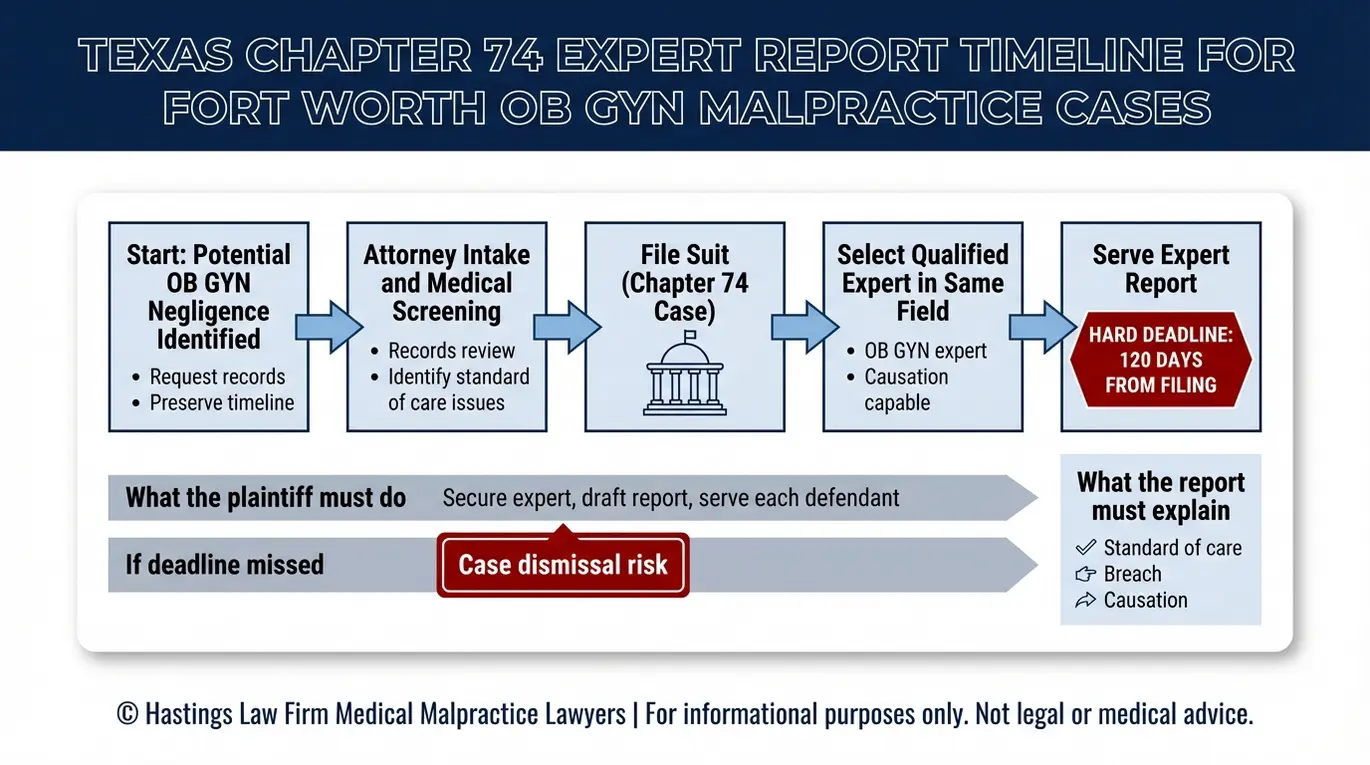
In Texas, a plaintiff must serve an expert report within 120 days of the date each defendant’s original answer is filed, detailing the standard of care, how it was breached, and how that breach caused the injury. This is not optional. Missing this deadline results in mandatory dismissal of your case with prejudice, meaning you cannot refile.
This report acts as a mandatory screening tool for all medical negligence lawsuits in Texas to ensure the claim has clinical merit. The report must be written by a qualified medical expert witness who is a physician with knowledge of the accepted standards of care for the condition at issue and who is qualified by training or experience to offer opinions on those standards.
In an OB-GYN malpractice case, that means the report should come from a physician with direct knowledge and experience in obstetrics or gynecology. The report needs to accomplish three things: define the applicable standard of care, explain how the defendant fell below that standard, and establish causation between the breach and your injury.
Texas Chapter 74 Expert Report Requirements (120-Day Rule)
Under Texas Civil Practice and Remedies Code § 74.351, the 120-day clock begins on the date each defendant’s original answer is filed. This deadline is strictly enforced by courts in Tarrant County and throughout Texas.
This is one of the primary reasons families should consult a Fort Worth OB-GYN malpractice lawyer as early as possible. Identifying the right medical expert, obtaining and reviewing all relevant records, and drafting an expert report requirement compliant document takes time. At Hastings Law Firm, our in-house medical staff begins reviewing records immediately after a case is accepted, allowing our attorneys to engage qualified experts and prepare the report well before the deadline.
If the defense successfully challenges the adequacy of the report, the court may grant a 30-day extension to cure deficiencies, but that extension is not guaranteed. The safest approach is to get it right the first time.
Understanding the Statute of Limitations for Texas Malpractice
The statute of limitations for medical malpractice in Texas is generally two years from the date of the negligence, though exceptions exist for minors and cases where the injury was not immediately discoverable. If you do not file your lawsuit within that window, you lose the right to pursue a claim, regardless of how strong the evidence may be.
There are limited exceptions to this two-year rule:
- The Discovery Rule: If the injury was not immediately apparent, the clock may begin on the date the injury was discovered or reasonably should have been discovered. This can apply to cases involving a missed diagnosis or a retained surgical item found months later.
- Minors: For children under 12 years old at the time of the injury, the statute of limitations is extended until the child’s 14th birthday.
- The Statute of Repose: Texas imposes a hard 10-year outer limit. Regardless of when the injury is discovered, no medical malpractice claim can be filed more than 10 years after the date of the negligent act. This applies even in cases involving minors.
This time limit to sue represents the final date a patient can file a legal claim for damages. Because these deadlines are rigid and the procedural requirements under Chapter 74 add additional time pressure, consulting an OB-GYN malpractice lawyer early gives your legal team the best opportunity to investigate, secure expert opinions, and file before the time limit expires.
Recoverable Damages for Obstetric and Gynecologic Injuries
Recoverable damages include economic costs like past and future medical bills and lost wages, as well as non-economic damages for pain, suffering, and physical impairment. The total value of a claim depends on the severity of the injury, the long-term care needs, and the impact on the patient’s daily life and earning capacity.
| Economic Damages | Non-Economic Damages |
|---|---|
| Past and future medical expenses | Physical pain and suffering |
| Lost wages and future earning capacity | Mental anguish and emotional distress |
| Rehabilitation and therapy costs | Loss of consortium (spousal relationship) |
| Life care plan expenses (for permanent injuries) | Physical impairment and disfigurement |
| Home modifications and assistive equipment | Loss of enjoyment of life |
In cases involving a child with a permanent birth injury such as cerebral palsy, the economic damages alone can be substantial. A life care plan, developed by medical and vocational experts, projects the lifetime cost of therapies, medications, adaptive equipment, surgeries, and around-the-clock care. Research published by the National Institutes of Health on the economic costs of childhood disability confirms that these future medical costs often reach into the millions over a lifetime.
For women who lose their fertility or reproductive organs due to gynecological negligence, damages also account for the profound personal and emotional impact of that loss. A Fort Worth OB-GYN malpractice lawyer at our firm works with medical experts to secure full compensation for birth injury and other damages in malpractice cases.
Impact of Texas Non-Economic Damage Caps
Texas law caps non-economic damages at $250,000 per claimant against all individual physicians and providers combined, and $250,000 per healthcare institution, up to $500,000 total across all healthcare institutions. These damage caps apply to pain, suffering, and mental anguish, but they do not apply to economic damages like medical expenses and lost income.
Because of these limits, the way a claim is structured matters significantly. Our Fort Worth OB-GYN malpractice lawyer team focuses on thoroughly documenting every economic loss, including future costs that may not be immediately obvious. By building detailed life care plans and retaining economists to project lifetime losses, we work to ensure that the recoverable damages reflect the true financial burden the injury has caused.
Why Partner with Hastings Law Firm for Your Claim
Partnering with Hastings Law Firm ensures you are represented by Board Certified specialists who utilize in-house medical experts and a trial-ready strategy to challenge powerful hospital systems. We do not handle car accidents, slip-and-fall cases, or any other type of personal injury. Medical malpractice is our exclusive focus.
That focus gives us a distinct advantage. Our legal team includes former defense attorneys who previously represented hospitals and insurance carriers. They understand the tactics the other side will use because they used to deploy them. This perspective shapes how we investigate, how we build our arguments, and how we prepare for depositions and as a trial lawyer team.
You pay nothing unless we recover compensation for you. Every case begins with a free, confidential evaluation, and our no fee guarantee contingency fee structure means there is no financial risk to you for hiring a malpractice attorney. We strive to be the best OB-GYN lawyer choice for your family’s needs.
In-House Nursing Professionals for Medical Record Review
One of the most important advantages we offer as a Fort Worth OB-GYN malpractice lawyer firm is immediate access to in-house nursing professionals. Our team includes nurse practitioners and board-certified nurse consultants who review your medical records with clinical expertise.
These professionals know how to read nursing flowsheets, interpret electronic health records, and identify charting inconsistencies that outside reviewers might overlook. In OB-GYN cases, the details buried in nursing notes, fetal monitoring strips, and medication administration records often contain the most important evidence. Having clinical professionals embedded in our legal team allows us to identify potential breaches in the standard of care faster and build stronger cases from the outset.
Contact the Fort Worth Birth Injury Attorneys at Hastings Law Firm Today for Help
If you or your child suffered an injury due to negligent OB-GYN care, you do not have to face this alone. The answers you are looking for may be buried in your medical records, and our team has the legal and clinical expertise to find them.
Hastings Law Firm offers a confidential, no-obligation evaluation led by a patient advocate who can help you understand whether you have a case. There are no upfront fees or costs. We only get paid if we secure a recovery for you.
Time limits under Texas law are strict, so the sooner you reach out, the more time our team has to investigate and protect your claim. Contact our Fort Worth OB-GYN malpractice lawyer team today to take the first step toward getting the answers and accountability your family deserves. Please contact our firm today.
Frequently Asked Questions About OB-GYN Malpractice in Fort Worth


This content was researched and written by the Hastings Law Firm editorial team, which includes attorneys, medical professionals, and experienced researchers. Our writing is informed by internal knowledge and practical experience, and we cross-check critical details against authoritative sources cited throughout. Every piece undergoes human-led fact-checking and legal review. Because legal and medical information can change, if you spot an error, please contact us. Learn more about our content standards and review process on our editorial policy page.

Brady D. Williams is a nationally recognized medical malpractice attorney who has spent his career handling high-stakes litigation for injured patients and families across the country. Licensed in both Texas and California, Brady draws on experience from hundreds of resolved medical cases to break down complex legal and medical topics for the people who need that information most. His writing reflects the same attention to detail and commitment to clarity that he brings to every case he handles.
