


Fort Worth Fetal Monitoring Injury Lawyer
Written by: Hastings Law Firm | Reviewed by: Gabe Sassin | Updated: July 27, 2026
Fetal monitoring is meant to alert a delivery team when a baby is not tolerating labor, but errors in reading or responding to the data can lead to oxygen deprivation and permanent harm. Families may be left with lifelong medical needs, emotional strain, and uncertainty about whether the outcome was preventable. Understanding how warning signs appear on monitoring strips and how care teams are expected to respond can clarify when medical negligence may be involved. If your child suffered harm or worse due to fetal monitoring errors in Fort Worth, Texas, contact Hastings Law Firm for a free, confidential case review.
Trusted Medical Attorneys for Birth Negligence Claims in Fort Worth
What You Should Know About Electronic Fetal Monitor Negligence Claims in Fort Worth:
- Lifelong harm can result when fetal distress is missed or not treated promptly because oxygen deprivation can cause permanent brain injury.
- A malpractice claim can turn on whether warning patterns on fetal monitoring strips were recognized and acted on in time.
- Severe outcomes can include Hypoxic Ischemic Encephalopathy, cerebral palsy, and cognitive disabilities when oxygen supply is interrupted during birth.
- Emergency delivery decisions can be central when fetal heart rate patterns show the most severe tracing classification requiring immediate intervention.
- Options for recovery in Texas can be limited for non economic losses because state law caps non economic damages in medical malpractice cases.
- Financial recovery can still be substantial when long term care costs are well documented because economic damages are not capped under Texas law.
- Disputes about what happened can depend on whether the electronic audit trail matches the clinical documentation of monitoring and response.
- Proof issues can hinge on whether fetal monitoring strips, nursing notes, and physician orders show gaps between the monitor data and staff actions.

A Healthcare Focused Law Firm
When a baby suffers a preventable injury during labor or delivery, the emotional weight can feel unbearable. You trusted your medical team to watch over your child, and now you are left searching for answers about what went wrong. Electronic fetal monitoring, the technology used to track your baby’s heart rate and your contractions throughout labor, exists specifically to catch warning signs before they become emergencies. If that monitoring was misread or ignored, you may have a legal claim for medical malpractice.
As a Fort Worth fetal monitoring injury lawyer, Hastings Law Firm focuses exclusively on helping families in exactly this situation. If you believe your child’s birth injury could have been prevented, we welcome the chance to review what happened and explain your options in a free, confidential consultation.
Understanding Fetal Monitoring Errors and Medical Negligence
Fetal monitoring errors occur when medical staff fail to correctly interpret or respond to electronic data indicating a baby is in distress, often leading to severe oxygen deprivation and permanent brain injury. These errors are among the most common and most preventable causes of birth injuries in hospital settings.
Electronic fetal monitoring (EFM) is the standard tool used during labor to continuously track the baby’s heart rate alongside the mother’s contractions. The monitor produces a printed or digital strip that gives the care team real-time information about how the baby is tolerating labor. Specifically, medical providers watch for fetal heart rate variability, which refers to the normal, healthy fluctuations in the baby’s heart rate that signal adequate oxygen supply to the brain.
The standard of care, meaning the level of treatment a reasonably competent provider would deliver under similar circumstances, generally requires nurses to assess these strips at regular intervals during active labor. This standard ensures that any changes in the baby’s status are noted immediately, allowing the team to intervene before distress becomes injury. According to the Intrapartum Fetal Heart Rate Monitoring clinical practice guideline from the American College of Obstetricians and Gynecologists, specific heart rate patterns demand prompt clinical response. When providers miss or ignore those patterns, a baby can lose critical minutes of oxygen.
Fort Worth fetal monitoring injury lawyers investigate whether the medical team recognized and acted on warning signs in time. A fetal monitoring injury attorney in Fort Worth will focus on whether documented strip readings match what the clinical team actually did. Fort Worth birth injury counsel often find gaps between what the monitor showed and how staff responded.
Here are common missed signals on fetal monitoring strips that typically require immediate intervention:
- Late decelerations: drops in the baby’s heart rate that occur after a contraction peaks, often indicating the placenta is not delivering enough oxygen
- Tachycardia: a sustained, abnormally fast fetal heart rate that may signal infection, fever, or distress
- Loss of variability: a flattening of the normal heart rate fluctuations, which can mean the baby’s brain is not receiving adequate oxygen
- Prolonged decelerations: extended drops in heart rate lasting more than two minutes, often requiring emergency delivery
- Variable decelerations with slow recovery: sudden heart rate drops associated with cord compression that do not resolve quickly
Any one of these patterns can indicate that a baby needs help. When providers fail to act on these signals, the consequences can be severe and permanent. Recognizing these errors is essential for proving medical negligence in a birth injury claim.

Common Causes of Fetal Distress Ignored by Hospital Staff
Fetal distress is often caused by umbilical cord compression, placental abruption, or maternal infections, all of which present specific warning signs that medical professionals are trained to identify and treat immediately. The monitoring equipment in a labor and delivery unit is designed to detect these problems before they cause irreversible harm.
Common causes of fetal distress include:
- Umbilical cord complications: Umbilical cord complications, such as compression or prolapse, occur when the cord is squeezed between the baby and the uterine wall or birth canal, reducing or cutting off blood flow. A prolapsed cord is a medical emergency that demands immediate action.
- Placenta problems: Placenta problems like placental abruption involve the premature separation of the placenta from the uterine wall, which can rapidly deprive the baby of oxygen and nutrients. Even partial separation can produce dangerous drops in fetal heart rate that should appear clearly on monitoring strips.
- Maternal health conditions: Preeclampsia, a dangerous pregnancy complication involving high blood pressure, can restrict blood flow to the placenta. Gestational diabetes and maternal infections also increase the risk of fetal distress, particularly during active labor.
Not every complication is malpractice. Pregnancies carry inherent risks, and some emergencies unfold despite proper care. However, when these issues are visible on the strip and ignored, the failure to manage them becomes the central issue. The negligence occurs when medical staff fail to detect these conditions through proper monitoring or fail to order an emergency C-section when the signs call for one.
A Fort Worth fetal monitoring injury lawyer examines whether the care team recognized the warning signs displayed on the monitors and responded within an appropriate timeframe. The CDC’s guidance on urgent maternal warning signs reinforces that trained providers should recognize and escalate these symptoms quickly. When those steps do not happen, families looking for legal help for fetal monitoring errors or a lawyer for fetal distress injuries deserve to understand why and what legal options exist.
The Hastings Law Firm Difference
Results matter, but what truly sets us apart is how we achieve them. Every verdict, every settlement, and every Fort Worth courtroom victory comes from one guiding promise: To treat each client’s fight for justice as if it were our own.
This balance of skill, experience, and empathy reflects our core philosophy that justice should not only compensate the injured, but also make healthcare safer nationwide.

Severe Injuries Resulting from Failure to Monitor
When healthcare providers fail to act on signs of fetal distress, the resulting oxygen deprivation can cause permanent conditions such as Hypoxic Ischemic Encephalopathy, cerebral palsy, and lifelong cognitive disabilities. Oxygen deprivation during birth can result in lifelong medical challenges for the child. Even brief periods without adequate oxygen can cause irreversible damage to a newborn’s developing brain.
Perinatal hypoxia, or oxygen deprivation occurring around the time of birth, is the underlying mechanism behind many of these injuries. When a baby’s oxygen supply is interrupted and not restored quickly enough, brain cells begin to die. This process can lead to Hypoxic Ischemic Encephalopathy (HIE), a specific type of hypoxic-ischemic brain injury where reduced blood flow and oxygen cause widespread damage to brain tissue. The severity of HIE ranges from mild to profound, and the long-term effects depend on how long the brain went without adequate oxygen.
Cerebral palsy is one of the most common long-term outcomes of birth asphyxia. It affects motor function, muscle control, and coordination, often requiring a lifetime of physical therapy, adaptive equipment, and specialized care. Meconium aspiration syndrome, another serious condition, occurs when a distressed baby inhales a mixture of amniotic fluid and waste products into the lungs, potentially causing respiratory failure and further brain injury.
| Injury | How It Occurs | Potential Long-Term Impact |
|---|---|---|
| HIE (Hypoxic Ischemic Encephalopathy) | Oxygen deprivation destroys brain cells during or around delivery | Cognitive disabilities, seizures, developmental delays |
| Cerebral Palsy | Brain damage from birth asphyxia affects motor control | Impaired movement, speech difficulties, need for lifelong care |
| Meconium Aspiration Syndrome | Distressed baby inhales waste into the lungs | Respiratory problems, possible brain damage from secondary oxygen loss |
| Erb’s Palsy | Nerve damage during a difficult delivery | Weakness or paralysis in the arm and shoulder |
These injuries do not just affect the child. A fetal distress injury lawyer understands that families face enormous emotional and financial strain, from round-the-clock caregiving to the grief of a future that looks different than what was planned. A Fort Worth fetal monitoring injury lawyer and birth injury attorney in Fort Worth can help families understand whether that harm was preventable.

How a Fort Worth Fetal Monitoring Injury Lawyer Proves Your Case
A Fort Worth fetal monitoring injury lawyer proves your case by securing medical records, auditing the electronic trail for inconsistencies, and working with independent medical experts to demonstrate that the delivery team deviated from accepted medical standards. Proving a birth injury case involves showing that a medical provider failed to meet the standard of care. Building this kind of case requires both legal skill and deep medical knowledge.
Here is how the process typically works:
- Step 1: Investigation and record preservation. The first priority is obtaining and preserving all relevant records, including the electronic fetal monitoring strips, nursing notes, physician orders, and the hospital’s electronic audit trail. The audit trail is an electronic footprint that shows exactly when staff accessed the monitoring system, what data they viewed, and whether any entries were added or modified after the fact. A fetal monitoring negligence attorney knows that this digital record can reveal critical gaps between what the monitors displayed and what the team documented.
- Step 2: Independent expert review. A medical malpractice lawyer for birth injuries will retain qualified, independent medical experts, typically maternal-fetal medicine specialists or experienced OB-GYN physicians, to review the complete record. These experts provide expert testimony explaining how the actions taken by the delivery team deviated from accepted medical standards under Texas law. Research published in PubMed on intermittent auscultation and fetal monitoring during labour helps establish the evidence-based standards that inform this analysis.
- Step 3: Establishing causation. Proving that a standard was violated is only part of the case. The legal team must also establish causation, showing that the specific period of unmonitored or unaddressed distress directly caused the injury. This means demonstrating that the harm was not genetic or unavoidable, but the result of a failure to respond to a Category III fetal heart rate tracing, the most severe classification requiring emergency cesarean section (C-section) or other immediate intervention.
At Hastings Law Firm, our in-house medical staff, including nurse practitioners and board-certified patient advocates, work alongside our attorneys from day one to reconstruct the clinical timeline. By connecting the audit trail data to the lack of intervention, we build a compelling narrative of negligence.
Recovering Damages for Lifelong Care and Trauma
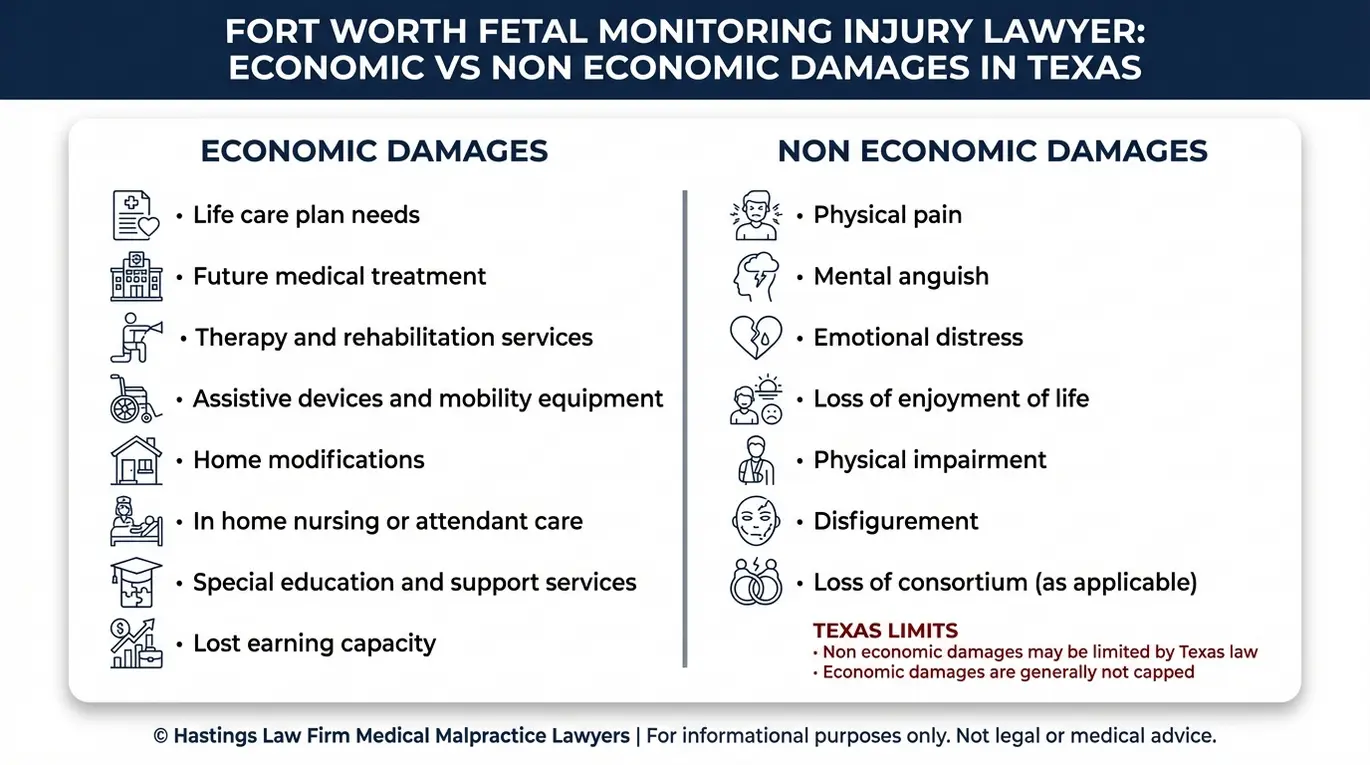
Compensation for fetal distress covers both economic losses, such as future medical expenses and lost earning capacity, and non-economic damages like physical pain, mental anguish, and loss of quality of life. When a child faces decades of medical needs because of a preventable injury, the financial picture must account for every stage of that child’s life.
Economic damages represent the measurable financial costs of the injury. In birth injury cases, the centerpiece is often a Life Care Plan, a detailed document prepared by medical and economic experts that projects the cost of care over the child’s expected lifetime. This can include 24/7 nursing care, specialized therapies, mobility equipment, home modifications, and rehabilitation services.
Lost wages and lost earning capacity, reflecting what the child would have earned as an adult without the injury, are also calculated. These costs frequently reach into the millions. Recovering full damages in birth injury cases ensures the child’s future is secure.
Non-economic damages address the harm that cannot be reduced to a receipt. This includes the child’s physical pain and suffering, the emotional distress experienced by both the child and the parents, and the loss of quality of life. These damages recognize that the injury’s true cost goes far beyond medical bills.
Under Texas law, there are caps on non-economic damages in medical malpractice cases. The Texas Civil Practice and Remedies Code, Chapter 74 limits non-economic damages to $250,000 against all individual healthcare providers and $250,000 per healthcare institution. The aggregate cap is $750,000 when both individual providers and multiple institutions are involved.
Economic damages, however, are not capped. A Fort Worth fetal monitoring injury lawyer builds the case to fully document economic losses, because those uncapped damages often represent the largest portion of a family’s recovery. Families should not bear the financial burden of a hospital’s mistake.
| Category | Economic Damages | Non-Economic Damages |
|---|---|---|
| What It Covers | Medical bills, future care costs, lost earning capacity, rehabilitation services, home modifications | Pain and suffering, emotional distress, loss of quality of life |
| How It’s Calculated | Life Care Plans, economic expert projections, documented expenses | Jury assessment based on severity and impact |
| Texas Caps | No cap | $250,000 against all individual providers; $250,000 per institution; ~$750,000 aggregate |
A Fort Worth medical negligence attorney will work to ensure every category of loss is fully documented so that a settlement or verdict reflects the true scope of your family’s needs.
Why Choose Hastings Law Firm for Your Birth Injury Claim
As your Fort Worth fetal monitoring injury lawyer, choosing Hastings Law Firm means partnering with a team that focuses exclusively on medical malpractice, pairing board-certified expertise with on-staff medical professionals to hold powerful hospital systems accountable.
Unlike general firms, we are a dedicated medical malpractice law firm. This singular focus means we understand the medicine behind your child’s injury, not just the law. Our legal team includes former defense attorneys who previously represented hospitals, giving us direct insight into the strategies the other side will use. Our in-house nurse practitioners and patient advocates review records and interpret clinical data from the very beginning of your case.
Founder Tommy Hastings is Board Certified in Personal Injury Trial Law by the Texas Board of Legal Specialization, a distinction held by fewer than 2% of Texas attorneys. He is a recognized leader in Texas medical malpractice law, serving as a Course Director for the State Bar of Texas Medical Torts Seminar.
We also believe that finances should never prevent a family from seeking justice. Hastings Law Firm works on a contingency fee basis, which means you pay no attorney fees or costs unless we recover compensation for your family. Your first free evaluation is confidential.
Contact the Fort Worth Birth Injury Attorneys at Hastings Law Firm Today for Help
If your child suffered a preventable injury because fetal monitoring was misread or ignored, you deserve clear answers about what happened and whether negligence played a role. Legal support can help families understand their rights and the path toward a recovery. As a trusted Fort Worth fetal monitoring injury lawyer, Hastings Law Firm is prepared to investigate your claim, challenge the responsible parties, and work toward securing the resources your child needs for a lifetime of care.
We serve families across the Dallas-Fort Worth Metroplex and throughout Texas. Every case begins with a free, confidential evaluation led by a patient advocate who will listen to your story and help determine if you have a claim.
You pay nothing unless we win. Call Hastings Law Firm today or contact us online to schedule your risk-free case review.
Frequently Asked Questions About Fetal Monitoring Error in Fort Worth


This content was researched and written by the Hastings Law Firm editorial team, which includes attorneys, medical professionals, and experienced researchers. Our writing is informed by internal knowledge and practical experience, and we cross-check critical details against authoritative sources cited throughout. Every piece undergoes human-led fact-checking and legal review. Because legal and medical information can change, if you spot an error, please contact us. Learn more about our content standards and review process on our editorial policy page.

Gabe Sassin has focused exclusively on medical malpractice law since 2007. After spending more than a decade as a malpractice defense attorney, he knows exactly how the other side works. He has seen firsthand how healthcare providers, insurers, corporate defendants, and their legal teams think, prepare, and build their defense against claims. That knowledge works for the people who need it most today, injured patients and their families. His unique experience shapes everything he writes, giving readers a look at how these cases actually work from someone who has handled them from both sides.
