


Fort Worth Brachial Plexus Injury Lawyer
Written by: Hastings Law Firm | Reviewed by: Gabe Sassin | Updated: July 27, 2026
A brachial plexus injury at birth can leave a family facing lasting uncertainty, complex medical care, and concerns that a preventable delivery room error caused permanent harm. These injuries involve nerves that control movement and sensation in the shoulder, arm, and hand, and the severity can range from temporary weakness to paralysis or significant limited mobility. The article discusses how shoulder dystocia, excessive traction, delayed decisions, and improper instrument use can contribute to avoidable nerve damage. If your child suffered harm or worse due to brachial plexus malpractice in Fort Worth, Texas, contact Hastings Law Firm for a free, confidential case review.

Trusted Fort Worth Malpractice Attorneys for Preventable Birth Injuries
What You Should Know About Infant Shoulder & Arm Nerve Injury Claims in Fort Worth:
- Long term function can be permanently reduced when brachial plexus nerves are stretched, torn, or pulled from the spine during delivery.
- Preventable delivery room errors can be central when shoulder dystocia is managed with excessive traction or delayed decisions.
- Recovery expectations can change significantly based on the documented classification of nerve damage from mild stretching to severe separation.
- Financial recovery can need to reflect lifelong care needs when a child faces ongoing therapy, surgeries, and adaptive support.
- Disputes about negligence often turn on whether warning signs and risk factors were recognized and acted on in time.
- Accountability can depend on whether the record reflects appropriate maneuvers rather than forceful pulling during an obstetric emergency.
- Non economic harm can be substantial when a child experiences chronic pain, physical impairment, or disfigurement.
- Case value can be influenced by whether lost earning capacity and caregiver income loss are supported by long range planning.
- Clarity about what happened can depend on detailed delivery documentation such as charting of maneuvers and instrument use.
- Options can be limited if legal time limits are missed under Texas medical malpractice rules.

A Healthcare Focused Law Firm
When your child is born with an injury that should not have happened, the weight of that moment stays with you. You may be dealing with unexpected medical appointments, uncertain diagnoses, and the realization that the people you trusted during delivery may have made a serious mistake. Those feelings of confusion and frustration are valid.
A brachial plexus injury during birth often points to preventable errors in the delivery room. If your family is facing this situation, you deserve clear answers about what went wrong and whether negligence was involved.
Hastings Law Firm focuses exclusively on medical malpractice, and our team includes in-house medical professionals who understand how these injuries happen and how to investigate them. As an experienced Fort Worth brachial plexus injury lawyer team, we are prepared to review your child’s medical records and explain your legal options. Contact us for a free, confidential case evaluation with no obligation.
Understanding Brachial Plexus Injuries and Erb’s Palsy
A brachial plexus injury occurs when the network of nerves controlling the shoulder, arm, and hand is stretched or torn during delivery, often resulting in conditions like Erb’s Palsy or Klumpke’s Palsy. These injuries can range from mild and temporary to severe and permanent, potentially causing paralysis or limited mobility, depending on which nerves are damaged and how.
The brachial plexus is a bundle of nerves originating from spinal nerve roots C5 through T1. According to the National Center for Biotechnology Information’s overview of brachial plexus anatomy, these nerves branch out from the neck and travel through the shoulder to supply movement and sensation to the entire upper limb. Each section of the plexus controls different functions:
- Upper nerves (C5–C6): Control the shoulder and upper arm. Injury here typically causes Erb’s palsy, where a child cannot lift or rotate the arm.
- Lower nerves (C8–T1): Control the hand and wrist. Damage to these nerves can cause grip weakness or a condition called Klumpke’s palsy.
- Posterior cord: A structure deeper in the plexus that, when injured, can cause wrist drop, meaning the child cannot extend the wrist or fingers.
Because different cords and nerve roots serve different functions, the location of the injury directly determines what your child can and cannot do with the affected arm. A Fort Worth brachial plexus injury lawyer with medical expertise can connect these specific deficits to what happened during delivery, which is essential for building a strong case. Working with a brachial plexus injury attorney who understands the anatomy behind the diagnosis matters from the very start.

Identifying Medical Negligence in Delivery Room Errors
Medical negligence occurs when healthcare providers fail to adhere to the standard of care during complications like shoulder dystocia, often by applying excessive force or failing to perform a timely C-section. During complicated deliveries, this can involve misusing instruments or failing to recognize warning signs.
One of the most common scenarios linked to brachial plexus injuries is shoulder dystocia, an obstetric emergency where the baby’s shoulder becomes lodged behind the mother’s pelvic bone after the head has delivered. According to a peer-reviewed study on shoulder dystocia published in PubMed Central, this complication requires immediate and careful intervention to prevent nerve damage.
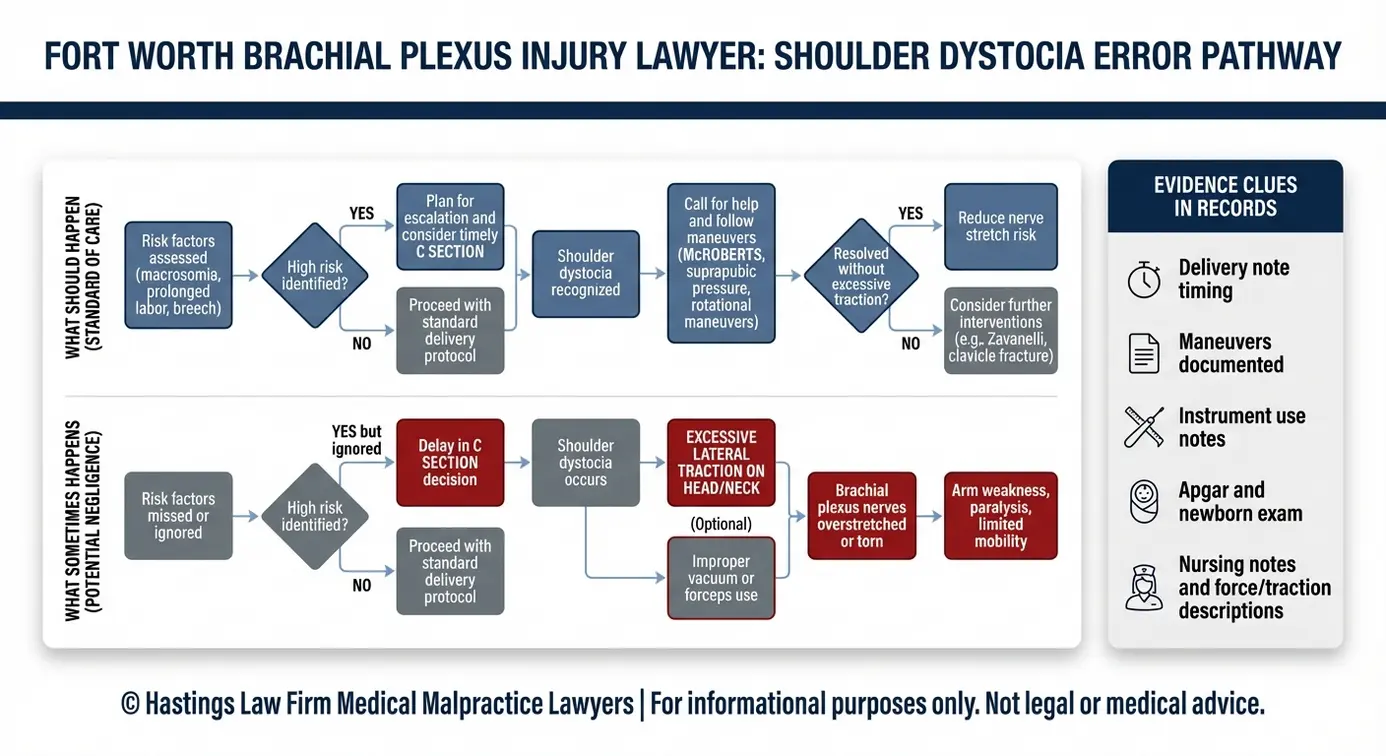
The injury often occurs when a provider applies excessive force during delivery, such as lateral traction, pulling too hard or at an improper angle on the baby’s head to free the trapped shoulder. This force can stretch or tear the brachial plexus nerves. A Fort Worth injury lawyer investigates whether this level of force was appropriate or whether it constituted medical malpractice.
When evaluating a potential case, our team looks for specific red flags in the medical records:
- Application of excessive downward or lateral traction on the baby’s head during delivery
- Failure to recognize fetal macrosomia, a condition where the baby is significantly larger than average, increasing the risk of shoulder dystocia
- Improper or aggressive use of vacuum extractors or forceps
- Failure to recommend a Cesarean section despite documented risk factors such as prolonged labor, gestational diabetes, or a history of difficult deliveries
- Delayed response to a known shoulder dystocia emergency
A birth injury attorney can work with medical experts to reconstruct the timeline of your delivery and determine whether these failures occurred. For families in Fort Worth, having a dedicated injury lawyer review the records is often the first step toward understanding what happened.
How Medical Providers Should Prevent Injury
Many difficult births should not result in a brachial plexus injury if established protocols are followed. The standard of care requires that providers recognize risk factors for shoulder dystocia before and during labor and respond with training and established maneuvers rather than excessive physical force.
The McRoberts maneuver, a technique where the mother’s legs are sharply flexed toward her abdomen to widen the pelvic opening, is considered a first-line response. Suprapubic pressure, applied just above the mother’s pubic bone, is another recognized technique. These methods are designed to free the trapped shoulder without placing dangerous force on the baby’s neck and nerves.
When a provider identifies fetal macrosomia, meaning the baby’s estimated weight exceeds a threshold that increases dystocia risk, a planned Cesarean section may be the safest option. We examine prenatal records, ultrasound estimates, and labor progress notes to evaluate whether providers identified these risks and acted appropriately.
The Hastings Law Firm Difference
Results matter, but what truly sets us apart is how we achieve them. Every verdict, every settlement, and every Fort Worth courtroom victory comes from one guiding promise: To treat each client’s fight for justice as if it were our own.
This balance of skill, experience, and empathy reflects our core philosophy that justice should not only compensate the injured, but also make healthcare safer nationwide.

Classifying Nerve Damage Severity and Long-Term Impact
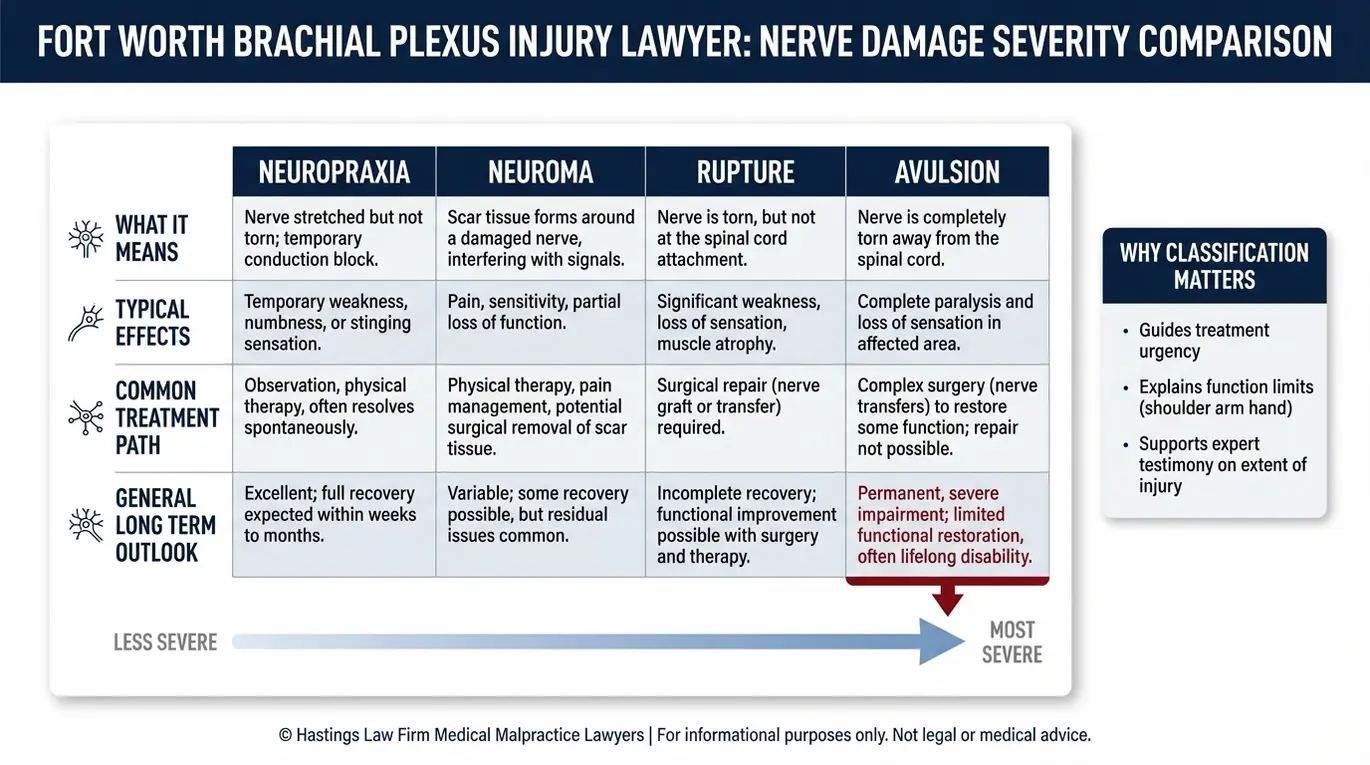
The severity of a brachial plexus injury ranges from temporary neuropraxia to permanent avulsion, with each level requiring different medical interventions and legal valuations. Each classification carries a different long-term outlook, which directly affects the legal value of a claim. Research published in the Journal of Surgery and Medicine on long-term outcomes of obstetric brachial plexus injuries confirms that injury classification is one of the strongest predictors of functional recovery.
| Injury Type | What Happens | Severity | Typical Prognosis |
|---|---|---|---|
| Neuropraxia | Nerve is stretched but not torn | Mildest | Often recovers within months with therapy |
| Neuroma | Scar tissue forms around a partially healed nerve, pressing on healthy fibers | Moderate | May cause chronic pain, muscle weakness, or numbness; recovery varies |
| Rupture | Nerve is torn but not detached from the spine | Severe | Requires surgical repair such as nerve grafting |
| Avulsion | Nerve is torn away from the spinal cord entirely | Most severe | Often results in permanent paralysis or significant limited mobility |
Neuropraxia, the mildest form, involves stretching without tearing and often improves with physical therapy. Avulsion, where the nerve root is ripped from the spinal cord, represents the most devastating outcome and frequently causes permanent loss of function. A brachial plexus injury lawyer in Fort Worth can work with your child’s medical team to document the specific classification.
This is important because the difference between a neuropraxia and an avulsion often determines whether a child recovers full movement. An experienced injury lawyer or brachial plexus attorney ensures this medical reality is accurately reflected in any legal claim.
Securing Compensation for Lifetime Care Costs
Compensation in brachial plexus cases covers past and future medical expenses, adaptive therapies, and non-economic damages like pain and suffering and physical impairment. Because these injuries can affect a child for life, the financial recovery must account for decades of care, not just immediate costs.
A Fort Worth brachial plexus injury lawyer works with life care planning experts to project the total cost of your child’s needs through adulthood. The Oregon Health Authority’s Care Planning Toolkit outlines frameworks used by medical professionals to develop these long-range care plans. A brachial plexus lawyer knows that damages in these cases typically include:
- Past and future medical expenses: Surgeries such as nerve grafts (a procedure where a healthy nerve is transplanted to repair the damaged one), physical therapy, occupational therapy, and ongoing specialist visits
- Adaptive equipment and home modifications: Braces, assistive devices, and changes to the home environment as the child grows
- Lost earning capacity: Projected limitations on the child’s ability to work as an adult due to permanent nerve damage
- Lost wages: Income a parent loses while caring for the child during treatment and recovery
- Pain and suffering: The physical discomfort and emotional distress the child endures
- Mental anguish and disfigurement: The psychological and visible impact of living with limited mobility or paralysis
A lawyer for birth injuries will ensure that every category of harm is documented and supported by qualified experts so that your family is not left covering costs that someone else’s negligence caused.
Why Choose Hastings Law Firm for Your Family
Hastings Law Firm offers a specialized medical malpractice focus with a zero-fee guarantee, ensuring families have access to elite legal resources without financial risk. Our attorneys, nurse consultants, and patient advocates work together on every case, bringing both legal strategy and clinical insight to families affected by preventable birth injuries.
Founder Tommy Hastings is Board Certified in Personal Injury Trial Law by the Texas Board of Legal Specialization, a distinction held by fewer than 2% of Texas attorneys. His team includes former defense attorneys who understand how hospitals and insurers approach these claims, and in-house medical professionals who can interpret your child’s records from day one. As a Fort Worth brachial plexus injury lawyer team, we prepare every case as if it is going to trial, because that preparation is what drives fair outcomes.
We also understand the emotional toll these injuries take on a family. Our mission is to restore the trust that was broken, give you honest answers, and hold negligent providers accountable under Texas Civil Practice and Remedies Code Chapter 74, which governs medical malpractice claims in our state.
There is no financial risk to your family. As a medical malpractice lawyer team operating on a contingency fee basis, we charge no upfront costs, which means there is no fee unless we win. If we do not recover compensation for your child, you owe us nothing.
Contact the Fort Worth Birth Injury Attorneys at Hastings Law Firm Today for Help
A brachial plexus injury during birth is often the result of preventable mistakes in the delivery room. Your child did not choose this outcome, and your family should not bear the financial and emotional burden alone.
Taking the first step does not require a commitment. It starts with a conversation. Our team will review your child’s medical records, explain whether negligence may have played a role, and help you understand the options available to your family.
Hastings Law Firm offers a case evaluation at no cost to you. We only collect a fee if we secure a recovery on your behalf. If you believe your child’s nerve injury was caused by a delivery error, reach out to our Fort Worth birth injury attorneys today. Let us help you find the answers your family deserves.
Frequently Asked Questions About Brachial Plexus Malpractice in Fort Worth


This content was researched and written by the Hastings Law Firm editorial team, which includes attorneys, medical professionals, and experienced researchers. Our writing is informed by internal knowledge and practical experience, and we cross-check critical details against authoritative sources cited throughout. Every piece undergoes human-led fact-checking and legal review. Because legal and medical information can change, if you spot an error, please contact us. Learn more about our content standards and review process on our editorial policy page.

Gabe Sassin has focused exclusively on medical malpractice law since 2007. After spending more than a decade as a malpractice defense attorney, he knows exactly how the other side works. He has seen firsthand how healthcare providers, insurers, corporate defendants, and their legal teams think, prepare, and build their defense against claims. That knowledge works for the people who need it most today, injured patients and their families. His unique experience shapes everything he writes, giving readers a look at how these cases actually work from someone who has handled them from both sides.
