


White Rock Medical Center Dallas Malpractice Lawyer
Hastings Law Firm handles hospital malpractice cases for patients and families harmed during treatment at White Rock Medical Center in Dallas, Texas. Those cases can be brought against the hospital, the nurses and staff it employs, the physicians who provided the care, or several of them together. When medical care goes wrong, a patient and their family can be left with a serious injury, a longer recovery, or the loss of a loved one. Finding out what happened and who should be held accountable takes attorneys who understand medicine as well as they understand the courtroom. At Hastings Law Firm, medical malpractice is all we do!

Last Updated: September 28, 2026
Trial-Ready Hospital Negligence Attorneys for White Rock Medical Center Patients and Families
Hastings Law Firm’s hospital negligence lawyers bring experienced representation to White Rock Medical Center patients and families in Dallas, Texas. Our founder, Tommy Hastings, has been a lawyer for injured patients since 2001 and is Board Certified in Personal Injury Trial Law. His colleagues include former malpractice defense attorneys who know how the medical industry defends claims.
That experience tells us where a hospital’s defense is likely to go before it takes shape. We answer it with physicians from a nationwide network of medical experts, who explain the care a patient should have received. We prepare each case as if it were headed to trial, from the first records request onward. For injured patients and families, that way of working has brought multimillion-dollar settlements and record-setting verdicts. Those results come from a firm that has been dedicated exclusively to medical malpractice since 2005.
Call us now for a free, confidential case review. Our team will hear what happened, investigate your claim, and explain your options.

The Types of White Rock Medical Center Lawsuits Our Hospital Malpractice Attorneys Handle
Hastings Law Firm brings White Rock Medical Center lawsuits in Dallas, Texas, over missed emergency diagnoses, surgical errors, and infections or wound complications. Our hospital malpractice lawyers build every lawsuit from the patient’s full chart, reviewed with physicians in the relevant field. We rely on that review to show where care fell below the accepted standard and what the harm took from the family.
The cases we see most often at a Dallas community hospital with 24/7 emergency care like White Rock Medical Center include:
- Emergency and orthopedic emergency diagnosis errors. A fracture, a stroke, or another urgent condition can be missed during an emergency visit, or a patient can be discharged before its cause is found. Hours lost at that stage can allow damage that prompt treatment might have limited. Our Dallas medical misdiagnosis lawyers compare the symptoms recorded at triage with the imaging, the physician’s notes, and the decision to discharge.
- Spine, bariatric, and vascular surgery errors. A mistake can happen during spine surgery, bariatric surgery, or a minimally invasive vascular procedure, or a complication in the days that follow can be missed. The patient may need a second operation and a longer stay, with additional recovery time. Our Dallas surgical error lawyers compare what the operative report describes with what the nursing staff charted afterward.
- Hospital-acquired infections and wound complications. An infection after surgery or during a stay can go unprevented, unrecognized, or untreated until it spreads, and a wound can be left without the care it needs. The result can be further procedures, lasting harm, or the loss of a loved one. Our Dallas hospital infection lawyers trace the infection through the wound care charting, culture results, and medication records.
While these are common claim types, our hospital malpractice attorneys handle any valid medical negligence case that arises at this hospital.
The Hastings Law Firm Difference
Results matter, but what truly sets us apart is how we achieve them. Every verdict, every settlement, and every Dallas courtroom victory comes from one guiding promise: To treat each client’s fight for justice as if it were our own.
This balance of skill, experience, and empathy reflects our core philosophy that justice should not only compensate the injured, but also make health care safer nationwide.

About White Rock Medical Center on Poppy Drive in Dallas
White Rock Medical Center is a hospital at 9440 Poppy Dr. in Dallas, Texas, and it says it provides care 24/7 for patients of all ages. The hospital’s home page highlights its 24/7 emergency care, and Emergency Care, Orthopedic Emergency, and Subacute Trauma Care are among its listed services. Spine Surgery, Bariatric Surgery, and Minimally Invasive Vascular Procedures are among its surgical services.
The hospital’s own list of services also names Cardiology, Neurology, and Stroke Care. Imaging, Gastroenterology, Orthopedic & Musculoskeletal Care, and Wound Care appear on the same list.
Those services can connect in a single patient’s treatment. One course of care can move from the emergency department to imaging, surgery, and wound care, and every team along the way keeps its own record of what it did. Hastings Law Firm represents patients of other Dallas hospitals as well, including Baylor University Medical Center and Texas Health Presbyterian Hospital Dallas.
Can You File a Lawsuit Against White Rock Medical Center, the Doctor, or Both?
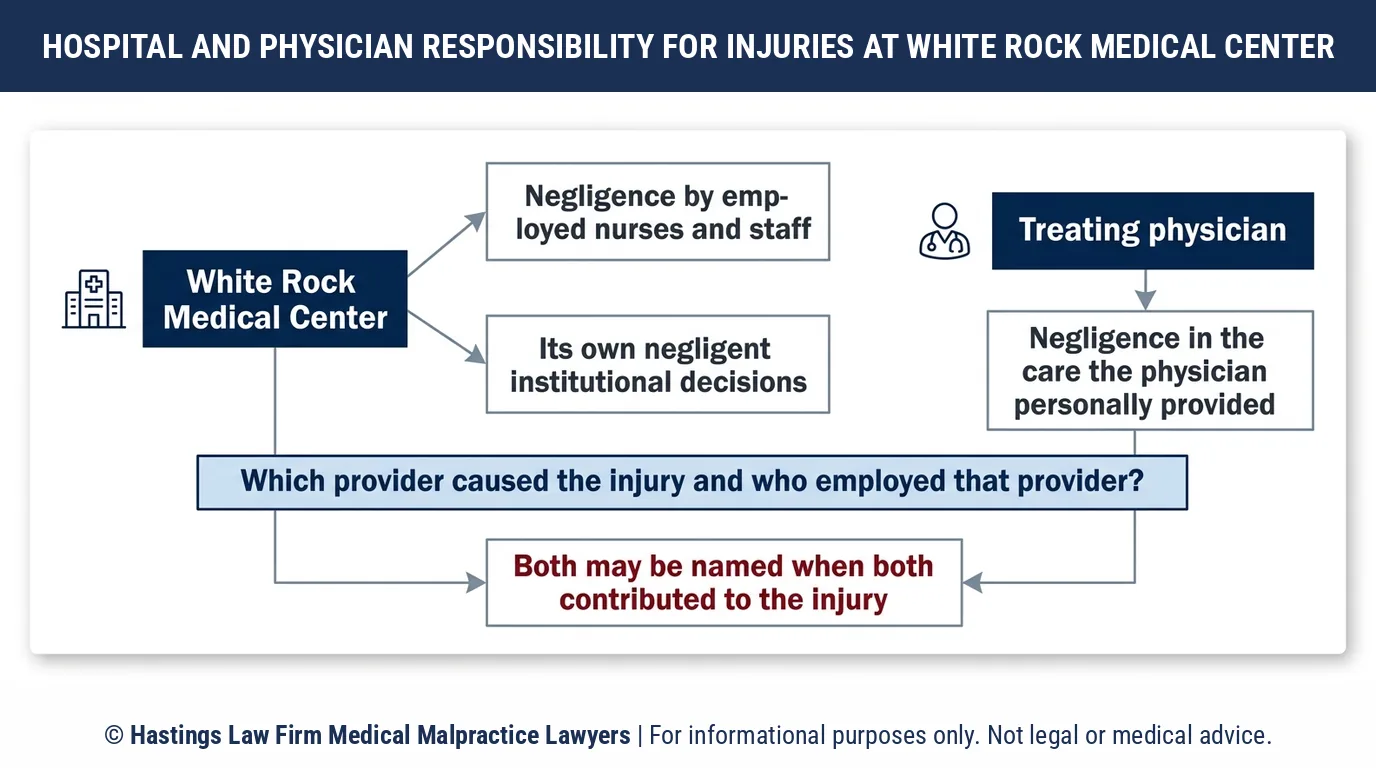
A patient may be able to file a lawsuit against White Rock Medical Center, a doctor, or both. Who can be sued rests on which provider’s negligence caused the injury and whether the hospital employed that provider. Chapter 74 of the Texas Civil Practice and Remedies Code governs these health care liability claims, whether the defendant is the hospital or the physician.
The hospital is responsible for negligence by the nurses and other staff it employs. It also answers for its own institutional decisions. A physician answers for the care that physician personally gave, and when the hospital and a physician both contributed to the injury, one claim can name both.
Who employed each provider is shown in the medical records, and that answer decides whom a claim names. Anyone looking for a lawyer to sue a hospital will find that this question comes first. Every Texas health care liability claim also needs a supporting expert report early in the case.
Medicine carries real risk, and not every bad outcome is negligence. Where an injury could have been prevented, the providers responsible should be held accountable. Our Dallas hospital malpractice lawyers cover how responsibility is shared among a hospital, its staff, and the physicians who practice there.
What Must an Expert Report Show Before a Lawsuit Against White Rock Medical Center Can Move Forward in Texas?
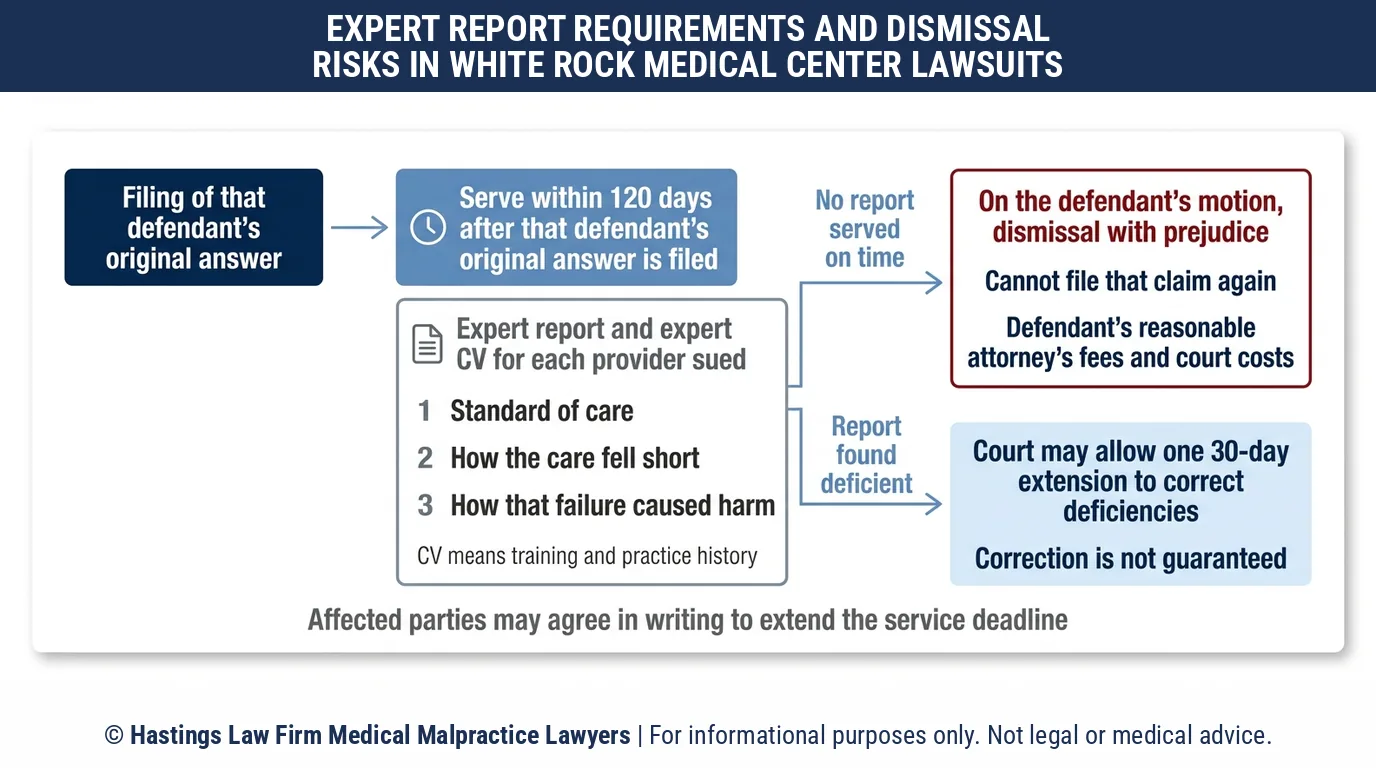
An expert report in a White Rock Medical Center lawsuit must show the standard of care, how the care fell short, and how that failure caused the harm. Section 74.351 of the Texas Civil Practice and Remedies Code requires the report, with the expert’s CV, for each physician or health care provider sued. The patient must serve it within 120 days after that defendant’s original answer is filed.
A CV, short for curriculum vitae, is the expert’s record of training and practice. The statute calls for a fair summary of the expert’s opinions as of the date of the report. The affected parties can agree in writing to extend the date for serving it.
Missing that deadline has serious consequences. If no report is served on a defendant in time, that defendant can ask the court to dismiss the claim against it. The court must then dismiss it with prejudice, which means the claim cannot be filed again, and award the defendant its reasonable attorney’s fees and court costs.
A report found deficient can sometimes be corrected. When a report was not served in time because elements of it were found deficient, the court may grant one 30-day extension to cure the problem. A challenge to a report succeeds only if the court finds, after a hearing, that the report does not represent an objective good faith effort to meet the statute’s definition.
Until the report is served, discovery, the formal exchange of evidence between the parties, is largely on hold. The statute allows only limited exceptions during that period. For a White Rock Medical Center patient whose care ran through the emergency department, surgery, and wound care, the report may need to address each provider named in the claim.
Our attorneys and medical professionals gather those records and review them with physicians in the relevant field before suit is filed, drawing on experts from our nationwide network. Our Texas doctor malpractice lawyers explain how a physician’s own care is measured against the standard.
How We Work With Injured White Rock Medical Center Patients and Their Families
From the first call about care at White Rock Medical Center to settlement or trial, Hastings Law Firm’s hospital malpractice lawyers represent patients and families in Dallas, Texas. We collect the medical records, have them reviewed by qualified physicians, and handle every exchange with the hospital and its insurer.
A member of our intake team answers your first call, and a relative is welcome to call for a patient unable to do so. Tell us, as well as you can, what care was given, on what dates, and by whom. Our team works to make sure every part of your account is heard, since that account starts our review.
Next, we obtain the complete chart for you. Our attorneys and medical professionals go through the emergency department notes, imaging reports, operative records, and wound care charting. They piece together the sequence of care and identify where it departed from the accepted standard. If our hospital negligence lawyers accept your case, those records and the physicians who interpret them are its foundation.
Once you hire us, all contact from the hospital, its insurer, and its lawyers comes to our office instead of to you. Board-certified patient advocates on our staff keep you informed, putting each new development into plain language as it comes. Our aim in negotiation is a settlement equal to what the injury has cost your family. If no fair offer comes, we are prepared to take your case to a jury.
If You or a Loved One Were Injured at White Rock Medical Center, Speak With Our Medical Attorneys Today
For anyone hurt at White Rock Medical Center in Dallas, Texas, Hastings Law Firm performs a free case review to find out whether they have a valid malpractice claim. Our Dallas medical malpractice lawyers look at the care that was given and who gave it. We tell you plainly if a poor result was not caused by negligence.
Our team is here for you. What you tell us stays private, and you owe no fee unless we win. Let us help you find the answers you deserve.
White Rock Medical Center Malpractice FAQs


This content was researched and written by the Hastings Law Firm editorial team, which includes attorneys, medical professionals, and experienced researchers. Our writing is informed by internal knowledge and practical experience, and we cross-check critical details against authoritative sources cited throughout. Every piece undergoes human-led fact-checking and legal review. Because legal and medical information can change, if you spot an error, please contact us. Learn more about our content standards and review process on our editorial policy page.

Brady D. Williams is a nationally recognized medical malpractice attorney who has spent his career handling high-stakes litigation for injured patients and families across the country. Licensed in both Texas and California, Brady draws on experience from hundreds of resolved medical cases to break down complex legal and medical topics for the people who need that information most. His writing reflects the same attention to detail and commitment to clarity that he brings to every case he handles.
