


Baylor University Medical Center Dallas Malpractice Lawyer
Hastings Law Firm pursues hospital malpractice claims over care at Baylor University Medical Center in Dallas, Texas, on behalf of injured patients and their families. A claim can be brought against the hospital, the nurses and staff it employs, the treating physicians, or several of them together. When medical care goes wrong, a patient and their family can be left with a serious injury, a longer recovery, or the loss of a loved one. Finding out what happened and who should be held accountable takes attorneys who understand medicine as well as they understand the courtroom. At Hastings Law Firm, medical malpractice is all we do!
Last Updated: September 28, 2026
Trial-Ready Hospital Negligence Attorneys for Baylor University Medical Center Patients and Families
Hastings Law Firm’s hospital negligence lawyers bring experienced representation to Baylor University Medical Center patients and families in Dallas, Texas. Tommy Hastings, the firm’s founder, has represented injured patients since 2001 and is Board Certified in Personal Injury Trial Law. Among our lawyers are former malpractice defense attorneys who know how the medical industry defends claims.
That background means we know how the defense will build its case, and we prepare ours with that in mind. We draw on a nationwide network of medical experts to show what safe care required, and we treat every case as if it were going to trial. For injured patients and families, that preparation has led to multimillion-dollar settlements and record-setting verdicts. Those results come from a firm that has been dedicated exclusively to medical malpractice since 2005.
Call us now for a free, confidential case review. We will listen to what happened, investigate your claim, and explain your options.

The Types of Baylor University Medical Center Lawsuits Our Hospital Malpractice Attorneys Handle
Hastings Law Firm takes on Baylor University Medical Center lawsuits in Dallas, Texas, arising from emergency and trauma care, surgery and transplantation, and infections acquired in the hospital. Our hospital malpractice lawyers start every case with the complete chart and the medical experts who can read it. We use both to trace where the care departed from the accepted standard and what that departure cost the patient.
The cases we see most often at a Level I trauma and teaching hospital like Baylor University Medical Center include:
- Emergency and trauma care errors. Signs of a serious injury or illness can go unrecognized once a patient is through the doors, or the treatment they call for can start too late. Lost hours can let a condition that was treatable become permanent. Our Dallas medical misdiagnosis lawyers line up the arrival time, each test result, and each order to show when the diagnosis should have been made.
- Surgical and transplant errors. A mistake can occur during an operation, including a transplant, or a complication in the days afterward can go unnoticed until it is harder to treat. The patient may face additional recovery time, a return to the operating room, and more days in the hospital. Our Dallas surgical malpractice lawyers trace each step of the procedure and the recovery through the surgical team’s own notes.
- Hospital-acquired infections. An infection can take hold because prevention steps lapsed, or it can go undetected or untreated until it spreads. A preventable infection can mean further treatment, a much longer stay, and in the worst cases lasting harm or the loss of a loved one. Our Dallas hospital infection lawyers study the lab results, antibiotic orders, and nursing notes to show when the signs appeared and how staff responded.
While these are common claim types, our hospital malpractice attorneys handle any valid medical negligence case that arises at this hospital.
The Hastings Law Firm Difference
Results matter, but what truly sets us apart is how we achieve them. Every verdict, every settlement, and every Dallas courtroom victory comes from one guiding promise: To treat each client’s fight for justice as if it were our own.
This balance of skill, experience, and empathy reflects our core philosophy that justice should not only compensate the injured, but also make health care safer nationwide.

About Baylor University Medical Center, a Level I Trauma and Teaching Hospital in Dallas
Baylor University Medical Center is a large teaching hospital at 3500 Gaston Ave in Dallas, Texas, and part of Baylor Scott & White Health. The hospital describes itself as a major patient care, teaching and research center. Its services range from emergency and trauma care to childbirth, transplant surgery, and neuroscience.
Seriously injured patients are treated in an emergency department that offers full trauma services 24 hours a day, seven days a week. The medical center calls itself a Level I trauma center, and the state’s roster of designated trauma facilities places it at Level I as well.
Care for mothers includes labor and delivery and maternal-fetal medicine. On its maternal designation list, the Texas Department of State Health Services places the medical center at Level IV. Critically ill newborns are cared for in the hospital’s Level IV Neonatal Intensive Care Unit, the same level shown on the state’s neonatal roster.
The medical center also provides transplant services, including heart transplant, along with neuroscience and surgery. A single course of treatment can begin in the emergency department, continue in an operating room, and end in intensive care. Physicians in training are among the teams at the bedside along the way.
Every unit along that path writes its own chart, so the full account of a patient’s care sits across several sets of records. Reading those records together is the same work our firm does for patients of other Dallas hospitals, including Parkland Hospital and Advanced Dallas Hospital and Clinics.
Can You File a Lawsuit Against Baylor University Medical Center, the Doctor, or Both?
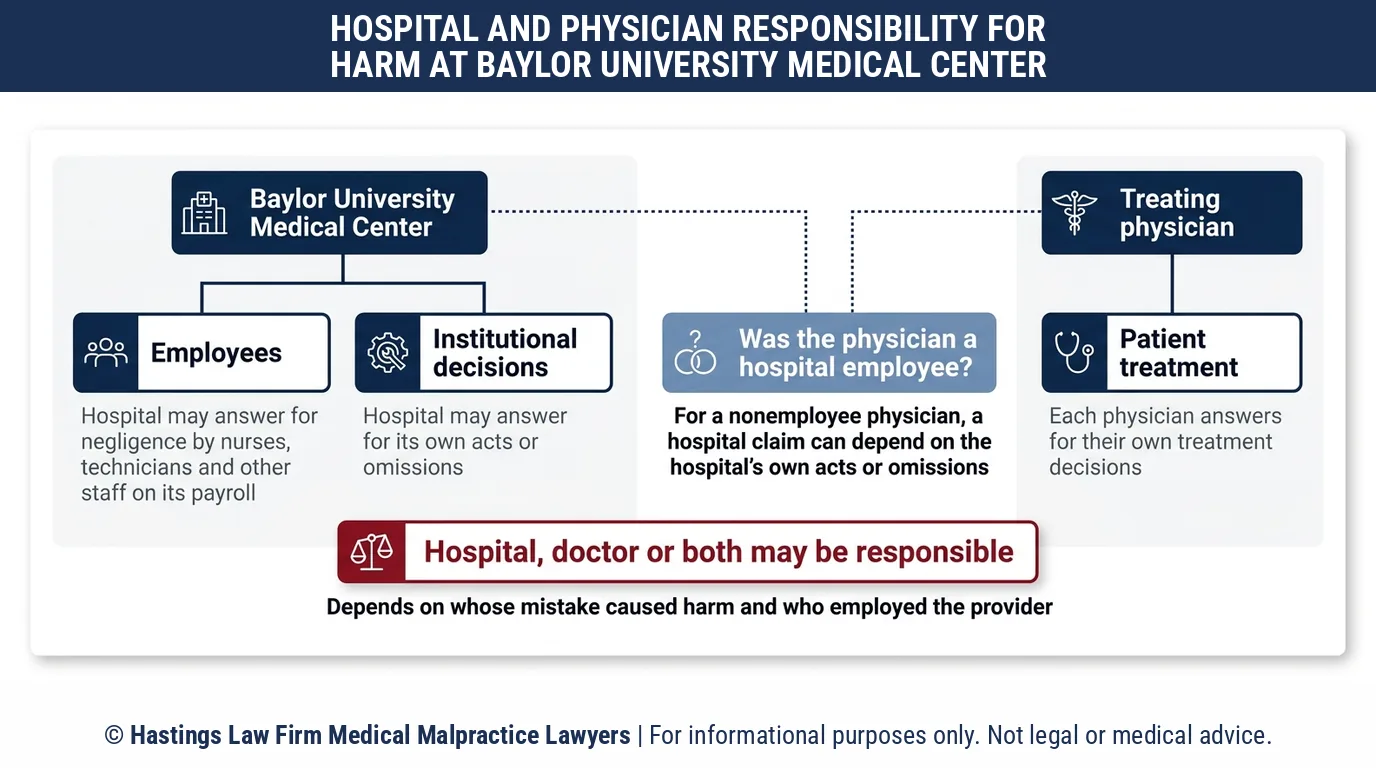
A patient may be able to sue Baylor University Medical Center, a treating doctor, or both. Who can be sued depends on whose mistake caused an injury and who employed that provider. Section 74.351 of the Texas Civil Practice and Remedies Code requires an expert report in any such claim, due within 120 days of each defendant’s original answer.
A hospital can answer for the negligence of the nurses, technicians, and other staff on its payroll, and separately for its own institutional decisions. Each physician answers for their own treatment of the patient. When a physician was not the hospital’s employee, the claim against the hospital can depend on what the hospital itself did or failed to do.
The medical records and the arrangement behind each provider’s role decide which of those paths a claim takes. A lawyer to sue a hospital starts there, because the answer settles who is named as a defendant. Our Dallas hospital malpractice lawyers cover the ways a hospital, its staff, and the physicians who practice there can each be held responsible.
What Must You Prove About Emergency Care at Baylor University Medical Center Under Texas Law?
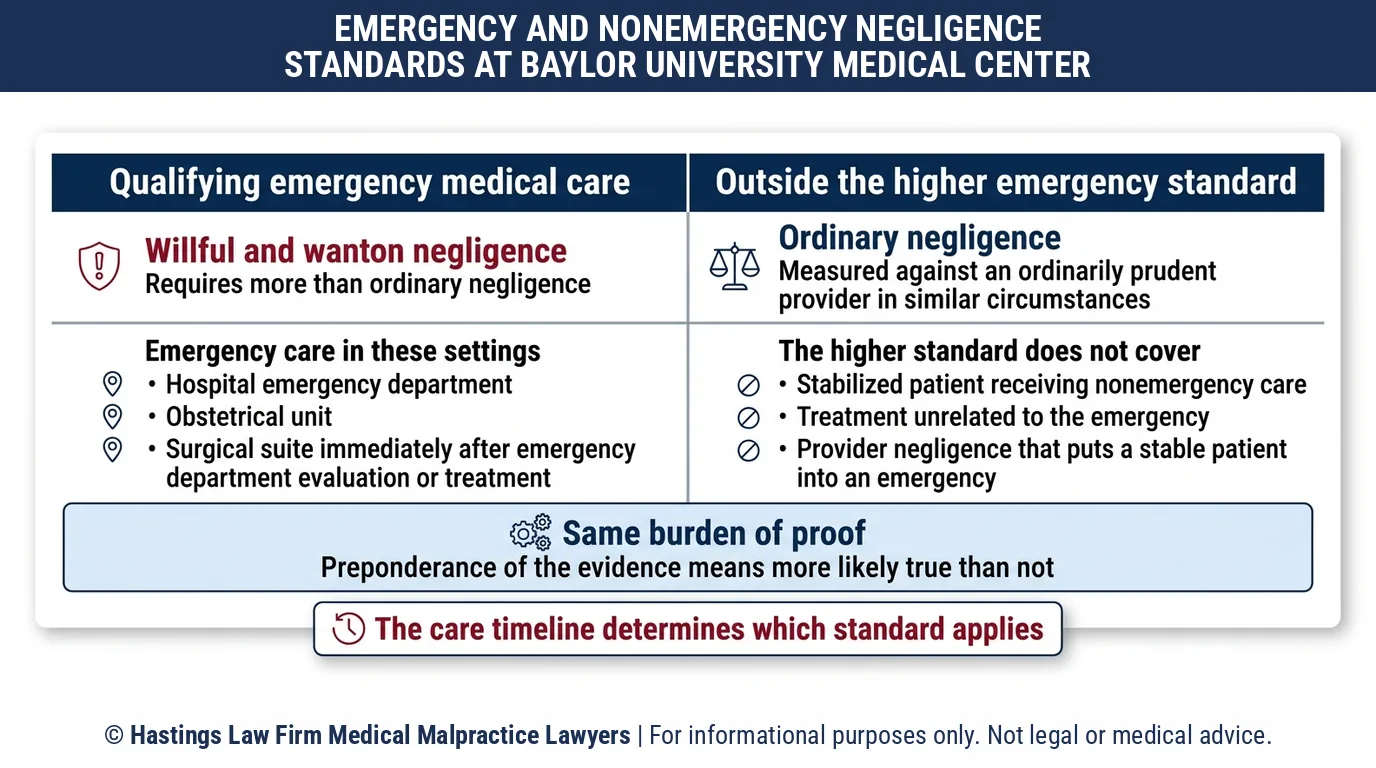
A patient hurt by emergency care at Baylor University Medical Center must prove, by a preponderance of the evidence, that the provider acted with willful and wanton negligence. Texas Civil Practice and Remedies Code Section 74.153 sets that higher standard for emergency medical care in three settings. They are the hospital emergency department, an obstetrical unit, and a surgical suite used immediately after an emergency department evaluation or treatment.
Most hospital care is judged by ordinary negligence, meaning what an ordinarily prudent physician or provider would have done in the same or similar circumstances. Willful and wanton negligence asks for more than that. The burden of proof does not change, and a preponderance of the evidence still means the claim is more likely true than not.
The higher standard ends when the emergency does. It does not reach treatment once the patient has been stabilized and is receiving nonemergency care, or treatment unrelated to the emergency. Nor does it protect a provider whose negligence put a stable patient into an emergency in the first place.
At a Level I trauma center, a patient can move from the trauma bay to surgery and on to intensive care within hours. The point where emergency care ended has to be shown from the records. Triage notes, the trauma record, operative reports, and handoff notes show when the patient was stabilized and which decisions came after. That timeline decides which standard each part of the care is measured against.
A higher standard is harder to meet, but it is not impossible. Our Texas medical misdiagnosis attorneys examine how a missed or delayed diagnosis in the emergency department fits within it.
How We Work With Injured Baylor University Medical Center Patients and Families
Hastings Law Firm’s hospital malpractice lawyers act for patients and families in Dallas, Texas, after an injury or a loss tied to care at Baylor University Medical Center. Our Dallas medical malpractice lawyers carry each claim from the first conversation through the records review, the expert work, negotiation, and trial when it is needed.
Your first call reaches a member of our intake team, and any relative is welcome to phone on behalf of a patient still in recovery. Tell us what you remember about the care, the dates, and the people who treated you or your family member. Our team works to make sure your account is heard in full, because it is where our review begins.
We then gather every page of the medical record for you. Attorneys and medical professionals at our firm go through the emergency and trauma notes, operative reports, and intensive care charting. They look for what was done, what was left undone, and when each decision was made. If our hospital negligence lawyers accept your case, we build it on that record and on physicians qualified to explain it.
Once we represent you, the hospital, its insurance carrier, and its defense lawyers deal with us rather than with you. Our board-certified patient advocates keep in touch as the case moves, explaining each new development in plain language. We seek a settlement that covers the full cost of the injury to your family. If the offers never reach that, our attorneys are ready to present your case to a jury.
If You or a Loved One Were Injured at Baylor University Medical Center, Speak With Our Medical Attorneys Today
Hastings Law Firm performs a free case review to find out whether a patient in Dallas, Texas, has a valid malpractice claim over care at Baylor University Medical Center. The review covers the facts of the care, the people who may be responsible, and whether treatment fell below the accepted standard. If a poor result was not the product of negligence, our hospital malpractice lawyers tell you so plainly.
Our team is here for you. Everything you tell us is kept confidential, and there is no fee unless we win. Let us help you find the answers you deserve.
Baylor University Medical Center Malpractice FAQs


This content was researched and written by the Hastings Law Firm editorial team, which includes attorneys, medical professionals, and experienced researchers. Our writing is informed by internal knowledge and practical experience, and we cross-check critical details against authoritative sources cited throughout. Every piece undergoes human-led fact-checking and legal review. Because legal and medical information can change, if you spot an error, please contact us. Learn more about our content standards and review process on our editorial policy page.

Brady D. Williams is a nationally recognized medical malpractice attorney who has spent his career handling high-stakes litigation for injured patients and families across the country. Licensed in both Texas and California, Brady draws on experience from hundreds of resolved medical cases to break down complex legal and medical topics for the people who need that information most. His writing reflects the same attention to detail and commitment to clarity that he brings to every case he handles.
