


The CORE Institute Specialty Hospital Malpractice Lawyer
Hastings Law Firm brings hospital malpractice claims for patients and families hurt during care at The CORE Institute Specialty Hospital in Phoenix, Arizona. A claim can name the hospital and its staff, the surgeon, the anesthesia provider, or the practice groups those physicians work through. When medical care goes wrong, a patient and their family can be left with a serious injury, a longer recovery, or the loss of a loved one. Finding out what happened and who should be held accountable takes attorneys who understand medicine as well as they understand the courtroom. At Hastings Law Firm, medical malpractice is all we do!

Last Updated: September 28, 2026
Trial-Ready Hospital Negligence Attorneys for The CORE Institute Specialty Hospital Patients and Families
Hastings Law Firm’s hospital negligence lawyers bring experienced representation to The CORE Institute Specialty Hospital patients and families in Phoenix, Arizona. Tommy Hastings, the firm’s founder, is Board Certified in Personal Injury Trial Law and has represented injured patients since 2001. Our team also includes former malpractice defense attorneys who understand the tactics hospitals use to deny liability.
Those tactics are what we prepare to answer from the start of every claim. Our attorneys consult a nationwide network of medical experts drawn from the same fields as the providers involved. Those experts explain the care each provider owed the patient and how that care fell short. We prepare every case as if it were going to trial, and that preparation has won multimillion-dollar settlements and record-setting verdicts for injured patients and their families. Those results come from a firm that has been dedicated exclusively to medical malpractice since 2005.
Call us now for a free, confidential case review. We will listen to your account, investigate your claim, and explain your options.

The Types of CORE Institute Specialty Hospital Lawsuits Our Hospital Malpractice Attorneys Handle
Hastings Law Firm handles The CORE Institute Specialty Hospital lawsuits in Phoenix, Arizona, over injuries in joint and spine operations, anesthesia errors, and complications missed during recovery. Our attorneys build each lawsuit from the operative report, the anesthesia record, and the recovery charting. We use those records to show where the care went wrong and what the injury has cost the patient.
The cases we see most often at an orthopedic and spine hospital like The CORE Institute Hospital include:
- Nerve, spinal cord and implant injuries in joint and spine operations. A nerve, a blood vessel or the spinal cord can be damaged during a replacement or fusion, hardware can be set in the wrong position, or the operation can be done at the wrong level or site. The patient can be left with chronic pain, weakness or paralysis, and a second operation may be needed to correct it. Our Arizona spine surgeon malpractice lawyers compare the operative report and the imaging with the plan the surgeon recorded beforehand.
- Careless anesthesia and breathing problems in recovery. A regional block or general anesthetic can be dosed or watched carelessly, and a patient’s breathing can decline in the recovery unit without a timely response. Oxygen loss can cause brain injury, heart damage or a fatal outcome. Our Phoenix anesthesia error attorneys read the anesthesia record entry by entry against the vital signs charted in recovery.
- Infection, clots or bleeding missed during the overnight stay after surgery. An infection, a blood clot or internal bleeding can develop in the hours after an operation, or a patient can be sent home before the warning signs are acted on. A complication found late can mean readmission, more surgery, or a clot that travels to the lungs. Our Phoenix postoperative malpractice lawyers set the nursing notes and the discharge decision against the patient’s changing condition.
While these are common claim types, our hospital malpractice attorneys handle any valid medical negligence case that arises at this hospital.
The Hastings Law Firm Difference
Results matter, but what truly sets us apart is how we achieve them. Every verdict, every settlement, and every Phoenix courtroom victory comes from one guiding promise: To treat each client’s fight for justice as if it were our own.
This balance of skill, experience, and empathy reflects our core philosophy that justice should not only compensate the injured, but also make health care safer nationwide.

About The CORE Institute Specialty Hospital in North Central Phoenix
The CORE Institute Specialty Hospital is an orthopedic and spine hospital at 6501 North 19th Avenue in Phoenix, in what the hospital calls the North Central Phoenix corridor. The hospital performs joint replacement, spine surgery, and other orthopedic operations on an inpatient and outpatient basis. The hospital says it is owned and managed by Healthcare Outcomes Performance Company (HOPCo), a physician managed company.
Spine care there includes cervical and lumbar fusion, lumbar laminectomy, posterior cervical decompression and fusion, sacroiliac joint fusion, and an interventional spine program. The joint replacement service performs total knee, hip and shoulder replacement, along with robotic total knee, total hip and partial knee replacement. The hospital also offers sports medicine, foot and ankle care, and hand and wrist procedures, including distal radius (wrist) fracture treatment.
The hospital’s surgery guide says an anesthesiologist or nurse anesthetist gives general or regional anesthesia, and patients recover in the post-anesthesia care unit. Some operations need an overnight or short stay in an inpatient room, and the inpatient recovery team includes a physical therapy department that treats patients daily.
CMS lists The CORE Institute Hospital as not providing emergency services, so it is a surgical hospital without an emergency department. Its outpatient imaging center offers MRI, CT and diagnostic radiology, and the hospital states that center is fully accredited by the American College of Radiology. Other Phoenix hospitals where we help injured patients include HonorHealth John C. Lincoln Medical Center and St. Joseph’s Hospital and Medical Center.
Can You File a Lawsuit Against The CORE Institute Specialty Hospital, the Surgeon, or Both?
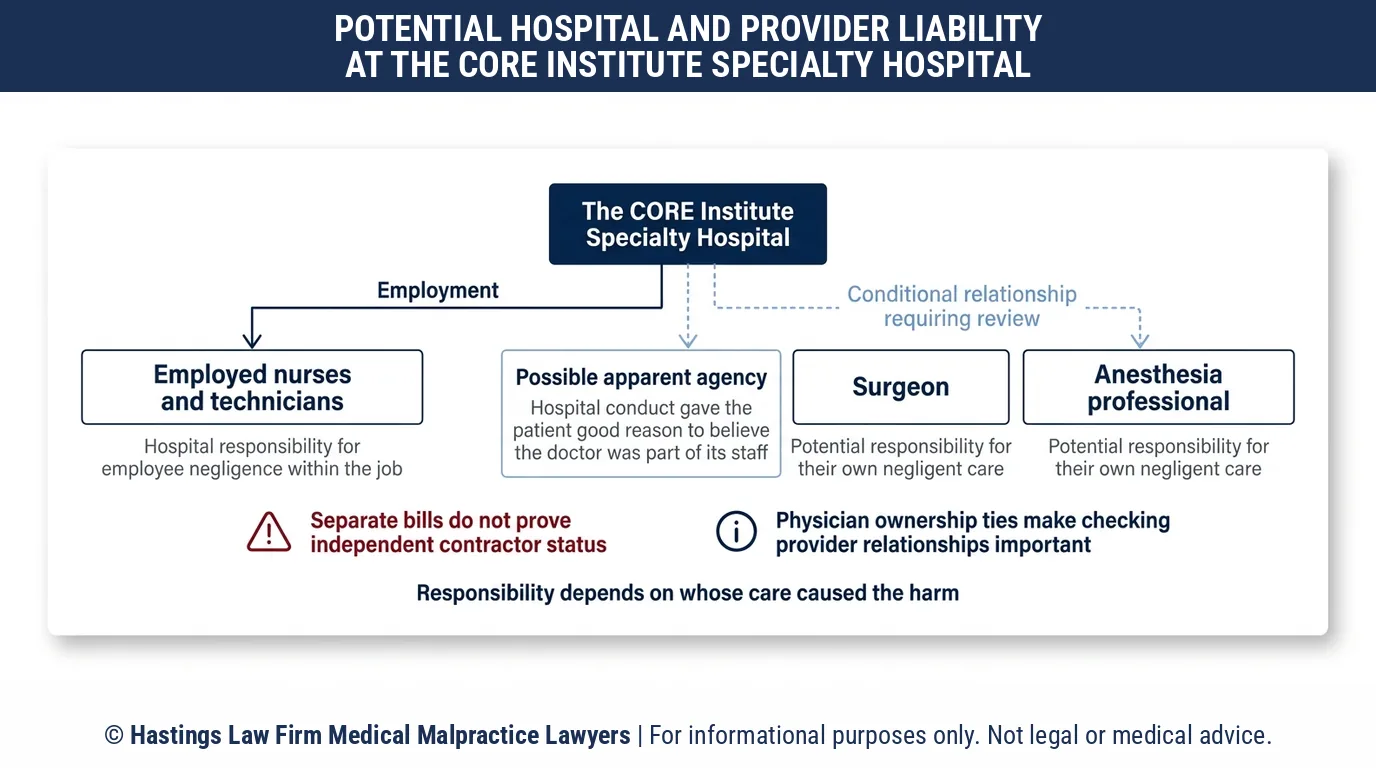
You may be able to sue The CORE Institute Specialty Hospital, a surgeon, or both, depending on who made the decisions that led to an injury. Under Kopp v. Physician Group of Arizona, a hospital is responsible for the negligence of the staff it employs, such as nurses and technicians, when they act within their jobs. That rule reaches only true employees, so doctors call for a closer look.
A hospital can sometimes answer for a surgeon or anesthesia professional it does not employ. Under a rule called apparent agency, that depends on whether something the hospital itself did gave the patient good reason to believe the doctor was part of its staff.
The CORE Institute Hospital’s billing page says the surgeon, anesthesiology and pathology services are billed separately from its own charges. Separate bills are a sign that more than one party may be involved, not proof that any doctor is an independent contractor. The hospital calls itself physician-owned, and The CORE Institute practice discloses that many of its physicians hold indirect ownership interests in the hospital. Those ties are why we confirm each surgeon’s and anesthesia provider’s relationship to the hospital from the records rather than assume it.
Arizona also asks for medical expert support early in a case. A.R.S. 12-2603 requires a preliminary expert opinion affidavit, sworn by a qualified expert, when a claim depends on expert testimony, and a claim without one risks dismissal. Choosing a lawyer to sue a hospital means choosing one who plans for that step, and our Phoenix hospital malpractice lawyers explain what it involves.
Is a Known Complication of Joint or Spine Surgery Still Malpractice in Arizona?
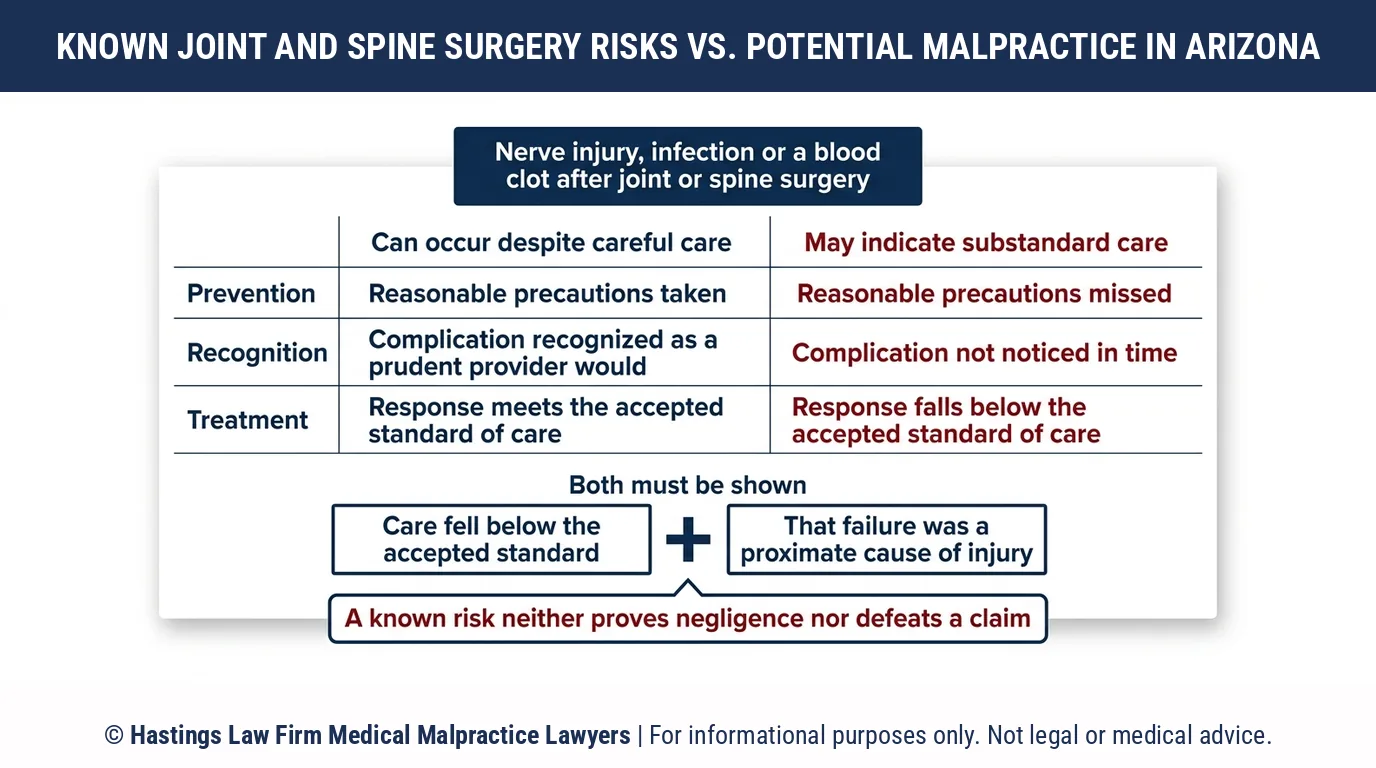
A known complication of joint or spine surgery can still be malpractice in Arizona, because a recognized risk on its own neither proves negligence nor defeats a claim. Under A.R.S. 12-563, the patient must show that a provider fell below the accepted standard of care. The patient must also show that this failure was a proximate cause of the injury.
For a joint or spine patient, the standard of care is measured by how the complication was prevented, recognized and treated. A nerve injury, an infection or a clot can happen despite careful care. The same complication can become negligence when it was not guarded against, noticed in time or treated as a reasonable, prudent provider would have.
A separate question arises when a risk was not adequately explained before the operation. Arizona treats inadequate disclosure of a risk as its own negligence claim, judged against what a reasonably prudent provider in that field would have disclosed. Our Arizona informed consent attorneys explain how those claims work.
Surgery carries real risk, and a hard recovery is not always the result of negligence. When a complication was preventable or poorly handled, the providers responsible should be held accountable. For a patient, a complication listed as a known risk is where the review of the care begins, not where it ends.
How We Work With Joint and Spine Surgery Patients Injured at The CORE Institute Hospital
Hastings Law Firm handles hospital malpractice claims for joint and spine surgery patients of The CORE Institute Specialty Hospital in Phoenix, Arizona, and for their families. Our attorneys and medical professionals carry each claim from the first call through settlement or trial, working from the records of every stage of the patient’s care.
A member of our intake team takes your first call about harm at The CORE Institute Specialty Hospital. If the patient is not well enough to talk yet, a close family member can make that call. Tell us which operation was performed, when it happened, and what changed afterward, as best you remember it. We work to make sure you are heard, and your account shows us where the review should begin.
Our team then requests the complete medical records from the hospital, the surgeon’s practice and the anesthesia provider. Our attorneys and medical professionals go through the operative report, anesthesia record, recovery notes, therapy entries and imaging to establish what was done, what was missed, and when. When our hospital negligence lawyers accept a case, those records and the physicians qualified to explain them become its foundation.
Once you hire us, the hospital, the insurers and their lawyers deal with our firm instead of with you. Our board-certified patient advocates stay in contact with you, and when something changes in the case they tell you what it means in plain language. We press for a settlement that reflects what the injury has cost your family, and when an offer falls short, we are prepared to take the case to a jury.
If You or a Loved One Were Injured at The CORE Institute Hospital, Speak With Our Medical Attorneys Today
Hastings Law Firm represents patients and families in Phoenix, Arizona, in hospital negligence claims after an operation or recovery at The CORE Institute Specialty Hospital left them worse off. Our lawyers study the care the patient received and identify any provider who may share responsibility. If careful treatment could not have prevented a difficult result, we say so honestly.
Our team is here for you. We perform a free case review to find out whether you have a valid claim. Everything you tell us is confidential, and there is no fee unless we win. Our Phoenix medical malpractice lawyers can help you find the answers you deserve.
The CORE Institute Specialty Hospital Malpractice FAQs


This content was researched and written by the Hastings Law Firm editorial team, which includes attorneys, medical professionals, and experienced researchers. Our writing is informed by internal knowledge and practical experience, and we cross-check critical details against authoritative sources cited throughout. Every piece undergoes human-led fact-checking and legal review. Because legal and medical information can change, if you spot an error, please contact us. Learn more about our content standards and review process on our editorial policy page.

Tommy Hastings, founder of Hastings Law Firm, is a board-certified personal injury trial lawyer (by the Texas Board of Legal Specialization) dedicated exclusively to healthcare injury cases. Since 2001, he has represented injured patients and families in litigation against major hospital systems, pharmaceutical companies, and negligent healthcare providers nationwide. He has handled numerous high-profile cases that have drawn national media attention and resulted in multi-million dollar recoveries.
