


Dallas Birth Injury Lawyer
Written by: Hastings Law Firm | Reviewed by: Tommy Hastings | Updated: May 6, 2026
Preventable errors during labor and delivery can leave a child with lasting injuries and leave families searching for clear answers. Birth injury concerns often involve missed warning signs, delayed decisions, or unsafe use of delivery instruments, and the effects can include lifelong medical needs, therapy, and significant emotional strain. Texas law draws an important line between birth injuries tied to delivery care and congenital conditions that develop during pregnancy. If your child suffered harm due to preventable birth injuries in Dallas, Texas, contact Hastings Law Firm for a free, confidential case review.

Trusted Legal Representation for Preventable Birth-Related Injuries
What You Should Know About Labor & Delivery Negligence Claims in Dallas:
- Long term care needs can follow a preventable birth injury when labor and delivery care falls below the accepted standard of care.
- Accountability can turn on whether the harm arose during labor, delivery, or the immediate postnatal period rather than from a congenital condition.
- Severe neurological harm can result when fetal distress is not recognized or acted on in time.
- Lasting physical trauma can occur when delivery instruments are used improperly or with excessive force.
- Recovery options can shift when a defective delivery device is involved because responsibility may extend beyond the treating provider.
- Compensation can cover both financial losses and human losses, including future care needs and the child’s pain and impairment.
- Non economic recovery can be limited in Texas medical malpractice cases, which can make documentation of economic losses more consequential.
- Options can be lost if legal time limits expire, and delays can also increase the risk that key clinical data is missing or overwritten.
- Disputes often focus on whether the injury was an unavoidable complication or a preventable outcome tied to substandard care.
- Case clarity can depend on whether fetal monitoring data, nursing logs, physician orders, and delivery timelines show missed warning signs or delayed escalation.

A Healthcare Focused Law Firm
When your child suffers harm during delivery, the confusion and grief can feel paralyzing. You may sense that something went wrong, but the medical team’s explanations leave more questions than answers. That instinct deserves to be heard, not dismissed.
At Hastings Law Firm, we focus exclusively on medical malpractice, including birth injuries caused by preventable medical errors. As a dedicated Dallas birth injury lawyer, we are here to help families uncover the truth about what happened and pursue the accountability their child deserves.
If your family is facing this situation, we encourage you to reach out for a free, confidential case evaluation. We can review what happened and explain your options at no cost to you.
Defining Preventable Birth Injuries Under Texas Law
A birth injury is physical harm suffered by an infant during labor or delivery, frequently caused by preventable medical errors or a failure to meet the accepted standard of care. Not every difficult delivery involves negligence, but when a healthcare provider’s actions fall below what a reasonably competent professional would have done in similar circumstances, the injury may be grounds for a legal claim.
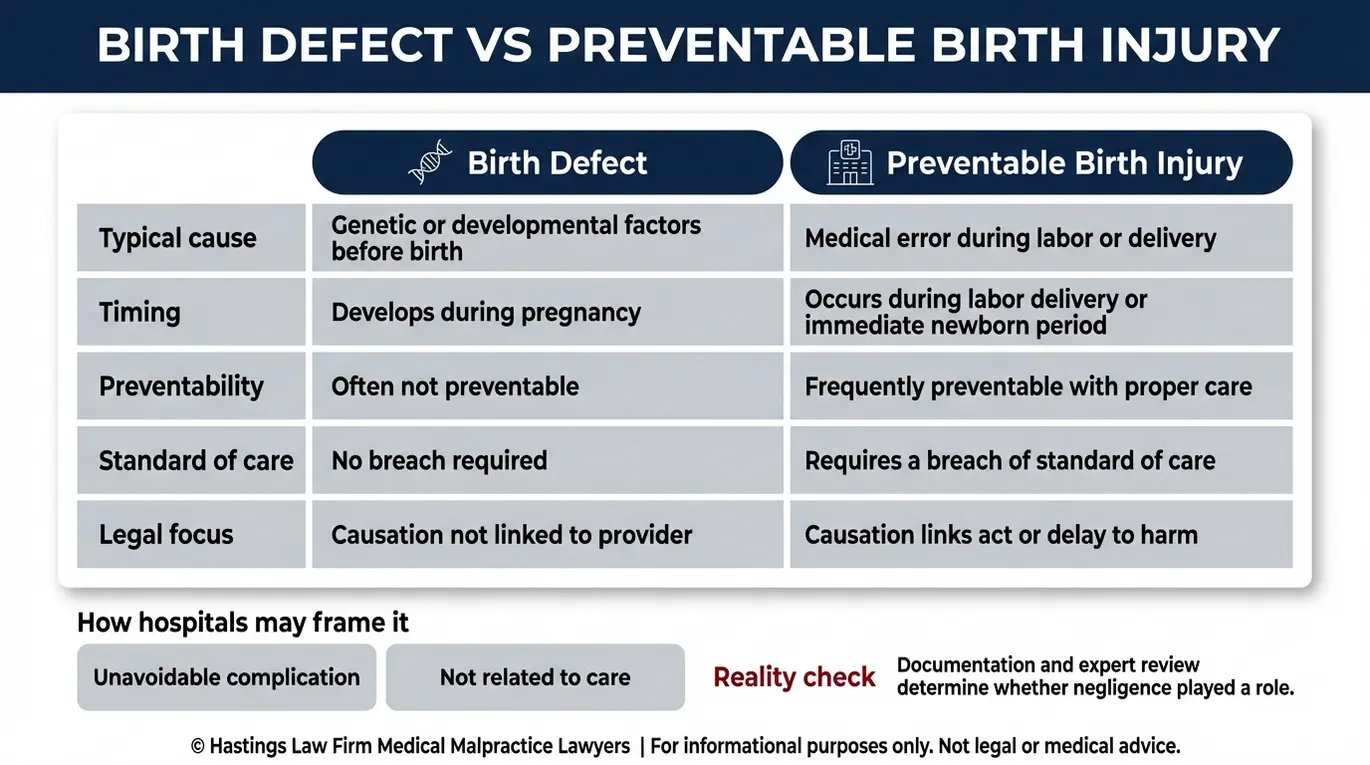
Understanding the difference between a birth injury and a birth defect is one of the most important distinctions in these cases. A birth defect, also called a congenital condition, is a structural or functional abnormality that develops during pregnancy due to genetic or environmental factors. A birth injury, by contrast, results from something that happened during labor, delivery, or the immediate postnatal period, often tied to the actions or inactions of the medical team.
| Birth Defect (Congenital Condition) | Birth Injury | |
|---|---|---|
| Cause | Genetic factors, chromosomal abnormalities, or environmental exposure during pregnancy | Medical errors, omissions, or substandard care during labor and delivery |
| Timing | Develops before or during pregnancy | Occurs during labor, delivery, or shortly after birth |
| Preventability | Generally not preventable through medical intervention at delivery | Often preventable with proper monitoring, timely decisions, and adherence to protocols |
| Legal Basis | Typically not actionable as medical malpractice | May support a malpractice claim if the standard of care was breached |
Under Texas law, medical malpractice claims require proof that a provider breached the standard of care and that this breach directly caused the injury. The Texas Civil Practice and Remedies Code, Chapter 74 outlines key provisions related to healthcare liability in the state. This standard is based on the level of care a competent medical professional would have provided in the same situation.
Hospitals sometimes characterize birth trauma as unavoidable “complications.” That framing may not reflect what actually happened. Our Dallas birth injury attorneys work with medical experts to examine the clinical record and determine whether the care provided met the standard or fell short of it.
Common Causes of Preventable Birth Injuries in Dallas Hospitals
Most preventable birth injuries result from a failure to monitor fetal distress signals, delayed performance of emergency C-sections, or improper use of delivery tools like forceps and vacuum extractors. These errors often occur during high-pressure moments in labor when timely, competent decision-making is essential. Healthcare providers must adhere to the standard of care to ensure the safety of both mother and child during these moments.
Failure to recognize and respond to fetal distress. Fetal distress refers to signs that a baby is not tolerating labor well, often indicated by abnormal heart rate patterns on electronic monitoring strips. When these warning signs are missed or ignored, oxygen deprivation, known as hypoxia, can develop rapidly.
A delay in escalating care or performing an emergency cesarean section (C-section), which is a surgical delivery performed when vaginal birth poses a serious risk, can result in lasting neurological harm. Our team investigates the timeline to determine if the medical staff responded to these signs within the appropriate clinical window.
Failure to diagnose or manage maternal conditions. Conditions like preeclampsia, a dangerous pregnancy complication involving high blood pressure and organ damage, require close monitoring and early intervention. According to University of Utah Health, preeclampsia can escalate quickly and threaten the health of both mother and baby. When providers fail to screen for or respond to these warning signs, the consequences can be severe.
Improper use of delivery instruments. Forceps and vacuum extractors are tools sometimes used to assist with delivery. When applied with excessive force or used in inappropriate circumstances, they can cause skull fractures, brain bleeds, and nerve damage. The decision to use these instruments, and the technique involved, must follow strict clinical guidelines.
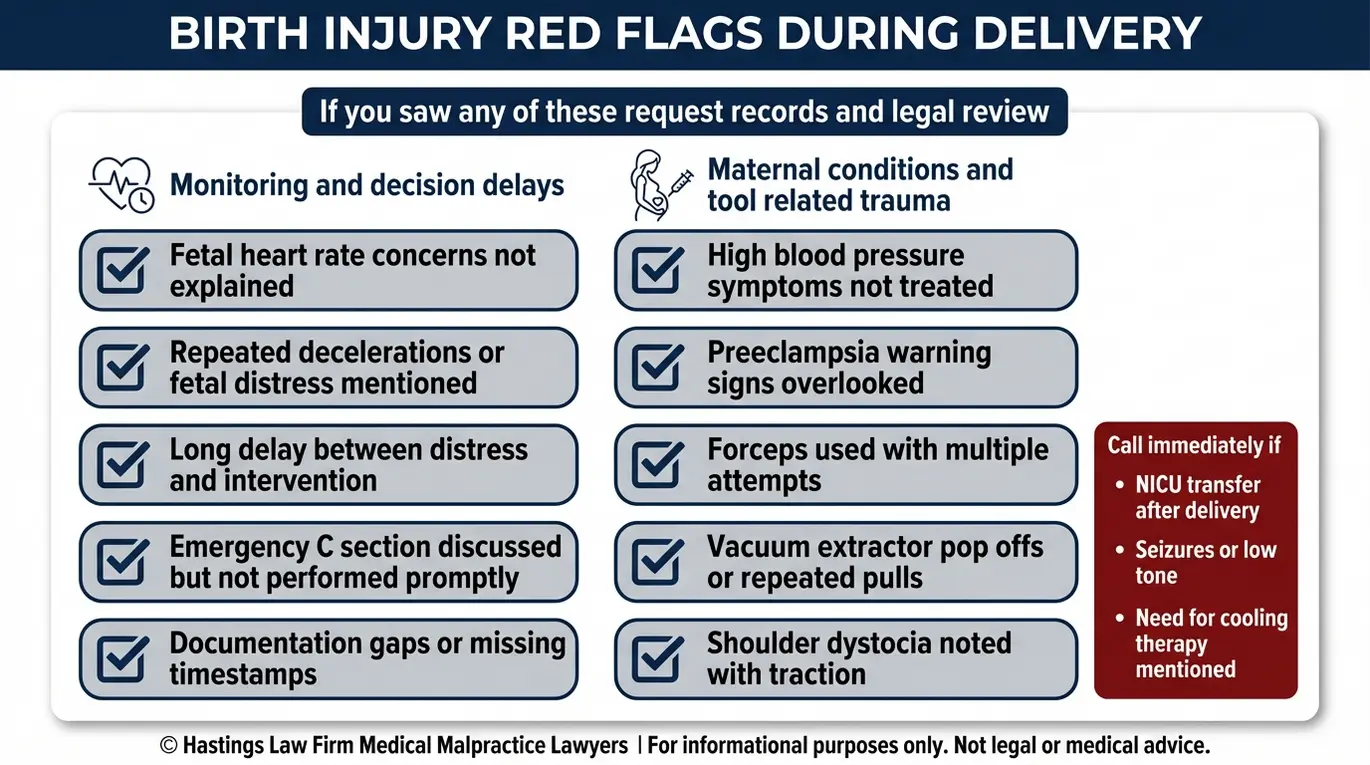
Warning signs that may indicate negligence occurred during delivery include:
- Abnormal fetal heart rate patterns that went unaddressed for an extended period
- A significant delay between recognized distress and the decision to perform a C-section
- Visible bruising, swelling, or marks from delivery instruments on the newborn
- Apgar scores that dropped sharply in the minutes after birth
- An unexpected NICU admission following what was described as a routine delivery
- Maternal conditions like preeclampsia that were documented but not adequately treated
A birth injury lawyer in Dallas can help you understand if these signs point to negligence. Our Dallas birth injury lawyers examine each of these factors when evaluating a potential case. We review fetal monitoring strips, nursing logs, physician orders, and delivery room timelines to identify where the standard of care may have been breached.
The Role of Defective Medical Devices
Not all birth injuries are caused by provider error. In some cases, the delivery instrument itself may be defective. A forceps delivery involves the use of curved metal instruments to guide the baby through the birth canal, while vacuum extraction uses a suction cup device applied to the baby’s head to assist delivery.
A medical product liability claim is a legal action taken when a device’s failure, rather than a provider’s error, causes an injury. If either tool malfunctions due to a design or manufacturing defect, the resulting injury may give rise to a medical product liability claim against the manufacturer rather than, or in addition to, the treating provider. We investigate the history of the specific tools used to see if equipment failure played a part in the harm.
The Hastings Law Firm Difference
Results matter, but what truly sets us apart is how we achieve them. Every verdict, every settlement, and every Dallas courtroom victory comes from one guiding promise: To treat each client’s fight for justice as if it were our own.
This balance of skill, experience, and empathy reflects our core philosophy that justice should not only compensate the injured, but also make healthcare safer nationwide.

Types of Birth Injuries We Litigate
We handle severe cases involving neurological damage and physical trauma, including Cerebral Palsy, Erb’s Palsy, and fractures caused by improper delivery techniques. Our Dallas birth injury legal team has the medical knowledge and litigation experience to take on the most complex of these claims. These conditions often require a lifetime of specialized medical care and support.
Brain injuries from oxygen deprivation. When a baby’s oxygen supply is interrupted during delivery, the result can be permanent brain damage. Hypoxic-ischemic encephalopathy (HIE) is a specific type of brain injury caused by reduced oxygen and blood flow to the brain around the time of birth. HIE can range from mild to severe and is a leading cause of cerebral palsy.
According to the CDC’s information on cerebral palsy, cerebral palsy is a group of disorders affecting movement, balance, and posture, often linked to brain damage that occurs before or during birth. Children with cerebral palsy may require lifelong therapy, adaptive equipment, and around-the-clock care.
Nerve injuries from delivery complications. Shoulder dystocia, a condition where the baby’s shoulder becomes lodged behind the mother’s pelvic bone during delivery, is a known obstetric emergency. When managed improperly, excessive traction on the baby’s head and neck can damage the brachial plexus, the network of nerves that controls movement and sensation in the arm and hand. This can lead to Erb’s palsy or, in more severe cases, permanent brachial plexus paralysis.
Research published in PubMed Central on neonatal brachial plexus palsy confirms that the management of shoulder dystocia directly affects the likelihood and severity of these nerve injuries.
Physical trauma during delivery. Broken collarbones, skull fractures, and soft tissue injuries can result from the misuse of forceps, vacuum extractors, or excessive manual force during delivery. While some fractures heal, others can lead to complications that affect the child’s development.
| Injury | Common Cause | Potential Long-Term Effects |
|---|---|---|
| Cerebral Palsy | Oxygen deprivation (HIE) | Motor impairment, speech difficulties, need for lifelong care |
| Erb’s Palsy | Shoulder dystocia, excessive traction | Weakness or paralysis in the affected arm |
| Brachial Plexus Paralysis | Severe nerve damage during delivery | Permanent loss of movement and sensation in the arm |
| HIE (Hypoxic-Ischemic Encephalopathy) | Prolonged oxygen deprivation | Cognitive delays, seizures, developmental disabilities |
| Skull Fractures | Improper forceps or vacuum use | Risk of brain bleeds, neurological complications |
A lawyer for birth injuries evaluates how the injury occurred, what decisions were made, and whether a different course of action would have changed the outcome.
Why Choose Hastings Law Firm as Your Dallas Birth Injury Lawyer
When hiring a Dallas birth injury lawyer, choosing our firm means partnering with a trial-ready team that uses in-house medical professionals and former defense counsel to build the strongest possible case from day one. We do not spread our resources across car accidents, slip-and-falls, or other unrelated practice areas. Every case we accept is a medical malpractice case, and that singular focus makes a difference.
Trial-ready from the start. We prepare every birth injury case as if it will go to a jury. This level of preparation sends a clear signal to hospitals and their insurers that we will not accept less than what the case is worth. That posture produces results, whether a case resolves through settlement or proceeds to trial.
Quality over quantity. We are not a high-volume settlement operation. We take fewer cases so each family receives the attention and resources their case demands. We handle everything from a birth injury claim to a wrongful death case with the same dedication. Tommy Hastings, our founder, is Board Certified in Personal Injury Trial Law by the Texas Board of Legal Specialization. He has secured results including a $7 million birth injury settlement in Houston and an $8 million settlement in Dallas.
No fee unless we recover for you. We operate on a contingency fee basis. You pay no attorney fees and no costs unless we secure a recovery on your behalf. Hiring an experienced Dallas birth injury lawyer should not add financial stress to an already difficult situation.
The Hastings difference includes:
- A legal team that handles only medical malpractice cases
- Former defense attorneys who know how hospitals and insurers build their arguments
- In-house nurse consultants and board-certified patient advocates
- A national network of medical experts for case review and testimony
- A track record of multi-million-dollar results in birth injury and medical negligence cases
- Direct access to Tommy Hastings and your legal team throughout the process
The Advantage of Nurse-Attorneys on Staff
Birth injury cases depend heavily on medical records, and those records are often dense, inconsistent, or incomplete. Our in-house medical staff, including nurse-attorneys and experienced nurses who previously worked in hospital settings, review electronic fetal monitoring (EFM) strips, which are continuous recordings of the baby’s heart rate and the mother’s contractions during labor. They identify charting gaps, interpret clinical data, and flag inconsistencies that a general practice attorney might overlook. This medical-legal collaboration is central to how we build each case.
Recovering Compensation for Lifelong Care Costs
Families can recover economic damages for medical bills and future care needs, as well as non-economic damages for the child’s physical pain, mental anguish, and physical impairment. The goal is to secure the financial resources your child will need for the rest of their life. Economic damages provide the financial support needed to cover tangible costs resulting from medical errors.
Economic damages cover the measurable financial costs of the injury. These include past and future medical bills, rehabilitation, physical and occupational therapy, assistive devices like wheelchairs or communication aids, home modifications, and lost earning capacity if the child’s disability will limit future employment. A life care plan, which is a detailed projection of all medical and support services a person will need over their lifetime, is often the foundation of this part of the claim.
The scope of these costs can be staggering. According to the CDC’s data on cerebral palsy, the lifetime costs for a person with cerebral palsy can reach well over a million dollars when factoring in medical care, therapy, and support services. Our Dallas birth injury attorneys work with life care planners, economists, and medical specialists to document every anticipated expense.
Non-economic damages address the human cost of the injury. These include the child’s physical pain and suffering, mental anguish, disfigurement, and the loss of the ability to enjoy a full and normal life. While harder to quantify, these damages are just as important to the family’s recovery.
Wrongful death. In the most devastating cases, a birth injury results in the death of the infant. Texas law allows families to pursue a wrongful death case to recover damages for their loss, including funeral costs, mental anguish, and the loss of companionship.
Understanding Texas Damage Caps
Texas places a cap on non-economic damages in medical malpractice cases. Generally, non-economic damages are limited to $250,000 per claimant against all individual physicians and healthcare providers, with a separate cap of $250,000 per healthcare institution (up to $500,000 across multiple institutions), and a total cap of $750,000 when both individual providers and institutions are involved. There is no cap on economic damages. Because of this structure, a lawyer in Dallas experienced in birth injury litigation will focus heavily on fully documenting every economic loss, including lifetime care costs, lost earning capacity, and ongoing medical needs, to ensure the family receives the full compensation the law allows, whether through a settlement or verdict.
The Statute of Limitations for Texas Birth Injury Cases
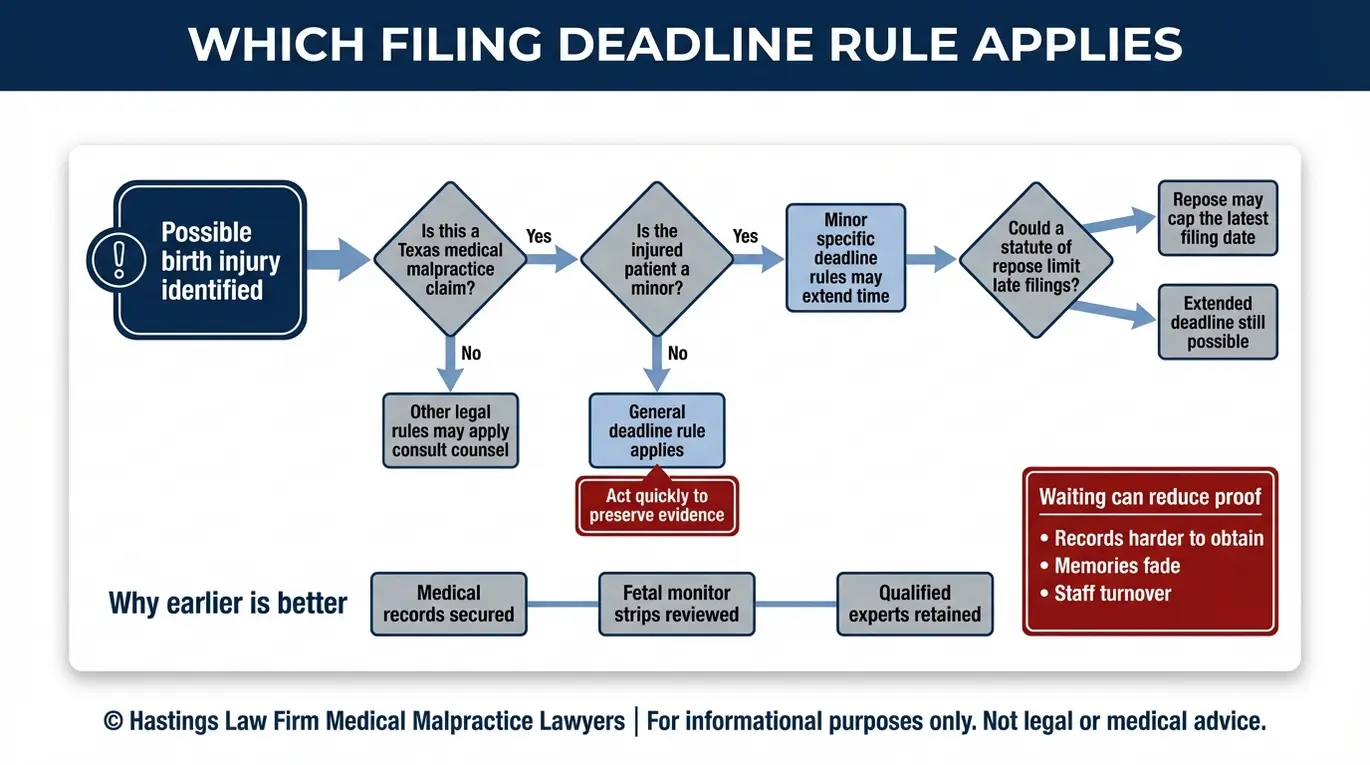
While Texas generally imposes a two-year statute of limitations for medical malpractice claims, cases involving minors may have an extended deadline. A statute of limitations is a legal deadline that limits how much time you have to file a lawsuit. Still, waiting to act can put your case at serious risk.
Under the Texas Civil Practice and Remedies Code, Chapter 74, most medical malpractice claims must be filed within two years of the date the negligence occurred or was discovered. For children, the statute of limitations may be tolled, meaning the clock is paused, until the child reaches a certain age. Specifically, minors under the age of 12 have until their 14th birthday to file. This tolling provision acknowledges that the full extent of a birth injury, such as developmental delays caused by hypoxia, may not be immediately apparent. However, parents should not rely on this extension as a reason to delay.
However, Texas also imposes a statute of repose, which sets a hard outer deadline regardless of when the injury was discovered. This typically bars any claim filed more than 10 years after the act of negligence, creating an absolute time limit that cannot be extended.
⚠ Do not assume you have unlimited time. Even when tolling applies, critical evidence can disappear. Medical records may be altered or lost. Memories of delivery room staff fade. Electronic fetal monitoring data may be overwritten. The sooner you speak to a Dallas birth injury lawyer, the sooner we can preserve the evidence your case depends on.
Early legal involvement also allows for better medical case management support, connecting your child with appropriate specialists while building the strongest possible record for your claim. Connecting with a legal team early allows us to secure expert witnesses who can evaluate the timeline of events before important details are lost.
Every day that passes without preserving evidence can impact the strength of your case. There is no cost and no obligation to have your case evaluated. If you believe your child was harmed by negligence during delivery, contact our team now to protect your rights and your child’s future.
Contact the Dallas Birth Injury Attorneys at Hastings Law Firm Today for Help
If your child was harmed during delivery, you deserve to know whether that injury was preventable. You deserve the truth, and your child deserves a secure future.
At Hastings Law Firm, we are trial-ready from the moment we accept your case. Our team of attorneys, in-house medical professionals, and former defense counsel will investigate what happened, identify who is responsible, and pursue the full compensation your family needs. There are no upfront costs. You pay nothing unless we win.
Taking this step is not about blame. It is about answers, accountability, and making sure your child has every resource they need going forward.
Contact a Dallas birth injury lawyer today for a free, confidential case evaluation. Call our Dallas office or submit your information online. Let us help you find the answers your family deserves.
Frequently Asked Questions About Birth Injury in Dallas

Key Birth Injury Terms:
- Birth injury
- A birth injury is physical harm to a baby that occurs during labor and delivery, typically caused by medical negligence or improper care. Unlike genetic conditions that cannot be prevented, birth injuries are often avoidable through proper monitoring, timely intervention, and adherence to accepted medical standards. In a Texas medical malpractice claim, proving a birth injury requires showing that the healthcare provider’s actions fell below the standard of care and directly caused the harm.
- Birth defect (congenital condition)
- A birth defect, also called a congenital condition, is a structural or functional abnormality present at birth that is typically caused by genetic factors, chromosomal abnormalities, or environmental exposures during pregnancy. These conditions are generally unavoidable and not the result of medical negligence. In birth injury cases, it is legally critical to distinguish between a birth defect (which is not actionable) and a birth injury (which may be caused by preventable medical errors during labor or delivery).
- Fetal distress
- Fetal distress is a medical condition indicating that a baby is not receiving enough oxygen during labor, often detected through abnormal heart rate patterns on a fetal monitor. Signs include a rapid, slow, or irregular heartbeat. When fetal distress is identified, immediate intervention—such as repositioning the mother, administering oxygen, or performing an emergency cesarean section—is required to prevent brain damage or death. Failure to recognize or respond to fetal distress is a common basis for birth injury malpractice claims.
- Emergency cesarean section (C-section)
- An emergency cesarean section, or C-section, is a surgical procedure performed urgently to deliver a baby when vaginal delivery poses immediate risks to the mother or child. Common reasons include fetal distress, umbilical cord complications, or failure of labor to progress. In birth injury cases, delays in ordering or performing an emergency C-section when medically necessary can result in oxygen deprivation and permanent brain damage to the infant.
- Forceps delivery
- Forceps delivery is a procedure in which a doctor uses a metal, tong-like instrument to guide the baby’s head out of the birth canal during a difficult vaginal delivery. While forceps can be helpful in certain situations, excessive force or improper use can cause serious injuries such as skull fractures, facial nerve damage, or brain bleeding. In malpractice cases, aggressive or negligent use of forceps is often cited as the cause of preventable birth trauma.
- Vacuum extraction (vacuum extractor)
- Vacuum extraction is a delivery technique in which a suction cup device is attached to the baby’s head to help pull the infant through the birth canal. When used correctly, it can assist in delivery, but improper technique, excessive pulling, or prolonged use can lead to scalp injuries, skull fractures, bleeding in the brain, or nerve damage. Vacuum extractor injuries are a common subject of birth injury lawsuits when the device is used negligently or when a C-section should have been performed instead.
- Shoulder dystocia
- Shoulder dystocia is an obstetric emergency that occurs when a baby’s shoulder becomes lodged behind the mother’s pelvic bone during delivery, preventing the baby from being born. This condition requires immediate and careful maneuvering by the delivery team to free the infant without causing injury. If handled improperly or with excessive force, shoulder dystocia can cause nerve damage to the baby’s arm and shoulder, resulting in conditions like Erb’s palsy or brachial plexus injuries.
- Brachial plexus
- The brachial plexus is a network of nerves located near the neck and shoulder that controls movement and sensation in the arm, hand, and fingers. During a difficult delivery—especially in cases of shoulder dystocia—excessive pulling or stretching can damage these nerves, leading to partial or complete paralysis of the affected arm. Brachial plexus injuries, including Erb’s palsy, are often the result of preventable trauma during labor and are a common focus of birth injury litigation.
- Electronic fetal monitoring (EFM)
- Electronic fetal monitoring (EFM) is a method used during labor to continuously track the baby’s heart rate and the mother’s contractions, typically using sensors placed on the mother’s abdomen or internally. The monitor produces a strip chart that helps medical staff detect signs of fetal distress or oxygen deprivation. In birth injury cases, failure to properly read, interpret, or respond to concerning patterns on the EFM is a frequent basis for claims of negligence, as timely intervention could have prevented harm.
- Life care plan
- A life care plan is a detailed, long-term projection prepared by medical and financial experts that estimates the future medical, therapeutic, and support costs for an injured child over their lifetime. In birth injury cases, a life care plan accounts for expenses such as surgeries, medications, physical therapy, adaptive equipment, home modifications, and attendant care. This document is essential for recovering full compensation, as it demonstrates the true financial impact of a preventable injury that will require decades of specialized care.
- Texas Civil Practice and Remedies Code, Chapter 88 | Texas Legislature Online
- Preeclampsia | University of Utah Health
- About Cerebral Palsy | CDC
- The evaluation and management of neonatal brachial plexus palsy | PubMed Central
- Data and Statistics for Cerebral Palsy | CDC
- Texas Civil Practice and Remedies Code, Chapter 74 | Texas Legislature Online
Get Answers Today
If you think that medical negligence, a dangerous drug, or a failed medical product caused harm to you or someone you love, our team is standing by to offer guidance. We’ll explain your options under current laws and help you move forward with clarity and understanding. Case reviews are free and 100% confidential.
