


St. David’s Georgetown Hospital Malpractice Lawyer
Hastings Law Firm pursues hospital malpractice claims in Georgetown, Texas, on behalf of patients and families hurt by negligent care at St. David’s Georgetown Hospital. Those claims can be brought against the hospital for the work of its employees, against a physician who treated the patient there, or against both. Treatment that falls short can leave a person with a permanent injury, additional recovery time, or the loss of a loved one. Learning what went wrong, and who should be held to account, takes attorneys who understand both the medicine behind a decision and the law that applies to it. At Hastings Law Firm, medical malpractice is all we do!
Last Updated: September 28, 2026
Trial-Ready Hospital Negligence Attorneys for St. David’s Georgetown Hospital Patients and Families
Hastings Law Firm’s hospital negligence lawyers bring experienced representation to St. David’s Georgetown Hospital patients and families in Georgetown, Texas. Tommy Hastings, the firm’s founder, is Board Certified in Personal Injury Trial Law and has represented injured patients since 2001. Our team also includes former malpractice defense attorneys who understand the tactics hospitals use to deny liability.
Knowing those tactics lets us plan for them from the day a case begins. We draw on a nationwide network of medical experts to show what careful treatment called for and where it fell short. Every case is built as if it were going to trial, an approach that has earned clients multimillion-dollar settlements and record-setting verdicts. Those results come from a firm that has been dedicated exclusively to medical malpractice since 2005.
Contact us now for a free, confidential case review. We will listen to your account, investigate your claim, and explain the options open to you.

The Types of St. David’s Georgetown Hospital Lawsuits Our Hospital Malpractice Attorneys Handle
Hastings Law Firm takes on St. David’s Georgetown Hospital lawsuits in Georgetown, Texas, involving emergency and diagnosis errors, surgical errors, and labor, delivery and newborn care errors. Our hospital malpractice lawyers build each claim on the patient’s full chart and on the opinions of physicians independent of the hospital. We use that work to show what the standard of care required and what the lapse cost the family.
The cases we see most often at a community hospital like St. David’s Georgetown Hospital include:
- Emergency care and diagnosis errors. Stroke signs can go unrecognized while time-sensitive treatment could still help, or a heart attack, blood clot, sepsis or internal injury can be missed. Imaging and lab work can go unordered, unread or unanswered, and a patient can leave before a dangerous condition has been excluded, or wait too long for a transfer. Lost time can leave a patient with permanent disability or cost a family a loved one. Our Texas emergency room malpractice attorneys line up the triage notes, results and order times, and our misdiagnosis lawyers pinpoint when the diagnosis should have been made.
- Surgical errors, especially in joint replacement, orthopedic and robot-assisted surgery. Damage to a nerve or blood vessel, surgery on the wrong site, or bleeding, infection or a clot that goes unnoticed afterward can all injure a patient. An anesthesia or medication error, a fall, or a warning sign missed during recovery can add to the damage. The patient may face another operation, lost mobility and a slower return to daily life. Our firm’s surgical error attorneys compare the operative, anesthesia and implant records, and our nurse malpractice lawyers examine how the patient was watched after surgery.
- Labor, delivery and routine newborn care errors. Signs that a baby is struggling during labor can be missed or not acted on, a cesarean delivery can be delayed, or a hemorrhage or blood pressure emergency can be poorly managed. After birth, jaundice, trouble breathing, low blood sugar or an infection in a newborn can go unnoticed, or a baby who needs a higher level of care can stay too long without one. Harm at birth can shape a mother’s recovery and a child’s health for years. Our birth injury attorneys read the fetal monitoring strips beside the delivery notes, while our pediatric malpractice attorneys go through the newborn nursery chart.
These are the more common claim types, and our hospital malpractice attorneys handle any valid medical negligence case that arises at this hospital. Tell us about care outside these categories as well.
The Hastings Law Firm Difference
Results matter, but what truly sets us apart is how we achieve them. Every verdict, every settlement, and every Georgetown courtroom victory comes from one guiding promise: To treat each client’s fight for justice as if it were our own.
This balance of skill, experience, and empathy reflects our core philosophy that justice should not only compensate the injured, but also make health care safer nationwide.

About St. David’s Georgetown Hospital on Scenic Drive
St. David’s Georgetown Hospital is a hospital at 2000 Scenic Dr in Georgetown, Texas, with a 24-hour emergency department, maternity and newborn services, and inpatient and outpatient surgery. The hospital’s About page says it is part of St. David’s HealthCare. That system describes itself as a partnership of HCA Healthcare with two local foundations, St. David’s Foundation and the Georgetown Health Foundation.
On its location page, the hospital calls its emergency department a Level IV Trauma Center and says it is a Certified Primary Stroke Center. The state trauma roster kept by the Texas Department of State Health Services (DSHS) also places it at Level IV, on the list of designated trauma facilities. The Texas Health and Human Services hospital list places the hospital in Williamson County.
For mothers and babies, the hospital describes maternity and newborn services with mother-baby couplet care. DSHS designates it a Level II facility on its maternal roster and as Level I, well newborn care, on its neonatal roster. Its surgical services include joint replacement and robot-assisted surgeries, and its About page also names advanced pulmonary intervention, critical care, acute rehabilitation and orthopedics.
Our Georgetown medical malpractice lawyers represent patients hurt by any health care provider in the city. St. David’s Round Rock Medical Center in Round Rock and St. David’s North Austin Medical Center in Austin are separate St. David’s HealthCare hospitals, and each has its own page.
Can You File a Lawsuit Against St. David’s Georgetown Hospital, the Doctor, or Both?
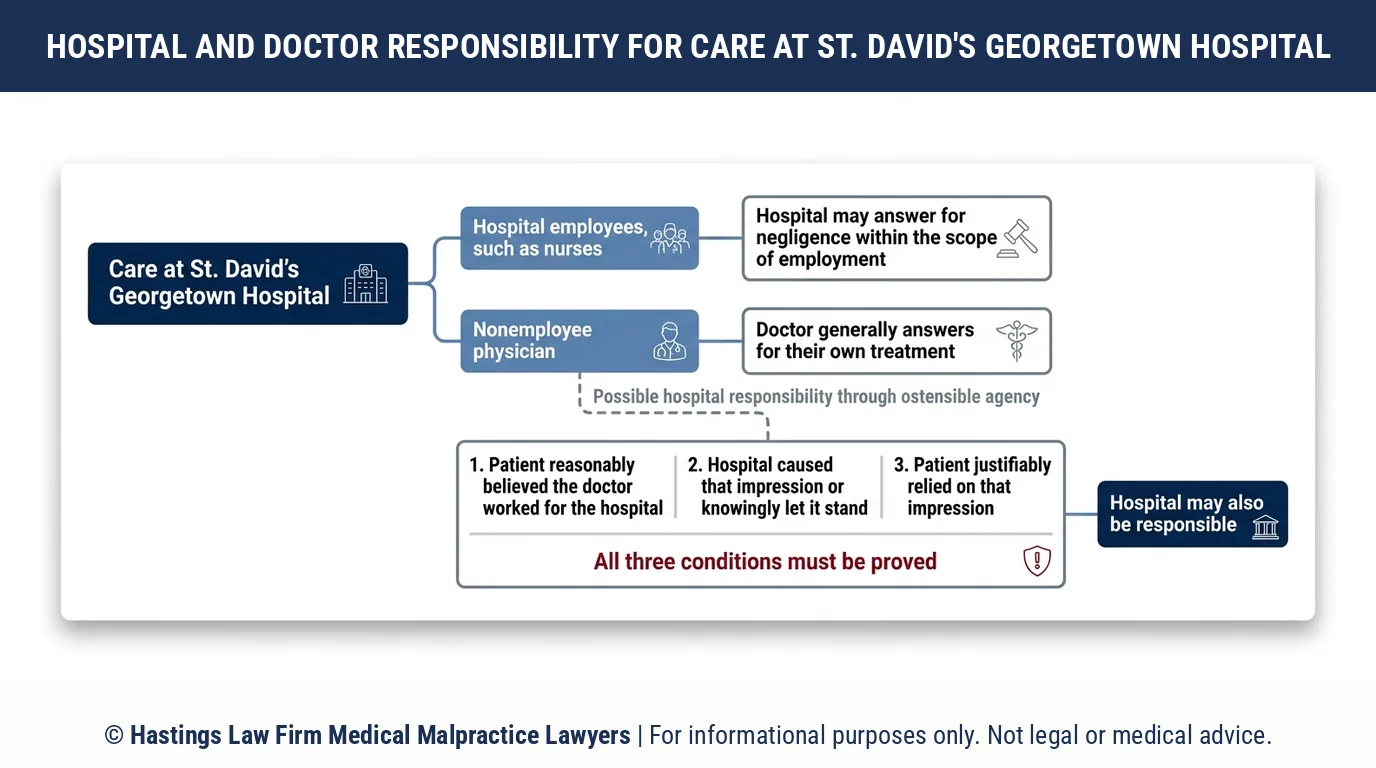
You can file a lawsuit against St. David’s Georgetown Hospital, a treating doctor, or both, depending on who gave the care and who employed that person. Under Baptist Memorial Hospital System v. Sampson, a Texas hospital can answer for negligence by its employees within the scope of their work, such as its nurses. A doctor the hospital does not employ is generally responsible for that doctor’s own treatment.
A hospital shares responsibility for a nonemployee physician when the patient proves all three parts of what Texas calls ostensible agency. First, the patient reasonably thought the doctor worked for the hospital. Second, the hospital caused that impression or knowingly let it stand, and third, the patient justifiably relied on it.
Whether St. David’s Georgetown should have let a particular doctor practice there at all is a different claim, with stricter rules of its own. A negligence claim over hospital care in Texas also runs through Chapter 74 of the Texas Civil Practice and Remedies Code. That law generally calls for a qualified expert’s report within 120 days after each defendant’s original answer. Deadlines like that one are a reason the choice of a lawyer to sue a hospital matters.
Medicine carries risk, and a bad outcome is not always negligence. When an injury was preventable, the providers responsible should be held accountable. Our Austin hospital malpractice lawyers find out which providers those were.
When Does Texas Law Hold St. David’s Georgetown Hospital Responsible for Credentialing a Surgeon?
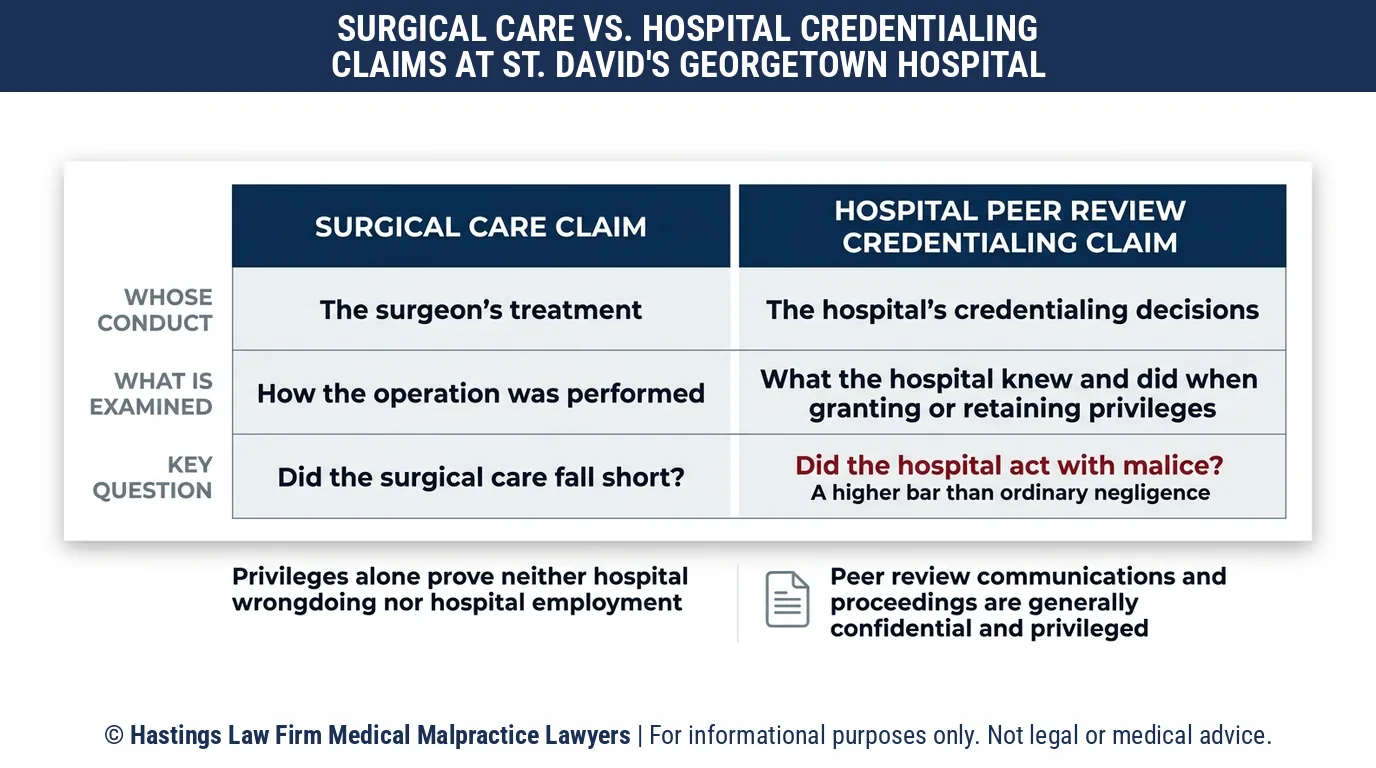
Texas law holds St. David’s Georgetown Hospital responsible for credentialing a surgeon through peer review only if the hospital acted with malice, under Romero v. KPH Consolidation. Texas recognizes improper credentialing claims, but that malice requirement sets a higher bar than ordinary negligence. The claim depends on what the hospital knew and did, not only on the surgeon’s mistake.
St. David’s HealthCare explains on its page for medical professionals that its credentialing validates a physician’s education, training, licensure and current competence before privileges are granted. The same page lists a medical-staff contact for St. David’s Georgetown Hospital. Granting a surgeon privileges does not, by itself, prove the hospital did anything wrong, and it does not make that surgeon a hospital employee.
The Texas Supreme Court case, Romero v. KPH Consolidation, involved a hospital that first granted a doctor privileges and then let him keep them. For the events in that case, the court described malice as “actual awareness of, yet conscious indifference to, an extreme risk.” That wording was tied to the time period of the case, so it is not a test that fits every claim.
Gathering the proof is its own hurdle. Romero notes that peer review communications and proceedings are generally confidential and privileged. The evidence for a credentialing claim usually has to come from somewhere other than the committee’s own file.
For a patient hurt in a joint replacement or robot-assisted operation, the first claim is usually against the surgeon, over how the operation itself was done. A credentialing claim against the hospital is a separate and harder case that some sets of facts support and many do not. Our attorneys examine the surgeon’s care first, then whether the facts support a credentialing claim, and when they do not, we tell the family directly.
How We Work With Injured St. David’s Georgetown Patients and Families
Hastings Law Firm works with St. David’s Georgetown Hospital patients and families on hospital malpractice claims in Georgetown, Texas. Your first call reaches a member of our intake team, and a relative can place that call for a patient who is unable to. We listen to what happened and who was involved, and our team works to make sure you are heard.
Once we have your account, we request the records ourselves, and for emergency or stroke care that means the emergency department records, imaging and lab results. After surgery, it means the operative and anesthesia records, implant records for a joint replacement, post-operative nursing notes and medication administration records. For a birth, it means the prenatal, labor and delivery records, the newborn nursery records and any transfer records. We also collect each clinician’s name, role and employer group, the admission and discharge dates, and the itemized bills.
If our hospital negligence lawyers accept your case, we speak for you with the hospital, its insurer and the lawyers defending it. Our board-certified patient advocates keep in touch as the case moves and put each new development into plain language. We press for a settlement that matches the full cost of the harm, and we are prepared to take your case to a jury if the offers do not.
If You or a Loved One Were Injured at St. David’s Georgetown, Speak With Our Medical Attorneys Today
Hastings Law Firm represents patients and families in Georgetown, Texas, in malpractice claims arising from care at St. David’s Georgetown Hospital. Our hospital malpractice lawyers look at every provider who took part in that care and explain who may be responsible. We perform a free case review to find out whether you have a valid claim.
The review is confidential, and there is no fee unless we win. Our team is here for you, so contact us to understand your options.
St. David’s Georgetown Hospital Malpractice FAQs


This content was researched and written by the Hastings Law Firm editorial team, which includes attorneys, medical professionals, and experienced researchers. Our writing is informed by internal knowledge and practical experience, and we cross-check critical details against authoritative sources cited throughout. Every piece undergoes human-led fact-checking and legal review. Because legal and medical information can change, if you spot an error, please contact us. Learn more about our content standards and review process on our editorial policy page.

Gabe Sassin has focused exclusively on medical malpractice law since 2007. After spending more than a decade as a malpractice defense attorney, he knows exactly how the other side works. He has seen firsthand how healthcare providers, insurers, corporate defendants, and their legal teams think, prepare, and build their defense against claims. That knowledge works for the people who need it most today, injured patients and their families. His unique experience shapes everything he writes, giving readers a look at how these cases actually work from someone who has handled them from both sides.
