


Austin Nurse Malpractice Lawyer
Nursing negligence can leave patients and families facing unexpected injuries, long recoveries, and lasting uncertainty about what went wrong. Nurses have a defined scope of practice, and serious harm can occur when care falls below accepted standards or when warning signs are missed, not communicated, or not acted on in time. Liability may involve an individual nurse, a hospital, or both, and proving causation is often the most contested issue. If you or a loved one were harmed or worse due to nurse malpractice in Austin, Texas, contact Hastings Law Firm for a free, confidential case review.
Last Updated: July 27, 2026
Trusted Medical Attorneys for Nursing Negligence Claims in Austin
When a nurse’s error causes harm to you or someone you love, the experience can feel disorienting. You placed your trust in a medical team, and that trust was broken. Nurses operate within a defined nursing scope of practice, the set of duties and responsibilities they are legally authorized to perform based on their training and licensure. When care falls outside or below that scope, the consequences can be serious and lasting.
As an Austin nurse malpractice lawyer, Hastings Law Firm is led by founder Tommy Hastings, who is board-certified in personal injury trial law. Our team includes in-house medical professionals and former defense attorneys who understand exactly how hospitals and their insurers respond to these claims. If you believe a nursing error led to an injury, we are here to review what happened and explain your options in a free, confidential consultation.

Can a Nurse Be Held Liable for Malpractice in Texas?
Yes, a nurse can be held individually liable for malpractice if they fail to meet the accepted standard of care, which is the level of treatment a reasonably competent nursing professional would have provided under similar circumstances, and that failure results in patient injury. This is a fundamental concept in medical negligence claims. The hospital that employs the nurse is also frequently one of the liable parties under a legal doctrine called *respondeat superior*, which holds employers responsible for the actions of their employees performed within the scope of their job.
To pursue a claim, we must demonstrate a clear chain: the nurse owed a duty of care to the patient, a specific breach of that duty occurred, and that breach directly caused the injury. This is the element of causation, and it is often the most contested part of the case.
Separating individual nurse liability from broader hospital failures can be complex. For example, a nurse’s failure to rescue, which is the failure to recognize and respond to a patient’s deteriorating condition in time to prevent serious harm, may stem from an individual lapse, an institutional staffing problem, or both. Our nurse malpractice attorneys in Austin investigate the full picture to identify every responsible party.
Common Examples of Nurse Negligence in Austin Hospitals
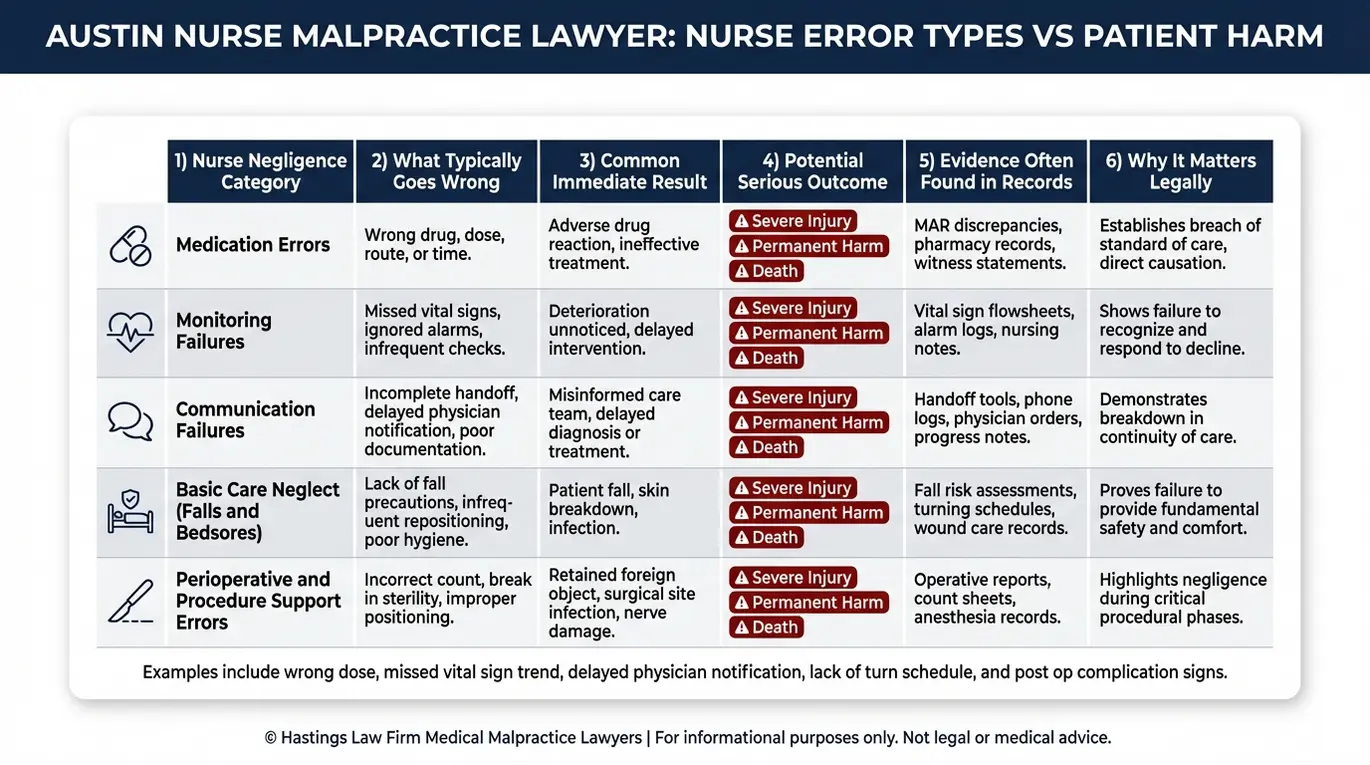
Common forms of nurse negligence include medication errors, failure to monitor vital signs, surgical mistakes, failure to prevent falls, and neglecting to communicate critical patient changes to a physician that results in failure to diagnose. These errors happen across nearly every hospital unit, from labor and delivery to post-surgical recovery.
Medication Errors
One of the most frequent categories involves violations of the medication administration errors known as the Five Rights: the right patient, right drug, right dose, right route, and right time. A nurse who administers the wrong dosage, gives medication to the wrong patient, or uses an improper method of delivery can cause severe and sometimes irreversible harm. Adverse drug events can be reported through the MedWatch Forms for FDA Safety Reporting, and these reports often help establish patterns of error at specific facilities.
Monitoring Failures
Nurses are the frontline observers for changes in a patient’s condition. A failure to recognize signs of distress, such as fetal distress during labor that may lead to birth injuries, or post-operative complications like internal bleeding, can allow a treatable problem to become a catastrophic one. When deterioration goes unnoticed, the window for effective intervention closes.
Communication Failures
A nursing negligence lawyer often sees cases where the breakdown was not in observation but in communication. A nurse may identify a change in the patient’s status but fail to relay that information to the treating physician promptly or clearly. As outlined in the Patient Safety 101 primer from the Agency for Healthcare Research and Quality (PSNet), communication failures between care team members are a leading contributor to preventable patient harm.
Basic Care Neglect
Falls due to lack of assistance and bedsores from failure to reposition patients remain persistent problems, particularly among elderly or immobilized patients. A pressure ulcer, commonly called a bedsore, is staged from I to IV based on severity, ranging from surface-level redness to deep tissue damage exposing muscle or bone. These injuries are largely preventable with proper nursing attention.
| Type of Nurse Error | Potential Consequence |
|---|---|
| Wrong medication or dosage | Adverse drug reaction, organ damage, death |
| Failure to monitor vital signs | Undetected cardiac event, respiratory failure |
| Failure to communicate changes to physician | Failure to diagnose, delayed diagnosis, delayed treatment |
| Failure to prevent patient falls | Fractures, traumatic brain injury |
| Failure to reposition patients | Pressure ulcers (bedsores), infection, sepsis |
| Errors during surgical assistance | Surgical mistakes, complications, anesthesia errors |
| Missed signs of fetal distress | Birth injuries, oxygen deprivation |
A nurse error attorney can help determine whether the harm you or your family member experienced fits within one of these recognized categories and whether the evidence supports a claim.
The Hastings Law Firm Difference
Results matter, but what truly sets us apart is how we achieve them. Every verdict, every settlement, and every Austin courtroom victory comes from one guiding promise: To treat each client’s fight for justice as if it were our own.
This balance of skill, experience, and empathy reflects our core philosophy that justice should not only compensate the injured, but also make health care safer nationwide.

Who Is Liable: The Nurse, The Hospital, or Both?
While nurses can be sued individually, the hospital is frequently the primary defendant due to hospital negligence and vicarious liability, which holds an employer legally responsible for the negligent acts of its employees committed within the scope of their work. In most cases, both the nurse and the hospital can be named.
Determining all liable parties involves evaluating several factors. As highlighted by the National Academies of Sciences, Engineering, and Medicine, systemic issues like nurse staffing shortages and inadequate training contribute directly to patient harm. When errors stem from an unsafe nurse-to-patient ratio, which is the number of patients assigned to a single nurse during a shift, or a failure in the chain of command, the hospital’s own policies may be at the center of the claim.
The chain of command is the process by which a nurse escalates concerns to supervisors or physicians when initial requests are ignored. At Hastings Law Firm, our team includes former defense attorneys who previously worked for the hospital systems we now challenge, providing a strategic advantage in identifying these institutional failures.
Factors that help determine liability for nursing errors include:
- Whether the nurse was a hospital employee or independent contractor
- Whether hospital staffing levels met safe patient care standards
- Whether training and supervision were adequate for the nurse’s assignment
- Whether institutional policies contributed to or enabled the error
- Whether the chain of command was followed when concerns arose
Proving a Nurse Malpractice Lawsuit: The Certificate of Merit
Texas law requires plaintiffs to serve an expert report, known as a Certificate of Merit, within 120 days after the defendant files an original answer. This report must come from a qualified medical expert who has reviewed the case and believes that the care provided fell below the accepted standard. This requirement helps prevent frivolous lawsuits by ensuring a professional peer validates the claim, as missing this deadline can result in dismissal of malpractice claims against nurses.
Here is a general overview of how the process works when building a case with Austin medical malpractice counsel:
- File the lawsuit. The claim is formally filed against the responsible parties.
- Gather and analyze medical records. Our in-house medical staff, which includes Board Certified Patient Advocates, reviews all relevant documentation, including the medication administration record (MAR), a clinical log that tracks every drug given to the patient.
- Identify charting inconsistencies. We examine electronic health record audit trails, which are the metadata within digital records that shows when entries were created, modified, or accessed.
- Secure the expert report. A qualified nursing or medical expert prepares the Certificate of Merit, as required under Texas Civil Practice and Remedies Code Chapter 74.
- Build the causation case. Meeting the burden of proof requires expert testimony that links the specific nursing breach to the patient’s injury.
One challenge in these cases is what we call the “White Coat Effect,” which is the instinctive hesitation people feel when questioning a medical professional’s judgment. That hesitation is natural, but it should not stop you from seeking answers. Expert testimony exists precisely to bridge that gap, providing an objective, credentialed voice that can explain to a jury what went wrong and why it mattered.

Damages Available in Nurse Malpractice Cases
Patients harmed by nursing negligence may recover economic damages for medical bills and lost wages, as well as non-economic damages for pain, suffering, and physical impairment, subject to Texas statutory caps.
Economic damages cover the verified economic losses directly tied to the injury:
- Past and future medical expenses, including surgeries, rehabilitation, and ongoing care
- Lost wages and diminished earning capacity
Non-economic damages address the subjective non-economic losses and personal toll:
- Pain and suffering
- Mental anguish and emotional distress
- Loss of consortium, which compensates a spouse or family for the loss of companionship
In wrongful death cases, surviving family members may seek compensation for nurse negligence that includes funeral expenses, loss of financial support, and the grief and loss of the relationship itself. Texas does impose caps on non-economic damages in medical malpractice cases, and understanding how those limits apply to your situation is something we discuss during the initial case review. Settlements and verdicts depend on the specific facts, the severity of injury, and the strength of the evidence.
Statute of Limitations for Texas Medical Malpractice Claims
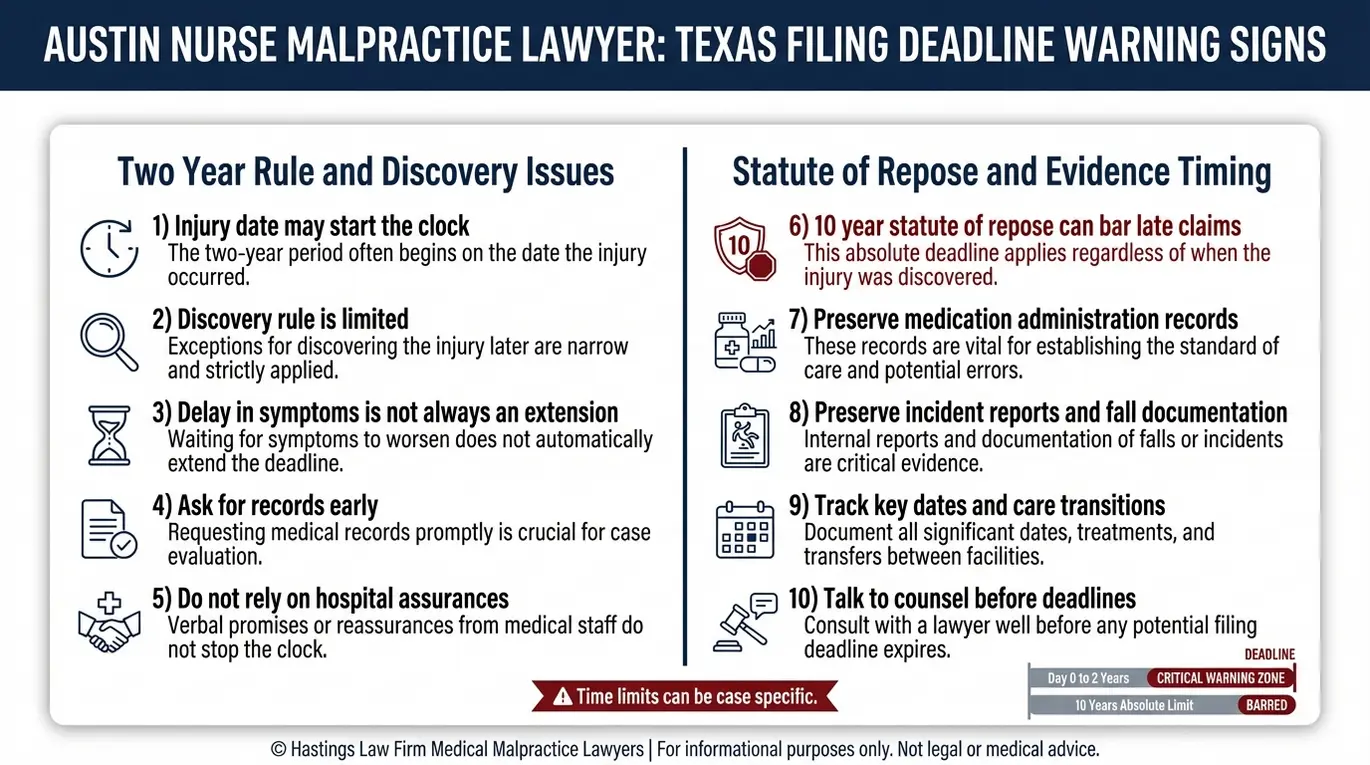
In Texas, the statute of limitations for medical malpractice is generally two years from the occurrence of the breach or tort, or from the date the relevant medical treatment or hospitalization is completed.
The Two-Year Rule
Most claims must be filed within two years. Strict time limits are a hallmark of personal injury law. This means legal action must be taken quickly to preserve evidence and testimony, as courts will almost certainly bar the case once the deadline passes.
The Discovery Rule
In some situations, a patient does not and could not have known about the injury right away. Texas courts have recognized limited circumstances in which the filing deadline may be extended, though the application of any such exception to medical malpractice claims is narrow and remains an actively debated area of Texas law. Because these exceptions are not guaranteed, patients should not assume they will receive additional time beyond the standard two-year period.
The Statute of Repose
Regardless of when an injury is discovered, Texas imposes an absolute 10-year outer limit, called the statute of repose. No claim can be filed more than 10 years after the date of the act or omission that caused the harm.
Time-Sensitive: If you suspect nursing negligence contributed to an injury, contact an attorney as soon as possible. Waiting too long can permanently eliminate your ability to file a claim, even if the evidence is strong.
Contact the Austin Nurse Malpractice Attorneys at Hastings Law Firm Today for Help
Nursing errors can change the course of a life in an instant, and the people affected deserve honest answers about what happened and why. At Hastings Law Firm, this is the only type of law we practice. Our team of attorneys, in-house nurses, and medical consultants has helped those harmed by medical negligence recover millions of dollars in cases involving errors at every level of the healthcare system.
If you or a loved one was harmed by a nursing error in Austin, an experienced Austin nurse malpractice lawyer at our firm can review your medical records, identify what went wrong, and explain your legal options. The consultation is free and confidential, and you pay no attorney fees unless we recover compensation on your behalf.
Call our Austin office or complete our online form to schedule your risk-free case evaluation today.
Frequently Asked Questions About Nurse Malpractice in Austin


This content was researched and written by the Hastings Law Firm editorial team, which includes attorneys, medical professionals, and experienced researchers. Our writing is informed by internal knowledge and practical experience, and we cross-check critical details against authoritative sources cited throughout. Every piece undergoes human-led fact-checking and legal review. Because legal and medical information can change, if you spot an error, please contact us. Learn more about our content standards and review process on our editorial policy page.

Gabe Sassin has focused exclusively on medical malpractice law since 2007. After spending more than a decade as a malpractice defense attorney, he knows exactly how the other side works. He has seen firsthand how healthcare providers, insurers, corporate defendants, and their legal teams think, prepare, and build their defense against claims. That knowledge works for the people who need it most today, injured patients and their families. His unique experience shapes everything he writes, giving readers a look at how these cases actually work from someone who has handled them from both sides.
