


Austin Hospital Malpractice Lawyer
A preventable hospital injury can leave families facing pain, uncertainty, and a loss of trust in the care system. Hospital negligence can involve breakdowns in monitoring, safety checks, infection control, medication administration, or emergency care, and the consequences can be life altering or worse. Texas rules also affect how these claims are evaluated, including limits on certain damages and strict requirements that can end a claim early. If you or a loved one were harmed or worse due to hospital negligence in Austin, Texas, contact Hastings Law Firm for a free, confidential case review.

Last Updated: September 28, 2026
Trusted Austin Malpractice Attorneys for Hospital Injury Claims
When a hospital stay leads to a preventable injury or the loss of someone you love, the experience can feel like a deep betrayal of trust. You placed your health in the hands of professionals and a system designed to heal, and something went wrong. If you or a loved one has been harmed by hospital negligence in Austin, you are not alone, and you have the right to get answers.
At Hastings Law Firm, we focus exclusively on medical malpractice. Our firm was founded in 2005 by Tommy Hastings, who is board-certified in personal injury trial law by the Texas Board of Legal Specialization. Our team includes former defense attorneys and hospital nurses who understand how hospital systems operate from the inside.
As a dedicated Austin hospital malpractice lawyer team, we prepare every case as if it is going to a jury. This level of preparation is what it takes to hold large hospital systems accountable.
If you believe a hospital’s actions caused harm, we are here to listen. Contact us for a free, confidential case evaluation and let us explain your options.

Understanding Hospital Negligence and the Standard of Care
Hospital negligence occurs when a facility or its staff fails to meet the accepted medical standard of care, resulting in preventable patient injury or death. Not every bad outcome in a hospital means someone made a mistake. But when the care you received falls below what a reasonably competent medical professional would have provided under similar circumstances, that gap between what should have happened and what did happen is the starting point for a legal claim.
The medical standard of care in a hospital setting covers more than just a surgeon’s skill. It includes proper post-operative monitoring, which involves tracking a patient’s vital signs and condition after a procedure. It also requires a surgical “time-out.” This is a safety pause where the team confirms the correct patient and procedure. A failure to monitor after surgery can allow a treatable complication to become catastrophic. When these safety steps are skipped or performed carelessly, the hospital and its staff may be in breach of duty.
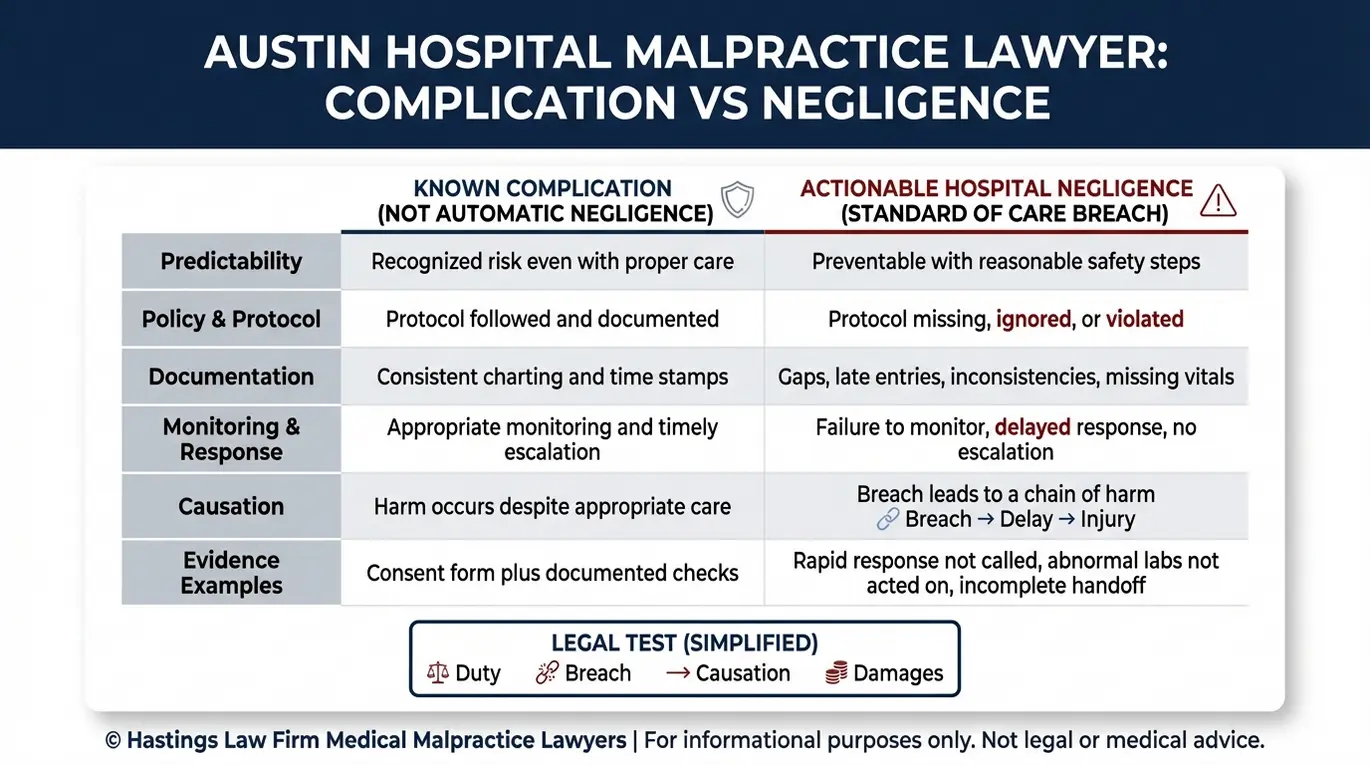
Distinguishing between a known complication and actionable negligence is one of the most important parts of any medical malpractice case. A known complication is an inherent medical risk that can occur even when every provider acts correctly. Negligence involves a failure to follow accepted protocols. To succeed, the patient must prove causation, meaning the breach directly caused the harm. This distinction is governed in Texas by Chapter 74 of the Texas Civil Practice and Remedies Code, which sets the procedural framework for medical liability claims.
Our Austin hospital negligence attorneys prepare every case for trial from day one for this reason. When a hospital’s legal team knows the case against them has been built with qualified medical experts, a detailed timeline, and a thorough reconstruction of the clinical events, they take the claim seriously. That trial-ready approach changes the dynamic of every negotiation and puts the focus where it belongs: on what the evidence shows and what the standard of care required.
Common Types of Hospital Errors in Travis County Facilities
Common hospital errors include surgical mistakes, medication administration failures, untreated hospital-acquired infections, and emergency room misdiagnoses. These errors can happen in any department, from the operating room to the recovery ward, and each one carries the potential for serious, life-altering harm.
| Category | Examples of Negligence | Potential Impact |
|---|---|---|
| Surgical & Anesthesia Errors | Wrong-site surgery, retained surgical items (objects like sponges or instruments left inside the body), anesthesia dosage miscalculations | Organ damage, brain injury, nerve damage, death |
| Hospital-Acquired Infections (HAIs) | Failure to follow aseptic technique (sterile procedures designed to prevent contamination), poor hand hygiene, inadequate instrument sterilization | MRSA, sepsis, prolonged hospitalization, organ failure |
| Medication & Monitoring Failures | Administering the wrong drug (a medication error) or dosage, failure to monitor vitals after surgery | Adverse drug reactions, cardiac events, undetected internal bleeding |
| Emergency Room Errors | Failure to properly triage patients, misdiagnosis of stroke or heart attack | Delayed treatment, permanent disability, wrongful death |
| Birth Injuries | Failure to monitor fetal heart rate, delayed C-section decisions | Cerebral palsy, hypoxic brain injury, maternal hemorrhage |
Surgical and anesthesia errors remain among the most alarming types of hospital negligence. A retained surgical item, or RSI, is a preventable event that should never occur when proper counting protocols are followed. Anesthesia errors, including incorrect dosing or failure to account for a patient’s medical history, can result in brain damage or death.
Hospital-acquired infections like MRSA and sepsis are tracked as quality measures by the Centers for Medicare & Medicaid Services (CMS) for a reason. Many of these infections are preventable when staff consistently follow sterile protocols and hand hygiene standards. When they do not, the consequences can be fatal.
Medication and monitoring failures often happen during shift changes or in understaffed units. Emergency department triage, the process of prioritizing patients by the severity of their condition, is another critical point where errors in judgment can delay life-saving treatment.
Systemic Change and Patient Safety
As a hospital malpractice lawyer in Austin, our goal is not limited to securing compensation for a single client. Every case we take creates an opportunity to expose unsafe policies and push for real change. When hospitals face accountability for systemic failures, whether that involves inadequate staffing, broken sterilization protocols, or ignored safety checklists, they are far more likely to implement policy reform. That kind of change can prevent the same tragedy from happening to the next patient who walks through those doors.
The Hastings Law Firm Difference
Results matter, but what truly sets us apart is how we achieve them. Every verdict, every settlement, and every Austin courtroom victory comes from one guiding promise: To treat each client’s fight for justice as if it were our own.
This balance of skill, experience, and empathy reflects our core philosophy that justice should not only compensate the injured, but also make health care safer nationwide.

Austin Hospitals Where Negligence Claims Arise
Austin-area hospitals include Ascension Seton’s adult and children’s hospitals, St. David’s HealthCare campuses, and a Texas Children’s campus, spread from central Austin north to Round Rock and south to Kyle. The duty of care a patient is owed does not change from one system or suburb to the next.
Our attorneys have written a dedicated page for each of the following Austin-area hospitals, covering the claim patterns that come up there.
- Dell Children’s Medical Center is a Level I pediatric trauma center with a Level IV NICU and a Level I Children’s Surgical Program, where pediatric emergency and trauma errors, surgery and anesthesia errors, and NICU care failures arise.
- Dell Seton Medical Center at The University of Texas is an adult Level I trauma center and teaching hospital for Dell Medical School, where trauma, burn, and emergency errors, stroke and brain care failures, and postoperative critical care errors arise.
- Ascension Seton Williamson is a Level II trauma center in Round Rock with a maternity center and a Level II NICU, where trauma and emergency errors, labor, delivery, and newborn care errors, and orthopedic and spine surgery errors arise.
- St. David’s Round Rock Medical Center is a Level II trauma center in the St. David’s HealthCare system, where trauma and emergency errors, labor and delivery injuries, and neurosurgical, orthopedic, and heart and vascular surgery errors arise.
- Ascension Seton Hays is a Level II trauma center and primary stroke center in Kyle, where trauma and emergency errors, labor, delivery, and newborn care errors, and trauma-related orthopedic, spine, and neurological surgery errors arise.
- Texas Children’s Hospital Austin is a children’s hospital with a 24-hour pediatric emergency center and a Level IV NICU, where pediatric emergency errors, labor, delivery, and NICU errors, and surgery, anesthesia, and intensive care errors arise.
- Dell Children’s Medical Center North Campus is a children’s hospital whose emergency department is a Level III trauma center, where children’s emergency diagnosis errors, injury and trauma care errors, and pediatric surgery errors arise.
Liability and Vicarious Liability: Suing a Hospital vs. Independent Doctors
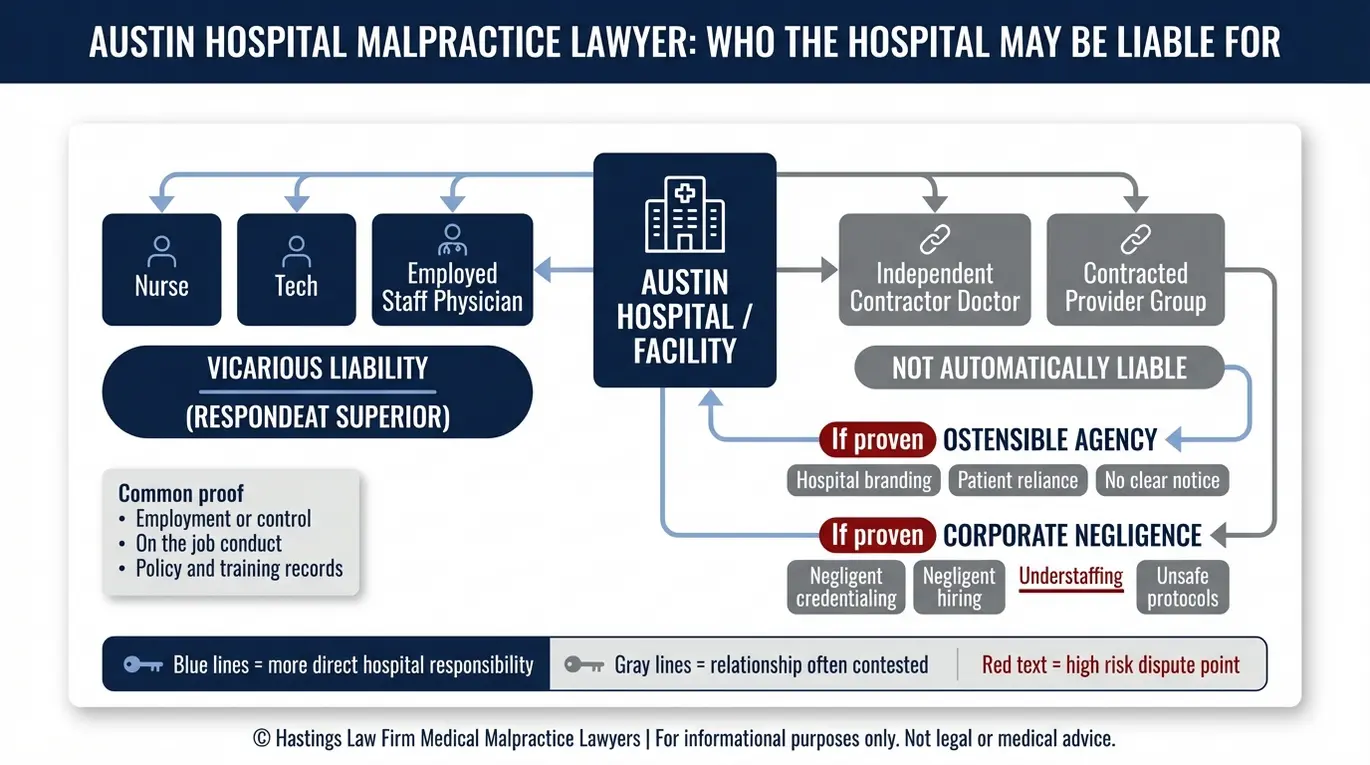
Under Texas law, hospitals are generally liable for the actions of their employees, such as nurses and technicians, but may not be automatically liable for independent contractor doctors unless specific legal theories are proven. Understanding this distinction is essential to building the right case against the right parties.
Vicarious liability is the legal principle that holds an employer responsible for the negligent actions of its employees. If a hospital nurse administers the wrong medication or a surgical tech fails to follow sterilization procedures, the hospital itself can be held accountable for that employee’s error. This applies to any staff member working under the hospital’s direct control and supervision.
The analysis becomes more complicated with independent contractor physicians. Many doctors who treat patients inside a hospital are not actually hospital employees. They maintain independent practices and contract with the facility for privileges. In these situations, the hospital may argue it has no legal responsibility for the doctor’s clinical decisions. However, Texas law recognizes exceptions. If the hospital presented the doctor as part of its own team, and the patient had no reason to know otherwise, a theory called “ostensible agency” may apply.
Corporate negligence takes a different approach entirely. Rather than holding the hospital responsible for someone else’s mistake, it targets the hospital’s own administrative failures directly:
- Negligent hiring: Granting privileges to a physician without properly verifying credentials, disciplinary history, or competence, a process known as credentialing and privileging
- Understaffing: Operating with a nurse-to-patient ratio, the number of patients assigned to each nurse, that is too low to provide safe post-operative care
- Unsafe protocols: Failing to implement or enforce evidence-based safety procedures
Liability Summary:
- Hospital Employees: The hospital is generally vicariously liable for the negligence of nurses and technicians.
- Independent Doctors: The hospital is typically not liable unless ostensible agency or corporate negligence is established.
Corporate Negligence vs. Medical Negligence
The difference between medical negligence and corporate negligence matters because it determines who is legally responsible. Medical negligence usually involves a specific provider’s mistake, while corporate negligence involves the hospital’s management of the facility. Administrative decisions, such as how a hospital hires doctors or monitors staffing levels, are the focus of corporate negligence.
As hospital injury lawyers, we investigate both pathways. We review credentialing files, staffing records, and internal policies alongside the clinical evidence. Identifying the correct corporate entity, such as the parent organization that owns the hospital, is also a critical step. Our team uses insider insight from former defense lawyers and nurse consultants who understand how hospitals document these administrative choices. We use resources like the Texas Secretary of State’s SOSDirect filing system to confirm ownership structures, parent companies, and registered agents tied to hospital facilities in the Austin area.
Calculating Compensation and Damages in Hospital Injury Cases
Damages in hospital injury cases may cover economic losses like medical bills and lost wages, as well as non-economic damages for pain, suffering, and physical impairment. The goal of a damages claim is to account for the full scope of harm caused by the negligence, whether resolved through settlement or litigation.
Economic damages are the measurable financial losses tied directly to the injury:
- Past and future medical bills, including surgeries, rehabilitation, and ongoing care
- Lost wages and diminished earning capacity
- Out-of-pocket costs for home modifications, medical equipment, or in-home care
Non-economic damages address the less tangible, but equally real, impact on your life:
- Physical pain and suffering
- Mental anguish and emotional distress
- Loss of enjoyment of life
- Disfigurement or physical impairment
Wrongful death claims involve additional considerations for families who lost a loved one. Surviving spouses, children, and parents may seek recovery for loss of companionship, loss of financial support, and funeral expenses.
As an Austin hospital malpractice law firm, we work with medical experts and financial professionals to build a clear picture of both current and projected losses. This is especially important in cases involving permanent disability or the need for lifelong care, where future medical costs must be calculated with precision.
Texas Laws Impacting Austin Malpractice Claims
Texas law imposes a cap on non-economic damages in medical malpractice cases and requires an expert report to be filed within 120 days after the date each defendant’s original answer is filed. These rules, established under tort reform legislation, create strict procedural hurdles that can end a case before it ever reaches a jury if they are not handled correctly.
Chapter 74 Expert Reports. Under Section 74.351 of the Texas Civil Practice and Remedies Code, a patient must file a written expert report from a qualified medical professional within 120 days after the date each defendant’s original answer is filed. The expert must practice in a field involving the same type of care or treatment as that delivered by the defendant and must identify the standard of care. They must explain how it was breached and connect that breach to the injury. If this report is late, incomplete, or written by an unqualified expert, the court can dismiss the case entirely.
Damage Caps. Texas caps non-economic damages in medical malpractice cases at $250,000 against all individual physicians or healthcare providers, and $250,000 per healthcare institution (up to $500,000 across multiple institutions), with an overall cap of $750,000 for non-economic damages when both are involved. These caps apply only to non-economic damages like pain and suffering. They do not limit recovery for economic losses such as medical bills, lost wages, or future care costs. A malpractice lawyer for hospital errors must build a case that fully documents the economic impact to ensure you receive fair compensation.
Statute of Limitations. The general deadline to file a medical malpractice lawsuit in Texas is two years from the date of the negligent act. To ensure procedural compliance, we often verify these dates immediately during our initial review.
Statute of Repose Nuances
Texas also enforces an absolute 10-year statute of repose. This means that regardless of when you discovered your injury, no claim can be filed more than 10 years after the date of the negligent treatment. This deadline applies even in cases involving hidden complications or injuries that develop slowly over time. For an Austin hospital malpractice lawyer, identifying when the clock started running is one of the first steps in evaluating any potential claim.
Fast Facts: Texas Medical Malpractice Rules
- Expert report deadline: 120 days after the date each defendant’s original answer is filed
- Statute of limitations: 2 years from the date of the negligent act (with limited exceptions)
- Statute of repose: 10-year absolute deadline
- Non-economic damage caps: $250,000 against all individual physicians or providers / $250,000 per healthcare institution (up to $500,000 across multiple institutions) / $750,000 overall cap
- Economic damages: No cap on medical bills, lost wages, or future care costs
- Pre-suit notice: Required 60 days before filing
The Legal Process: Filing a Hospital Malpractice Claim
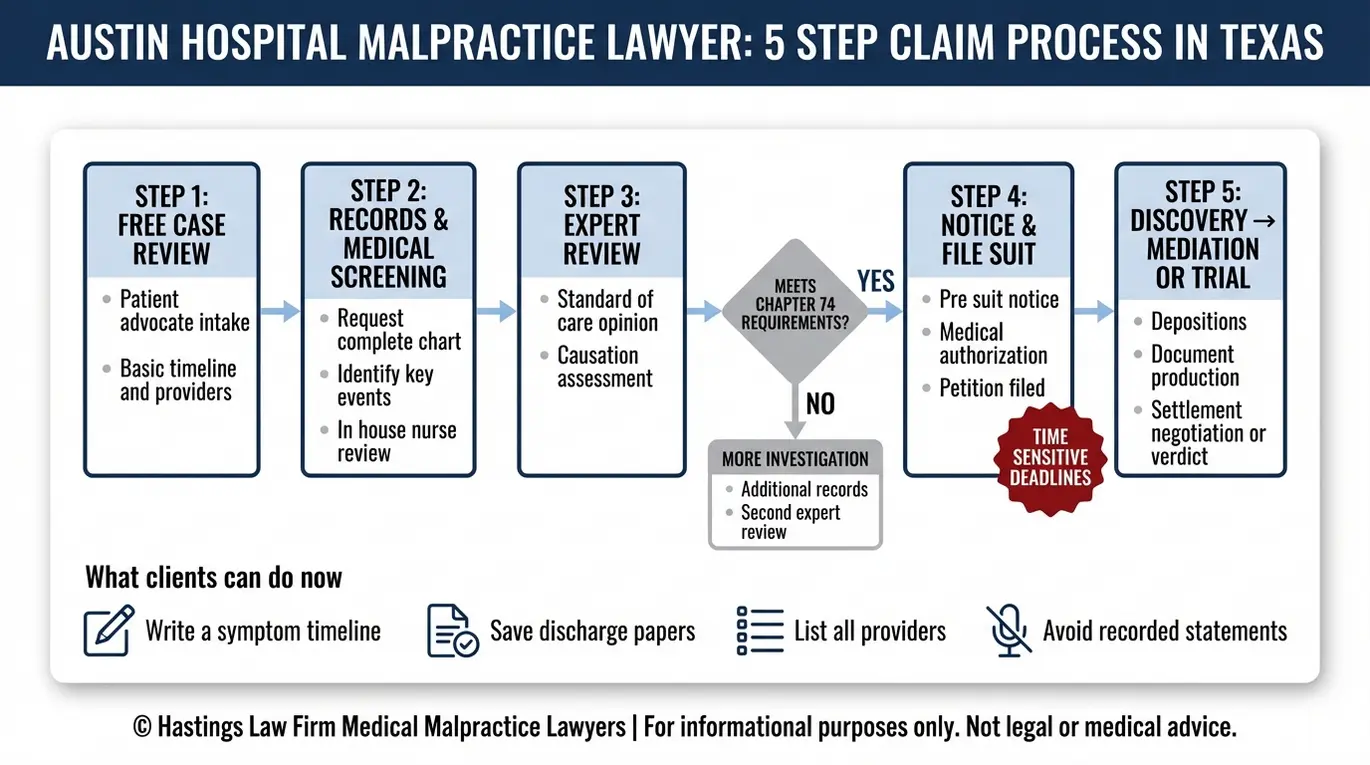
The legal process involves an initial investigation by medical experts, serving a pre-suit notice letter, filing the lawsuit, engaging in discovery, and proceeding to mediation or trial. Here is how each stage works:
- Free Case Evaluation. The process starts with a confidential screening led by one of our patient advocates. We listen to what happened, review your initial concerns, and determine whether the facts support a potential claim.
- Medical Investigation. Once we accept a case, our in-house medical team conducts a thorough review of your medical records, including hospital charts, nursing logs, and physician orders. We work with qualified medical experts to identify where the standard of care was breached and how that breach caused your injury.
- Pre-Suit Notice and Filing. Texas law requires that a written notice be sent to the healthcare provider at least 60 days before filing a lawsuit, as outlined in Chapter 74 of the Civil Practice and Remedies Code. After the notice period, we file the lawsuit to initiate litigation and submit the required expert report.
- Discovery and Depositions. During the discovery phase, both sides exchange evidence. This includes written questions, document requests, and depositions of treating physicians, hospital staff, and expert witnesses. Our hospital negligence attorney team uses this stage to lock in testimony and uncover records that strengthen your case.
- Mediation or Trial. Many cases resolve through mediation, a structured negotiation overseen by a neutral third party. If the hospital or its insurer refuses to offer a fair settlement, we are fully prepared to present the case to a jury. Because we build for trial from the start, we never have to scramble to prepare when the other side won’t come to the table.
Contact the Austin Hospital Malpractice Attorneys at Hastings Law Firm Today for Help
Hospital systems have experienced legal teams and significant resources dedicated to defending against malpractice claims. You deserve a team that matches that level of preparation and commitment, one that understands how hospitals operate and knows how to hold them accountable when their failures cause harm.
At Hastings Law Firm, every attorney, nurse consultant, and patient advocate on our team focuses exclusively on medical malpractice. Our team includes former defense lawyers and experienced nurses who understand the clinical and administrative systems they now challenge. This insider perspective provides a strategic advantage when identifying gaps in care or inconsistencies in medical charts.
If you or a loved one was injured due to hospital negligence in Austin, time matters. Texas imposes strict deadlines on medical malpractice claims, and evidence can become harder to preserve as time passes.
Call us today for a free, confidential case evaluation. There is no fee unless we recover compensation for you. Let us review what happened and help you understand your legal options.
Frequently Asked Questions About Hospital Malpractice in Austin


This content was researched and written by the Hastings Law Firm editorial team, which includes attorneys, medical professionals, and experienced researchers. Our writing is informed by internal knowledge and practical experience, and we cross-check critical details against authoritative sources cited throughout. Every piece undergoes human-led fact-checking and legal review. Because legal and medical information can change, if you spot an error, please contact us. Learn more about our content standards and review process on our editorial policy page.

Gabe Sassin has focused exclusively on medical malpractice law since 2007. After spending more than a decade as a malpractice defense attorney, he knows exactly how the other side works. He has seen firsthand how healthcare providers, insurers, corporate defendants, and their legal teams think, prepare, and build their defense against claims. That knowledge works for the people who need it most today, injured patients and their families. His unique experience shapes everything he writes, giving readers a look at how these cases actually work from someone who has handled them from both sides.
