


Dell Seton Medical Center Malpractice Lawyer
For patients and families in Austin, Texas, who were harmed by negligent care at Dell Seton Medical Center, Hastings Law Firm handles hospital malpractice claims. A claim can be brought against the hospital, its employees, or the physicians and residents who treated the patient, depending on who employed each of them. Treatment that falls short can bring a lasting injury, additional recovery time, or the loss of a loved one. Sorting out what went wrong, and who should be held accountable for that loss, takes attorneys who can tell from the records which doctor, resident or nurse made each decision. At Hastings Law Firm, medical malpractice is all we do!
Last Updated: September 28, 2026
Trial-Ready Hospital Negligence Attorneys for Dell Seton Medical Center Patients and Families
Hastings Law Firm’s hospital negligence lawyers bring experienced representation to Dell Seton Medical Center patients and families in Austin, Texas. Tommy Hastings, the firm’s founder, is Board Certified in Personal Injury Trial Law and has represented injured patients since 2001. Our lawyers include former malpractice defense attorneys who understand the tactics hospitals use to deny liability.
Knowing how those defenses are built lets us prepare for them before a claim is ever filed. Our attorneys consult a nationwide network of medical experts who can explain what a patient’s treatment required and where it fell short. We prepare each case as if it were going to trial, an approach that has earned multimillion-dollar settlements and record-setting verdicts for our clients. Those results come from a firm that has been dedicated exclusively to medical malpractice since 2005.
Contact us now for a free, confidential case review. Our team will listen to your story, investigate your claim, and explain your options.

The Types of Dell Seton Medical Center Lawsuits Our Hospital Malpractice Attorneys Handle
Hastings Law Firm handles Dell Seton Medical Center lawsuits in Austin, Texas, over trauma and emergency care, stroke and brain care, and surgery with the critical care after it. Our hospital malpractice lawyers build each claim from the complete chart and from physicians who practice in the same specialties. We use that record to show where the care fell short and what the harm has cost the patient and family.
The cases we see most often at a trauma center like Dell Seton Medical Center include:
- Trauma, burn, and emergency care errors. After a crash or fall, an internal injury, bleed, or fracture can be missed or treated late, and a scan can go unordered or be misread. A burn’s depth or a patient’s fluid needs can be misjudged, or a patient can be discharged before a dangerous condition is ruled out. Lost time can leave a patient with permanent harm, so our Austin doctor malpractice lawyers rebuild the timeline from the trauma flow sheets, imaging, and discharge records.
- Stroke, brain, and spine care errors. The signs of a stroke can go unrecognized or clot treatment can be delayed, and a brain bleed or spinal cord compression can be missed. In neurocritical care, a change in a patient’s condition can slip past monitoring, and the damage to movement, speech, or thinking can be lasting. Our Austin medical misdiagnosis lawyers set the neurology notes and imaging times beside the nursing assessments to show when each sign appeared.
- Surgical and postoperative critical care errors. An organ, nerve, or blood vessel can be injured during surgery, including minimally invasive surgery, or a medication error can follow the operation. Bleeding, a postoperative infection, or breathing trouble in the intensive care unit can go unrecognized, and the patient can face another operation and additional recovery time. Our Austin surgical error lawyers compare the operative report with the anesthesia record, ICU flow sheets, and medication administration records.
While these are common claim types, our hospital malpractice attorneys handle any valid medical negligence case that arises at this hospital.
The Hastings Law Firm Difference
Results matter, but what truly sets us apart is how we achieve them. Every verdict, every settlement, and every Austin courtroom victory comes from one guiding promise: To treat each client’s fight for justice as if it were our own.
This balance of skill, experience, and empathy reflects our core philosophy that justice should not only compensate the injured, but also make health care safer nationwide.

About Dell Seton Medical Center, an Adult Level I Trauma Center in Austin
Dell Seton Medical Center at The University of Texas is one of Ascension’s hospitals in Austin, Texas, offering 24/7 emergency care. The hospital says it serves as a Level I Trauma Center for adults, and the state’s trauma facility roster lists it as a Comprehensive (Level I) facility. ProPublica’s Nonprofit Explorer lists Ascension Seton as a 501(c)(3) nonprofit.
The hospital’s emergency department page lists trauma surgeons, burn care, a Comprehensive Stroke Center, imaging, and on-call specialists. The hospital also lists stroke care and care for brain and spine conditions. A critical care unit there is dedicated to neurocritical care, the intensive care of patients with serious brain and spinal conditions. Dell Seton also names minimally invasive procedures, surgical subspecialists, heart and vascular care, radiology, lab testing, and rehabilitation.
Dell Medical School calls Dell Seton “the primary teaching hospital affiliated with Dell Med.” Its partners page says Dell Med faculty physicians, residents, and fellows provide care at the hospital. The emergency medicine residency curriculum also places first-year residents at Dell Seton for part of their training.
Ascension Seton Medical Center Austin and Dell Children’s Medical Center are separate Austin hospitals in the same Ascension Seton system, and each has a page of its own. Our Austin medical malpractice lawyers handle claims arising at hospitals throughout the city.
Can You File a Lawsuit Against Dell Seton Medical Center, the Doctor, or Both?
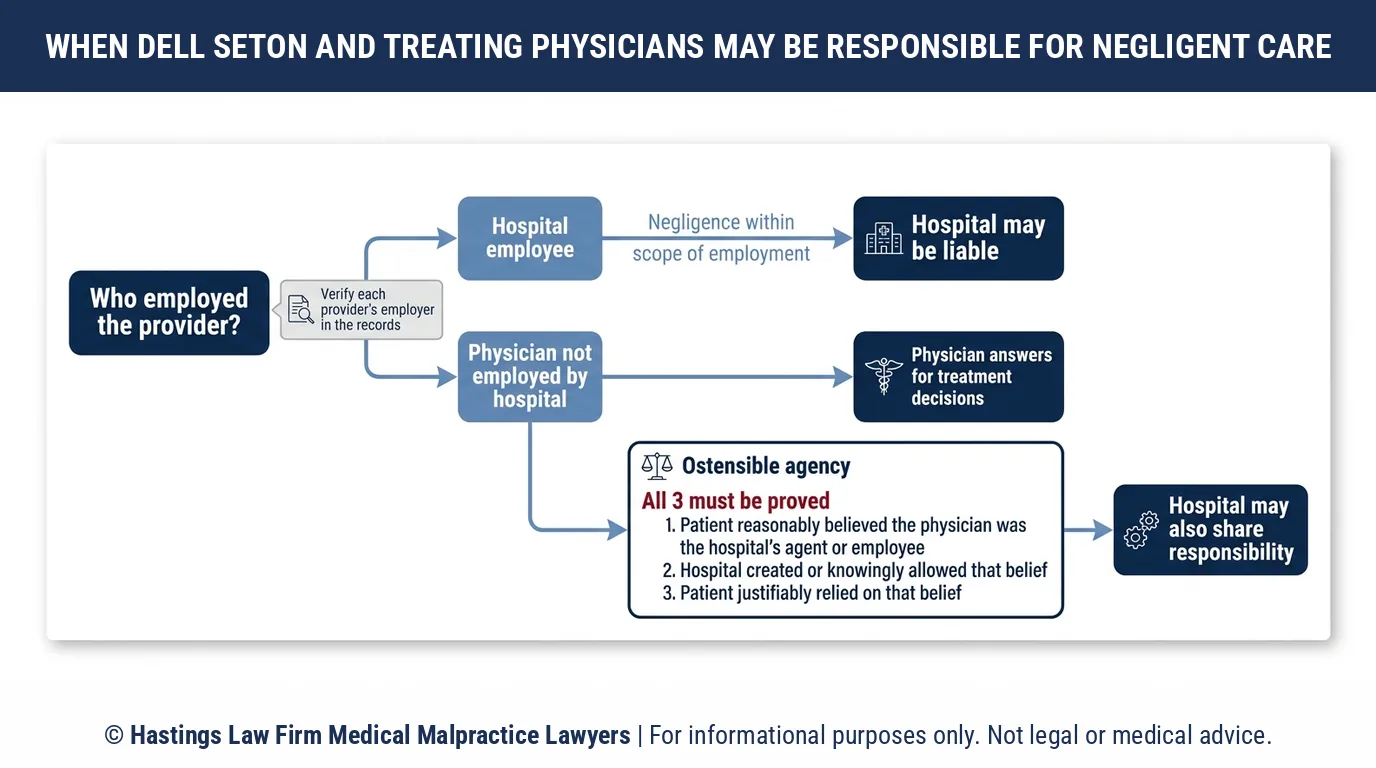
You may be able to sue Dell Seton Medical Center, a doctor, or both, depending on who gave the care and who employed that person. Under Baptist Memorial Hospital System v. Sampson, a Texas hospital can be liable when one of its employees, such as a nurse, is negligent within the scope of employment. A doctor who is not the hospital’s employee is responsible for their own treatment decisions.
Dell Seton shares responsibility for a physician it does not employ only when all three elements of ostensible agency are proved. The patient must have reasonably believed the physician was the hospital’s agent or employee, a belief the hospital created or knowingly allowed, and must have justifiably relied on it.
At a teaching hospital, the answer can differ from one provider to the next. A trauma surgeon, a neurologist, a resident, and a nurse may each have a different employer, and the records and staffing arrangements settle that question of fact. Who employed each person decides who a lawsuit against Dell Seton names, and here it can also decide which body of law applies.
A health care liability claim, the legal name for a malpractice claim, is governed by Chapter 74 of the Texas Civil Practice and Remedies Code. Each provider must receive written notice at least 60 days before suit is filed. Once each defendant answers, a qualified expert’s report is due within 120 days.
Trauma and critical care carry real risk, and a poor outcome does not by itself mean anyone was negligent. When an injury could have been prevented, the providers responsible should be held accountable. Anyone deciding whether they need a lawyer to sue a hospital can talk it through with our Austin hospital malpractice lawyers, who explain which providers a claim should name.
Who Answers Under Texas Law When a University Doctor or Resident Treats a Patient at Dell Seton?
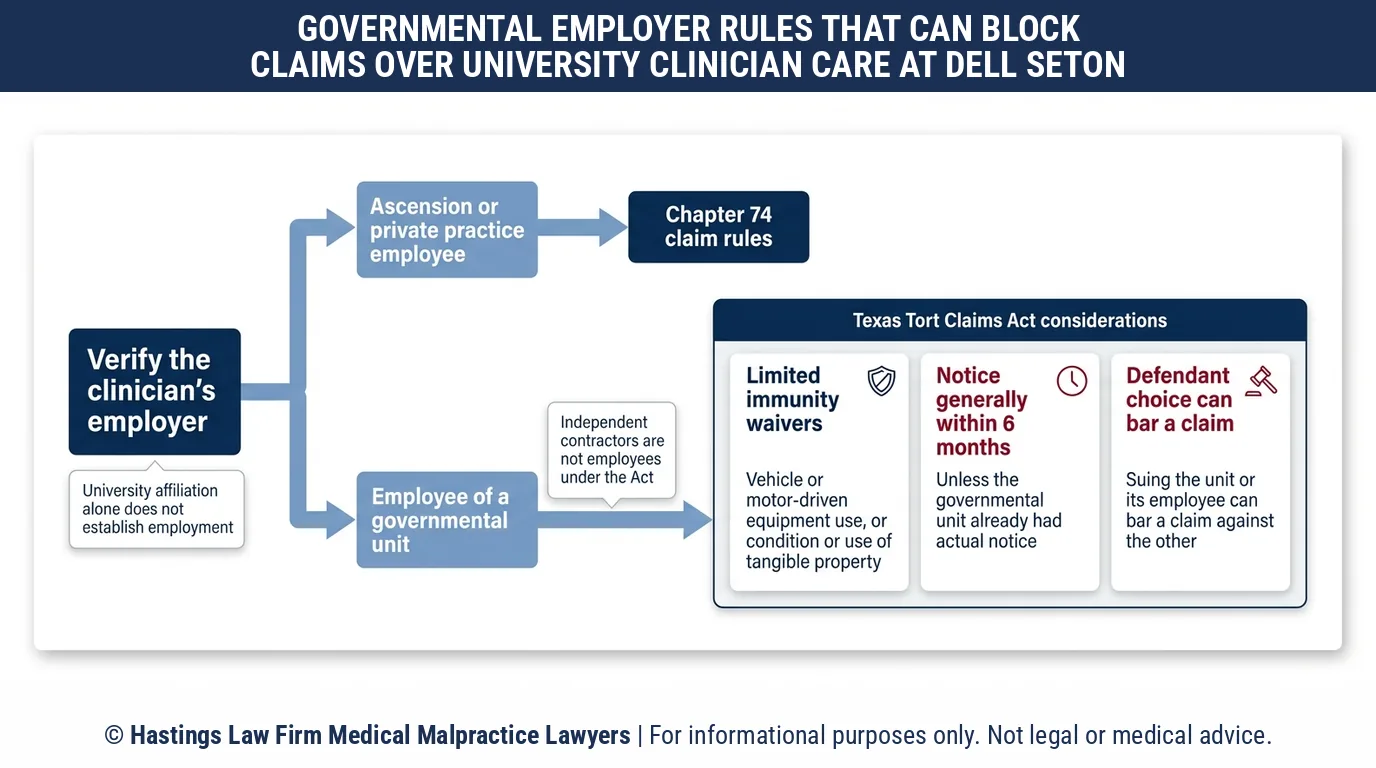
Who answers for a university doctor or resident at Dell Seton Medical Center depends on their employer. Under Baptist Memorial Hospital System v. Sampson, a hospital can answer for its employees and, on proof of ostensible agency, for physicians it held out as its own. When the employer is a governmental unit, Sections 101.001 and 101.021 of the Texas Tort Claims Act set separate rules.
Dell Medical School says its faculty physicians, residents, and fellows provide care at Dell Seton. UT News reported that Dell Med faculty are paid by the university for their teaching and research responsibilities and may also have arrangements with Seton. Which arrangement covered the person who treated a patient is found in the records, never assumed.
The Texas Tort Claims Act, Chapter 101 of the Texas Civil Practice and Remedies Code, applies to a clinician only when the employer is a governmental unit as Chapter 101 defines one. An independent contractor is not an employee under the Act. Where the employer does qualify, Section 101.021 waives immunity in two situations only.
The first is injury from an employee’s use of a motor vehicle or motor-driven equipment. The second is injury caused by a condition or use of tangible personal or real property. Where the defendant is state government, Section 101.023 limits damages to $250,000 for each person and $500,000 for each single occurrence for bodily injury or death. The defendant’s status has to be established first, from the law that created it.
A governmental unit is generally entitled to written notice of a claim within six months of the incident, unless it already had actual notice. Pleading choices carry lasting consequences too, because Section 101.106 treats suing a governmental unit or its employee as an election that can bar a claim against the other.
Where the clinician who treated the patient worked for Ascension or a private practice, the Tort Claims Act plays no part, and Chapter 74 governs the claim as usual. Our attorneys identify every clinician’s employer from the records before the first notice goes out. That way a six-month deadline is not missed, and no claim is filed against the wrong party.
How We Work With Injured Dell Seton Medical Center Patients and Families
Hastings Law Firm’s hospital malpractice lawyers take on claims for Dell Seton Medical Center patients and families in Austin, Texas. A member of our intake team answers the first call, and a relative can call on behalf of a patient who is unable to. We listen to what happened, where in the hospital it happened, and who was involved, and our review begins there.
Our team requests the complete records, from trauma, emergency, and burn care records to imaging and lab results, stroke and neurology notes, and operative and anesthesia records. ICU and neurocritical care nursing notes, medication administration records, admission and discharge dates, discharge instructions, and itemized bills complete the set. Our attorneys and medical professionals read them with the names and roles of every physician, resident, and fellow in the chart, establishing what was done and what was missed.
If our hospital negligence lawyers accept your case, we handle every exchange with the hospital, its insurers, and their attorneys. Our board-certified patient advocates stay in contact with you and explain each development in plain language as it happens. Our hospital malpractice attorneys pursue a settlement that reflects the full cost of the injury. When an offer falls short, we are prepared to take your case to a jury.
If You or a Loved One Were Injured at Dell Seton, Speak With Our Medical Attorneys Today
Hastings Law Firm’s hospital negligence lawyers handle malpractice claims in Austin, Texas, for patients and families harmed by care at Dell Seton Medical Center. We perform a free case review to find out whether you have a valid claim and who employed each provider involved. What you share with us in that review is kept confidential.
Our team is here for you, and there is no fee unless we win. Contact us to understand your options.
Dell Seton Medical Center Malpractice FAQs


This content was researched and written by the Hastings Law Firm editorial team, which includes attorneys, medical professionals, and experienced researchers. Our writing is informed by internal knowledge and practical experience, and we cross-check critical details against authoritative sources cited throughout. Every piece undergoes human-led fact-checking and legal review. Because legal and medical information can change, if you spot an error, please contact us. Learn more about our content standards and review process on our editorial policy page.

Gabe Sassin has focused exclusively on medical malpractice law since 2007. After spending more than a decade as a malpractice defense attorney, he knows exactly how the other side works. He has seen firsthand how healthcare providers, insurers, corporate defendants, and their legal teams think, prepare, and build their defense against claims. That knowledge works for the people who need it most today, injured patients and their families. His unique experience shapes everything he writes, giving readers a look at how these cases actually work from someone who has handled them from both sides.
