


St. David’s Surgical Hospital Malpractice Lawyer
When negligent care at St. David’s Surgical Hospital in Austin, Texas, harms a patient, Hastings Law Firm brings hospital malpractice claims for the patient and their family. Each claim can be brought against the hospital, the people on its staff, the physicians who provided the treatment, or more than one of them. Treatment below the accepted standard can leave the people who relied on it with a serious injury, additional recovery time, or the loss of a loved one. Tracing that loss to the decisions behind it, and to those who should be held accountable, takes attorneys who know how hospital care is charted. At Hastings Law Firm, medical malpractice is all we do!
Last Updated: September 28, 2026
Trial-Ready Hospital Negligence Attorneys for St. David’s Surgical Hospital Patients and Families
Hastings Law Firm’s hospital negligence lawyers bring experienced representation to St. David’s Surgical Hospital patients and families in Austin, Texas. Tommy Hastings, the firm’s founder, is Board Certified in Personal Injury Trial Law and has represented injured patients since 2001. Several attorneys on our team are former malpractice defense attorneys who know how the medical industry defends claims.
That background shows us how a hospital’s defense will be built, so we build each claim to meet it. We work with a nationwide network of medical experts who can explain what accepted practice required at every point in a patient’s care. Each case is prepared as if it were going to trial, and that preparation has brought our clients multimillion-dollar settlements and record-setting verdicts. Those results come from a firm that has been dedicated exclusively to medical malpractice since 2005.
Contact us now for a free, confidential case review. Our team will listen to your story, investigate your claim, and explain your options.

The Types of St. David’s Surgical Hospital Lawsuits Our Hospital Malpractice Attorneys Handle
Hastings Law Firm handles St. David’s Surgical Hospital lawsuits in Austin, Texas, over surgical errors, anesthesia errors, and failures in monitoring and care after surgery. Our hospital malpractice lawyers ground each claim in the operative, anesthesia and recovery records and in the opinions of qualified physicians. We use that evidence to show where the care departed from accepted practice and what that has cost the patient.
The cases we see most often at a specialty surgical hospital like St. David’s Surgical Hospital include:
- Surgical errors. In orthopedic, spine and neurological, bariatric, gynecological or urological surgery, an operation can be performed on the wrong site or spinal level, or a nerve, blood vessel or organ can be injured during the procedure. A joint component can be placed poorly, or an instrument or sponge can be left behind. Setting that right can take another operation, lasting weakness or pain, and more time away from work and family. Our Austin surgical error lawyers match the operative report and the implant records against the nursing notes to show what happened in the operating room.
- Anesthesia errors. A dose can be wrong, an airway can go unsecured or unprotected, or a patient’s breathing, oxygen and blood pressure can go unwatched under anesthesia or in recovery. A known allergy or medical condition can also be missed in the pre-anesthesia assessment. The harm can include a brain injury from lost oxygen, a heart or lung complication, or the loss of a loved one. Our Austin anesthesia error attorneys read the pre-anesthesia assessment and the anesthesia record entry by entry, then follow the patient into recovery.
- Post-operative monitoring, infection and complication failures. Bleeding, a blood clot, a surgical-site infection, or falling oxygen from pain medicine can go unrecognized after surgery, and changes in a patient’s condition may never be reported to the surgeon. A patient can also be sent home or moved to rehabilitation before a complication has been addressed. A problem caught late can mean a return to the operating room, a stay in intensive care, and a harder recovery for the whole family. Our Austin postoperative malpractice lawyers line up the vital-sign flowsheets, medication records and nursing notes with the orders the surgeon gave.
While these are common claim types, our hospital malpractice attorneys handle any valid medical negligence case that arises at this hospital. We welcome a call about any surgical care that left a patient worse off.
The Hastings Law Firm Difference
Results matter, but what truly sets us apart is how we achieve them. Every verdict, every settlement, and every Austin courtroom victory comes from one guiding promise: To treat each client’s fight for justice as if it were our own.
This balance of skill, experience, and empathy reflects our core philosophy that justice should not only compensate the injured, but also make health care safer nationwide.

About St. David’s Surgical Hospital on West Louis Henna Boulevard
St. David’s Surgical Hospital is a hospital at 1201 W Louis Henna Blvd in Austin, Texas, and part of St. David’s HealthCare. The hospital’s About page calls it a campus of St. David’s North Austin Medical Center, another St. David’s HealthCare hospital in Austin. The Surgical Hospital lists orthopedic, neurological, bariatric, gynecological and urological surgery as its specialties.
The hospital’s location page adds that joint replacement and spine surgeries are available. Its urologic services include operations on the bladder, kidney and prostate, such as nephrectomy, the removal of a kidney, and prostatectomy, the removal of the prostate. Its neurological services describe nursing care around the clock.
Recovery and inpatient care take place in a post-anesthesia care unit, where patients wake after surgery, an intensive care unit, advanced inpatient rooms, and an inpatient rehabilitation unit. Imaging, pharmacy and laboratory services work alongside them. A surgical patient’s course of care can pass through several of these units, and each keeps its own records.
St. David’s HealthCare describes itself as a partnership of HCA Healthcare and two local nonprofits, St. David’s Foundation and Georgetown Health Foundation. The campus sits in Williamson County, according to the Texas Health and Human Services hospital list. Like North Austin Medical Center, St. David’s Round Rock Medical Center in Round Rock is a St. David’s HealthCare hospital with its own page, and our Austin medical malpractice lawyers handle claims across the region.
Can You File a Lawsuit Against St. David’s Surgical Hospital, the Doctor, or Both?
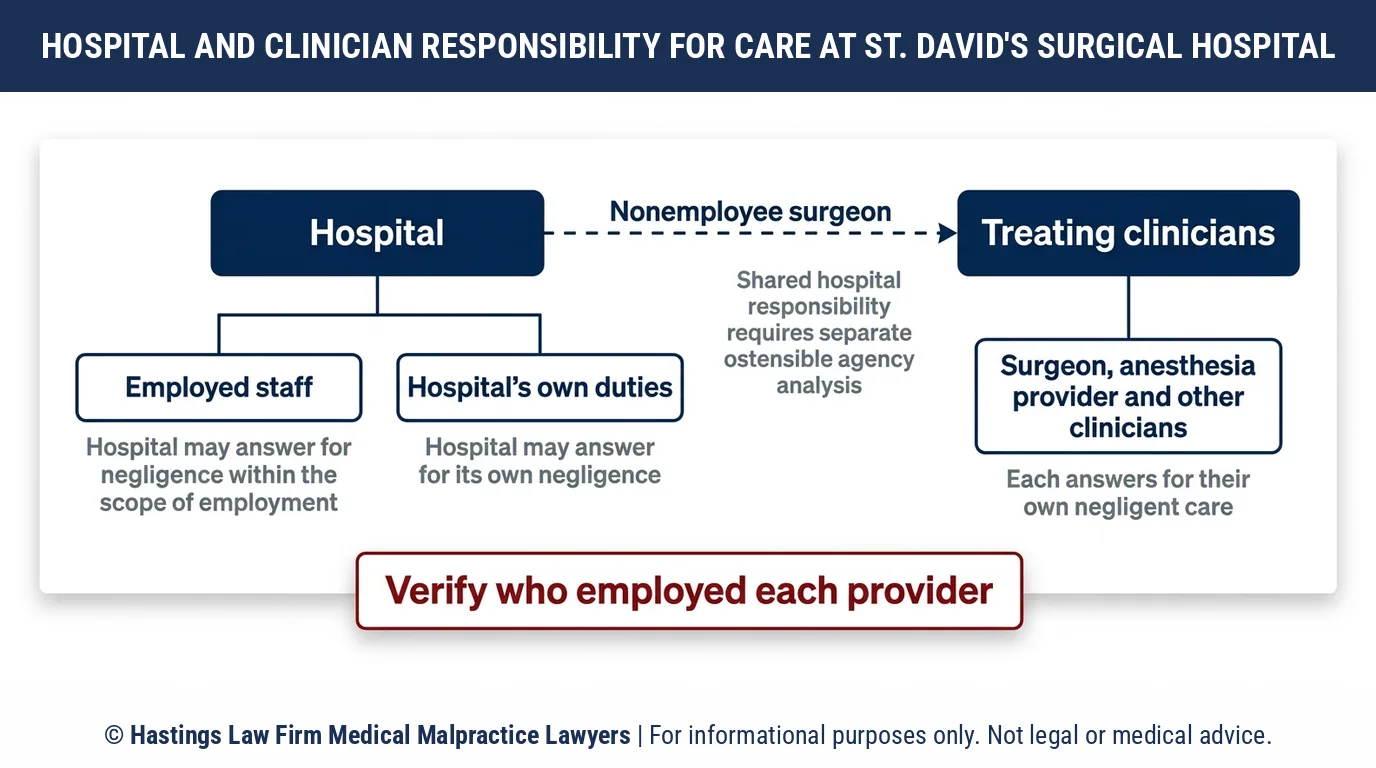
A patient may be able to file a lawsuit against St. David’s Surgical Hospital, the doctor, or both, depending on who gave the care and who employed them. The Texas Supreme Court has held that an employer can be responsible for negligence by an employee acting within the scope of the job. For a hospital, that rule reaches the staff it employs, such as its nurses.
The surgeon, the anesthesia provider, and any other clinician who treated the patient each answer for their own care. A hospital can also face a direct claim for its own negligence, when it failed in a duty it owed to the patient itself. Whether the hospital also shares responsibility for a surgeon who is not its employee is a separate question under Texas law, decided by the rules of ostensible agency.
Before anyone is named, a lawyer to sue a hospital has to work out which provider did what and who employed each of them. Claims like these fall under Chapter 74 of the Texas Civil Practice and Remedies Code, the state’s medical liability law. A qualified expert’s report is generally due 120 days after each defendant answers the suit, so the medical opinions have to be in place early.
Surgery carries real risk, and a poor result is not always a sign of negligence. When an injury could have been prevented, the providers responsible should be held accountable. Our Austin hospital malpractice lawyers sort out which of them a claim should include.
Can St. David’s Surgical Hospital Be Responsible Under Texas Law for a Surgeon Who Is Not Its Employee?
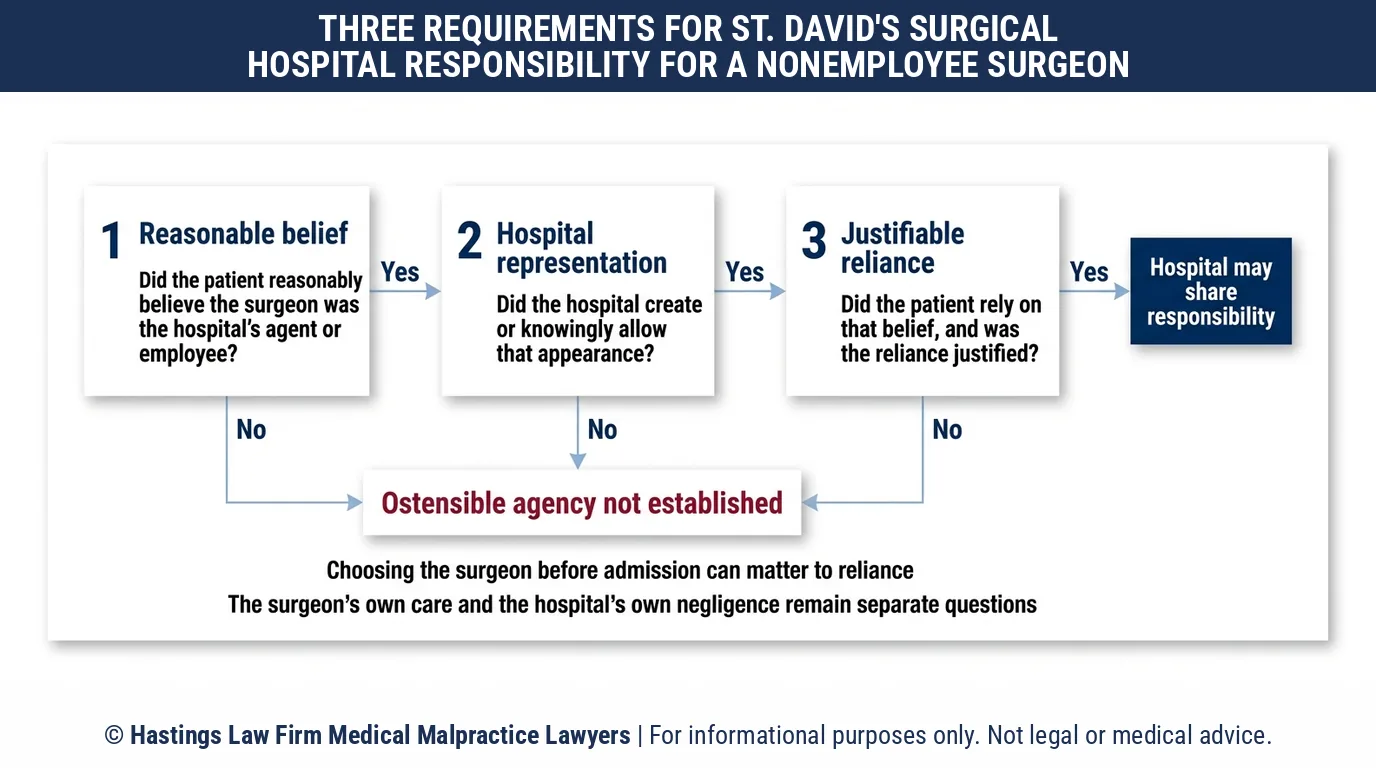
St. David’s Surgical Hospital can share responsibility for a surgeon it does not employ only if the patient proves ostensible agency under Texas law. Baptist Memorial Hospital System v. Sampson requires a reasonable belief that the surgeon was the hospital’s agent or employee, created or knowingly allowed by the hospital, and justifiable reliance. The surgeon remains responsible for their own care whether or not the hospital shares that responsibility.
Put plainly, ostensible agency asks whether the hospital made a surgeon appear to be one of its own. The patient must have believed, on reasonable grounds, that the surgeon worked for the hospital. That belief has to trace back to the hospital, through its own statements and conduct or through a representation it knowingly let stand. The patient must also have relied on the belief, and the reliance must have been justified.
Scheduled surgery gives the reliance element its own shape. A patient who chose a surgeon at an office visit, and was then booked for an operation at the hospital, may have known that surgeon long before arriving. Reliance looks at what the patient believed and why, so the path to the operating room matters.
At any hospital, the evidence on that point comes from several places. The admission and consent paperwork shows what the forms said about who the physicians are. The way the bills arrived, from the hospital or from separate physician groups, adds to that picture, and so does the patient’s own account. In Sampson, the court weighed emergency room signs and signed consent forms that described the physicians as independent contractors, facts that belonged to that case alone.
The hospital’s patient rights page promises patients the names and functions of the physicians treating them. A patient or family can use that right to ask who took part in the surgery and the recovery, and in what role.
Our attorneys gather the admission and consent documents, the billing records, and the names and roles of everyone in the operating room and the recovery unit. We apply Sampson’s three elements to those facts as they stand, without stretching them. Where the evidence supports it, we pursue the surgeon’s own responsibility and any direct claim against the hospital for its own negligence.
How We Work With Injured St. David’s Surgical Hospital Patients and Their Families
Hastings Law Firm represents patients and families in Austin, Texas, in hospital malpractice claims arising from care at St. David’s Surgical Hospital. Our attorneys handle each claim from the first conversation through settlement or trial. We explain every stage in plain language as it happens.
A member of our intake team takes your first call, and a spouse, parent or adult child may call for a patient who cannot. Describe the weeks before the operation, the surgery itself and the days after it, and name the people involved as best you can. We work to make sure you are heard, because that account shapes the review.
Our team then requests the records for you: the surgeon’s office notes and scheduling records, the admission and consent forms, the operative report and the anesthesia record. Our attorneys and medical professionals study the PACU and ICU charts, implant and device records, nursing notes, vital-sign flowsheets, medication administration records, imaging, and the discharge and rehabilitation files. We also identify each clinician’s name and role, the group each one works for, and what the itemized bills show.
If our hospital negligence lawyers take your case, we handle every contact with the hospital, its insurer and its lawyers. Our board-certified patient advocates stay in contact with you and explain each noteworthy development. We seek a settlement that matches your family’s losses. When the offers do not, we are prepared to take your case to a jury.
If You or a Loved One Were Injured at St. David’s Surgical Hospital, Speak With Our Medical Attorneys Today
Hastings Law Firm’s attorneys take on hospital malpractice claims for patients and families in Austin, Texas, after care at St. David’s Surgical Hospital. Our hospital negligence lawyers review a patient’s surgery and the care around it, then identify the providers who may be responsible. We then explain what a claim against each of those providers would involve.
Our team is here for you. We perform a free case review to find out whether you have a valid claim. Case reviews are confidential, and you pay no fees or costs unless we win. Contact us to understand your options.
St. David’s Surgical Hospital Malpractice FAQs


This content was researched and written by the Hastings Law Firm editorial team, which includes attorneys, medical professionals, and experienced researchers. Our writing is informed by internal knowledge and practical experience, and we cross-check critical details against authoritative sources cited throughout. Every piece undergoes human-led fact-checking and legal review. Because legal and medical information can change, if you spot an error, please contact us. Learn more about our content standards and review process on our editorial policy page.

Gabe Sassin has focused exclusively on medical malpractice law since 2007. After spending more than a decade as a malpractice defense attorney, he knows exactly how the other side works. He has seen firsthand how healthcare providers, insurers, corporate defendants, and their legal teams think, prepare, and build their defense against claims. That knowledge works for the people who need it most today, injured patients and their families. His unique experience shapes everything he writes, giving readers a look at how these cases actually work from someone who has handled them from both sides.
