


Banner Thunderbird Medical Center Malpractice Lawyer
Hastings Law Firm represents patients and families in hospital malpractice claims over care at Banner Thunderbird Medical Center, a Banner Health hospital in Glendale, Arizona. Those claims can name the hospital, the nurses and staff it employs, or a physician practicing there under contract rather than as a Banner employee. When medical care goes wrong, a patient and their family can be left with a serious injury, a longer recovery, or the loss of a loved one. Finding out what happened and who should be held accountable takes attorneys who understand medicine as well as they understand the courtroom. At Hastings Law Firm, medical malpractice is all we do!
Last Updated: September 28, 2026
Trial-Ready Hospital Negligence Attorneys for Banner Thunderbird Medical Center Patients and Families
Hastings Law Firm’s hospital negligence lawyers bring experienced representation to Banner Thunderbird Medical Center patients and families in Glendale, Arizona. Tommy Hastings, our founder, is Board Certified in Personal Injury Trial Law and has represented injured patients since 2001. The firm’s lawyers include former malpractice defense attorneys who know how the medical industry defends claims.
Knowing how that defense is built, we gather the evidence to meet it from the first weeks of a claim. Physicians from a nationwide network of medical experts review each provider’s decisions against what the standard of care required at that point in the patient’s care. Our attorneys prepare every case as if it were going to trial, and that preparation has produced multimillion-dollar settlements and record-setting verdicts for injured patients. Those results come from a firm that has been dedicated exclusively to medical malpractice since 2005.
Call us now for a free, confidential case review. Our team will listen to what happened, investigate your claim, and explain your options.

The Types of Banner Thunderbird Medical Center Lawsuits Our Hospital Malpractice Attorneys Handle
Hastings Law Firm handles Banner Thunderbird Medical Center lawsuits in Glendale, Arizona, over trauma and emergency diagnoses, high-risk pregnancy and newborn care, and heart, spine and joint surgery. Our hospital malpractice lawyers build each lawsuit from the records of every unit that cared for the patient. We use those records to show where a decision departed from the standard of care and what that departure cost the family.
The cases we see most often at a Glendale Level I trauma center with a Level III NICU like Banner Thunderbird include:
- Adult trauma and emergency diagnoses that come too late. Internal bleeding, a spinal fracture or a head injury can be missed on the first examination or scan, or an operation the patient needs can be put off too long. A treatable injury can become a permanent disability or the loss of a loved one. Our Arizona emergency room malpractice attorneys line up the trauma team’s notes, the scan times and the orders to show when the injury should have been found.
- Mistakes that injure a mother in a high-risk pregnancy or a baby in the NICU. A worsening condition in pregnancy can be managed too slowly, signs of fetal distress can go unanswered, or a premature baby’s breathing or infection can be caught late. A child can be left with a brain injury and needs that last a lifetime, while the mother faces her own recovery. Our Phoenix birth injury attorneys compare the fetal monitoring strips, the pregnancy and delivery notes, and the NICU charting to find the point where care should have changed.
- Heart, valve, spine and joint operations with preventable complications. A surgeon can injure a nerve, vessel or organ, or bleeding, infection or a clot can go unnoticed once the operation is over. The patient can need another surgery, more days in the hospital, and additional recovery time with lasting pain or lost function. Our Phoenix surgical error lawyers set the operative report against the anesthesia record and the vital signs charted in recovery.
While these are common claim types, our hospital malpractice attorneys handle any valid medical negligence case that arises at this hospital.
The Hastings Law Firm Difference
Results matter, but what truly sets us apart is how we achieve them. Every verdict, every settlement, and every Glendale courtroom victory comes from one guiding promise: To treat each client’s fight for justice as if it were our own.
This balance of skill, experience, and empathy reflects our core philosophy that justice should not only compensate the injured, but also make health care safer nationwide.

About Banner Thunderbird Medical Center in Glendale
Banner Thunderbird Medical Center is a large acute care hospital at 5555 West Thunderbird Road in Glendale, Arizona, in Maricopa County, with a patient tower on its campus. The hospital belongs to Banner Health, a nonprofit health system. Its services include emergency and trauma care, maternity and newborn care, heart care, surgery and intensive care.
The Arizona Department of Health Services names Banner Thunderbird on its list of designated trauma centers as a Level I trauma center. Banner describes its emergency department as a Level I Adult Trauma Center for patients 15 and older. Children are seen in a separate emergency department with its own waiting area and treatment rooms, and the campus also provides pediatric intensive care.
For mothers and newborns, Banner lists labor and delivery care, a Maternal-Fetal Medicine Center and a Level III neonatal intensive care unit at Banner Thunderbird. The Maternal-Fetal Medicine Center offers consultation for high-risk pregnancies, and an antepartum unit cares for mothers before delivery. The NICU treats premature and sick babies.
Banner’s heart services at Banner Thunderbird cover heart attack, heart failure, rhythm disorders, valve problems and vascular disease, with treatments that include open-heart surgery, angioplasty, pacemaker implantation and valve replacement. Its surgeons perform inpatient and outpatient surgery, including robot-assisted, open and minimally invasive procedures, along with spinal surgery, arthroscopy and joint replacement. Patients with severe illness or injury, or who need close care after major surgery, are treated in the intensive care unit, which Banner supports with TeleICU remote monitoring.
Other Banner Health hospitals include Banner Boswell Medical Center in Sun City and Banner Del E. Webb Medical Center in Sun City West. Abrazo Arrowhead Campus, part of Abrazo Community Health Network, is another Glendale hospital.
Can You File a Lawsuit Against Banner Thunderbird Medical Center, the Doctor, or Both?
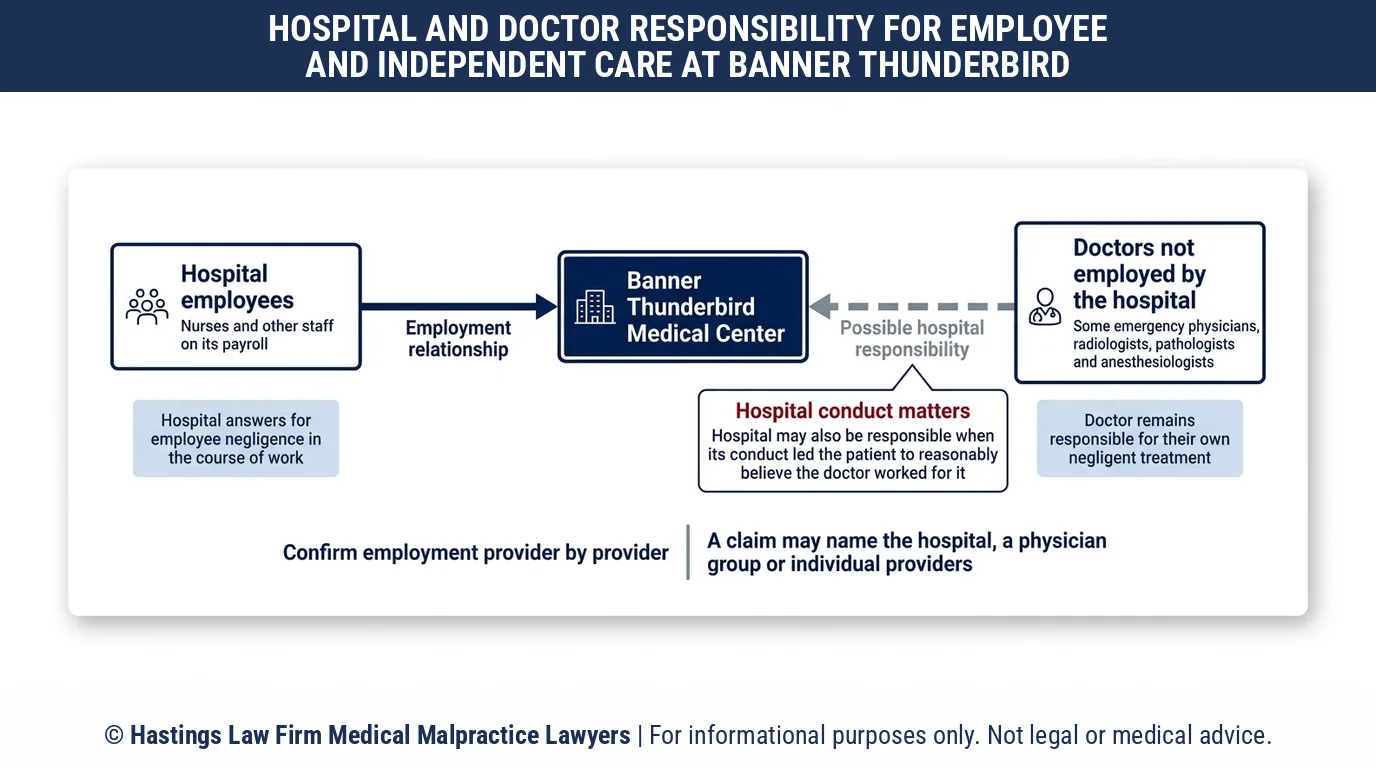
You can file a lawsuit against Banner Thunderbird Medical Center, against a doctor, or against both, depending on whose care caused an injury. Under Kopp v. Physician Group of Arizona, a hospital answers for negligence by its own employees on the job, such as its nurses and other staff. That rule reaches only the hospital’s true employees, not every physician who treats a patient there.
A claim can also name a physician group or individual providers, such as an emergency physician, a trauma surgeon, an obstetrician or a neonatologist. Whether each physician was a hospital employee needs a separate answer. Banner’s billing FAQ tells patients that some doctors may work at the hospital without working for it, and it names contracted emergency physicians, radiologists, pathologists and anesthesiologists as examples. Who employed each provider is therefore confirmed from the records, one provider at a time.
A doctor the hospital does not employ can still bring the hospital into a claim. Arizona can hold a hospital responsible for that doctor’s negligence when the hospital’s own conduct led the patient to reasonably believe the doctor worked for it. The doctor still answers for their own treatment however that question is decided. Sorting out these relationships is one of the first tasks for a lawyer to sue a hospital, because they decide who is named in the claim.
Arizona also asks for medical support at the start of the case. Under A.R.S. 12-2603, the patient’s side certifies in writing whether proving the claim will take expert testimony. If it will, a sworn preliminary expert opinion affidavit must be served near the start of the case. In it, the expert states their qualifications and the facts, identifies the departure from the standard of care, and explains how it led to the injury.
That expert has to fit the provider. A.R.S. 12-2604 generally limits standard of care testimony to experts in the defendant’s own specialty. A claim involving an emergency physician and a neonatologist can therefore need a separate expert for each. Our Phoenix hospital malpractice lawyers walk families through how these expert rules shape a hospital claim.
Is There a Different Burden of Proof for Emergency Treatment at Banner Thunderbird Under Arizona Law?
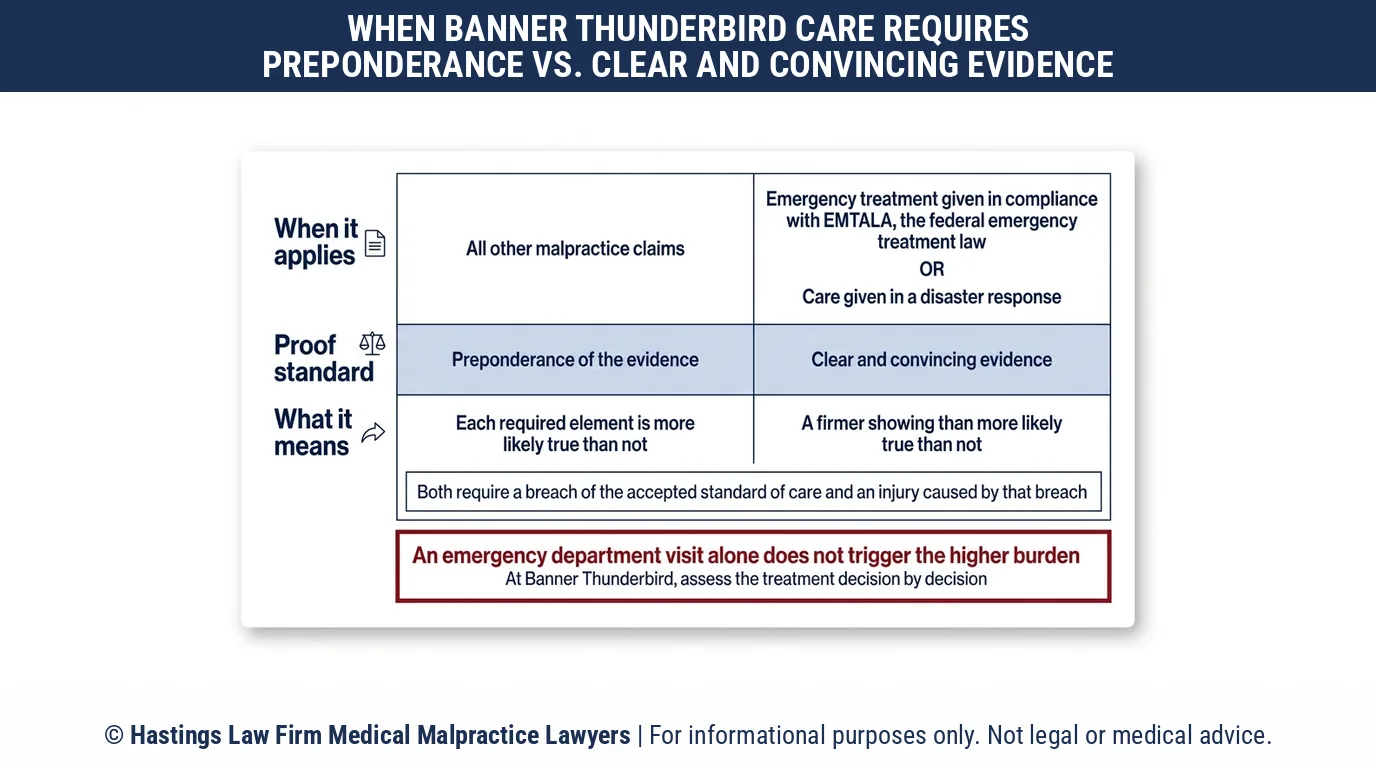
Arizona raises the burden of proof at Banner Thunderbird only for emergency care that complies with EMTALA, the federal emergency treatment law, and for care given in a disaster. For that care, A.R.S. 12-572 requires the patient to prove a malpractice claim by clear and convincing evidence. The rule covers both the health professional who gave the care and the hospital itself.
What the patient must prove stays the same under either burden. A.R.S. 12-563 makes the patient show a breach of the accepted standard of care and an injury caused by that breach. In every other malpractice claim, both are proved by a preponderance of the evidence, which asks whether each is more likely true than not. Clear and convincing evidence asks for a firmer showing than that.
The higher burden is narrow. It does not reach every emergency room visit, and it does not reach hospital negligence in general. It applies only where the treatment meets the statute’s conditions.
At a campus with an adult trauma center, a separate children’s emergency department, a NICU and an ICU, a patient’s care can pass through several of those settings. The patient’s records show which care fell under which standard, and that question is answered decision by decision. For a patient or family, the higher burden is never assumed simply because the care began in an emergency department.
How We Work With Banner Thunderbird Patients and Families After an Injury
Hastings Law Firm handles hospital malpractice claims for Banner Thunderbird Medical Center patients and families in Glendale, Arizona, from the first call through settlement or trial. That first call reaches a member of our intake team, and a spouse, parent or adult child can make it for a patient too ill to phone.
We ask about the care, the people who gave it and any explanation the family received. Our team works to make sure each caller is heard, and what you tell us guides the records request that follows.
The complete medical records come next, and our team requests them from every provider involved. Our attorneys and medical professionals study the emergency notes, NICU or intensive care flowsheets, operative reports and medication records. That study establishes what was done, what was missed and when. A case our hospital negligence lawyers accept rests on those findings and on specialists qualified to explain them.
Once we represent you, every contact with the hospital, its insurer and its defense lawyers goes through us. Our board-certified patient advocates stay in contact with you and put each development into plain language as it comes. Our attorneys negotiate for a settlement that accounts for everything the injury has taken from your family. If the offer does not, we are prepared to present the case to a jury.
If You or a Loved One Were Injured at Banner Thunderbird, Speak With Our Medical Attorneys Today
Hastings Law Firm represents patients and families in Glendale, Arizona, in hospital malpractice claims over care at Banner Thunderbird Medical Center. Our hospital negligence lawyers look into which providers may be responsible. If the medical records point to a hard outcome rather than negligence, we will tell you so directly.
Our team is here for you, and we perform a free case review to find out whether you have a valid claim. Families in Glendale and throughout the Phoenix area work with our Phoenix medical malpractice lawyers. Everything you share with us is confidential, and you owe no fee unless we win. Contact us to understand your options.
Banner Thunderbird Medical Center Malpractice FAQs


This content was researched and written by the Hastings Law Firm editorial team, which includes attorneys, medical professionals, and experienced researchers. Our writing is informed by internal knowledge and practical experience, and we cross-check critical details against authoritative sources cited throughout. Every piece undergoes human-led fact-checking and legal review. Because legal and medical information can change, if you spot an error, please contact us. Learn more about our content standards and review process on our editorial policy page.

Tommy Hastings, founder of Hastings Law Firm, is a board-certified personal injury trial lawyer (by the Texas Board of Legal Specialization) dedicated exclusively to healthcare injury cases. Since 2001, he has represented injured patients and families in litigation against major hospital systems, pharmaceutical companies, and negligent healthcare providers nationwide. He has handled numerous high-profile cases that have drawn national media attention and resulted in multi-million dollar recoveries.
