


Baylor St. Luke’s Medical Center Malpractice Lawyer
Written by: Hastings Law Firm | Reviewed by: Tommy Hastings | Updated: September 21, 2026
When medical malpractice occurs at Baylor St. Luke’s Medical Center, the effects can reach beyond the hospital stay and into every part of a family’s life. Patients at this hospital are treated by many providers over time, and responsibility for a preventable error can belong to any of them or to the hospital. Learning who was responsible is frequently what lets a family understand what happened and why. If you or a loved one were harmed or worse due to medical malpractice at Baylor St. Luke’s Medical Center in Houston, contact Hastings Law Firm for a free, confidential case review.
Top-Rated Hospital Negligence Lawyers for Baylor St. Luke’s Patients and Families

A Health Care Focused Law Firm
An injury caused by medical negligence at Baylor St. Luke’s Medical Center can mean lasting harm, additional recovery time, or the loss of a loved one. Medicine carries risk, and not every bad outcome is negligence. When an injury was preventable, our Baylor St. Luke’s hospital malpractice lawyers work to establish what happened and why.
Our firm has been dedicated exclusively to medical malpractice since 2005, which is the background a claim against a hospital this specialized calls for. Treatment can run through several teams and several departments across a course of care, and each of them keeps its own part of the record. Pulling those pieces into a single account of what happened is where a claim of this kind begins. Our attorneys and medical professionals are experienced at that work, and at identifying the point where the treatment stopped meeting the standard.
Call us now for a free, confidential case review. Our team will listen, investigate your claim, and explain your options.
The Types of Baylor St. Luke’s Lawsuits Our Hospital Malpractice Attorneys Handle
Our hospital malpractice lawyers bring claims against Baylor St. Luke’s Medical Center, against its staff, and against the physicians and groups who treat patients there. The cases we see most often at an academic heart and transplant hospital like Baylor St. Luke’s include:
- Cardiac catheterization and interventional heart procedure errors. A vessel injured during the procedure, a device placed incorrectly, or a bleed or stroke that goes unrecognized in recovery can do damage in minutes. What follows can be emergency surgery, permanent injury to the heart or the brain, or a loss a family never saw coming. Our Texas cardiac catheterization complication attorneys read the procedure log against the imaging and the notes written afterward.
- Transplant surgery errors. A technical mistake during the operation, a missed sign that an organ is failing, or a breakdown in the handoff between teams can cost a patient the transplant. Recovering from that can mean another operation, a return to the waiting list, or a loss the family was not prepared for. Our Texas transplant surgery malpractice lawyers work through the surgical and follow-up records with physicians who perform these operations.
- Hospital-acquired infection after major surgery. An infection can take hold in a surgical site, a bloodstream line, or a ventilator and move quickly in a patient recovering from a long operation. Early signs of it can go unanswered. Treating it late can undo the surgery it followed and add months of care to a recovery that was nearly finished. Our Houston hospital infection lawyers trace when the infection first appeared in the chart and what the staff did about it.
While these are the more common claim types, our hospital malpractice attorneys handle any valid medical negligence case that arises at this hospital.
The Hastings Law Firm Difference
Results matter, but what truly sets us apart is how we achieve them. Every verdict, every settlement, and every Houston courtroom victory comes from one guiding promise: To treat each client’s fight for justice as if it were our own.
This balance of skill, experience, and empathy reflects our core philosophy that justice should not only compensate the injured, but also make health care safer nationwide.

About Baylor St. Luke’s Medical Center
Baylor St. Luke’s Medical Center is a private, nonprofit hospital in Houston’s Texas Medical Center, jointly owned by Baylor College of Medicine and CommonSpirit Health. It belongs to the St. Luke’s Health system and is not a government facility. It is also the primary private adult teaching hospital for Baylor College of Medicine.
Its care runs across two campuses, the Bertner Campus in the Texas Medical Center and the newer McNair Campus, with inpatient services moving to the McNair Campus over time. Between them the hospital holds more than 800 licensed beds.
Much of the treatment given there is heart and vascular care and transplant surgery, covering heart, lung, kidney, and liver transplants. The intensive care that follows a major operation is part of that work. The Texas Heart Institute at Baylor College of Medicine is located at the hospital, and its cardiologists and cardiovascular surgeons practice there. The state’s roster of designated trauma facilities does not include Baylor St. Luke’s.
Baylor St. Luke’s Medical Center is a Houston institution, and it is not connected to the hospitals that use the St. Luke’s name in other parts of the country. The wider St. Luke’s Health network runs hospitals across greater Houston, and a claim can arise at one of those community hospitals as readily as in the Texas Medical Center. Its Houston-area hospitals include:
- Baylor St. Luke’s Medical Center (Texas Medical Center)
- St. Luke’s Health The Woodlands Hospital
- St. Luke’s Health Lakeside Hospital (The Woodlands)
- St. Luke’s Health The Vintage Hospital (Houston)
- St. Luke’s Health Springwoods Village Hospital (Spring)
- St. Luke’s Health Patients Medical Center (Pasadena)
- St. Luke’s Health Sugar Land Hospital
- St. Luke’s Health Brazosport Hospital (Lake Jackson)
Can You File a Lawsuit Against Baylor St. Luke’s Medical Center, the Doctor, or Both?
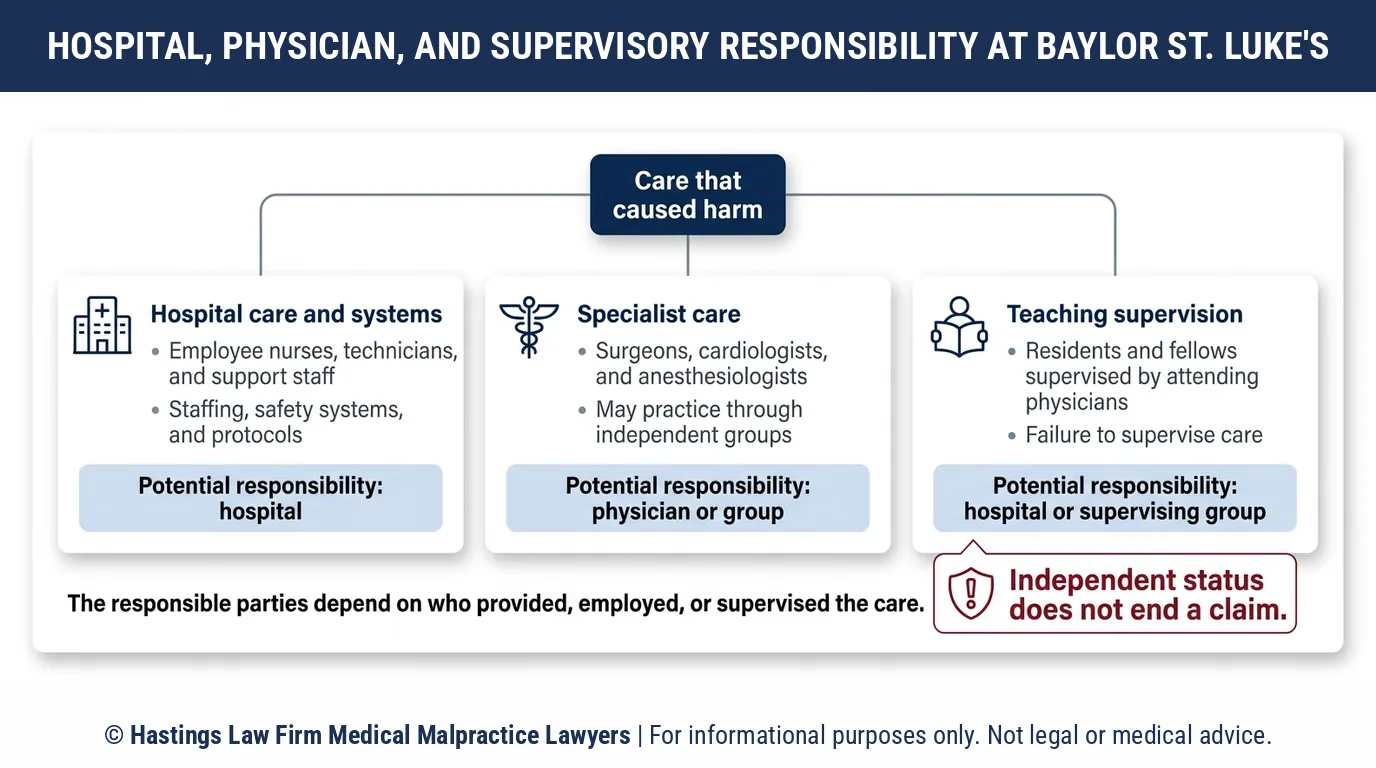
You may be able to file a lawsuit against Baylor St. Luke’s Medical Center, an individual provider, or both. Who you name depends on who was responsible for the care that caused the harm. Negligence by a hospital’s own employees, the nurses, technicians, and support staff who deliver care hour to hour, is the hospital’s responsibility. The hospital also carries responsibility of its own, for staffing levels, for safety systems, and for the protocols meant to keep a patient from being hurt.
The staffing arrangements at a hospital like this one decide the rest of the answer. Baylor St. Luke’s is a teaching hospital, and residents and fellows take part in patient care there with attending physicians supervising them. A failure in that supervision can make the hospital or the supervising group responsible, rather than the trainee. The second question is who employs the specialists.
Many of the surgeons, cardiologists, and anesthesiologists who practice at a hospital of this kind work through their own groups rather than as hospital employees. That status does not end a claim by itself. It does change the list of defendants and the way the case has to be built. Finding a lawyer to sue a hospital, a physician group, or both starts with identifying every health care provider or facility that took part in the care.
Texas law adds a requirement of its own. Under Chapter 74 of the Texas Civil Practice and Remedies Code, a qualified medical expert has to put an opinion in writing early in the case. Corporate negligence, vicarious liability, the contractor defense, and that expert report all come up in these claims, and our Houston hospital malpractice lawyers explain each of them.
Does Signing a Consent Form at Baylor St. Luke’s Prevent a Malpractice Claim in Texas?
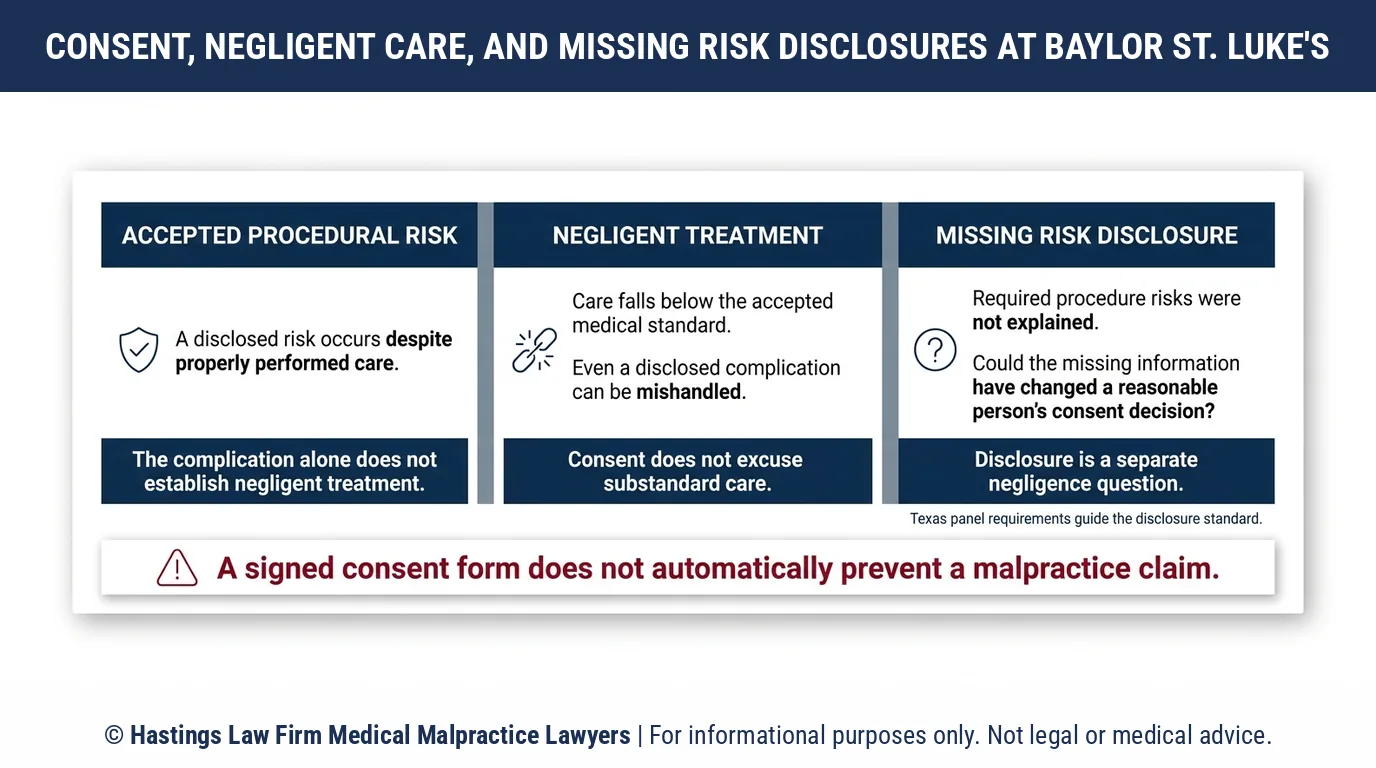
Signing a consent form at Baylor St. Luke’s Medical Center does not prevent a malpractice claim in Texas. A consent form covers the risks and hazards that come with a procedure performed properly. It does not cover treatment that fell short of the accepted medical standard, and no signature makes a preventable error acceptable.
Texas treats a disclosure problem as its own kind of negligence claim. When the risks of a procedure were never explained, the law asks whether that missing information could have influenced the patient’s decision. The measure is a reasonable person deciding whether to give or withhold consent.
A state panel decides which procedures require disclosure, which risks have to be named, and what form the disclosure takes. Because the Texas Medical Disclosure Panel publishes those lists, whether a disclosure was adequate is measured against a published standard and not against anyone’s memory of a conversation before surgery. A form that meets the panel’s requirements is presumed to satisfy the duty, and a form that leaves out a required risk is presumed not to. Either presumption can be challenged with evidence.
The two questions stay separate. A risk that was properly disclosed can still have been mishandled once it appeared. A complication a patient agreed to accept does not excuse a slow or careless response to it. Our Texas surgical malpractice attorneys explain how these claims are proven.
How We Work With Injured Baylor St. Luke’s Patients
The first conversation about an injury or a loss at Baylor St. Luke’s Medical Center happens with a member of our intake team. A relative can place that call when the patient is not well enough to make it. Tell us what happened, who was involved in the treatment, and what you believe went wrong. Our team works to make sure you are heard, and your account is where our review starts.
Our team requests the complete medical records for you, and the review begins there. Our attorneys and medical professionals read the procedure logs, the monitoring records, the intensive care notes, and the medication orders against one another. That reading produces a timeline of the treatment and shows the gaps in it. When our hospital negligence lawyers accept a case, we build it on that timeline and on the physicians who can explain it to a jury.
As your attorneys, we deal with the hospital, its insurer, and its lawyers, so none of that reaches you. Through the case, our board-certified patient advocates stay in contact and explain each development in plain language as it arrives. Our hospital malpractice attorneys negotiate for a settlement that covers everything this injury has taken from you and your family. When an offer falls short of that, we are prepared to take your case to a jury.
If You or a Loved One Were Injured at Baylor St. Luke’s, Speak With Our Medical Attorneys Today
If care at Baylor St. Luke’s Medical Center, or at another hospital in the St. Luke’s Health network, has left you or a family member worse off, our team is here for you. Our hospital negligence lawyers will go through what happened with you and say who may be responsible for it. If we believe a bad outcome was not malpractice, you will hear that from us plainly.
We perform a free case review to find out whether you have a valid claim. Everything you tell us is confidential, and you pay no fees or costs unless we win. Let us help you find the answers you deserve.
Baylor St. Luke’s Medical Center Malpractice FAQs


This content was researched and written by the Hastings Law Firm editorial team, which includes attorneys, medical professionals, and experienced researchers. Our writing is informed by internal knowledge and practical experience, and we cross-check critical details against authoritative sources cited throughout. Every piece undergoes human-led fact-checking and legal review. Because legal and medical information can change, if you spot an error, please contact us. Learn more about our content standards and review process on our editorial policy page.

Tommy Hastings, founder of Hastings Law Firm, is a board-certified personal injury trial lawyer dedicated exclusively to healthcare injury cases. Since 2001, he has represented injured patients and families in litigation against major hospital systems, pharmaceutical companies, and negligent healthcare providers nationwide. He has handled numerous high-profile cases that have drawn national media attention and resulted in multi-million dollar recoveries. He draws on that experience in his writing, helping readers understand how these cases work and what options may be available to them.
