


Texas Cardiac Catheterization Complications Lawyer
Written by: Hastings Law Firm | Reviewed by: Gabe Sassin | Updated: July 27, 2026
Heart catheterization can be lifesaving, but serious harm can occur when a cardiologist or cath lab team deviates from accepted medical standards. A central issue is whether an outcome was a known risk discussed in informed consent or a preventable medical error tied to technique, monitoring, or delayed response to complications. The consequences can include major vascular injury, organ damage, stroke, or fatal outcomes, along with lasting financial and personal strain. If you or a loved one were harmed or worse due to cardiac catheterization malpractice in Texas, contact Hastings Law Firm for a free, confidential case review.
Trusted Texas Medical Attorneys for Heart Catheterization Malpractice Claims
What You Should Know About Heart Catheterization Malpractice Claims in Texas:
- Recovery can turn on whether a serious outcome was a known risk despite proper care or a preventable error tied to a deviation from the standard of care.
- Severe injury can follow technique and monitoring failures during cardiac catheterization, including vascular damage, organ damage, and systemic events such as stroke.
- Harm can worsen after the procedure when warning signs are missed, since delayed recognition of internal bleeding or cardiac tamponade can lead to fatal outcomes.
- Options can narrow quickly in Texas because medical malpractice claims face strict timing limits and narrow exceptions.
- The ability to proceed in Texas can depend on meeting expert support requirements, since a qualified expert report is required early in the case.
- Total recovery can be limited for non economic harms in Texas because state law caps non economic damages.
- Financial recovery can be broader for measurable losses in Texas because economic damages for provable financial losses are not capped.
- Clarity about what happened can depend on procedure specific documentation, including cath lab logs, cineangiogram footage, and monitoring records.

A Healthcare Focused Law Firm
Cardiac catheterization, a procedure where a thin tube is threaded through a blood vessel to diagnose or treat heart conditions, is one of the most commonly performed cardiac procedures in the United States. When performed correctly, it can be lifesaving. But when a cardiologist or cath lab team deviates from accepted medical standards, the consequences can be devastating.
If you or a loved one suffered a serious injury during or after a heart catheterization, you may be wondering whether what happened was a known risk or a preventable medical error. That distinction matters. It is often the central question in these cases.
As a Texas cardiac catheterization complications lawyer, Tommy Hastings and his team at Hastings Law Firm have focused exclusively on medical malpractice since 2005. Our team includes in-house nurse consultants and former defense attorneys who previously worked for hospital systems and their insurers. If something went wrong during a heart cath procedure, we can review your medical records and help you understand your legal options at no cost.
Common Errors and Complications in Cardiac Catheterization Procedures
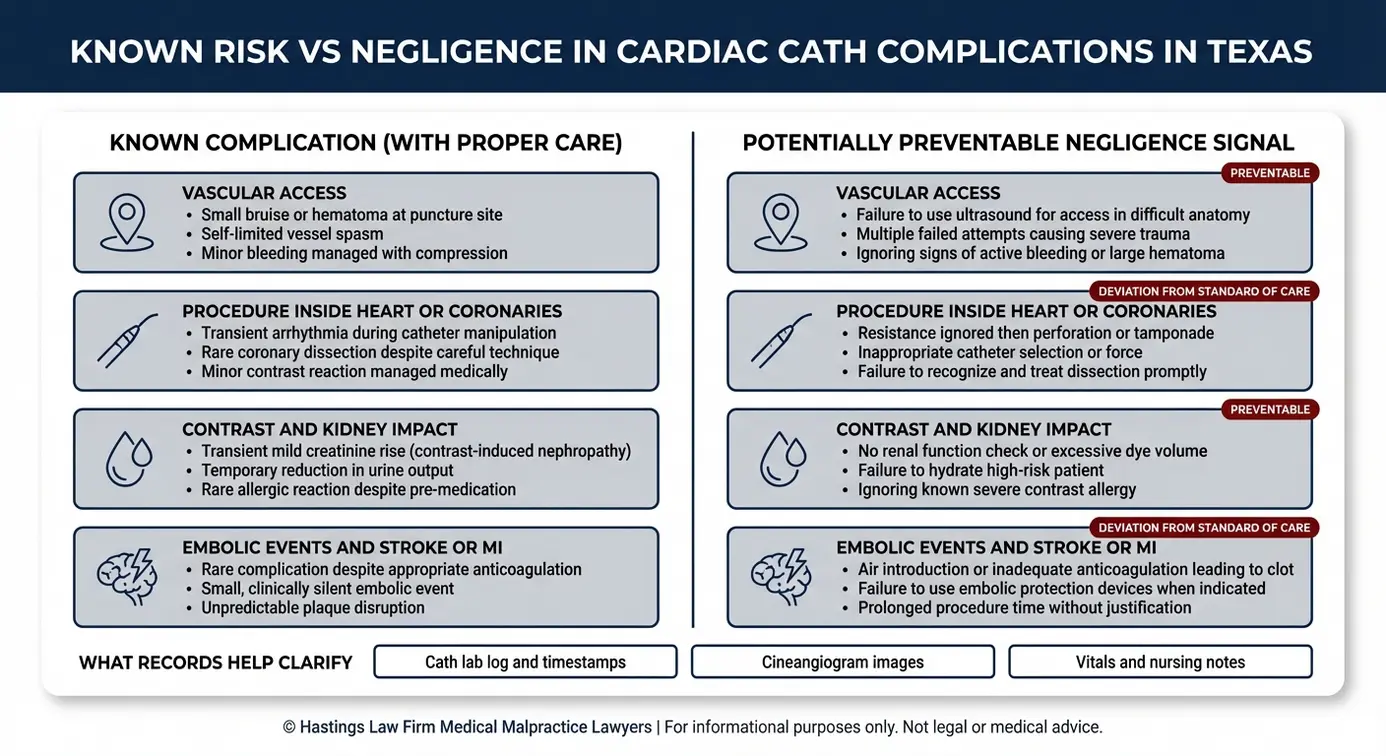
Cardiac catheterization malpractice occurs when a cardiologist deviates from the standard of care, the level of treatment a reasonably competent specialist would provide under similar circumstances, resulting in preventable injuries such as perforated arteries, air embolisms, or an unrecognized dissection.
Not every complication is malpractice. Some risks, like minor bruising at the insertion site, are expected and discussed during informed consent. The line between a “known risk” and heart catheterization malpractice defines our investigation.
Research published by the National Institutes of Health on stroke determinants following percutaneous coronary intervention highlights the serious embolic risks associated with catheter-based cardiac procedures, particularly in patients with acute coronary syndrome. These risks underscore why strict adherence to technique and monitoring protocols is essential. We examine whether specific failures led to catastrophic outcomes, such as kidney damage from improper contrast management or a life-threatening aortic dissection caused by aggressive catheter manipulation.
To prove a claim, we must distinguish between unavoidable outcomes and actionable negligence. Vascular injuries often result from improper access techniques, while procedural errors can damage the heart structure itself.
Contrast toxicity is another preventable issue where failure to screen renal function leads to injury. Embolic events, such as a stroke caused by dislodged plaque, require careful analysis of the technique used. A cardiac cath injury attorney evaluates the procedure records, imaging, and lab work to determine whether the complication was truly unavoidable or whether it resulted from a preventable error.
Here is how we categorize the types of injuries we see in these cases:
| Type of Injury | Examples | Potential Negligent Cause |
|---|---|---|
| Vascular | Hematoma, pseudoaneurysm, arteriovenous fistula, retroperitoneal bleed | Poor puncture technique, failure to use ultrasound-guided arterial access (using imaging to precisely locate the artery before needle insertion) |
| Organ | Perforated coronary artery, cardiac tamponade, acute kidney failure | Excessive catheter force, failure to check renal function before administering contrast dye |
| Systemic | Stroke, heart attack, air embolism (a bubble of air introduced into the bloodstream that can block blood flow to the brain or heart) | Dislodging arterial plaque, improper catheter flushing, failure to manage anticoagulation |
Failure to Diagnose and Treat Procedure Complications
Sometimes the error is not in the procedure itself but in what happens afterward. A patient may develop retroperitoneal hemorrhage, which is internal bleeding behind the abdominal wall that is not visible from the outside. If the cath lab team fails to recognize dropping blood pressure, rising heart rate, or a declining hemoglobin level, that delay can turn a manageable bleed into a fatal one.
The same applies to cardiac tamponade, a condition where fluid or blood accumulates in the pericardial sac and compresses the heart, preventing it from pumping effectively. When a heart catheter perforates a heart chamber or vessel, tamponade can develop rapidly.
The standard of care requires immediate recognition and intervention. A proper differential diagnosis is important to distinguish these symptoms from other issues. If clinical signs of a blood clot or active bleed are ignored or misread, that failure to act can form the basis of a negligence claim.
Proving Negligence in Heart Catheterization Cases
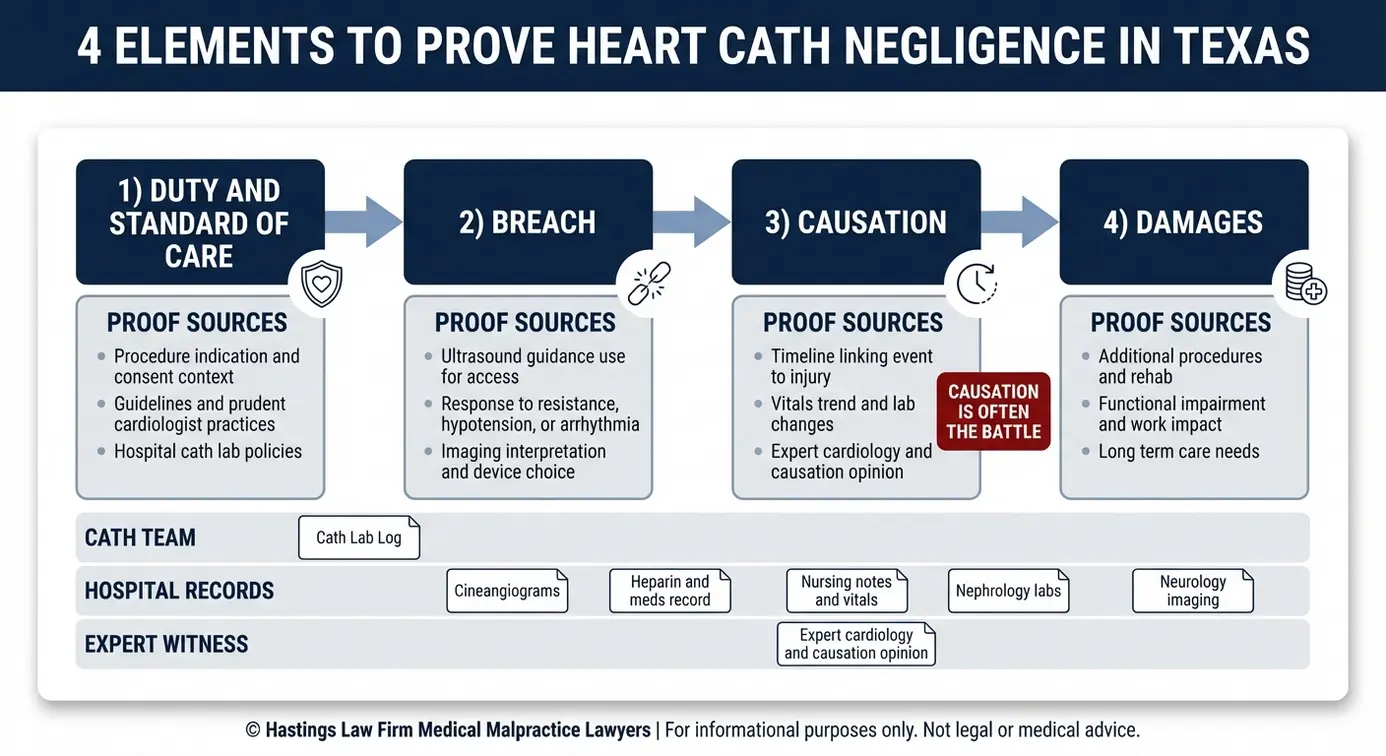
To prove negligence, a plaintiff must show the cardiologist failed to adhere to the accepted medical standard of care, such as failing to use ultrasound guidance for arterial access or misinterpreting angiogram imagery, and that this failure directly caused the injury.
Texas medical malpractice cases require more than just showing a bad outcome. Under Texas Civil Practice and Remedies Code Chapter 74, plaintiffs must serve a qualified expert witness report within 120 days of each defendant’s original answer to ensure a medical professional supports the claim. These requirements, along with noneconomic damages caps under Section 74.301, define whether and how the case can proceed.
The evidence collection phase is important to our work. A Texas medical malpractice attorney builds the case by securing and analyzing specific records from the procedure, including:
- Cath lab logs and procedure notes documenting the timeline of events, catheter types used during angioplasty or stent placement, and any complications noted in real time
- Cineangiogram footage (the recorded X-ray video of the catheter moving through the arteries) showing technique and catheter positioning
- Vital signs and hemodynamic monitoring records tracking blood pressure, heart rate, and oxygen levels throughout the procedure
- Pre-procedure lab work including renal function panels to determine whether the team screened for contrast-induced acute kidney injury (CI-AKI), a form of kidney damage triggered by the contrast dye used during imaging
- Billing and procedure codes cross-referenced against documentation, as outlined in the CMS guidelines on billing and coding for cardiac catheterization and coronary angiography, to identify whether billed services match what was actually performed
- Post-procedure nursing notes and discharge records revealing how complications were monitored and managed
Our team works with board-certified cardiologists and interventional specialists across the country to review this evidence and establish whether the care fell below the accepted standard. If it did, and if that failure caused an injury like aortic dissection (a tear in the wall of the aorta) or organ damage, we build the case to hold the responsible parties accountable.
The Hastings Law Firm Difference
Results matter, but what truly sets us apart is how we achieve them. Every verdict, every settlement, and every Texas courtroom victory comes from one guiding promise: To treat each client’s fight for justice as if it were our own.
This balance of skill, experience, and empathy reflects our core philosophy that justice should not only compensate the injured, but also make healthcare safer nationwide.

Damages Recoverable for Botched Heart Cath Procedures
Patients who suffer cardiac catheterization errors in Texas can recover economic damages for medical bills and lost wages, as well as non-economic damages for pain, suffering, and physical impairment, subject to state-imposed caps. Securing full compensation for catheterization injury is our priority.
Economic damages cover the tangible financial losses: emergency care, corrective surgeries, rehabilitation, ongoing cardiac treatment, and lost earning capacity if the injury affects your ability to work. Research published in JAMA Network Open on the economic burden of illness confirms that serious medical injuries from heart catheterization procedures generate costs that extend far beyond the initial hospitalization. These economic damages are uncapped in Texas, meaning there is no statutory limit on what a jury can award for provable financial losses.
Non-economic damages, which include pain and suffering, mental anguish, disfigurement, and loss of enjoyment of life, are subject to caps under Texas Civil Practice and Remedies Code § 74.301. Building a strong case on the economic side is important because the full scope of compensation, including future financial security, can be pursued without a statutory ceiling.
If a patient died during or shortly after the procedure due to negligence, surviving family members may bring a wrongful death claim. A heart procedure injury lawyer can help the family identify all available sources of recovery, including future financial support the deceased would have provided.
Texas Deadlines for Filing a Cardiac Injury Claim
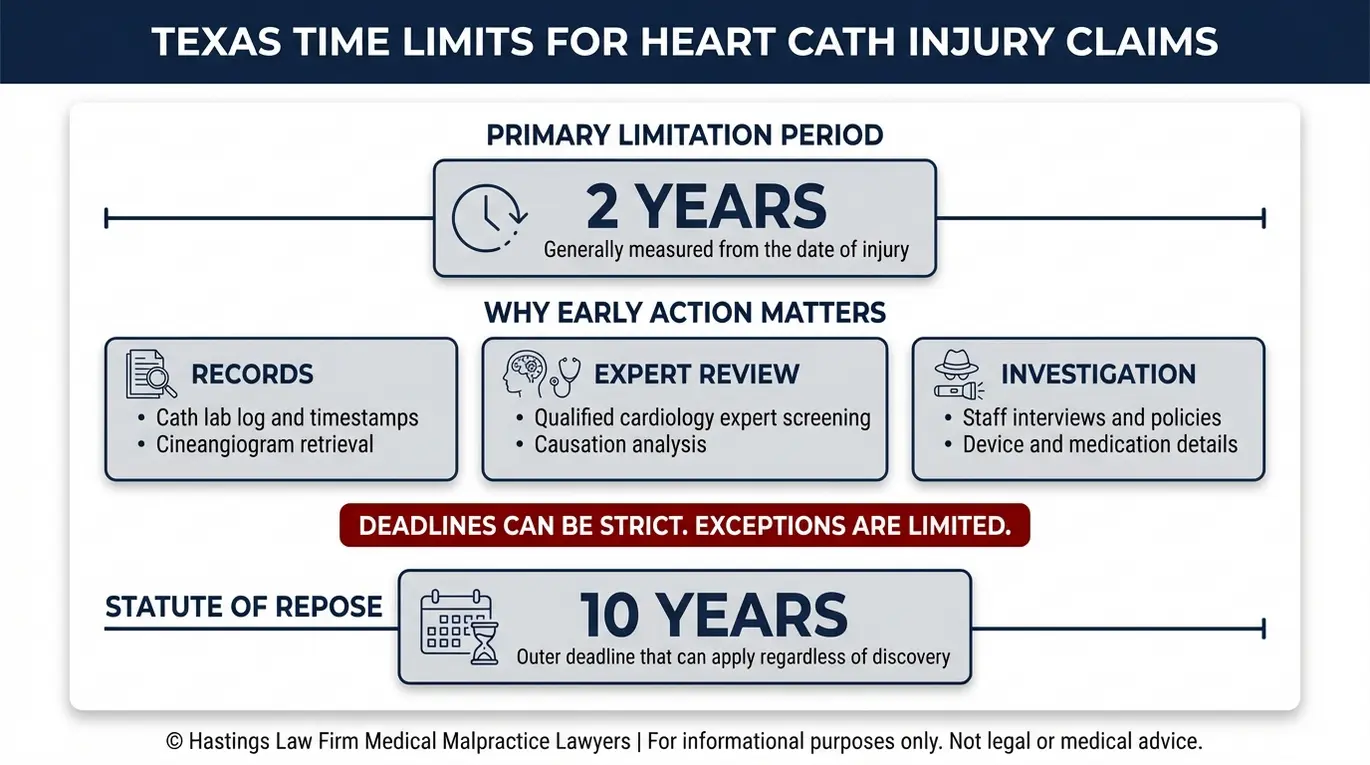
Under the Texas cardiac malpractice statute of limitations, patients generally have two years from the date of the cardiac injury to file a lawsuit. A separate statute of repose imposes a hard 10-year outer deadline regardless of when the injury was discovered.
In situations involving latent complications, limited exceptions may apply, but Texas courts interpret them very narrowly. The general discovery rule does not apply to most medical malpractice claims under Texas law. Because the investigation takes time to obtain records and retain experts, the sooner the investigation begins, the stronger your position.
Preparing the mandatory expert report for a Texas heart procedure injury claim under Texas Civil Practice and Remedies Code § 74.351 is a detailed process that must be started early. If you wait until the two year deadline approaches, you may lose your right to seek compensation.
Contact the Texas Healthcare Malpractice Attorneys at Hastings Law Firm Today for Help
After a serious complication in the cath lab, you may feel overwhelmed by medical bills, uncertain about what went wrong, and unsure whether anyone will take your concerns seriously. We understand that feeling. The healthcare system holds the records, the expertise, and the institutional support. You deserve someone in your corner who can level that imbalance.
At Hastings Law Firm, we represent patients and families exclusively. Every member of our team, from our attorneys to our in-house nurse consultants, is dedicated to investigating medical negligence and holding the responsible parties accountable. Our founder, Tommy Hastings, is Board Certified in Personal Injury Trial Law, a distinction held by fewer than 2% of attorneys in Texas.
As a Texas cardiac catheterization complications lawyer, we offer a free, confidential case evaluation. You pay no fees or costs unless we recover compensation on your behalf. If something went wrong during your heart procedure, contact us for a free, confidential case evaluation.
Frequently Asked Questions About Cardiac Catheterization Complications in Texas


This content was researched and written by the Hastings Law Firm editorial team, which includes attorneys, medical professionals, and experienced researchers. Our writing is informed by internal knowledge and practical experience, and we cross-check critical details against authoritative sources cited throughout. Every piece undergoes human-led fact-checking and legal review. Because legal and medical information can change, if you spot an error, please contact us. Learn more about our content standards and review process on our editorial policy page.

Gabe Sassin has focused exclusively on medical malpractice law since 2007. After spending more than a decade as a malpractice defense attorney, he knows exactly how the other side works. He has seen firsthand how healthcare providers, insurers, corporate defendants, and their legal teams think, prepare, and build their defense against claims. That knowledge works for the people who need it most today, injured patients and their families. His unique experience shapes everything he writes, giving readers a look at how these cases actually work from someone who has handled them from both sides.
