


Houston Hospital Negligence Lawyer
Hospital negligence can leave patients and families facing worsening health, unexpected costs, and lasting uncertainty about what went wrong. Unlike a mistake by a single clinician, hospital negligence often traces back to the institution itself, its staffing choices, its safety protocols, or the way it monitors patients during the most vulnerable hours of a stay. Understanding how a hospital can be held responsible is often the first step toward getting a straight answer about what happened. If you or someone you love were harmed by hospital negligence in Houston, contact Hastings Law Firm for a free, confidential case review.

Last Updated: September 28, 2026
Trial-Ready Hospital Negligence Attorneys in Houston, TX
When a hospital stay ends in unexpected harm, the experience can leave you questioning everything. You trusted the facility, the staff, and the system to keep you or your loved one safe. Now you may be dealing with a worsening condition, mounting medical bills, and the unsettling feeling that something went wrong. That feeling is sometimes called the “White Coat Effect,” the deep-seated conditioning that tells us not to question medical professionals, even when the evidence of a mistake is staring us in the face.
You deserve to know what happened, and you have the right to ask.
Founded by board-certified trial attorney Tommy Hastings in 2005, Hastings Law Firm focuses exclusively on medical malpractice. Our team of trial attorneys, former defense lawyers, and in-house medical professionals reviews hospital cases every day. If you believe negligent care at a Houston hospital harmed you or someone in your family, we can review what happened and explain your options in a free, confidential evaluation.

What is Hospital Negligence?
Hospital negligence is health care negligence for which the hospital itself is responsible, separate from the mistakes of a single doctor or nurse. The distinction matters because a hospital has its own independent duty of care to every patient who walks through its doors.
When most people picture malpractice in Houston, they imagine a surgeon making the wrong cut or a physician missing a diagnosis, and those are examples of individual negligence. Institutional negligence is different. It refers to systemic breakdowns at the organizational level, such as inadequate staffing, poorly enforced safety protocols, defective equipment, or a failure to properly credential the physicians a hospital allows to practice.
The standard of care for a hospital is measured differently than for an individual doctor. It focuses on whether the facility maintained the administrative, operational, and safety standards a reasonably competent institution would uphold under similar circumstances, including safe nurse-to-patient ratios that directly affect how quickly a deteriorating patient is noticed. These failures are more common than most people realize. A landmark Johns Hopkins study, analyzed by the Petrie Flom Center at Harvard Law School, identified medical errors as the third leading cause of death in the United States, and many of those errors trace back to hospital-level breakdowns rather than one provider’s judgment.
Can You Sue a Houston Hospital or Just the Doctor?
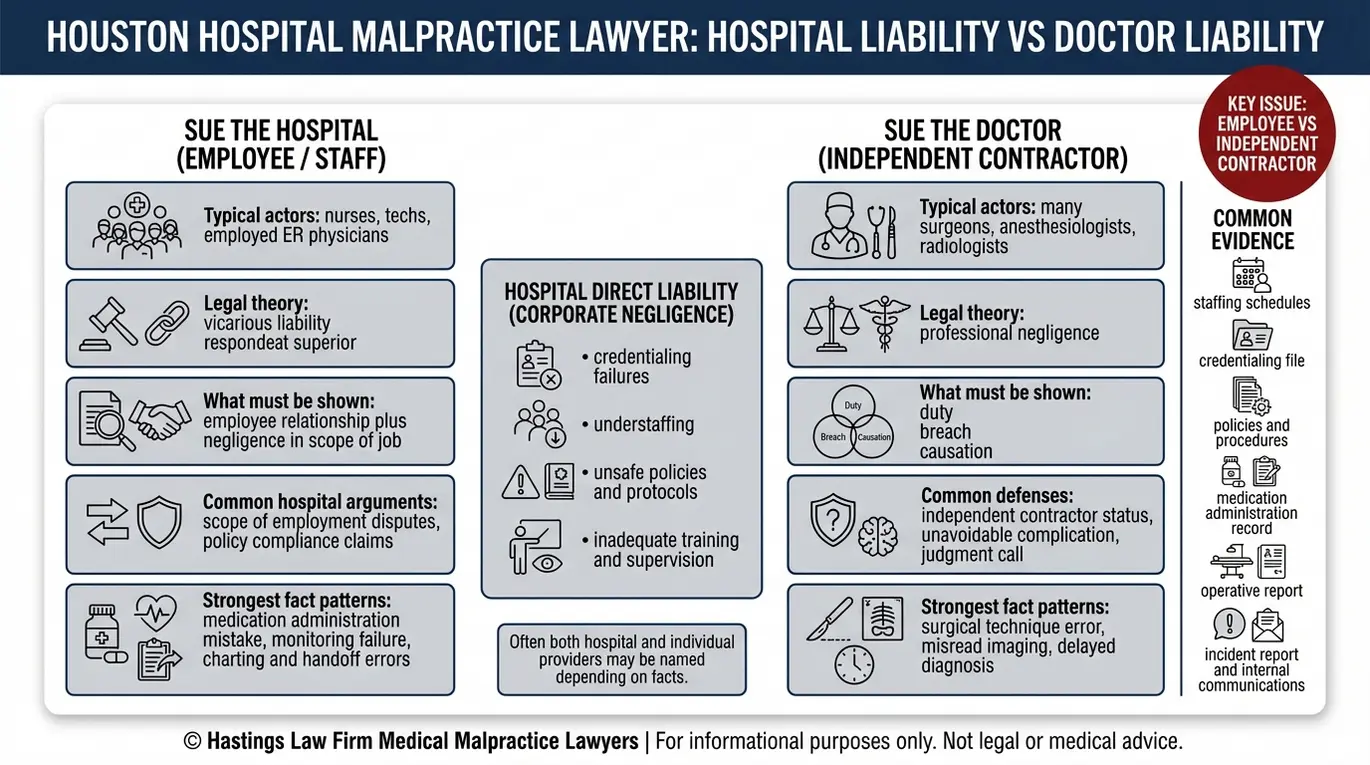
You can sue a Houston hospital directly for the negligence of its employees under a doctrine called vicarious liability, and separately for its own institutional failures, though hospitals often argue that the physician who treated you was an independent contractor rather than an employee. Understanding the difference between these theories is essential to building the right case.
Vicarious liability means a hospital can be held responsible for the negligent acts of its employees, including nurses, technicians, and physician assistants, even when hospital administrators did nothing wrong themselves. The principle behind it is respondeat superior, which holds employers accountable for harm caused by employees acting within the scope of their duties. The Texas Pattern Jury Charges provide the framework Texas courts use to instruct juries on these questions.
Corporate negligence targets the hospital’s own conduct. It applies when a facility fails in its duty to properly credential and privilege its physicians, maintain safe staffing, or enforce safety policies. Credentialing is the process of verifying a doctor’s qualifications and competence before granting permission to practice at the facility, and a failure there can make the hospital directly liable.
The independent contractor defense is one of the most common strategies hospitals use. Many hospitals classify their ER physicians, anesthesiologists, and radiologists as independent contractors rather than employees, and if a hospital can show it did not control how a doctor practiced medicine, it may argue it cannot be held vicariously liable for that doctor’s actions. Even then, the hospital may still face liability if it failed in its credentialing process or if the patient had no reason to know the doctor was not a hospital employee.
| Factor | Hospital Employee | Independent Contractor |
|---|---|---|
| Hospital controls how work is performed | Yes | No |
| Hospital vicariously liable for negligence | Generally yes | Generally no |
| Common examples | Nurses, techs, PAs | ER physicians, anesthesiologists, radiologists |
| Corporate negligence claim available | Yes | Yes |
Direct Hospital Liability After Bush v. Columbia (2025)
A hospital can be held directly liable for its own institutional failures in Texas, apart from whether any individual physician did anything wrong. A 2025 Texas Supreme Court decision, Bush v. Columbia Medical Center of Arlington, No. 23-0460 (Tex. May 23, 2025), clarified how far that theory reaches at the Chapter 74 expert-report stage. The case involved a patient who died of an undiagnosed pulmonary embolism, and the expert report alleged the hospital had failed to adopt testing policies for the symptoms she presented with. The Court held the report adequately tied the hospital’s own policy failure to her death, and it rejected the argument that the corporate practice of medicine doctrine should defeat the report at that early stage, letting the direct claim against the hospital move forward.
Corporate practice of medicine is the Texas rule that keeps a hospital from directly employing physicians to practice medicine, which is why hospitals staff their emergency departments, radiology, anesthesiology, and hospitalist programs through contractor groups. Hospitals have long used that arrangement to argue they do not control a contractor physician’s decisions. Bush v. Columbia narrowed that argument, giving families a clearer path to hold a hospital accountable for its own systemic safety failures, not just what an individual employee did.
Common Types of Hospital Negligence in Houston
Common forms of hospital negligence include surgical and anesthesia errors, medication mistakes, failure to monitor patients in recovery, and preventable infections, and a single hospitalization can involve more than one of them. Identifying the specific cause of an injury often requires a careful review of the medical records and internal hospital logs.
- Surgical and anesthesia errors. Wrong-site surgery, instruments or sponges left inside a patient, and anesthesia dosing mistakes that lead to respiratory failure or nerve damage.
- Medication errors. The wrong drug, wrong dose, or wrong route reaching a patient, whether at the pharmacy or at the bedside.
- Hospital-acquired infections. Preventable infections that result from failures in sanitation, sterilization, or hand-hygiene compliance.
- Emergency room errors. Overcrowding, triage failures, and delayed treatment that allow a treatable condition to become life-threatening.
- Recovery-room monitoring failures. In the post-anesthesia care unit, a partially blocked airway or slowed breathing can cause a dangerous drop in oxygen, and a delayed response can lead to brain injury or death.
- Birth injuries. Delayed cesarean delivery, improper use of delivery instruments, and failure to monitor fetal distress.
- Systemic understaffing. When staffing falls below safe levels, nurses are stretched too thin to monitor patients properly, and subtle changes in a patient’s condition can be missed until it is too late.
Houston Hospitals Where Negligence Claims Arise
Houston is home to the Texas Medical Center, the largest medical complex in the world, along with a wide network of community hospitals and freestanding facilities across the surrounding counties. Texas law holds every one of them to the same standard of care, regardless of size or location.
Hospital negligence claims in Houston most often involve the following institutions, and each has a dedicated page that covers the claim patterns we see there in more detail.
- Memorial Hermann, Texas Medical Center is a high-volume Level I trauma center, where trauma, emergency, surgical, and high-risk obstetric claims are most common.
- Houston Methodist Hospital is nationally known for cardiovascular, neurology, and transplant care, where the most complex procedures leave little margin for error.
- UT MD Anderson Cancer Center treats cancer patients almost exclusively, where delayed diagnoses, chemotherapy and radiation errors, and surgical-oncology complications arise. As part of the UT System, claims here can also fall under the Texas Tort Claims Act.
- Texas Children’s Hospital is one of the largest children’s hospitals in the country, where pediatric surgical errors, NICU care failures, and birth injuries are the focus.
- Ben Taub Hospital (Harris Health System) is a Level I trauma center and safety-net teaching hospital, where trauma care, resident supervision, and staffing strain are recurring issues. As a governmental unit, it falls under the Texas Tort Claims Act.
- Baylor St. Luke’s Medical Center centers on cardiac and transplant care, where surgical and post-operative monitoring failures carry especially high stakes.
- The Woman’s Hospital of Texas is one of the highest-volume delivery hospitals in the state, where labor and delivery errors, birth injuries, and fetal-monitoring failures arise.
- Memorial Hermann The Woodlands Medical Center is a Level II trauma center in Montgomery County with a Level III NICU and a heart and vascular institute, where emergency and trauma delays, labor, delivery, and NICU errors, and surgical and heart procedure errors arise.
- Texas Children’s Hospital The Woodlands is a Texas Children’s campus with a 24-hour pediatric emergency center, a pediatric ICU, and a Level IV NICU, where delayed emergency diagnoses, pediatric surgery and sedation errors, and inpatient medication and monitoring errors arise.
- HCA Houston Healthcare runs community hospitals and 24/7 emergency locations across greater Houston, including Kingwood, Clear Lake, Conroe, Tomball, and Pearland, where emergency room errors, heart, bariatric, and orthopedic surgery errors, and labor and delivery injuries arise. These suburban and community hospitals owe patients the same duty of care as the flagship TMC hospitals.
The Hastings Law Firm Difference
Results matter, but what truly sets us apart is how we achieve them. Every verdict, every settlement, and every Houston courtroom victory comes from one guiding promise: To treat each client’s fight for justice as if it were our own.
This balance of skill, experience, and empathy reflects our core philosophy that justice should not only compensate the injured, but also make health care safer nationwide.

How Do You Prove a Hospital Negligence Case in Texas?
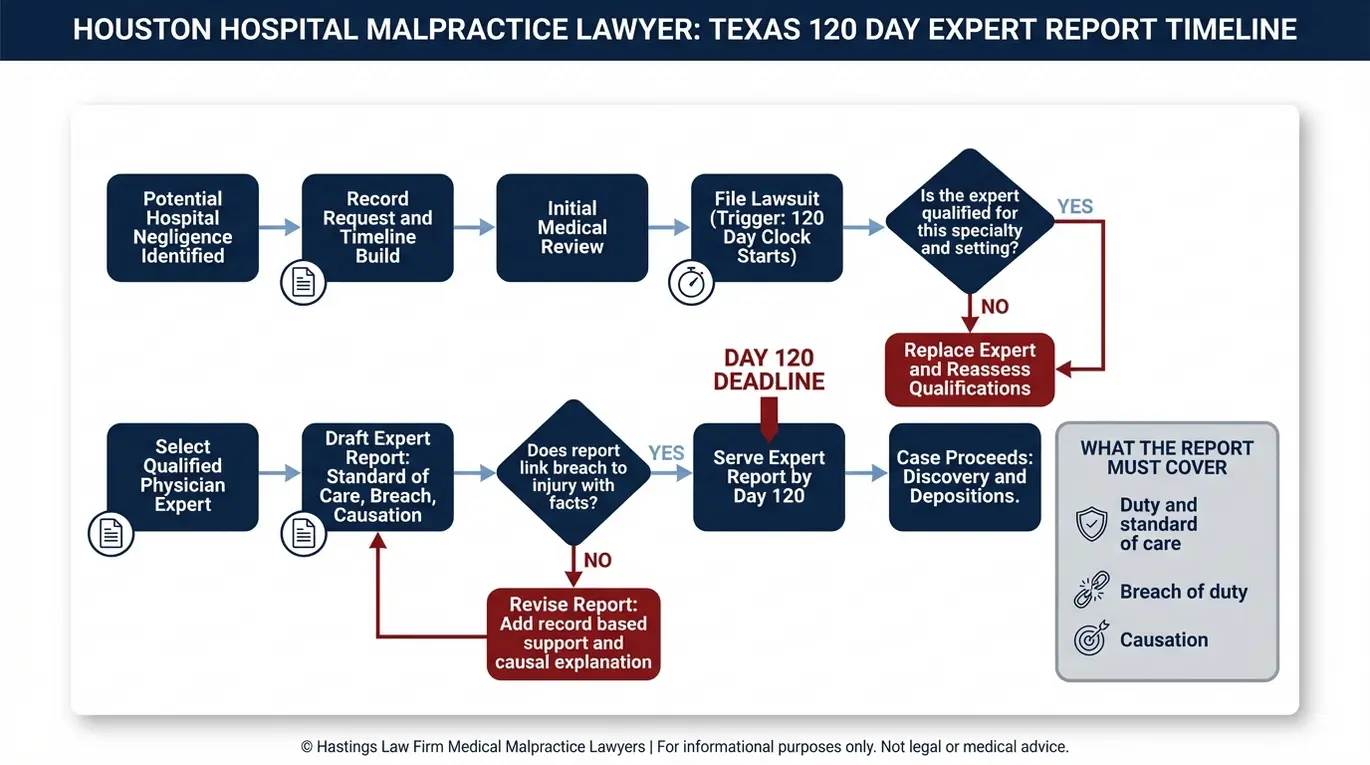
To move a hospital negligence case forward in Texas, you must serve a detailed expert report from a qualified physician within 120 days after the defendant files its original answer, or the court will dismiss the case with prejudice. This requirement, established under Texas Civil Practice and Remedies Code Section 74.351, is one of the most demanding procedural hurdles in the country, and it exists to screen out claims that lack medical merit before the case advances. Sometimes called a certificate of merit, the report has to do four things.
- Identify a qualified expert. The physician who authors the report must have relevant clinical experience in the same field as the defendant.
- Define the applicable standard of care. The report must state what a reasonably competent hospital or provider should have done under the same circumstances.
- Establish the breach. It must identify the specific acts or omissions that fell below that standard.
- Connect the breach to the injury. It must explain how the breach directly caused or contributed to the patient’s harm.
Because the deadline runs from the defendant’s answer and cannot be missed by even a day, hospital negligence cases are handled differently than a general personal injury practice. Firms that focus on this work maintain established relationships with qualified experts across medical specialties, which is what makes it possible to build a credible report on a tight timeline.
What Compensation Can You Recover, and How Do Texas Caps Work?
Patients harmed by hospital negligence in Texas can recover economic damages for measurable financial losses and non-economic damages for the human cost of the injury, though Texas law caps part of that recovery. Economic damages cover past and future medical care, lost wages and earning capacity, home modifications, and other out-of-pocket costs, and they are not subject to any statutory cap. Non-economic damages cover pain and suffering, mental anguish, and loss of enjoyment of life.
Under Texas Civil Practice and Remedies Code Chapter 74, non-economic damages against a single hospital are capped at $250,000 per claimant. When more than one institution is at fault, those institutional caps together reach $500,000, and a separate $250,000 cap applies to the individual physicians named, for a maximum of $750,000 in non-economic damages across every defendant. Because the cap limits non-economic recovery, documenting the full economic cost of an injury becomes even more important, which is why we work with medical and financial experts to project the lifetime cost of a serious injury. When a hospital error causes a death rather than an injury, a different limit applies to those claims, and our wrongful death from medical malpractice guide explains how it is calculated.
When the Hospital is a Government Entity Under the Texas Tort Claims Act
If the hospital where you were harmed is operated by a governmental entity, a different set of rules applies and the clock moves faster. Chapter 101 of the Texas Civil Practice and Remedies Code, the Texas Tort Claims Act, governs claims against a state agency, a county hospital district, or a municipality, and it adds requirements on top of the standard malpractice rules. The most important is notice. Under Section 101.101, a claimant generally must give written notice within six months of the injury, far shorter than the standard deadline, unless the governmental unit already had actual notice.
Damages are also capped differently depending on the type of entity involved.
| Entity Type | Cap Per Person | Cap Per Occurrence |
|---|---|---|
| State government (for example, a state university hospital system) | $250,000 | $500,000 |
| Unit of local government (for example, a county hospital district) | $100,000 | $300,000 |
| Municipality | $250,000 | $500,000 |
Houston patients most often encounter this framework at institutions connected to the UT System, such as MD Anderson, and at Harris Health System, the county hospital district that operates Ben Taub. Determining which category applies, and whether the notice deadline has already started running, is not something to guess at on your own.
How Long Do You Have to File a Hospital Negligence Claim in Texas?
The deadline for filing a hospital negligence lawsuit in Texas is generally two years from the date of the negligent act or the completion of the related treatment. Missing that deadline can permanently bar your claim no matter how strong the evidence is. The two-year window is set by Texas Civil Practice and Remedies Code Section 74.251, and unlike some other injury claims, Texas medical malpractice does not apply a general discovery rule that restarts the clock when an injury is found later.
In narrow situations where an injury could not reasonably have been discovered within the two-year period, the open-courts provision of the Texas Constitution may offer limited relief, but never past the statute of repose, which bars any claim brought more than 10 years after the negligent act. Minor children under age 12 have until their 14th birthday to file, while children who are already 12 or older follow the standard two-year rule. There is one tool that buys real time. Under Section 74.051, giving the required written notice at least 60 days before filing tolls the two-year deadline for an additional 75 days. Because these deadlines are strict and the exceptions are narrow, contacting a Houston hospital negligence lawyer early protects your right to file.
Time-sensitive: Because Texas also requires a 60-day pre-suit notice before filing a hospital lawsuit, the effective window for taking action is even shorter than two years. Contact a Houston hospital malpractice lawyer as early as possible to protect your right to file.
What Evidence Preserves a Houston Hospital Negligence Lawsuit?
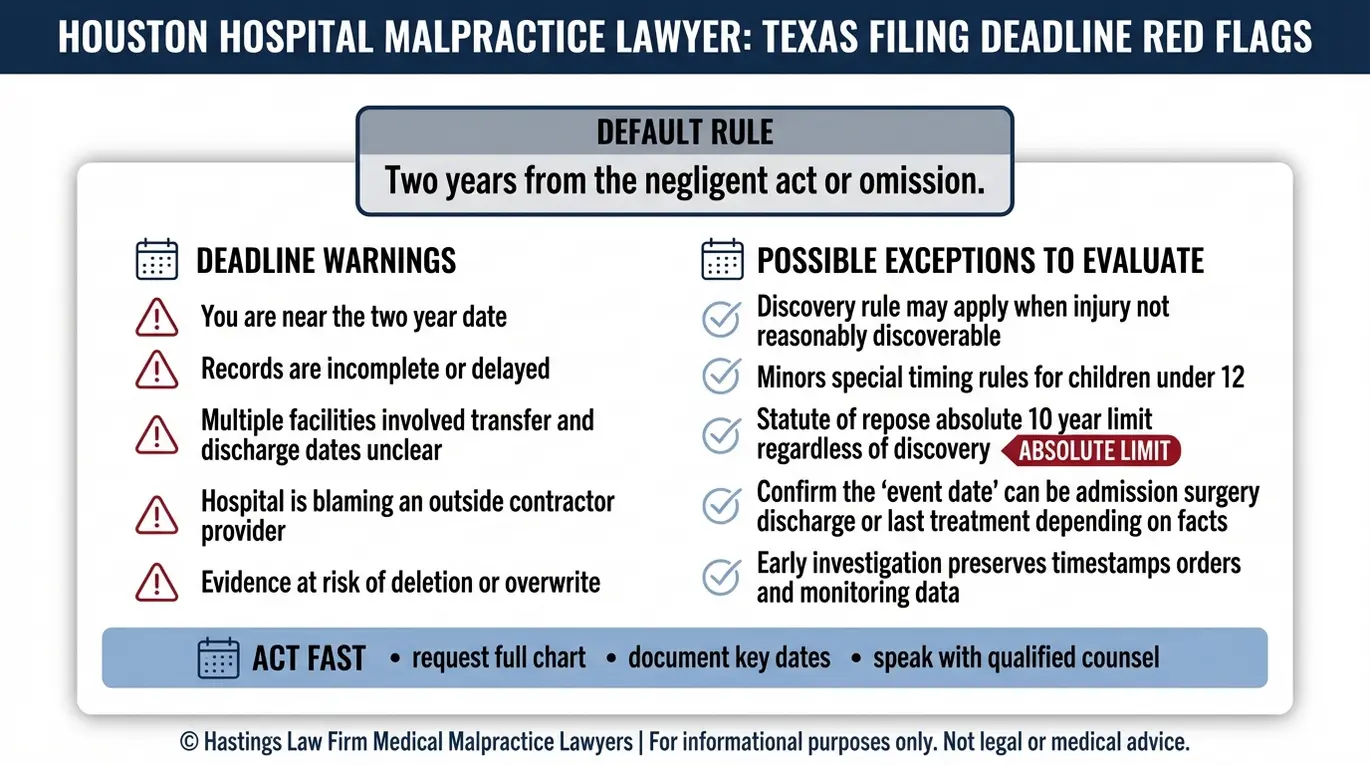
Hospital negligence cases depend on records that are created in real time and that can be lost, altered, or overwritten if they are not preserved quickly. Building a strong case starts with locking down that evidence early.
- Medical records. The complete chart, not just the discharge summary, showing every note, order, and result from the admission.
- Medication administration records. What was given, when, and by whom, which can reveal a dosing or timing error.
- Nursing notes and shift-change documentation. What staff observed, and whether a change in the patient’s condition was escalated.
- Electronic monitoring data. Cardiac, fetal, and ventilator logs often capture warning signs in real time.
- Credentialing files. Particularly important in contractor-physician claims, showing what the hospital knew before granting privileges.
- Staffing records. Nurse-to-patient ratios and coverage levels at the time of the harm, which can support an institutional-negligence claim.
Our in-house medical professionals, board-certified patient advocates, and former defense attorneys review the complete record before we evaluate whether a case has merit. We do not file a hospital negligence claim based on a chart summary, and our record of multimillion-dollar verdicts and settlements reflects what thorough review can uncover. Past results never guarantee a similar outcome for a future client.
Talk to a Houston Hospital Negligence Attorney About Your Case
If a Houston hospital’s own failures, not just a single provider’s mistake, contributed to your injury or the loss of someone you love, you deserve a clear answer about what happened. We will read what the complete record actually shows, walk you through whether the hospital, a contractor physician, or both may be responsible, and give you an honest assessment, even when the answer is that we cannot help. Founder Tommy Hastings is Board Certified in Personal Injury Trial Law by the Texas Board of Legal Specialization, a distinction held by less than 2% of Texas attorneys, and our team of former defense attorneys and in-house medical professionals has focused on medical malpractice exclusively since 2005.
We handle hospital negligence cases on a contingency fee basis, so there is no fee up front and nothing owed unless we recover for you. The White Coat Effect may tell you to stay quiet, but your health and your family’s future deserve honest answers. Call Hastings Law Firm or contact us online to schedule your free, confidential case review.
Frequently Asked Questions About Houston Hospital Negligence


This content was researched and written by the Hastings Law Firm editorial team, which includes attorneys, medical professionals, and experienced researchers. Our writing is informed by internal knowledge and practical experience, and we cross-check critical details against authoritative sources cited throughout. Every piece undergoes human-led fact-checking and legal review. Because legal and medical information can change, if you spot an error, please contact us. Learn more about our content standards and review process on our editorial policy page.

Tommy Hastings, founder of Hastings Law Firm, is a board-certified personal injury trial lawyer (by the Texas Board of Legal Specialization) dedicated exclusively to healthcare injury cases. Since 2001, he has represented injured patients and families in litigation against major hospital systems, pharmaceutical companies, and negligent healthcare providers nationwide. He has handled numerous high-profile cases that have drawn national media attention and resulted in multi-million dollar recoveries.
