


Mayo Clinic Hospital Phoenix Malpractice Lawyer
Hastings Law Firm represents patients and families in hospital malpractice claims over care at Mayo Clinic Hospital in Phoenix, Arizona. A claim there can name the hospital, a nurse or other member of its staff, or any physician who took part in the patient’s care. When medical care goes wrong, a patient and their family can be left with a serious injury, a longer recovery, or the loss of a loved one. Finding out what happened and who should be held accountable takes attorneys who understand medicine as well as they understand the courtroom. At Hastings Law Firm, medical malpractice is all we do!
Last Updated: September 28, 2026
Trial-Ready Hospital Negligence Attorneys for Mayo Clinic Hospital Patients and Families
Hastings Law Firm’s hospital negligence lawyers bring experienced representation to Mayo Clinic Hospital patients and families in Phoenix, Arizona. Our founder, Tommy Hastings, is Board Certified in Personal Injury Trial Law and has represented injured patients since 2001. Several of our lawyers are former malpractice defense attorneys who understand the tactics hospitals use to deny liability.
Knowing those tactics lets us answer them from the first weeks of a case. When a patient’s care passed through several specialists, our attorneys turn to a nationwide network of medical experts and match each provider with a physician from the same field. We prepare every case as if it were going to trial, and that preparation has brought multimillion-dollar settlements and record-setting verdicts for the families we represent. Those results come from a firm that has been dedicated exclusively to medical malpractice since 2005.
Call us now for a free, confidential case review. We will listen to what happened, investigate your claim, and explain your options.

The Types of Mayo Clinic Hospital Lawsuits Our Hospital Malpractice Attorneys Handle
Hastings Law Firm handles Mayo Clinic Hospital lawsuits in Phoenix, Arizona, over organ transplant care, heart, brain and spine surgery, and monitoring in intensive care. Our hospital malpractice lawyers build each lawsuit from the operative, intensive care and follow-up records. We use those pages to show where the care fell below the standard and what the harm has cost the patient and family.
The cases we see most often at a Phoenix specialty hospital with transplant and complex surgery programs like Mayo Clinic Hospital include:
- Transplant surgery and post-transplant care errors. A mistake can happen during the operation itself, or signs of rejection, infection or a failing graft can go unanswered in the weeks that follow. A new organ that could have been saved may be lost, and the patient may face another transplant or a life-threatening decline. Our Arizona transplant surgeon malpractice lawyers trace the operative record, the lab trends and the follow-up visit notes from start to finish.
- Heart, chest, brain and spine operations that go wrong. A technical error in the operating room, or a complication that nobody recognizes during recovery, can cause lasting damage. For these patients that can mean paralysis, a stroke, or organ damage that changes daily life. Our Phoenix surgical error lawyers compare the surgeon’s report with the anesthesia chart and the first days of recovery notes.
- Monitoring failures in intensive care and after surgery. A patient’s decline can go unnoticed, or a nurse’s warning can go unanswered, until the chance to treat it has passed. Delays like these can turn a manageable problem into brain injury, organ failure, or the loss of the patient. Our Arizona postoperative malpractice attorneys line up heart rate and oxygen readings, alarm times and call logs against the orders given in response.
While these are among the more common claim types, our hospital malpractice attorneys handle any valid medical negligence case that arises at this hospital.
The Hastings Law Firm Difference
Results matter, but what truly sets us apart is how we achieve them. Every verdict, every settlement, and every Phoenix courtroom victory comes from one guiding promise: To treat each client’s fight for justice as if it were our own.
This balance of skill, experience, and empathy reflects our core philosophy that justice should not only compensate the injured, but also make health care safer nationwide.

About Mayo Clinic Hospital on Mayo Clinic’s Phoenix Campus
Mayo Clinic Hospital is part of nonprofit Mayo Clinic and stands at 5777 E. Mayo Boulevard in Phoenix, Arizona, providing inpatient medical and surgical specialty care. Mayo Clinic keeps separate Phoenix and Scottsdale campuses, and the hospital belongs to the Phoenix campus. Mayo Clinic’s 2025 community health assessment places the hospital in Maricopa County, with an emergency department open 24 hours a day.
Surgical specialties make up a large part of the hospital’s work. Mayo Clinic’s heart and chest surgeons operate in Arizona, and its neurosurgery department, based at the Phoenix hospital, performs brain, spine and nervous system procedures. Mayo Clinic’s orthopedic surgery practice in Arizona offers spine surgery as well. The general surgery team in Phoenix uses advanced laparoscopic and robotic platforms for abdominal wall, bariatric, gastrointestinal, reflux, hernia and gallbladder operations.
The hospital houses a transplant center, and Mayo Clinic’s internal medicine residency, which rotates at Mayo Clinic Hospital in Phoenix, describes active heart, lung, liver, pancreas and kidney transplant programs. The same program trains residents in inpatient and outpatient oncology. Proton beam therapy is available on the Phoenix campus as well.
Critically ill patients are treated in intensive care units that include cardiovascular and thoracic, medical and surgical ICU care, with patients recovering from heart and chest operations among them. Physicians also train here, including through a pulmonary and critical care fellowship and with medical students from the Arizona campus of the Mayo Clinic Alix School of Medicine. Other Phoenix hospitals include Banner – University Medical Center Phoenix and St. Joseph’s Hospital and Medical Center.
Can You File a Lawsuit Against Mayo Clinic Hospital in Phoenix, the Doctor, or Both?
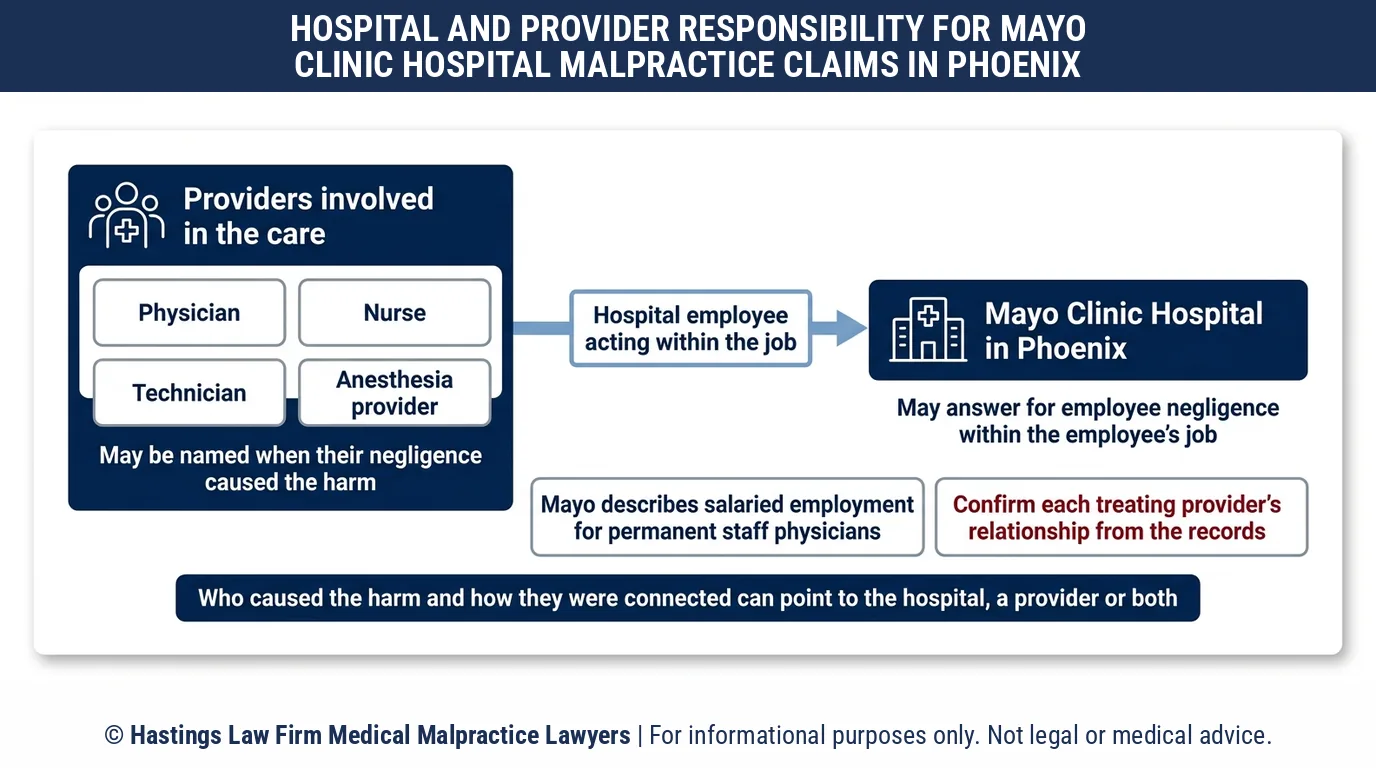
You may be able to file a lawsuit against Mayo Clinic Hospital in Phoenix, the physician who treated you, or both, depending on whose decisions caused the harm. Under Kopp v. Physician Group of Arizona, an employer answers for its employees’ negligent work, so a hospital is responsible for staff acting within their jobs. A nurse, a technician or an anesthesia provider can be named as well.
That rule reaches only true employees, and how each provider was connected to the hospital decides who belongs in the case. Mayo Clinic’s own report on physician pay describes a salary-based employment model for its permanent staff physicians, including those in Arizona. That description does not settle who employed every clinician who treated a particular patient, so we confirm each relationship from the records. The answer tells a family whether they need a lawyer to sue a hospital, an individual provider, or both.
Before the case goes far, Arizona law calls for a sworn opinion from a medical expert. Under A.R.S. 12-2603, the patient certifies whether expert testimony is needed and, if it is, serves a preliminary expert opinion affidavit early in the lawsuit. Our Phoenix hospital malpractice lawyers explain how that affidavit and employee liability shape claims against hospitals in the area.
What Kind of Medical Expert Does a Mayo Clinic Hospital Lawsuit Need in Arizona?
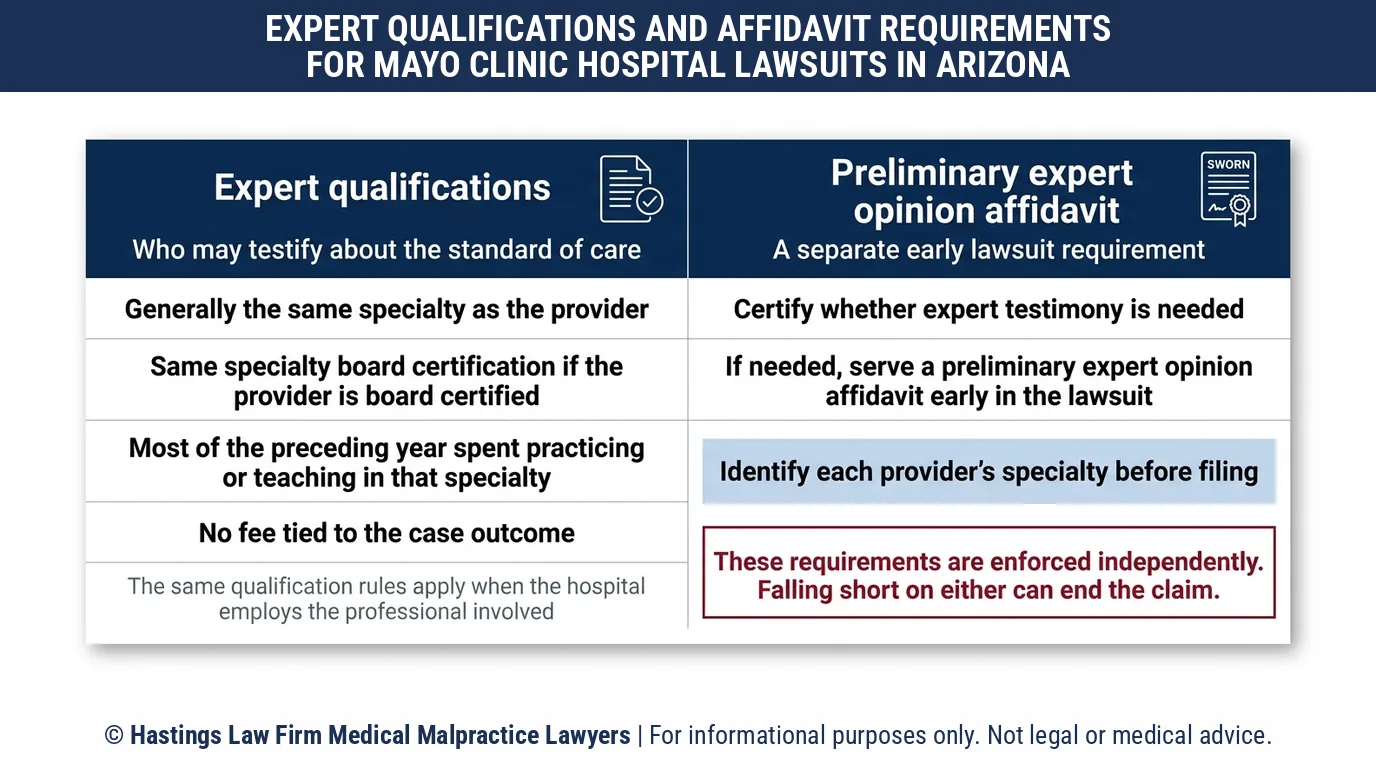
A Mayo Clinic Hospital lawsuit in Arizona generally needs a medical expert who practices in the same specialty as the provider whose care is being questioned. If that provider is board certified, the expert must hold board certification in the same specialty. Those rules come from A.R.S. 12-2604, and they decide who is allowed to testify about the standard of care.
Care at Mayo Clinic Hospital in Phoenix can involve highly specialized fields such as transplant surgery, cardiothoracic surgery and neurosurgery. In a claim about one of those operations, the expert generally has to come from the surgeon’s own specialty. That expert must also have spent most of the year before the injury practicing or teaching in it. The expert cannot be paid a fee that depends on the outcome. When the hospital employs the professional involved, the same rules apply as if that professional were the defendant.
The preliminary expert opinion affidavit is a separate requirement that comes earlier in the case. In Rasor v. Northwest Hospital, the Arizona Supreme Court held that the affidavit and the qualification rule are enforced independently. Falling short on either one can end a patient’s claim.
For a patient, these rules mean a claim can end before anyone weighs what happened if the wrong expert signs the affidavit or testifies. That makes the specialty of every provider involved the first question to settle, before a lawsuit is filed. Our firm draws on a nationwide network of medical experts to match each provider with a physician from the same field.
How We Work With Injured Mayo Clinic Hospital Patients and Their Families
Hastings Law Firm represents Mayo Clinic Hospital patients and families in Phoenix, Arizona, in hospital malpractice claims from the first call to a settlement or verdict. Our firm is dedicated exclusively to medical malpractice, and our attorneys and medical professionals take each family through every stage of the claim.
A call about treatment at Mayo Clinic Hospital in Phoenix connects you with a member of our intake team. When the patient is too ill or injured to talk, a spouse, parent or grown child can call instead. Share what you remember about the treatment, the providers involved and what the family was told. Our team works to make sure you are heard, and that account is where our work begins.
We request the complete medical records on your family’s behalf. Our attorneys and medical professionals study the surgical notes, the intensive care flow sheets and the medication records to learn what was done and what was left undone. If our hospital negligence lawyers accept your case, it is built on that record and on specialists who can explain it to a jury.
From then on, our attorneys handle every exchange with the hospital, its insurer and its defense lawyers. Our board-certified patient advocates stay in contact with you, explain each development in plain terms when it happens, and answer your questions along the way. Our hospital malpractice attorneys pursue a settlement that reflects the full cost of the injury to your family. When an offer falls short, we are prepared to take your case to a jury.
If You or a Loved One Were Injured at Mayo Clinic Hospital Phoenix, Speak With Our Medical Attorneys Today
Hastings Law Firm represents patients and families in Phoenix, Arizona, in hospital negligence claims after treatment at Mayo Clinic Hospital left them injured or worse off. Our lawyers will look closely at what happened and tell you who may be responsible. If the records point to a risk that careful treatment could not have prevented, we will tell you that plainly.
Our team is here for you. We perform a free case review to find out whether you have a valid claim, and our Phoenix medical malpractice lawyers keep that conversation confidential. There is no fee unless we win. Contact us to understand your options.
Mayo Clinic Hospital Phoenix Malpractice FAQs


This content was researched and written by the Hastings Law Firm editorial team, which includes attorneys, medical professionals, and experienced researchers. Our writing is informed by internal knowledge and practical experience, and we cross-check critical details against authoritative sources cited throughout. Every piece undergoes human-led fact-checking and legal review. Because legal and medical information can change, if you spot an error, please contact us. Learn more about our content standards and review process on our editorial policy page.

Tommy Hastings, founder of Hastings Law Firm, is a board-certified personal injury trial lawyer (by the Texas Board of Legal Specialization) dedicated exclusively to healthcare injury cases. Since 2001, he has represented injured patients and families in litigation against major hospital systems, pharmaceutical companies, and negligent healthcare providers nationwide. He has handled numerous high-profile cases that have drawn national media attention and resulted in multi-million dollar recoveries.
