


William P. Clements Jr. University Hospital Dallas Malpractice Lawyer
For patients and families harmed during care at William P. Clements Jr. University Hospital in Dallas, Texas, Hastings Law Firm pursues hospital malpractice claims. Those claims can be brought against the hospital, the nurses and other staff it employs, the treating physicians, or more than one of them. When medical care goes wrong, a patient and their family can be left with a serious injury, a longer recovery, or the loss of a loved one. Finding out what happened and who should be held accountable takes attorneys who understand medicine as well as they understand the courtroom. At Hastings Law Firm, medical malpractice is all we do!
Last Updated: September 28, 2026
Trial-Ready Hospital Negligence Attorneys for William P. Clements Jr. University Hospital Patients and Families
Hastings Law Firm’s hospital negligence lawyers bring experienced representation to William P. Clements Jr. University Hospital patients and families in Dallas, Texas. Our founder, Tommy Hastings, has represented injured patients since 2001 and is Board Certified in Personal Injury Trial Law. Our lawyers also include former malpractice defense attorneys who understand the tactics hospitals use to deny liability.
Knowing those tactics lets us anticipate and answer a hospital’s defense before it is ever raised. We call on a nationwide network of medical experts, physicians able to show what safe treatment looked like for each patient. Every case is prepared as if it were going to trial, and that preparation has resulted in multimillion-dollar settlements and record-setting verdicts for injured patients and their families. Those results come from a firm that has been dedicated exclusively to medical malpractice since 2005.
Call us now for a free, confidential case review. We will listen closely, investigate your claim, and explain your options.
The Types of Clements University Hospital Lawsuits Our Hospital Malpractice Attorneys Handle
In Dallas, Texas, Hastings Law Firm brings William P. Clements Jr. University Hospital lawsuits over surgery and transplantation, neurological and neuro ICU care, and maternity and newborn intensive care. Our hospital malpractice lawyers open each lawsuit by obtaining the full medical record and the physicians qualified to interpret it. We use both to show which decisions fell below the standard of care and how the patient was harmed.
The cases we see most often at a university hospital like William P. Clements Jr. University Hospital include:
- Surgical and transplant errors. An operation or an organ transplant can go wrong through a technical mistake, or a complication in the days that follow can be missed while it is still treatable. The patient may face another operation, a longer admission, and additional recovery time. Working from the operative notes and every post-operative check, our Dallas surgical malpractice attorneys find where the problem should have been caught.
- Neurological and neuro ICU care failures. A change in a patient’s neurological condition can go unrecognized, or the close monitoring a neuro ICU patient needs can lapse. Lost time with a brain or spinal cord condition can mean lasting loss of movement, speech, or independence. Our Dallas nurse malpractice lawyers compare the neurological checks and nursing flowsheets with the physician orders to show when a change was charted and who was told.
- Maternity and newborn intensive care errors. A complication of pregnancy or childbirth can go unaddressed, or a newborn in intensive care can decline without a timely response. Harm at the start of life can bring years of therapy and medical care for a child and the whole family. Our Dallas birth injury attorneys read the maternity and NICU charts together to pinpoint where a warning sign went unanswered.
While these are common claim types, our hospital malpractice attorneys handle any valid medical negligence case that arises at this hospital.
The Hastings Law Firm Difference
Results matter, but what truly sets us apart is how we achieve them. Every verdict, every settlement, and every Dallas courtroom victory comes from one guiding promise: To treat each client’s fight for justice as if it were our own.
This balance of skill, experience, and empathy reflects our core philosophy that justice should not only compensate the injured, but also make health care safer nationwide.

About William P. Clements Jr. University Hospital, UT Southwestern’s Teaching Hospital in Dallas
William P. Clements Jr. University Hospital is a UT Southwestern Medical Center hospital at 6201 Harry Hines Boulevard in Dallas, Texas. UT Southwestern is a component institution of The University of Texas System, and the medical center describes Clements as a teaching hospital. The hospital’s services range from emergency and surgical care to transplant, neurologic, heart, and maternity care.
The hospital’s third tower includes a newly expanded Emergency Department, according to the Clements hospital page. Clements calls itself a Level IV Basic Trauma Facility, a designation that also appears on the Texas trauma facility roster.
Maternity Care and a Neonatal Intensive Care Unit (NICU) are among the services the hospital lists. The Texas Department of State Health Services records Clements as a Level IV maternal facility and as a Level III neonatal facility.
Clements also lists Surgical Care, Transplant Services, Neurologic Care, a Neuro ICU, and Heart Care. Zale Lipshy Pavilion, which UT Southwestern calls a rehabilitation treatment center, has its own address at 5151 Harry Hines Blvd., and its page carries the William P. Clements Jr. University Hospital name.
A single patient’s treatment can pass from the Emergency Department to an operating room, the Neuro ICU, or a separately addressed location, and each unit keeps its own records. Our firm reads records like these for families across the city, including at other Dallas hospitals such as Baylor University Medical Center and Medical City Dallas Hospital.
Can You File a Lawsuit Against William P. Clements Jr. University Hospital, the Doctor, or Both?
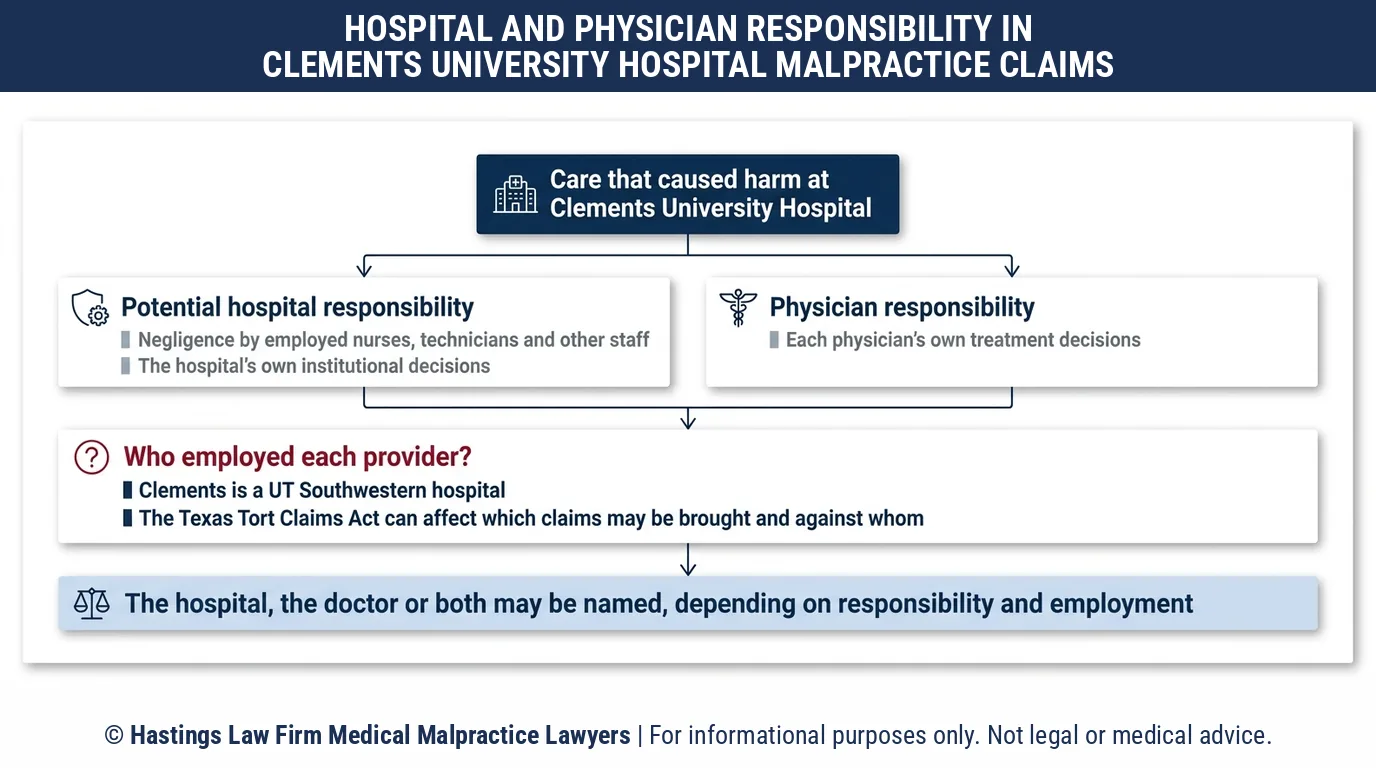
A lawsuit may name William P. Clements Jr. University Hospital, a doctor, or both, depending on whose care caused an injury and who employed each provider. Under Section 74.351 of the Texas Civil Practice and Remedies Code, the claim needs an expert report within 120 days after each defendant files an answer.
A hospital can be held responsible for negligence by nurses, technicians, and other staff on its payroll, and separately for its own institutional decisions. Each physician is responsible for their own treatment of the patient, and the hospital’s place in a public university system adds one more question.
Clements is a UT Southwestern hospital, so the Texas Tort Claims Act can shape which claims are brought and against whom. Who employed each nurse, physician, and technician therefore has to be established before anything is filed. That question is the starting point for a lawyer to sue a hospital.
Only certain kinds of claims get past the university’s immunity. Section 101.021 allows one when an injury comes from an employee operating a motor vehicle or motor-driven equipment, or from the condition or use of tangible personal or real property. In McCall v. Dallas County Hospital District, a Texas appeals court held that not using a monitored bed, oxygen equipment, or a heart monitor fell outside that rule. The facts of how the injury happened matter from the first review.
Medicine carries risk, and a poor outcome is not always negligence. When an injury could have been prevented, the providers responsible should be held accountable. Tracing that responsibility through many providers is work our Dallas hospital malpractice lawyers do on every claim.
What Notice Deadlines Apply to a Malpractice Claim Against Clements University Hospital in Texas?
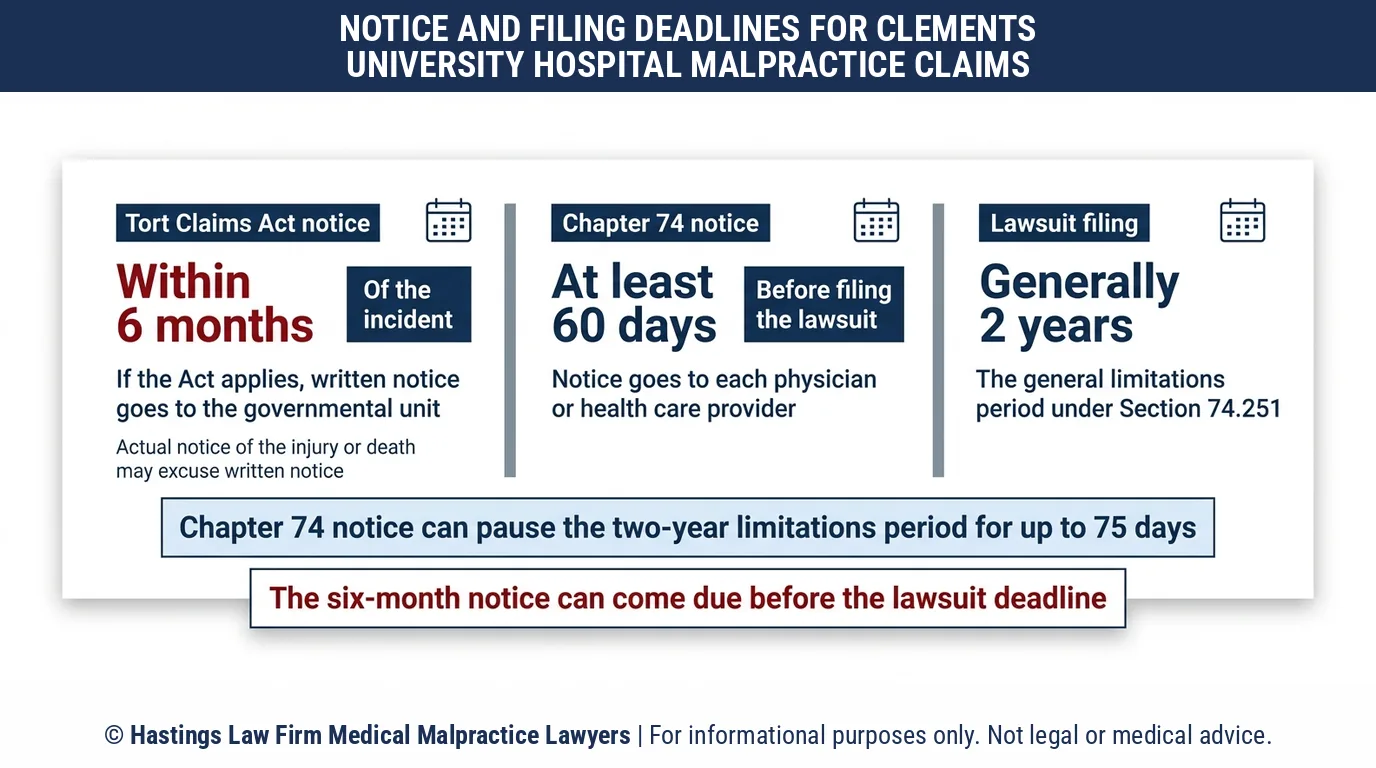
Written notice is due within six months of the incident when a claim over care at William P. Clements Jr. University Hospital is brought under the Texas Tort Claims Act. That deadline comes from Texas Civil Practice and Remedies Code Section 101.101. Chapter 74 separately requires notice to each provider at least 60 days before a lawsuit is filed.
The six-month notice goes to the governmental unit. It has to give a reasonable description of what happened, when and where it happened, and the injury that resulted. Section 101.101 excuses the notice when the unit already had actual notice, meaning it was actually aware of the injury or death, of the people involved, and that its own fault may have contributed to it.
The Chapter 74 notice applies to any health care liability claim, the legal term for a medical malpractice claim. It goes by certified mail to each physician or health care provider, together with an authorization form for the release of medical records. Giving it tolls, or pauses, the two-year limitations period for up to 75 days.
The lawsuit itself is generally due within two years under Section 74.251. Two notices with different clocks can therefore apply to one claim, and the six-month notice runs out first. Acting early gives a family room to meet both.
How We Work With Injured Clements University Hospital Patients and Their Families
In Dallas, Texas, Hastings Law Firm’s hospital malpractice lawyers represent patients and relatives when treatment at William P. Clements Jr. University Hospital led to an injury or a loss. Our Dallas medical malpractice lawyers gather the records, retain the medical experts, and send the required notices on a family’s behalf.
Your first conversation is with a member of our intake team, and a spouse, parent, or adult child may phone for a patient still recovering. Share what you recall about the treatment, the dates, and the providers. Our team works to make sure you are heard, since your account shapes everything we look at next.
Next, our team orders every page of the chart on your behalf. Attorneys and medical professionals at our firm go through the emergency, operative, transplant, Neuro ICU, and maternity records to learn what each provider did and at what point. Once our hospital negligence lawyers accept a case, that record and the physicians who can interpret it become its foundation.
From then on, the hospital, its insurance carrier, and its defense counsel deal with us, not with you. Our board-certified patient advocates keep in touch whenever something noteworthy happens and put each development in plain language. Our hospital malpractice attorneys pursue a settlement that matches the full cost of the harm. When no offer reaches that point, we are prepared to take your case to a jury.
If You or a Loved One Were Injured at Clements University Hospital, Speak With Our Medical Attorneys Today
Hastings Law Firm takes on claims in Dallas, Texas, for patients harmed at William P. Clements Jr. University Hospital and for their families. Our hospital negligence lawyers examine the care, identify each provider who may be responsible, and track the notice deadlines that can apply to a claim involving a university hospital.
Our team is here for you. We perform a free case review to find out whether you have a valid claim, and what you tell us stays confidential. You pay no fee unless we win. Let us help you find the answers you deserve.
Clements University Hospital Malpractice FAQs


This content was researched and written by the Hastings Law Firm editorial team, which includes attorneys, medical professionals, and experienced researchers. Our writing is informed by internal knowledge and practical experience, and we cross-check critical details against authoritative sources cited throughout. Every piece undergoes human-led fact-checking and legal review. Because legal and medical information can change, if you spot an error, please contact us. Learn more about our content standards and review process on our editorial policy page.

Brady D. Williams is a nationally recognized medical malpractice attorney who has spent his career handling high-stakes litigation for injured patients and families across the country. Licensed in both Texas and California, Brady draws on experience from hundreds of resolved medical cases to break down complex legal and medical topics for the people who need that information most. His writing reflects the same attention to detail and commitment to clarity that he brings to every case he handles.
