


MD Anderson Cancer Center Malpractice Lawyer
Written by: Hastings Law Firm | Reviewed by: Tommy Hastings | Updated: September 21, 2026
For a patient already facing a serious illness, a preventable medical error at MD Anderson Cancer Center can bring new harm and added uncertainty for the family. Treatment at this hospital is delivered by many providers over time, and responsibility for a mistake may rest with one of them or with the institution. Finding out where that responsibility lies is often how a family begins to get clear answers. If you or a loved one were harmed or worse due to medical malpractice at MD Anderson Cancer Center in Houston, contact Hastings Law Firm for a free, confidential case review.
Top-Rated Hospital Negligence Lawyers for MD Anderson Patients and Families

A Health Care Focused Law Firm
Medical negligence at MD Anderson Cancer Center can mean a serious injury, additional recovery time, or the loss of a loved one. Medicine carries risk, and a bad outcome is not always negligence. When an injury or a loss was preventable, our MD Anderson hospital malpractice lawyers work to establish what went wrong and who is responsible.
Our firm has been dedicated exclusively to medical malpractice since 2005, and that focus matters in a claim against an institution of this size. Treatment here is planned by one team and carried out by others over a course of care that can run for months, and every department involved keeps its own record. Our attorneys and medical professionals are experienced at reading all of those records together as one account of what a patient received, from the first order to the last note.
Call us now for a free, confidential case review. Our team will listen to you, investigate your claim, and explain your options.
The Types of MD Anderson Lawsuits Our Hospital Malpractice Attorneys Handle
Our hospital malpractice lawyers represent patients harmed at MD Anderson Cancer Center, and we bring claims against the institution, the physicians and groups who practice there, and its staff. The cases we see most often at specialty cancer hospitals like MD Anderson include:
- Cancer surgery errors. A technical mistake during an operation, an injury that goes unrecognized in the operating room, or a breakdown in the handoff to the next team can cause lasting damage. Correcting it can take further surgery and additional recovery time, and it can push back the treatment that was planned next. Our Houston surgical malpractice lawyers read the operative report against the orders and nursing notes that follow it.
- Chemotherapy and radiation dosing errors. These treatments work within narrow margins, so a dose calculated wrong, a mix-up between drugs or patients, or radiation delivered to the wrong site can injure healthy tissue and organs. That harm can be permanent, and it can interrupt the treatment a patient was counting on. Our Houston medication error lawyers check the prescribing orders, the pharmacy records, and the treatment plan they were meant to follow.
- Infection and monitoring failures. Cancer treatment can leave a patient less able to fight an infection, which makes infection control and a quick response to an early warning sign matter more. A slow response can turn a treatable infection into critical illness or the loss of a family member. Our Houston hospital infection lawyers examine the monitoring records, the culture results, and how quickly staff acted on them.
While these are the more common claim types, our hospital malpractice attorneys handle any valid medical negligence case that arises at this hospital.
The Hastings Law Firm Difference
Results matter, but what truly sets us apart is how we achieve them. Every verdict, every settlement, and every Houston courtroom victory comes from one guiding promise: To treat each client’s fight for justice as if it were our own.
This balance of skill, experience, and empathy reflects our core philosophy that justice should not only compensate the injured, but also make health care safer nationwide.

About MD Anderson Cancer Center
The University of Texas MD Anderson Cancer Center is a cancer hospital in Houston and a component institution of the University of Texas System. The Texas Legislature created it under the Education Code. It is a public institution rather than a private hospital, and that is what decides which rules apply to a claim against it.
Its inpatient hospital sits on the Texas Medical Center campus in Houston and has more than 700 inpatient beds. MD Anderson is also one of the nation’s original three comprehensive cancer centers, designated under the National Cancer Act of 1971.
Its other locations around greater Houston are outpatient, and a claim can arise from care given at one of them as readily as from an admission at the main hospital. The current Houston-area locations are:
- MD Anderson Cancer Center (Texas Medical Center, the inpatient hospital)
- MD Anderson West Houston
- MD Anderson Sugar Land
- MD Anderson The Woodlands
- MD Anderson League City
- MD Anderson Proton Therapy Center
- MD Anderson Northwest Houston Surgical & Specialty Care
- Gynecologic Oncology Clinic at The Woman’s Hospital of Texas
Can You File a Lawsuit Against MD Anderson Cancer Center, the Doctor, or Both?
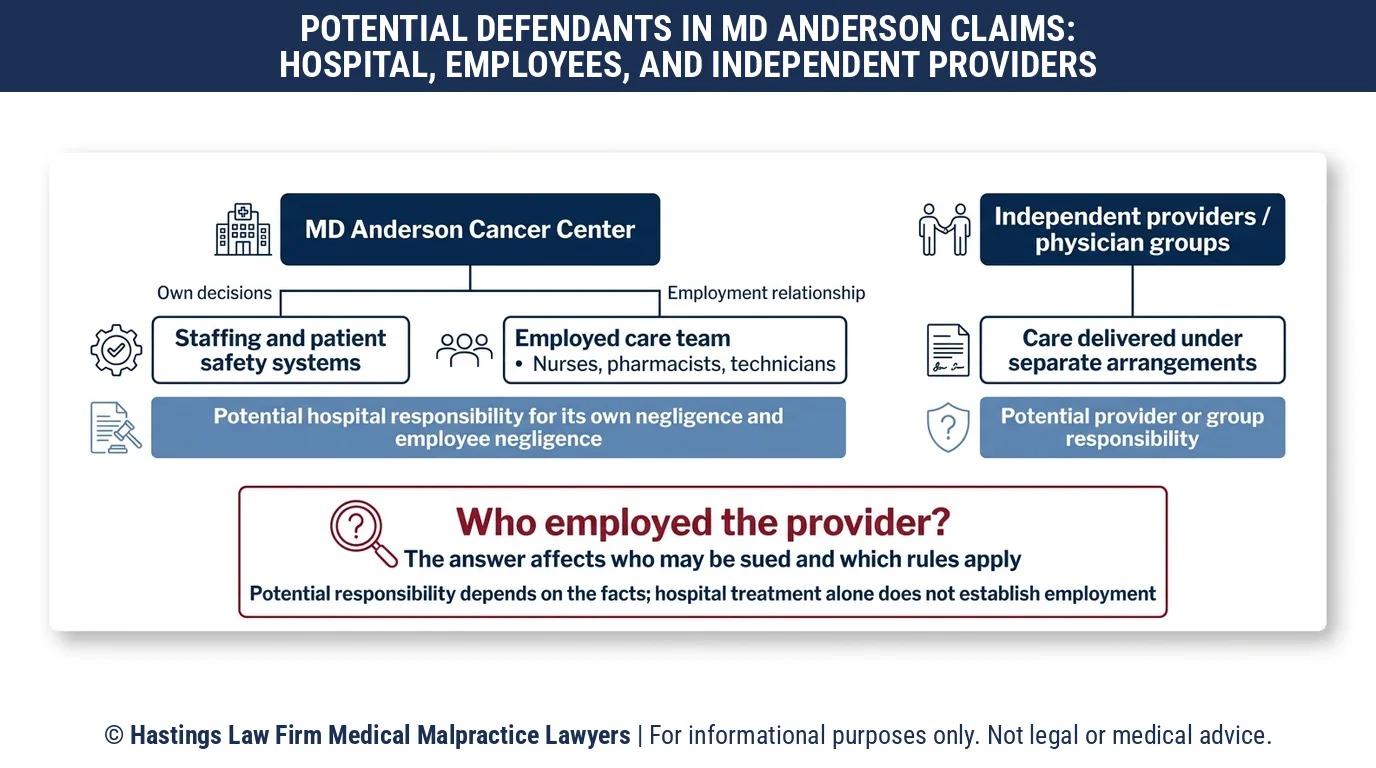
You may be able to file a lawsuit against MD Anderson Cancer Center, against an individual provider, or against both, depending on who was responsible and who employed them. A hospital answers for the negligence of the people it employs, including the nurses, pharmacists, and technicians who carry out a treatment plan. It answers separately for its own decisions, from staffing levels to the safety systems meant to protect patients.
Not every provider who treats a patient at a hospital is employed by it. Some work through their own groups or under other arrangements, and the answer is rarely obvious from a bill or a chart. That question decides who is named as a defendant and which set of rules governs the claim against each of them, which is why it is settled first.
Chapter 74 of the Texas Civil Practice and Remedies Code also requires a written report from a qualified medical expert early in the case. Whether you need a lawyer to sue a hospital, a physician’s group, or both, the work begins with identifying every health care provider or facility involved. Our Texas hospital negligence lawyers explain vicarious liability, corporate negligence, and how that report requirement works.
Is MD Anderson a Government Hospital, and How Does That Change a Malpractice Claim in Texas?
MD Anderson Cancer Center is a government hospital, and that changes the notice a patient has to give, the amount recoverable, and the choice of who is sued. It is part of the University of Texas System, which makes it a public institution. A claim arising from care there can fall under the Texas Tort Claims Act, Chapter 101 of the Texas Civil Practice and Remedies Code.
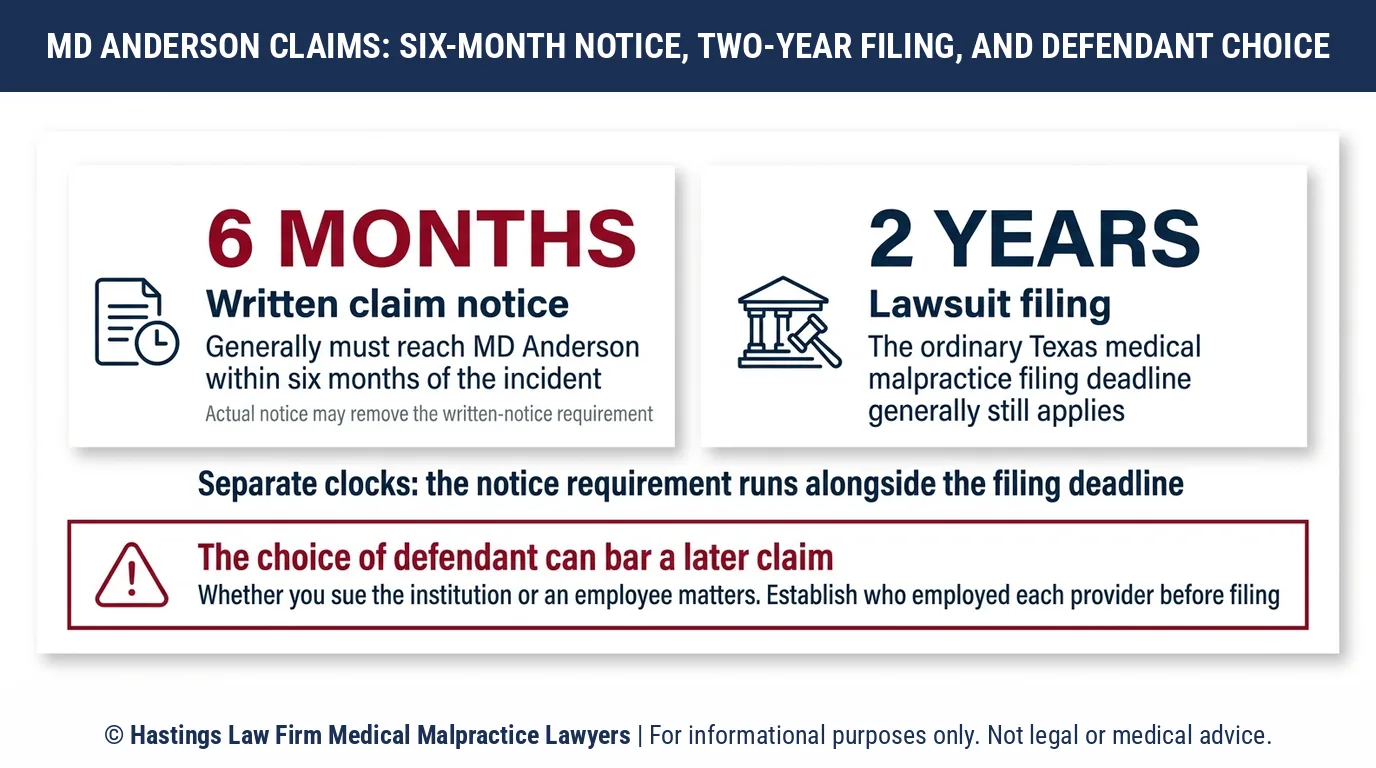
Written notice of the claim generally has to reach the institution within six months of the incident. That notice describes the injury, when and where it happened, and what happened. It is not required when the institution already had actual notice of the injury or death.
Six months is the deadline for the notice, not for the lawsuit. The ordinary two-year deadline to file a Texas medical malpractice case still applies, and the notice requirement runs alongside it rather than in place of it.
The Act also limits the damages that can be recovered, at amounts far lower than the limits in a claim against a private hospital. How the limit is set depends on how the institution is classified under the Act, so that classification is one of the first things our attorneys work out.
Who is sued matters just as much, because the Act makes that choice permanent. Suing the institution bars a later claim against an individual employee over the same care, and suing the employee bars the claim against the institution unless the institution consents. Establishing who employed each provider therefore comes before anything is filed.
Stricter rules and a shorter clock are a reason to have the conversation early, not a reason to assume nothing can be done. Our Houston hospital malpractice lawyers explain how the Act applies to a claim against a public hospital.
How We Work With Injured MD Anderson Patients
When you call about care at MD Anderson Cancer Center, you speak with a member of our intake team. A family member can call on behalf of a patient who is still in treatment. Share what happened and when, along with the names of the providers you remember. Our team works to make sure you are heard, and your account becomes the starting point for our review.
We request the complete medical records for you, and the review is built on them. Our attorneys and medical professionals compare the treatment plans, the medication and dosing orders, the operative notes, and the monitoring records. Read together, they show what was ordered, what was given, and where the care departed from the plan. When our hospital negligence lawyers accept a case, those records and the physicians who can interpret them become its foundation.
As your attorneys, we handle every contact with the hospital and the lawyers who represent it, so you never deal with them on your own. Our board-certified patient advocates stay in contact with you and explain each development in plain language as it happens. Our hospital malpractice attorneys press for a settlement that reflects what the harm has cost you and your family. When an offer falls short, we are prepared to take the case to a jury.
If You or a Loved One Were Injured at MD Anderson, Speak With Our Medical Attorneys Today
Our team is here for you if care at MD Anderson Cancer Center, or at one of its Houston-area locations, left you or someone you love worse off. Our hospital negligence lawyers will review what happened and tell you who may be responsible, and we will say so plainly when we believe a bad outcome was not malpractice.
We perform a free case review to find out whether you have a valid claim, and what you tell us stays confidential. You pay no fees or costs unless we win. Let us help you find the answers you deserve.
MD Anderson Cancer Center Malpractice FAQs


This content was researched and written by the Hastings Law Firm editorial team, which includes attorneys, medical professionals, and experienced researchers. Our writing is informed by internal knowledge and practical experience, and we cross-check critical details against authoritative sources cited throughout. Every piece undergoes human-led fact-checking and legal review. Because legal and medical information can change, if you spot an error, please contact us. Learn more about our content standards and review process on our editorial policy page.

Tommy Hastings, founder of Hastings Law Firm, is a board-certified personal injury trial lawyer dedicated exclusively to healthcare injury cases. Since 2001, he has represented injured patients and families in litigation against major hospital systems, pharmaceutical companies, and negligent healthcare providers nationwide. He has handled numerous high-profile cases that have drawn national media attention and resulted in multi-million dollar recoveries. He draws on that experience in his writing, helping readers understand how these cases work and what options may be available to them.
