


Houston Unnecessary Surgery Lawyer
Unnecessary surgery can leave lasting physical, emotional, and financial harm, especially when less invasive options were available and never meaningfully considered. Warning signs often involve missing conservative treatment, incomplete diagnostic testing, rushed scheduling, or an informed consent process that did not clearly address risks and alternatives. These situations can also reflect broader systemic pressures that prioritize procedure volume over individualized care. If you or a loved one were harmed or worse due to unnecessary surgery in Houston, Texas, contact Hastings Law Firm for a free, confidential case review.

Last Updated: July 27, 2026
Trusted Houston Malpractice Attorneys for Unneeded Medical Procedures
When you trust a surgeon’s recommendation only to learn later that the procedure may not have been medically necessary, the feeling goes beyond physical pain. It calls into question the very foundation of the doctor-patient relationship. Unnecessary surgery, any invasive procedure performed when a less invasive or equally effective treatment option existed, can leave lasting physical, emotional, and financial harm.
As a Houston unnecessary surgery lawyer, board-certified attorney Tommy Hastings and our team focus exclusively on medical malpractice and have the medical and legal resources to investigate whether a procedure met the accepted standard of care. We welcome you to contact us for a free, confidential case evaluation so we can review what happened and explain your options. We focus only on medical negligence cases to ensure our clients receive the full benefit of our specialized experience.

Identifying the Warning Signs of an Unnecessary Procedure
An unnecessary surgery claim may be valid when a physician recommends and performs an invasive procedure despite equally effective, less invasive conservative treatments, or when the decision to operate falls outside the standard of care, the accepted level of treatment a reasonably competent physician would provide under similar circumstances, for the patient’s specific diagnosis.
In Houston medical malpractice law, the standard of care is the benchmark for patient safety. One of the most telling indicators is the absence of conservative treatment before surgery. Conservative treatment includes non-surgical approaches like physical therapy, medication, or lifestyle changes. These are typically the first line of care for many conditions. Bypassing them without clear medical justification raises serious questions about whether surgery was warranted.
Informed consent violations can also signal a problem. Informed consent, the process ensuring the surgeon explained the risks, benefits, and alternatives to the procedure, means you agreed to move forward with a full understanding of your options. If alternatives were never discussed, or if the risks were minimized to encourage you to proceed, the consent process may not have met the required standard.
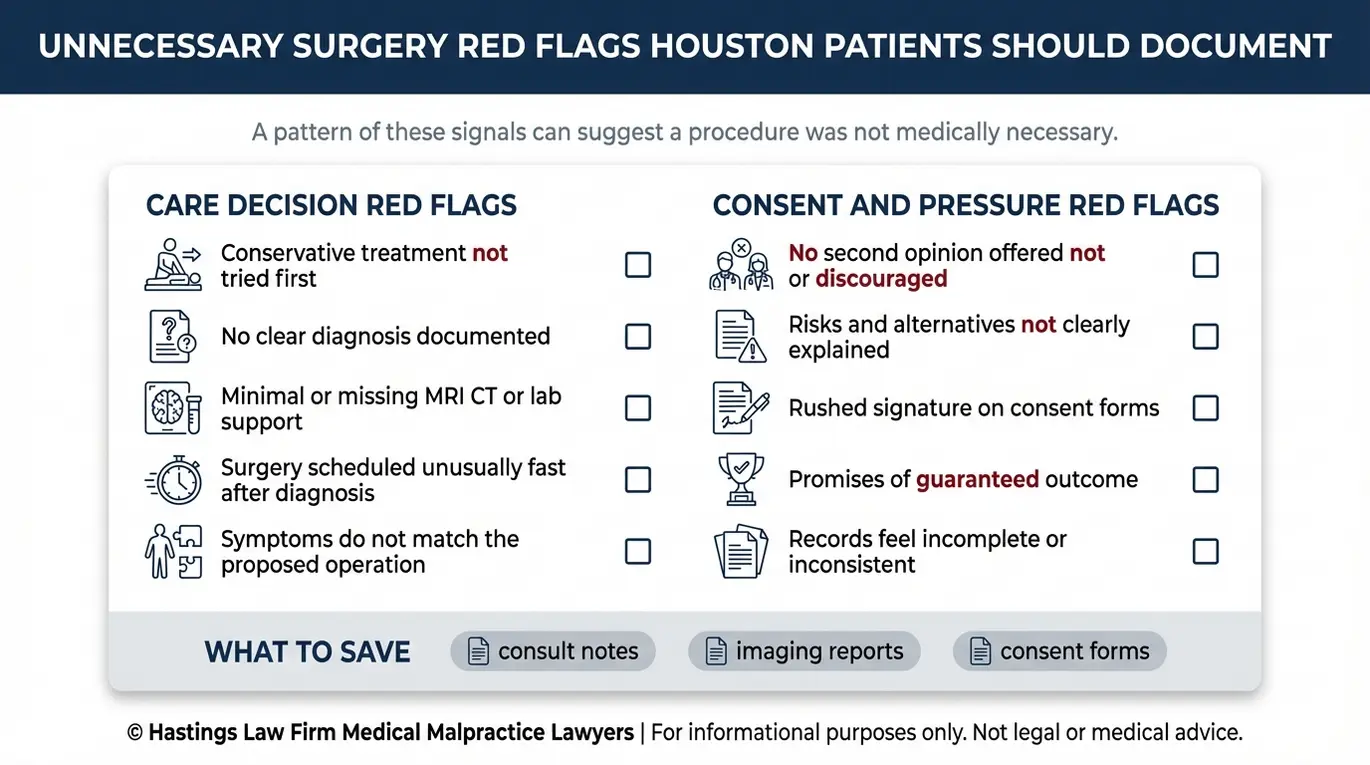
An unnecessary surgery attorney evaluates the full picture surrounding the decision to operate. Our team looks at the clinical record, the timeline, and the decision-making process to determine whether patient safety was compromised. We typically examine the following warning signs:
- No second opinion was offered or encouraged before scheduling the procedure
- The timeline between initial consultation and surgery was unusually short
- Diagnostic testing such as MRI or CT scans was incomplete or absent
- Conservative treatments were never attempted or documented
- The surgeon did not clearly explain risks, alternatives, or the option of no treatment
- The Pre-verification Checklist protocols recommended by institutions like Stony Brook Medicine were not followed
If several of these factors are present in your situation, it does not automatically confirm medical negligence, but it does warrant a closer look by a legal and medical team experienced in these claims.
Common Types of Unnecessary Surgeries Seen in Houston Hospitals
While any procedure can potentially be performed without adequate justification, the most common unnecessary surgery claims in Texas involve high-revenue procedures such as spinal fusions, hysterectomies, knee replacements, and cardiac stent or pacemaker implants.
In Houston, high-revenue surgeries are often scrutinized for medical necessity because they share a common thread: each has a well-established, less invasive alternative. Unlike clear-cut cases like wrong-site surgery, these claims require detailed analysis of the decision to operate.
Spinal fusions are among the most frequently questioned procedures. A spinal fusion, a surgery that permanently joins two or more vertebrae to eliminate motion between them, is often performed for chronic back pain. For many patients, physical therapy, steroid injections, and pain management programs can provide meaningful relief. When a surgeon moves directly to fusion without documenting the failure of these alternatives, the decision to operate may lack adequate medical support. Failed back surgery, where the patient’s pain worsens or new symptoms appear after the procedure, is a common and devastating outcome in these cases.
Hysterectomies, or the surgical removal of the uterus, are another area of concern. Conditions like uterine fibroids can often be managed through medication, hormonal therapy, or less invasive procedures such as uterine artery embolization. A Houston surgical negligence lawyer examines whether these options were explored and documented before surgery was recommended.
Cardiac procedures such as stent placements or pacemaker implants, a surgically implanted device that helps regulate the heartbeat, can be life-saving when medically indicated. However, in patients with stable cardiac conditions, these interventions may not be necessary. Unnecessary surgery claims in this area often involve patients whose test results did not support the level of intervention they received.
Knee and hip replacements round out the most common categories. These procedures are appropriate for patients with severe joint degeneration who have exhausted other options. When a replacement is performed before physical therapy, weight management, or injection therapy has been tried, the medical justification may be insufficient.
The Inpatient Quality Indicators published by Texas Health Data provide useful benchmarks for procedure rates across Texas hospitals, which can help identify patterns that deviate from expected norms.
| Surgery Type | Common Condition | Conservative Alternative |
|---|---|---|
| Spinal Fusion | Chronic back pain, disc degeneration | Physical therapy, steroid injections, pain management |
| Hysterectomy | Uterine fibroids, heavy bleeding | Medication, hormonal therapy, uterine artery embolization |
| Pacemaker Implant / Stent | Stable cardiac conditions | Medication management, lifestyle changes, monitoring |
| Knee / Hip Replacement | Joint pain, early-stage arthritis | Physical therapy, injections, weight management |
Systemic Issues and the Profit Motive in Healthcare
These patterns do not always arise from isolated errors. In some cases, unnecessary procedures may reflect systemic healthcare issues within a hospital or practice. The profit motive is sometimes examined in cases where surgery rates exceed statistical norms. We evaluate whether clinical data supports the medical necessity of these procedures or if hospital protocols favored volume over specific patient needs.
Audit reports, which are internal or external reviews of a facility’s procedure volumes and outcomes, and peer review processes can reveal whether a surgeon’s operative rate significantly exceeds regional or national averages. When a practice consistently performs a high volume of a particular surgery compared to peers treating similar patient populations, it may point to a pattern rather than an isolated lapse in judgment.
Our legal team examines billing records, internal communications, and clinical documentation to evaluate whether systemic factors may have influenced the recommendation for surgery. We approach this analysis carefully, relying on verifiable data rather than assumptions.

The Hastings Law Firm Difference
Results matter, but what truly sets us apart is how we achieve them. Every verdict, every settlement, and every Houston courtroom victory comes from one guiding promise: To treat each client’s fight for justice as if it were our own.
This balance of skill, experience, and empathy reflects our core philosophy that justice should not only compensate the injured, but also make health care safer nationwide.

Proving the Case Through Preoperative Planning and Records
Proving a surgery was unnecessary requires a forensic analysis of the preoperative planning phase, demonstrating that the surgeon failed to document a legitimate medical indication, a specific clinical reason supported by diagnostic evidence, or ignored protocols that typically require conservative therapy first.
Medical documentation provides the foundation for determining if a surgeon followed established protocols. Our unnecessary surgery law firm follows a structured forensic analysis process to build these cases:
- Analyzing the preoperative record: We review the surgeon’s medical records, office notes, referral letters, and imaging orders to determine what information was available before the decision to operate. Gaps in documentation, such as missing diagnostic results or absent clinical reasoning, can indicate that the surgical recommendation lacked adequate support.
- Reconstructing the timeline: The interval between a patient’s initial complaint and the date of surgery matters. When that window is unusually compressed, with little time for conservative treatment to be tried or for a full diagnostic workup to be completed, it raises questions about whether the standard decision-making process was followed.
- Reviewing diagnostic imaging and lab results: An attorney for surgical errors works alongside medical professionals to evaluate whether the MRI, CT, or lab findings actually supported the need for surgery. In some cases, the imaging itself may show a condition that is better managed without an operation.
- Securing expert witness testimony: Hastings Law Firm maintains a national network of top-tier medical experts across specialties. These experts review the full medical record and provide objective opinions on whether a reasonable physician, looking at the same clinical data, would have recommended the procedure. Their testimony is often the centerpiece of proving that the surgery fell outside the accepted standard of care.
- Examining audit reports and surgical logs: When available, we review facility-level data to determine whether the surgeon’s procedure volume or case selection pattern departs from what would be expected in a comparable practice.
Each piece of evidence builds on the others. A short timeline alone may not prove a case, but combined with absent conservative treatment documentation and expert testimony, it can form a compelling record of medical negligence.
Handling Texas Chapter 74 and Expert Report Requirements
Texas law (Chapter 74) imposes strict requirements on malpractice claims, including a mandatory expert report served within 120 days after the date each defendant’s original answer is filed, which must explicitly detail how the physician breached the standard of care by performing the surgery.
Chapter 74 refers to the Texas Medical Liability Act, which governs all malpractice lawsuits in the state. The 120-day deadline is one of the most common reasons malpractice cases fail before they ever reach a courtroom. General personal injury attorneys who handle malpractice cases only occasionally may underestimate the time needed to secure a qualified expert witness. If the report is late, incomplete, or insufficiently specific, the court can dismiss the case with prejudice.
To establish liability, the standard of proof in Texas medical malpractice cases is “preponderance of the evidence,” meaning it must be shown that it is more likely than not that the unnecessary surgery caused the patient harm. This is a lower bar than criminal cases but still requires organized, well-supported evidence. A Houston medical malpractice lawyer experienced in Chapter 74 requirements understands how to structure the case from the outset.
Texas also enforces a statute of limitations that generally requires a malpractice lawsuit to be filed within two years of the date the alleged malpractice occurred or the treatment was completed. There are limited exceptions, but waiting too long to consult with a legal team can put your claim at risk.
At Hastings Law Firm, our medical staff begins reviewing records and identifying qualified experts as soon as a case is accepted. This early preparation is built into our process because we know that Chapter 74 does not offer second chances on missed deadlines.
Recovering Compensation for Surgical Trauma and Financial Loss
Patients harmed by unnecessary surgery may be entitled to economic damages covering medical bills, lost wages, and future care costs, as well as non-economic damages for pain, suffering, and disfigurement, subject to Texas statutory caps. Statutory caps are legal limits on the amount of money a person can recover for certain types of damages.
Economic and non-economic damages are the two primary categories of recovery in a Texas medical malpractice claim. Economic damages are designed to reimburse you for the financial losses tied directly to the unnecessary procedure. These may include:
- The cost of the original, unnecessary surgery
- Medical expenses for corrective or revision surgeries
- Ongoing rehabilitation, physical therapy, and follow-up care
- Lost income during recovery, including reduced future earning capacity
- Out-of-pocket costs such as prescription medications, medical equipment, and travel to appointments
There is no statutory cap on economic damages in Texas, so the full scope of your financial losses can be pursued.
Non-economic damages compensate for the physical and emotional toll of the experience. These cover chronic pain, scarring or disfigurement, psychological trauma, loss of enjoyment of life, and the anxiety that often follows an unnecessary procedure. Under the Texas Civil Practice & Remedies Code, Section 74.301, non-economic damages in medical malpractice cases are generally capped at $250,000 per claimant against all physicians and individual health care providers combined, and $250,000 per health care institution with a total institutional cap of $500,000. Subject to the non-economic damages cap, these compensate for subjective losses.
Punitive damages may also be available in cases involving gross negligence or fraud. If the evidence supports that a surgeon knowingly performed a procedure without medical justification, or that a facility maintained policies encouraging unnecessary operations, a jury may award additional damages. These awards are intended to deter similar conduct. These claims require a higher burden of proof but can significantly increase the value of an unnecessary surgery compensation case.
Every claim for damages in surgical cases is unique. The severity of surgical complications, post-surgical infection risks, hospital errors, the impact on your daily life, and the strength of the evidence all shape what recovery may be possible.
Why Choose Hastings Law Firm for Your Surgical Malpractice Claim
Hastings Law Firm prepares every unnecessary surgery claim for the courtroom from day one.
Selecting a firm with a background in hospital defense provides a strategic advantage for patients. This trial-ready approach means our team investigates, documents, and builds your case as though it will be decided by a jury. That level of preparation sends a clear message to insurance carriers and defense counsel: we will not accept less than fair value.
We are not a general personal injury firm. Every attorney, nurse consultant, and staff member at Hastings Law Firm works exclusively on medical malpractice cases. This singular focus means we understand the medicine as well as the law. Our in-house medical team includes nurse practitioners and Board Certified Patient Advocates who review your records alongside our attorneys to identify where the standard of care was breached.
Our legal team also includes former defense attorneys who previously represented hospitals and physicians. That experience gives us direct insight into how the other side builds its case, what arguments they rely on, and where their strategies are most vulnerable to challenge. Combined with our national network of medical experts, this means your case is supported by both legal strategy and credible medical analysis.
As a Houston unnecessary surgery lawyer, Tommy Hastings brings over two decades of experience and board certification in personal injury trial law, a distinction held by fewer than 2% of Texas attorneys. This certification reflects his expertise in handling complex litigation and his commitment to the highest professional standards. His ability to present medical evidence clearly has earned the trust of juries and clients alike.
We handle every case on a contingency fee basis. You pay no attorney fees or costs unless we recover compensation on your behalf. Contact us for a free case evaluation.
Contact the Houston Surgical Error Attorneys at Hastings Law Firm Today for Help
If you suspect that a surgery you or a loved one underwent was not medically necessary, the answers you need are within reach.
Acting now protects both your legal rights and the evidence that supports your case. Texas law limits the time you have to file a claim, and critical medical records can become harder to obtain as time passes. You deserve to know the truth about why that surgery happened.
Hastings Law Firm is here to help you find those answers and to hold the responsible parties accountable so that it does not happen to someone else. Contact Hastings Law Firm to speak with a board-certified patient advocate for a free, confidential case evaluation. There is no fee unless we win your case.
Frequently Asked Questions About Unnecessary Surgery in Houston


This content was researched and written by the Hastings Law Firm editorial team, which includes attorneys, medical professionals, and experienced researchers. Our writing is informed by internal knowledge and practical experience, and we cross-check critical details against authoritative sources cited throughout. Every piece undergoes human-led fact-checking and legal review. Because legal and medical information can change, if you spot an error, please contact us. Learn more about our content standards and review process on our editorial policy page.

Tommy Hastings, founder of Hastings Law Firm, is a board-certified personal injury trial lawyer dedicated exclusively to healthcare injury cases. Since 2001, he has represented injured patients and families in litigation against major hospital systems, pharmaceutical companies, and negligent healthcare providers nationwide. He has handled numerous high-profile cases that have drawn national media attention and resulted in multi-million dollar recoveries. He draws on that experience in his writing, helping readers understand how these cases work and what options may be available to them.
