


Texas Torticollis & Wry Neck Lawyer
Written by: Hastings Law Firm | Reviewed by: Tommy Hastings | Updated: July 27, 2026
Infant torticollis, also called wry neck, can follow a difficult delivery and may affect a child’s comfort, head shape, and long term mobility. Some cases are congenital and not caused by error, while others are traumatic and linked to excessive force during birth. Distinguishing the cause often depends on delivery records, physical findings, and diagnostic imaging. When traumatic injury is suspected, Texas law can shape what must be shown and what damages may be available. If you or a loved one were harmed or worse due to traumatic infant torticollis during delivery in Texas, contact Hastings Law Firm for a free, confidential case review.

Top Rated Birth Injury Attorneys Helping Families Across Texas
What You Should Know About Infant Traumatic Neck Injury Claims in Texas:
- Long term mobility and appearance can be affected when infant torticollis is not identified and treated early.
- Accountability can hinge on whether torticollis is congenital from intrauterine positioning or traumatic from force during delivery.
- Negligence disputes can center on difficult delivery events such as shoulder dystocia or instrument assisted delivery.
- Recovery options can be limited by Texas caps on non economic damages even when pain, disfigurement, or impairment is significant.
- Financial impact can remain substantial because economic damages such as future therapy, medical care, and surgery costs are not capped.
- Case viability can be lost when Texas procedural requirements are not met, including expert verification and required notices.
- Causation can be harder to prove when congenital explanations are not ruled out with medical evidence.
- Objective testing can be central to showing traumatic injury, including ultrasound, MRI, or EMG findings.
- Medical records can be decisive when they document delivery complications, neck bruising or swelling, or other signs of trauma.

A Healthcare Focused Law Firm
When your child is diagnosed with torticollis after a difficult delivery, the questions come fast and the answers feel impossible to find. You may be wondering whether the injury was preventable, whether something went wrong during birth, and what options exist to protect your child’s future. These concerns are valid, and you deserve honest, informed guidance.
As a Texas torticollis and wry neck lawyer team led by board-certified trial lawyer Tommy Hastings, we focus exclusively on medical malpractice. Our team has over 20 years of experience investigating birth injuries, identifying potential negligence, and holding providers accountable. If your infant was diagnosed with a neck injury following delivery, we can review what happened and explain your options in a free, confidential case evaluation.
Understanding Infant Torticollis: Congenital vs. Traumatic Injury
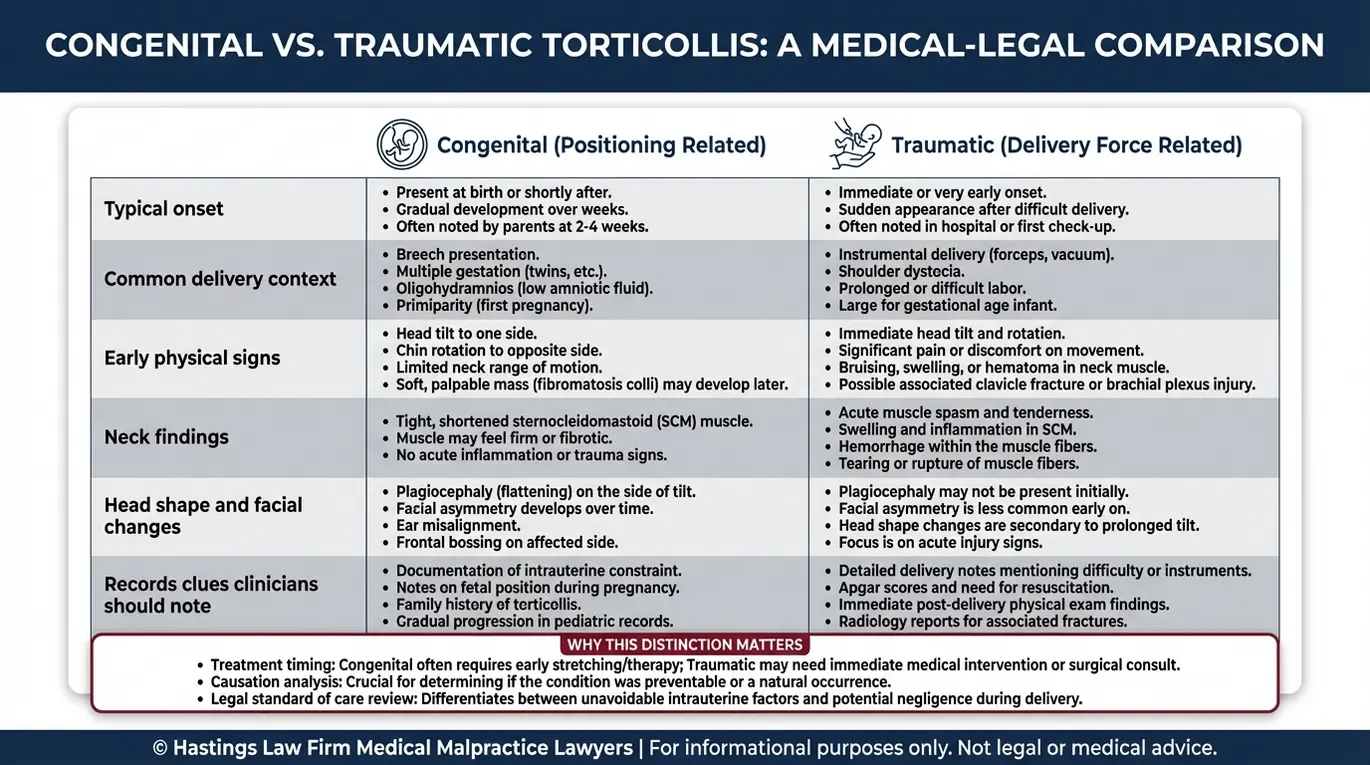
Infant torticollis, also known as wry neck, is a condition where the neck muscles (sternocleidomastoid) are shortened or tight, causing the head to tilt. While some cases are congenital (positioning in the womb), others are “acquired” through traumatic force during delivery. According to a current concept review published by SurgiColl, this condition affects many newborns and can range from mild to severe.
Parents often notice the signs early. A baby with torticollis may consistently tilt their head in one direction, have difficulty nursing on one side, or develop a flat spot on the skull called plagiocephaly. Over time, facial asymmetry can become visible as the limited range of motion affects how the baby’s head and face develop.
Not all torticollis is the same. Congenital muscular torticollis (CMT), a condition arising from intrauterine positioning where the baby’s posture places pressure on the neck muscle, is not caused by anyone’s error. However, acquired or traumatic torticollis results from excessive force applied to the infant’s neck during delivery, and that distinction matters enormously from both a medical and legal perspective.
Entirely Kids Pediatrics notes that early intervention with stretching and physical therapy can improve outcomes, but the underlying cause of the condition determines the treatment path and, potentially, whether a legal claim exists. Under Texas Civil Practice and Remedies Code, Chapter 74.351, birth injury claims require a qualified expert to confirm the connection between a provider’s actions and the resulting harm.
A qualified Texas birth injury attorney or torticollis and wry neck lawyer in Texas can help determine which type of injury your child has and whether it warrants further investigation.
| Characteristic | Congenital (CMT) | Traumatic / Acquired |
|---|---|---|
| Cause | Intrauterine positioning or cramped womb environment | Excessive force, pulling, or twisting during delivery |
| Onset | Present at birth or noticed within first weeks | Symptoms appear shortly after a difficult delivery |
| Neck Findings | Gradual muscle tightness; no acute trauma signs | Possible bruising, swelling, or hematoma on the neck |
| Associated Risk Factors | Breech position in utero, first pregnancy, multiple births | Forceps use, vacuum extraction, shoulder dystocia |
| Key Medical Evidence | Normal delivery records; positional history | Delivery complications documented in medical records |
Common Causes of Traumatic Torticollis During Delivery
Traumatic torticollis is often caused by excessive force or improper traction used by the obstetrician during a difficult birth, leading to muscle tears, hematomas, or nerve damage in the infant’s neck. This type of birth injury often involves the SCM muscle being torn, after which the body repairs the damage with scar tissue.
Several delivery scenarios carry a higher risk for this type of injury:
- Shoulder dystocia, a condition where the baby’s shoulder becomes lodged behind the mother’s pelvic bone after the head delivers. A literature review published in PubMed Central on shoulder dystocia describes how improper maneuvers during this emergency can result in significant traction injuries to the neck.
- Forceps or vacuum extraction (also called ventouse), where instruments are used to assist delivery. When applied improperly or with excessive force, these tools can cause direct trauma to the infant’s neck structures.
- Prolonged labor without appropriate intervention, which can increase the risk of positional complications and lead providers to resort to aggressive delivery techniques.
- Breech presentation, where the baby is positioned feet-first or bottom-first. Failure to recognize a dangerous fetal position and perform a timely C-section may expose the infant to preventable neck trauma when providers fail to uphold the standard of care.
When the SCM muscle is torn during delivery, the body repairs the damage with scar tissue. That scar tissue is less flexible than healthy muscle, which can permanently shorten the muscle and restrict the baby’s ability to turn their head. Without early diagnosis and treatment, the tightening can worsen over time.
If your child’s torticollis appeared after a complicated birth, a Texas torticollis and wry neck lawyer or infant neck injury lawyer can evaluate the delivery records to determine whether medical negligence may have contributed to the injury.
The Hastings Law Firm Difference
Results matter, but what truly sets us apart is how we achieve them. Every verdict, every settlement, and every Texas courtroom victory comes from one guiding promise: To treat each client’s fight for justice as if it were our own.
This balance of skill, experience, and empathy reflects our core philosophy that justice should not only compensate the injured, but also make healthcare safer nationwide.

Proving Medical Malpractice in Texas Torticollis Cases
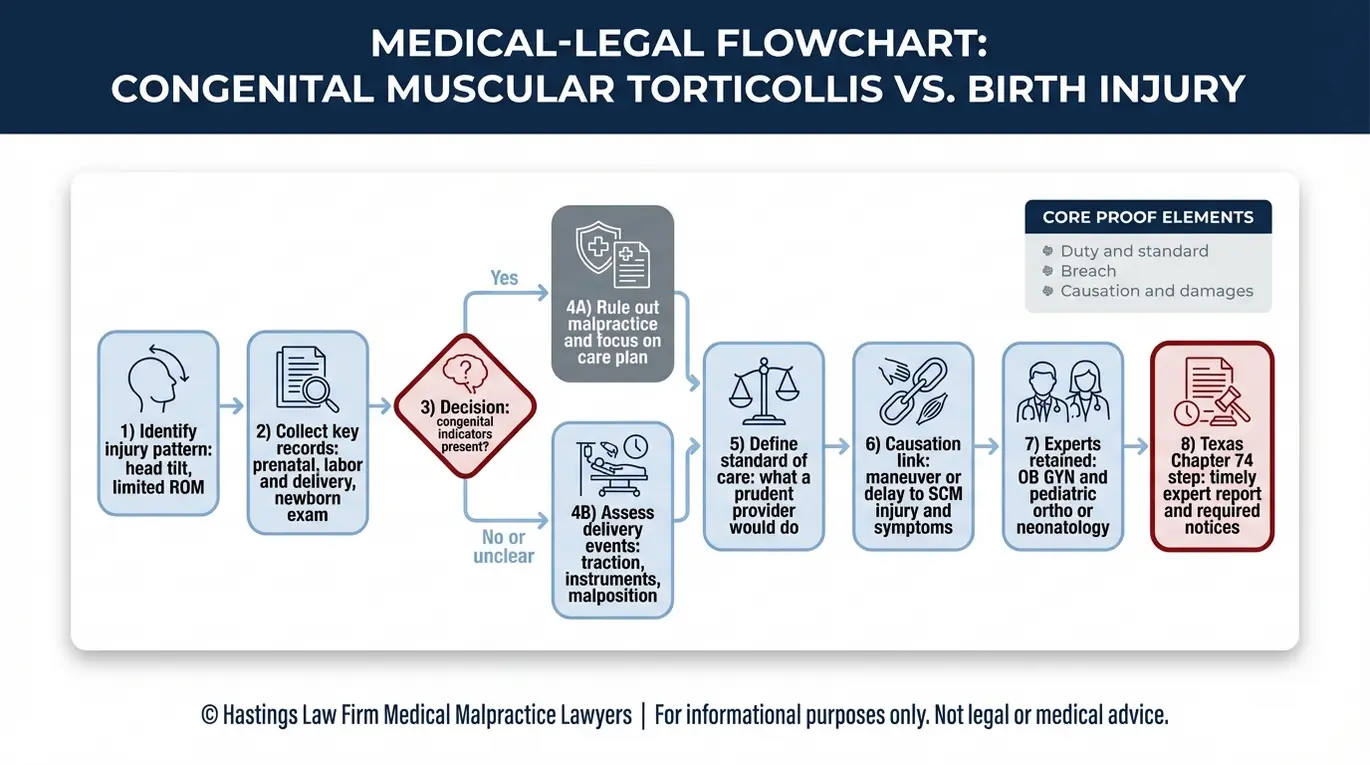
To prove malpractice in Texas, a plaintiff must show that the healthcare provider breached the accepted standard of care and that this breach directly caused the infant’s neck injury. This requires expert testimony and adherence to strict procedural rules like Chapter 74.
This requires more than showing a bad outcome. The legal team must establish what a prudent obstetrician should have done differently, whether that was ordering a C-section, adjusting delivery technique, or avoiding excessive traction. Then, causation must be proven: a direct link between the specific delivery maneuver and the muscle damage your child sustained. This means ruling out congenital causes like genetics or intrauterine positioning.
Under Texas Civil Practice and Remedies Code, Chapter 74, families filing a medical malpractice claim must provide a qualified expert report early in the case. This report must identify the standard of care, explain how it was violated, and connect that violation to the child’s injury. Chapter 74 also requires a pre-suit notice to be sent to defendants before filing. Failing to meet these requirements can result in dismissal of the case.
At Hastings Law Firm, our in-house medical staff, including nurse consultants and former defense attorneys who understand hospital protocols, review delivery records and fetal monitoring strips to reconstruct what happened. We then work with qualified experts, including orthopedic experts and maternal-fetal medicine specialists, to build the medical foundation of the case. As a malpractice attorney for wry neck cases and Texas Torticollis & Wry Neck Lawyer, we prepare every claim as if it will go to a jury.
Diagnostic Testing & Evidence
Objective diagnostic testing is essential to proving that a child’s torticollis was traumatic rather than congenital. These tests allow medical experts to differentiate between a condition that developed in the womb and an injury sustained during delivery. Ultrasound imaging of the neck can reveal a neck hematoma, a collection of blood in the tissue, or thickened tissue in the SCM muscle shortly after birth. MRI provides more detailed views of soft tissue damage, including scar tissue, also called fibrosis or contracture, that forms as a torn muscle heals. In some cases, an EMG (electromyography) test can assess whether nerve damage accompanied the muscle injury.
These imaging and testing results become critical evidence. When combined with delivery records, they help experts distinguish between a baby born with positional tightness and a baby whose neck was injured by force during birth.
Compensation for Long-Term Rehabilitation and Damages
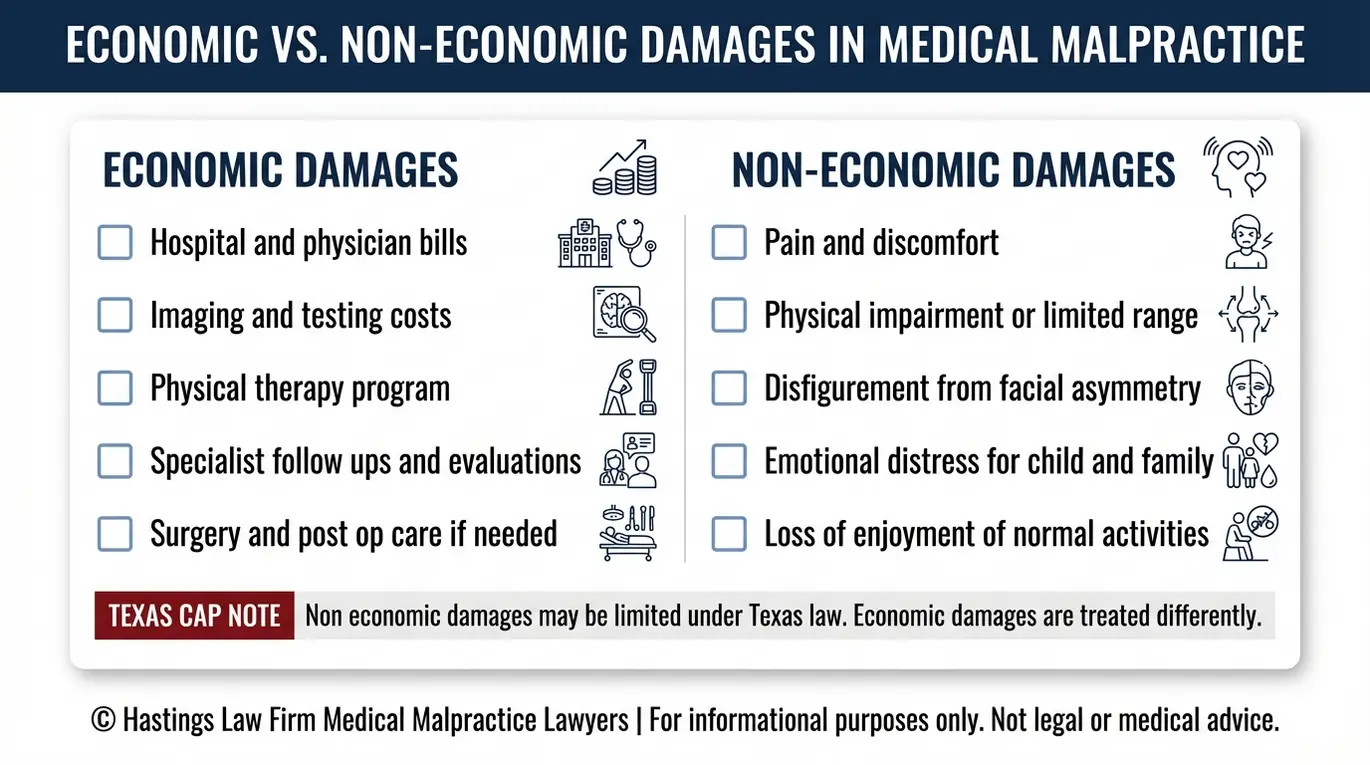
Compensation in torticollis cases covers the cost of medical treatment, physical therapy, and surgery, as well as non-economic damages for the child’s pain, disfigurement, and physical impairment. A Torticollis & Wry Neck Lawyer Texas families trust can help identify and pursue every category of damages the law allows.
Recoverable damages in these cases may include:
- Past and future medical expenses, including specialist visits, imaging, and surgical procedures such as muscle release surgery if physical therapy alone cannot restore mobility
- Physical therapy costs, which can span months or years of regular sessions to improve range of motion
- Disfigurement, including compensation for facial asymmetry or plagiocephaly (flattening of the skull) caused by restricted head movement
- Pain and physical impairment the child experiences during treatment and recovery
- Emotional distress endured by the child and family
Physical therapy (PT) for infant torticollis, a regimen involving targeted stretching, positioning exercises, and ongoing monitoring, is critical for recovery. Texas law under Chapter 74 does place a cap on non-economic damages, such as pain and suffering, at $250,000 per physician with an additional cap for hospital-level defendants. However, economic damages, including the full cost of future therapy, medical care, and surgery, are not subject to any cap. Building a thorough life care plan and reviewing settlements and verdicts with qualified experts is how we work to ensure a wry neck injury settlement reflects the true long-term cost of the child’s care.
Contact the Texas Birth Injury Attorneys at Hastings Law Firm Today for Help
Your child’s future mobility should not be defined by a preventable delivery injury. If your baby was diagnosed with torticollis or wry neck after a difficult birth, you have the right to find out what happened and whether it could have been avoided.
Hastings Law Firm represents families across Texas on a contingency fee basis, meaning you pay no attorney fees or costs unless we recover compensation for your family. Our Texas torticollis and wry neck lawyer team is ready to listen, review your child’s medical records, and give you an honest assessment of your case.
Call us today for a free, confidential case evaluation. Let us help you find the answers you deserve.
Frequently Asked Questions About Torticollis & Wry Neck in Texas


This content was researched and written by the Hastings Law Firm editorial team, which includes attorneys, medical professionals, and experienced researchers. Our writing is informed by internal knowledge and practical experience, and we cross-check critical details against authoritative sources cited throughout. Every piece undergoes human-led fact-checking and legal review. Because legal and medical information can change, if you spot an error, please contact us. Learn more about our content standards and review process on our editorial policy page.

Tommy Hastings, founder of Hastings Law Firm, is a board-certified personal injury trial lawyer dedicated exclusively to healthcare injury cases. Since 2001, he has represented injured patients and families in litigation against major hospital systems, pharmaceutical companies, and negligent healthcare providers nationwide. He has handled numerous high-profile cases that have drawn national media attention and resulted in multi-million dollar recoveries. He draws on that experience in his writing, helping readers understand how these cases work and what options may be available to them.
