


Houston Pediatric Malpractice Lawyer
Pediatric medical malpractice claims often arise when a child is treated with methods that fall below accepted medical practice and the lapse causes harm. Children face unique risks because symptoms can be hard to describe, vital signs differ by age, and dosing and monitoring require precision. Errors in diagnosis, medication, anesthesia, surgery, nursing care, and emergency triage can lead to lasting developmental harm, permanent disability, or fatal outcomes. If your child suffered harm due to pediatric medical malpractice in Houston, Texas, contact Hastings Law Firm for a free, confidential case review.
Last Updated: September 19, 2026
Trusted Houston Medical Attorneys for Pediatric Negligence Claims
When your child has been harmed by a medical professional you trusted, the confusion and grief can feel overwhelming. You may sense that something went wrong during your child’s care, but you’re unsure how to confirm it or what steps to take next. That instinct deserves to be heard, and you deserve clear, honest answers about what happened and what your options are.
Founded by board-certified trial lawyer Tommy Hastings, Hastings Law Firm is a medical malpractice trial firm with a team that includes in-house nurse consultants, former defense attorneys, and board-certified trial lawyers who focus exclusively on cases involving medical negligence. As a Houston pediatric malpractice lawyer team, we understand the unique medical and legal challenges that arise when a child is the patient. Our goal is to help families uncover the truth, protect their child’s future, and hold the responsible parties accountable.
If your child was injured during medical treatment, we welcome you to contact us for a free, confidential case evaluation. We can review what happened and explain your options.

What Constitutes Pediatric Medical Malpractice in Texas?
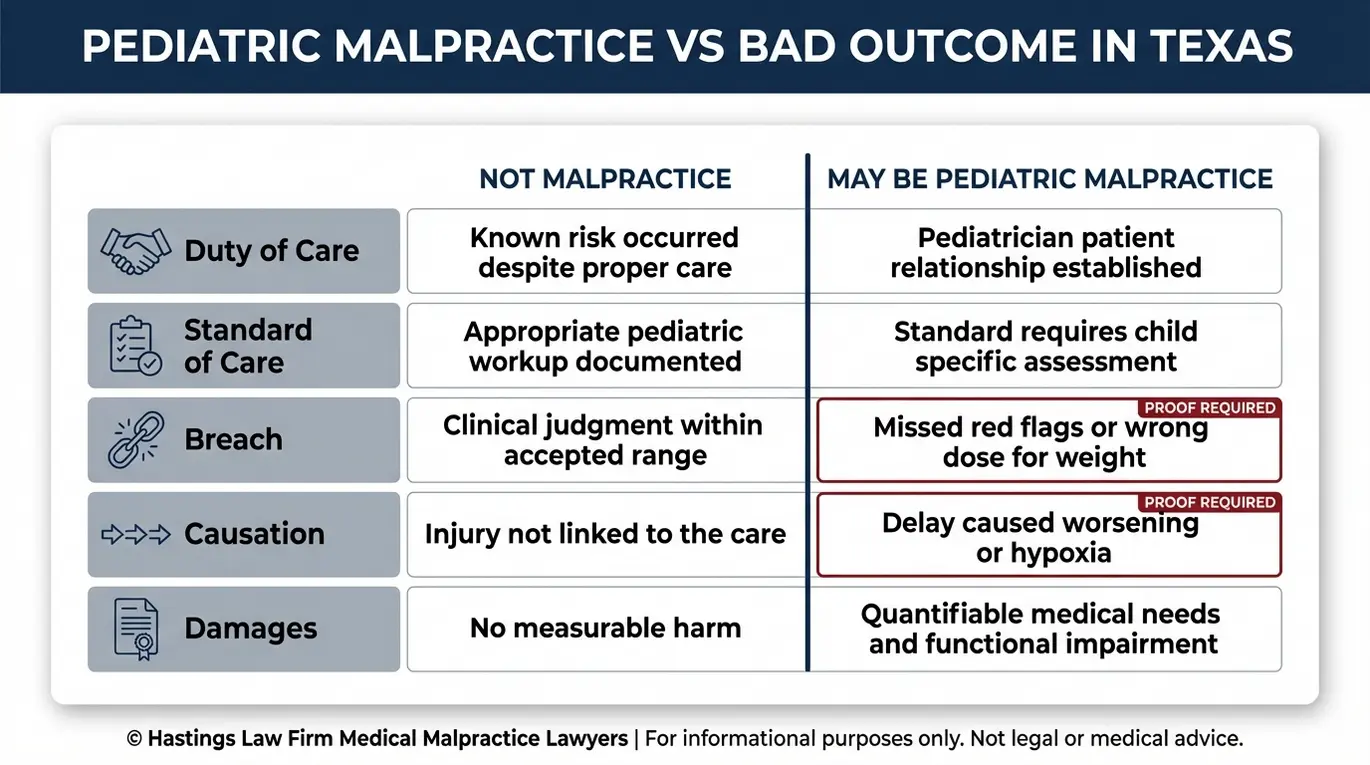
Pediatric medical malpractice occurs when a healthcare provider fails to meet the accepted standard of care for treating children, and that failure directly causes injury or harm. In Texas, these standards apply to any licensed medical professional treating a minor patient. The standard of care refers to the accepted medical practices used by providers in similar situations.
For children, this standard carries additional weight. A child’s physiology is fundamentally different from an adult’s. Organ systems are still developing, medication tolerances vary based on weight and age, and younger patients often cannot describe their own symptoms.
Pediatrician liability, like that of any treating physician, begins with a duty of care that is established the moment a provider-patient relationship is formed. That duty requires the provider to evaluate, diagnose, and treat the child using methods consistent with accepted medical practice.
A bad outcome alone does not constitute medical negligence. Children can experience complications even when every provider acts appropriately. Under Texas Civil Practice and Remedies Code Chapter 74, a health care liability claim requires proof that the provider deviated from the standard of care and that this deviation was the direct cause of the child’s injury.
The distinction between an unfortunate outcome and actionable negligence is one of the first things a Houston pediatric malpractice lawyer will help you understand. Experienced pediatric malpractice attorneys know that these cases require a meticulous examination of medical records to identify where hospital protocols were ignored. This legal scrutiny is necessary because the duty of care in pediatrics extends beyond simple treatment; it encompasses the foresight to anticipate complications specific to a child’s age and medical history.
Our team, which includes nurse practitioners and former hospital staff, reviews the clinical details of each case to determine whether the care your child received fell short of what the standard required. If you believe your child was harmed by pediatric medical malpractice, that evaluation is the critical first step.
Common Types of Pediatric Medical Negligence in Houston Hospitals
Common forms of pediatric negligence include surgical errors, medication errors involving weight-based calculations, and failure to diagnose critical conditions such as meningitis or appendicitis. These errors involve a failure to follow safety protocols in a hospital environment, from the operating room to the emergency department. Medical protocols are established safety steps designed to prevent errors in high-pressure hospital settings.
The types of negligence we most frequently investigate in pediatric cases include:
- Surgical errors: Wrong-site procedures, instruments or sponges retained after surgery, and anesthesia complications that are unique to smaller patients. Children respond differently to sedation and general anesthesia, and dosing or monitoring failures can lead to serious injury.
- Emergency room negligence: Failure to properly triage a child’s symptoms or recognize that a pediatric patient is deteriorating. Pediatric triage, the process of assessing and prioritizing a child’s condition based on severity, requires training that accounts for how children present differently than adults. In a busy hospital environment, staff may dismiss a parent’s intuition, leading to tragic delays. When a provider fails to listen or re-evaluate a child whose condition is not improving, that failure can constitute negligence.
- Nursing errors: Mistakes in monitoring vital signs, failure to report changes in a child’s condition to the treating physician, and IV infiltration or extravasation. IV infiltration occurs when fluid leaks from the vein into surrounding tissue, while extravasation involves the leakage of irritating or vesicant medications, potentially causing burns, tissue damage, or compartment syndrome in small limbs.
Research published through the Agency for Healthcare Research and Quality’s Patient Safety Network (PSNet) has documented ongoing trends in diagnostic adverse events, underscoring the systemic nature of these failures. Each of these categories involves specific protocols that healthcare providers are expected to follow. As a Houston pediatric malpractice lawyer team, we work with our in-house medical staff to identify exactly where the breakdown occurred, what protocols were missed, and how those failures connect to the child’s injury. A pediatric negligence lawyer can help families understand whether the care their child received meets the threshold for a legal claim.
The Hastings Law Firm Difference
Results matter, but what truly sets us apart is how we achieve them. Every verdict, every settlement, and every Houston courtroom victory comes from one guiding promise: To treat each client’s fight for justice as if it were our own.
This balance of skill, experience, and empathy reflects our core philosophy that justice should not only compensate the injured, but also make health care safer nationwide.

Misdiagnosis and Delayed Diagnosis in Children
A delayed diagnosis in a child can lead to permanent developmental setbacks or death because children’s bodies compensate for illness differently than adults, often masking the severity of a condition until they decline rapidly. A diagnostic error occurs when a doctor fails to identify a serious condition in a timely manner.
Children present symptoms in ways that do not always match adult patterns. A young child with appendicitis may not have the classic localized pain an adult would report. Pneumonia can progress quickly in a toddler whose immune system is still developing. These conditions are among the most commonly misdiagnosed in pediatric emergency settings.
Unlike congenital defects which are present at birth, these are preventable errors. Children often experience compensated shock, a state where their bodies maintain normal blood pressure despite serious illness, masking the danger until they suddenly collapse.
Case Example: Consider a toddler brought to the ER with fever and vomiting. An adult with similar symptoms might be discharged with fluids. However, if the provider fails to check for neck stiffness or sensitivity to light, which are classic signs of meningitis, and sends the child home, the delay in antibiotic treatment can result in severe brain damage. This failure to diagnose a treatable condition violates the standard of care.
The impact on a child’s long-term development makes these diagnostic errors uniquely dangerous. A brain infection that goes untreated for even a short window can cause lasting cognitive impairment.
Age-adjusted pediatric vital signs, which are the normal ranges for heart rate, blood pressure, and respiratory rate that vary by a child’s age, should guide clinical decision-making. When a provider fails to interpret these signs correctly, the result can be a preventable tragedy. The VA Health Systems Research division has documented how health systems research continues to shape improvements in diagnostic safety.
A Houston pediatric malpractice lawyer can help determine whether a delayed or missed diagnosis constituted a breach of the standard of care. As a malpractice lawyer for children, our role is to reconstruct the clinical timeline and connect the delay to the harm your child suffered.
Birth Injuries and Congenital Defects
Birth injuries such as cerebral palsy or brachial plexus injuries often result from a failure to perform a timely C-section or improper use of delivery tools like forceps and vacuum extractors. Medical negligence during birth can result in permanent injuries to the newborn.
One of the first things we evaluate in any birth injury case is the distinction between a birth defect and a birth injury. Birth defects are typically genetic or congenital in nature, meaning they developed during pregnancy due to factors that may not involve medical negligence. Birth injuries are caused by something that happened during labor, delivery, or the immediate postpartum period.
Oxygen deprivation during birth, known as hypoxia, is one of the most common and devastating mechanisms of injury. Even a few minutes of inadequate oxygen supply to a newborn’s brain can cause irreversible damage, including cerebral palsy, seizure disorders, and cognitive disabilities that require lifelong support. If the medical team ignores these warning signs, the resulting wrongful death of an infant or permanent disability becomes a tragedy that requires legal intervention.
The medical records generated during labor and delivery are critical to these cases. Electronic fetal monitoring (EFM) strips, which are continuous recordings of the baby’s heart rate and the mother’s contractions, provide a real-time picture of how the baby was tolerating labor.
These strips can reveal patterns of distress that should have prompted intervention. These strips are the voice of the unborn child. When decelerations in heart rate go unnoticed or unaddressed by the delivery team, the window to prevent injury closes rapidly.
Our in-house medical staff and national network of obstetric experts analyze these records closely, evaluating whether the clinical team responded appropriately to the information available to them. If your child suffered a birth injury, early investigation is critical. As a birth injury attorney team, we examine the full record, from prenatal care through delivery, to determine whether preventable negligence played a role.
Medication and Anesthesia Errors in Pediatrics
Medication errors in pediatrics frequently involve incorrect weight-based dosage calculations, which can lead to toxicity or under-treatment capable of causing organ failure or cardiac arrest. Pediatric dosing requires precise calculations because children are not simply small adults.
Weight-based dosing, the practice of calculating a drug dose in milligrams per kilogram of body weight (mg/kg), is standard in pediatric medicine. One of the most well-documented risks is the “tenfold dosing error,” where a misplaced decimal point results in a child receiving ten times the intended dose. Adhering to the standard of care requires double-checks and strict protocols for these high-alert medications.
Common drugs involved in pediatric errors often include:
- Antibiotics: Medications like Gentamicin or Vancomycin that require therapeutic monitoring.
- Insulin: A high-alert medication where dosing errors can cause rapid hypoglycemia.
- Sedatives: Drugs like Fentanyl or Morphine used during procedures.
- Heparin: Anticoagulants that carry high bleeding risks if overdosed.
Anesthesia carries its own set of risks for children. A developing brain is more sensitive to anesthetic agents, and airway management in small patients requires specialized equipment and training. Errors in anesthesia depth, ventilation, or monitoring during pediatric procedures can result in brain injury or death.
The CDC’s PROTECT Initiative highlights the ongoing public health effort to reduce medication-related harm in children, reinforcing that these errors remain a recognized and preventable problem.
As a Houston pediatric malpractice lawyer team, we review pharmacy logs, medication administration records, anesthesia charts, and nursing notes to trace where the error originated. A pediatric medication error lawyer can help identify whether the mistake was made by the prescribing physician, the dispensing pharmacy, or the administering nurse, and hold the responsible parties accountable.
Establishing Liability in Pediatric Malpractice Cases
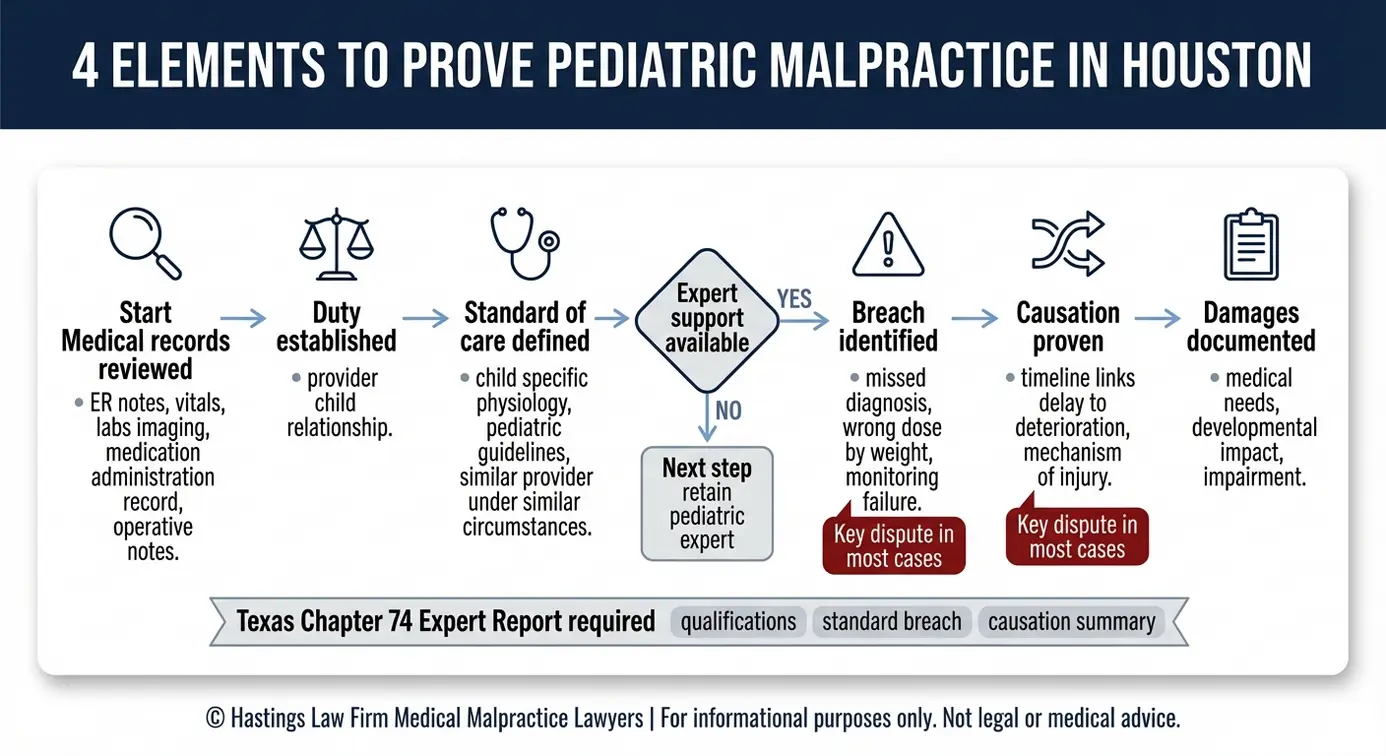
Liability in a pediatric malpractice case is established by proving four elements: duty of care, breach of that duty, causation, and quantifiable damages. Liability means showing that a healthcare provider is legally responsible for an injury due to their actions or omissions.
The four elements work together as a chain. First, the healthcare provider must have owed a duty of care to the child, which is established through the provider-patient relationship. Second, the provider must have breached that duty by deviating from the accepted standard of care. Third, the breach must have been a direct cause of the child’s injury, not merely a coincidence or an unrelated complication. Fourth, the injury must have resulted in measurable damages, whether medical costs, pain, developmental harm, or other losses.
In pediatric cases, the standard of care analysis differs from adult cases. A provider treating a five-year-old with abdominal pain is held to the standard of a reasonably competent provider with similar training treating a pediatric patient in similar circumstances.
Pediatric physiology, communication limitations, and developmental considerations all factor into what constitutes reasonable care. Proving causation is often the most complex hurdle. The defense may argue that the child’s injury was caused by an underlying condition rather than the medical error. Overcoming this requires detailed physiological analysis from experts who can separate the natural progression of an illness from the preventable harm caused by negligence.
Texas law adds an additional procedural requirement that makes early legal counsel essential. Under Texas Civil Practice and Remedies Code § 74.351, a plaintiff in a health care liability case must serve an expert report within 120 days of the defendant’s original answer. The decision of suing a pediatrician or hospital is never taken lightly, but it is often the only path to securing the resources a disabled child needs.
Working with a Houston pediatric malpractice lawyer early in the process matters. At Hastings Law Firm, we begin building the expert framework from the day we accept a case, drawing on our national expert network to match the defendant’s exact specialty with a credible, board-certified reviewer.
Recoverable Damages for Injured Children
Families can recover economic damages for past and future medical care, as well as non-economic damages for pain, suffering, and physical impairment. Economic and non-economic damages are the legal terms for the various losses a family can recover following a medical error.
| Damage Type | Description | Examples |
|---|---|---|
| :— | :— | :— |
| Economic Damages | Financial losses with a calculable value. | Medical bills, future surgeries, lost earning capacity, life care planning. |
| Non-Economic Damages | Subjective losses related to quality of life. | Pain and suffering, physical impairment, disfigurement, mental anguish. |
Calculating loss of future earning capacity for an infant or young child requires economic experts who project lifetime earnings based on statistical data, parental education levels, and other demographic factors. Because a child has no work history, these calculations rely on statistical models of what a person with their probable educational trajectory would have earned. The CDC’s Healthcare Cost Data provides baseline information on the financial burden of disability and chronic conditions that can support these projections.
Non-economic damages compensate for losses that do not carry a specific price tag but are deeply real: physical pain, emotional suffering, disfigurement, and loss of enjoyment of life. A child who suffers a brain injury and can never play sports, attend school independently, or live without daily assistance has experienced a profound loss that the law recognizes.
In wrongful death cases where a child dies due to medical negligence, Texas law allows parents to seek damages for mental anguish, loss of companionship, and funeral expenses. These claims carry their own procedural requirements and timelines.
A Houston pediatric malpractice lawyer can work with medical, vocational, and economic experts to build a full picture of what your child’s injury will cost over a lifetime, both financially and personally. Securing full compensation for injured child claims requires accounting for every aspect of their altered future.
Texas Statute of Limitations for Minors
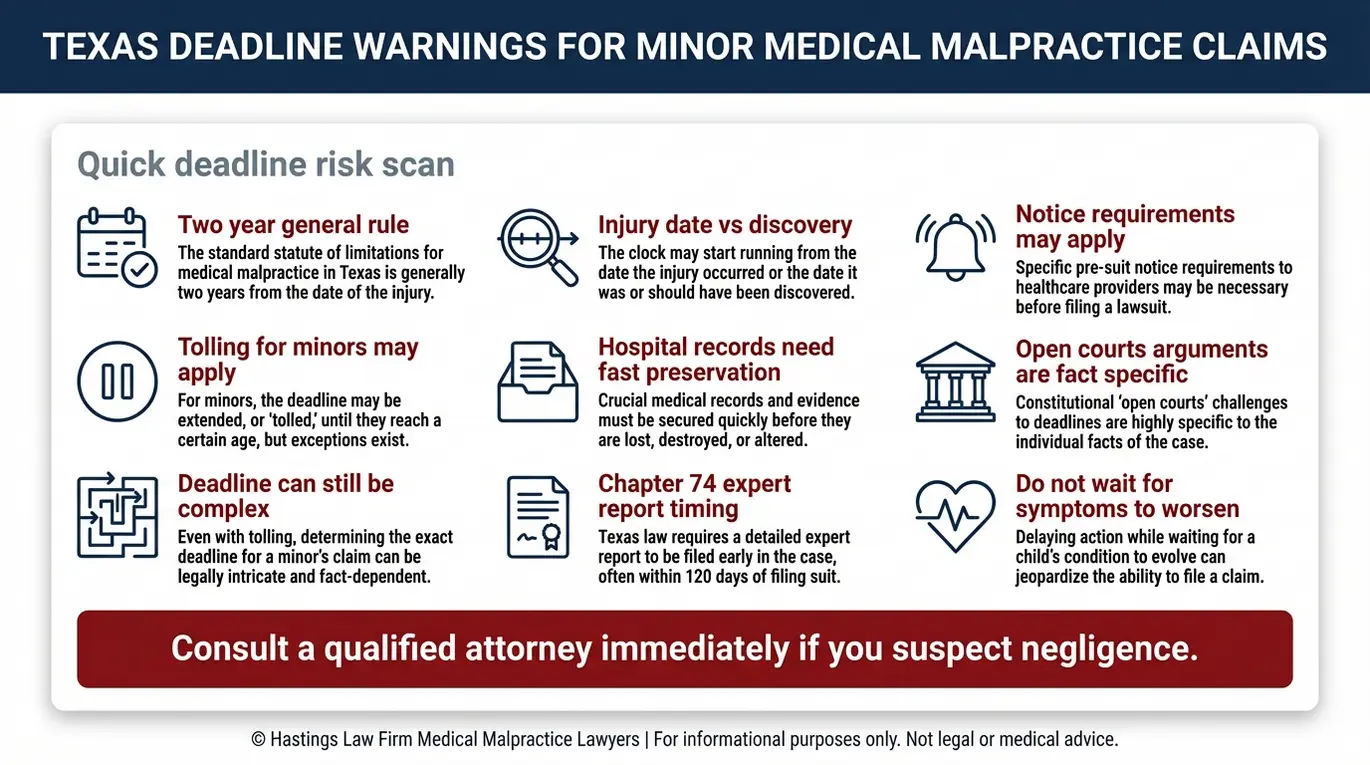
In Texas, children injured before age 12 by medical negligence generally have until their 14th birthday to file a claim, while the standard two-year statute of limitations applies to older minors. The statute of limitations is the legal deadline for filing a medical negligence claim in Texas.
General Rule: Under the Texas Civil Practice and Remedies Code, the standard statute of limitations for a medical malpractice claim is two years from the date of the injury or the date the injury was discovered or should have been discovered through reasonable diligence.
Tolling for Minors: Texas law provides that for children under the age of 12, the tolling of the statute of limitations generally applies, meaning the clock is paused until the child turns 12.
At that point, the family has two years (until the child’s 14th birthday) to file suit. If the child was 12 or older at the time of the injury, the standard two-year deadline applies without tolling. This exists because minors cannot bring legal claims on their own behalf.
The Statute of Repose: Texas also imposes a 10-year statute of repose, which sets an absolute outer deadline regardless of when the injury is discovered. This can create tension with the “Open Courts” provision of the Texas Constitution, which has been interpreted by courts to protect a citizen’s right to bring a claim. While the Statute of Repose is strict, skilled attorneys may challenge its application in specific scenarios, though these are legally complex battles. Parents should never assume they are barred from filing without a professional review of the specific timeline.
Certain circumstances, including claims against governmental entities or situations involving the statute of repose, can shorten these deadlines significantly. Consulting a Houston pediatric malpractice lawyer as early as possible protects your child’s right to pursue a claim.
Evidence preservation is another reason to act promptly. Medical records, monitoring data, and staffing logs can be altered, archived, or lost over time. Early investigation allows us to secure these records and begin building a case while the evidence is intact.
Contact the Houston Doctor Malpractice Attorneys at Hastings Law Firm Today for Help
No parent should have to wonder alone whether their child’s injury was preventable. At Hastings Law Firm, our purpose is to help families find the truth about what happened, restore trust that was broken, and protect their child’s future. Our team of attorneys, nurse consultants, and patient advocates is built specifically to handle pediatric malpractice claims with the medical depth and legal rigor these cases demand.
We represent families on a contingency fee basis, which means you pay no attorney fees or costs unless we secure a recovery for your family. Every case begins with a free, confidential evaluation where we listen to your experience, review the medical details, and give you an honest assessment of your options.
If your child was harmed by medical negligence, contact Hastings Law Firm today. Let us help you find the answers you deserve.
Frequently Asked Questions About Pediatric Malpractice in Houston


This content was researched and written by the Hastings Law Firm editorial team, which includes attorneys, medical professionals, and experienced researchers. Our writing is informed by internal knowledge and practical experience, and we cross-check critical details against authoritative sources cited throughout. Every piece undergoes human-led fact-checking and legal review. Because legal and medical information can change, if you spot an error, please contact us. Learn more about our content standards and review process on our editorial policy page.

Tommy Hastings, founder of Hastings Law Firm, is a board-certified personal injury trial lawyer dedicated exclusively to healthcare injury cases. Since 2001, he has represented injured patients and families in litigation against major hospital systems, pharmaceutical companies, and negligent healthcare providers nationwide. He has handled numerous high-profile cases that have drawn national media attention and resulted in multi-million dollar recoveries. He draws on that experience in his writing, helping readers understand how these cases work and what options may be available to them.
