


Houston Home Health Care Provider Malpractice Lawyer
Home health care is meant to keep a patient safe and supported, but negligence in the home can cause serious injury, worsening health, and life threatening consequences. Problems often involve missed monitoring, medication mistakes, unsafe transfers, or failures to follow a physician ordered plan of care. Responsibility may extend beyond an individual caregiver to a home health agency or other involved parties. Options for compensation can be shaped by limits on certain damages and strict filing time limits. If you or a loved one were harmed or worse due to home health care provider malpractice in Houston, Texas, contact Hastings Law Firm for a free, confidential case review.
Last Updated: July 27, 2026
Trusted Houston Medical Attorneys for Patients Injured by Home Healthcare
When someone you love is harmed by the very person sent to care for them at home, the sense of betrayal can be overwhelming. You trusted a home health care provider to follow the treatment plan, monitor your family member’s condition, and keep them safe. If that trust was broken through carelessness or neglect, you deserve answers about what went wrong and what can be done about it.
At Hastings Law Firm, we focus exclusively on medical malpractice. Our firm was founded by Tommy Hastings, a board-certified trial lawyer who has handled complex medical negligence cases for over two decades. Our team of attorneys, in-house nurse consultants, and patient advocates understands both the medical and legal details involved in home health care negligence cases. As a Houston home health care provider malpractice lawyer team, we are prepared to investigate what happened and hold the responsible parties accountable.
If you believe your loved one was injured by a home health provider, contact us for a free, confidential case evaluation. There is no fee unless we recover compensation on your behalf.

What Constitutes Home Health Care Malpractice in Houston
Home health care malpractice occurs when a provider, such as a visiting nurse or health aide, deviates from the accepted standard of care, directly causing injury or worsening the patient’s condition. The standard of care is the level of treatment that a reasonably competent home health professional, with similar training and experience, would provide under the same circumstances.
In-home care carries its own set of responsibilities. Providers must follow a home health plan of care (POC), which is the physician-ordered document outlining the patient’s specific treatment needs, medications, and monitoring requirements. They are also responsible for assisting with activities of daily living (ADLs), the routine tasks like bathing, dressing, eating, and mobility that many patients cannot safely perform alone.
Medical negligence in this setting can take many forms. Common examples include:
- Medication errors: Giving the wrong drug, the wrong dose, or skipping doses entirely.
- Failure to treat or prevent bedsores: Neglecting skin checks and repositioning schedules for immobile patients.
- Improper treatment during transfers: Improper lifting or transfer techniques that result in falls, fractures, or head injuries.
- Failure to monitor vital signs: Missing critical changes in blood pressure, heart rate, or oxygen levels.
- Ignoring symptoms or failing to report changes: Not alerting the supervising physician when a patient’s condition worsens.
A bad medical result is not always malpractice. The distinction between simple dissatisfaction with care and actionable negligence by a home health provider lies in whether the provider failed to meet the duty of care their training and licensure require. If a provider skipped required steps on a home health referral checklist (FCSO Medicare), failed to follow the POC, or ignored standard clinical protocols, that failure may constitute malpractice.
A home health care malpractice lawyer can review the records and help determine whether what happened in your situation crosses the line into actionable negligence. Our Houston home health attorneys work alongside medical professionals to evaluate these cases from day one. If you need a Houston home health attorney to review your case, we are here to help.
Liability: Suing Home Health Agencies vs. Individual Caregivers
Liability often extends beyond the individual caregiver to the employing agency under the doctrine of *respondeat superior*, a legal principle meaning “let the master answer.” If the aide was acting within the scope of their employment at the time of the injury, the agency that hired and assigned them can be held responsible.
This matters because individual caregivers rarely carry sufficient insurance or assets to cover serious injuries. Suing a home health agency opens a path to meaningful recovery. Our team includes former defense attorneys and experienced hospital nurses who provide an insider perspective on how these agencies operate. Agencies can also face direct liability for negligent hiring, meaning they failed to conduct proper background checks, verify credentials, or provide adequate training.
In a medical malpractice case involving home health, third parties may also share responsibility. A pharmacy that filled the wrong prescription, or a manufacturer whose defective Hoyer lift malfunctioned, could be one of the liable parties. A Hoyer lift is a mechanical device used to move patients who have limited mobility.
The agency’s duty of care extends to ensuring all protocols are followed, including medication reconciliation. You can review a home health agency’s track record through Home Health Star Ratings from CMS. A provider malpractice lawyer in Houston can investigate liability for home health negligence and help identify every party whose actions contributed to the harm.
| Factor | Home Health Agency (Employer) | Independent Contractor |
|---|---|---|
| Vicarious Liability | Typically liable for employee actions on the job | Agency may argue reduced liability |
| Hiring & Training | Directly responsible for vetting and training staff | May shift responsibility to staffing company |
| Insurance Coverage | Usually carries commercial liability insurance | May have limited or no malpractice coverage |
| Control Over Care | Sets schedules, assigns patients, supervises | May operate with less direct oversight |

The Hastings Law Firm Difference
Results matter, but what truly sets us apart is how we achieve them. Every verdict, every settlement, and every Houston courtroom victory comes from one guiding promise: To treat each client’s fight for justice as if it were our own.
This balance of skill, experience, and empathy reflects our core philosophy that justice should not only compensate the injured, but also make health care safer nationwide.

Proving Negligence in Home Health Care Claims
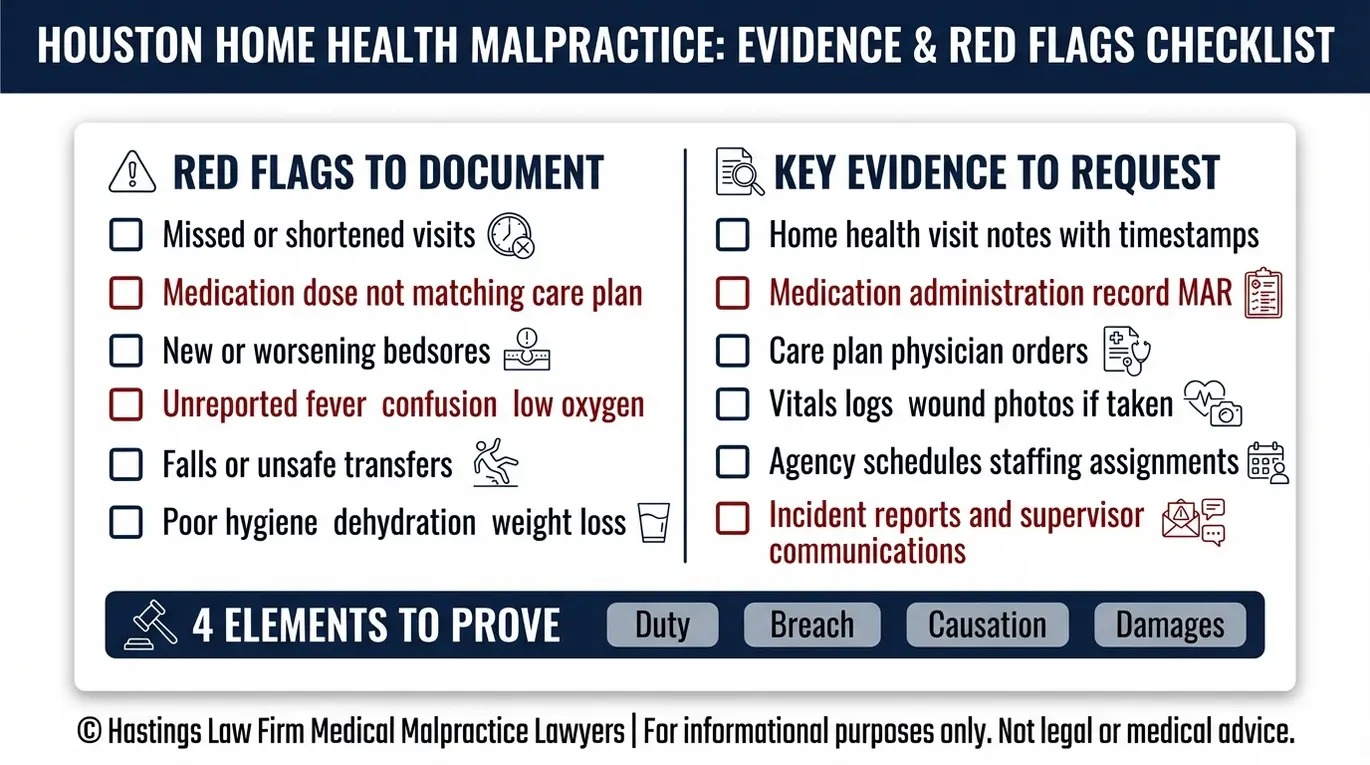
Proving negligence requires demonstrating four key elements: a professional duty of care existed, the provider breached that duty, the breach directly caused the injury, and the patient suffered quantifiable damages. Each element must be supported by evidence, and a gap in any one of them can undermine the entire claim.
Duty: The provider-patient relationship establishes the duty of care. Once a home health agency assigns a caregiver to a patient, that caregiver has a legal obligation to deliver care consistent with their training and the POC.
Breach: A breach of duty occurs when the provider fails to meet the standard of care. This could mean skipped visits, ignored symptoms, medication errors, or improper treatment techniques. Home health visit notes are a primary source for identifying these failures.
Causation: This is often the most contested element, especially when the patient has pre-existing conditions. We must establish that the provider’s breach, not the patient’s underlying illness, directly caused or worsened the injury. A Houston home health care provider malpractice lawyer works with medical experts to isolate the provider’s role from the natural course of the disease.
Damages: The patient must have suffered real, measurable harm, whether physical injury, worsened medical condition, or financial loss.
To prove home health malpractice, we gather and examine evidence of medical negligence including:
- Medication administration records (MARs), the logs tracking every dose given, missed, or refused
- Home health visit notes and caregiver logs
- The physician-ordered plan of care
- Hospital admission records following the injury
- Witness statements from family members present in the home
- Your loved one’s full medical records, which you have a right to request under the HIPAA right of access rules from HHS.gov
Collecting this evidence early is critical. Home health logs can be altered, lost, or overwritten if you wait too long to act.
Damages Available to Victims of Home Health Negligence
Patients may recover compensation for malpractice, including economic damages for financial losses like medical bills and non-economic damages for subjective losses like pain and suffering, both subject to Texas statutory caps. The type and amount of compensation depends on the severity of the injury and its impact on the patient’s life and family.
Economic damages cover the measurable financial costs caused by the malpractice. These can include:
- Additional medical expenses needed to treat or correct the injury
- Rehabilitation and ongoing therapy costs
- Medical equipment or home modifications
- Lost wages for family members who had to leave work to provide replacement care
Non-economic damages address the personal toll of the injury. These include physical pain, emotional distress, loss of independence, and diminished quality of life. For family members, loss of companionship and the burden of increased caregiving responsibilities can also factor in.
Texas places a cap on non-economic damages in medical malpractice cases. Under the Texas Civil Practice & Remedies Code Chapter 74 and §74.301, non-economic damages are capped at $250,000 per claimant against all individual physicians and healthcare providers combined, with an additional cap of $250,000 per healthcare institution, up to $500,000 total for all healthcare institutions. Economic damages have no cap.
Understanding how these Texas statutory caps apply to your case is something a Houston malpractice attorney can walk you through during an initial evaluation. We calculate the full scope of damages in home health cases so that every category of loss is accounted for before any settlement discussion begins.
Statute of Limitations for Texas Home Health Lawsuits
In Texas, the statute of limitations for medical malpractice claims is generally two years from the date of the injury or the date the injury could reasonably have been discovered. Missing this deadline typically means losing the right to file a claim, regardless of how strong the evidence may be. The statute of limitations Texas courts enforce is strict.
The two-year rule applies to most home health malpractice situations. Legal deadlines are strictly enforced in Texas medical claims, but because home health patients are often elderly, isolated, or cognitively impaired, injuries can go undetected for weeks. The discovery rule can extend the starting point of the deadline, but only if the injury was not reasonably discoverable earlier.
Texas also imposes an absolute 10-year statute of repose under Texas Civil Practice & Remedies Code §74.251. This is a hard outer limit. No matter when the injury is discovered, no claim can be filed more than 10 years after the date the malpractice occurred. Be aware of the time limit to sue home health provider defendants.
Acting quickly also protects the evidence. Home health visit logs, medication administration records, and staffing schedules may be discarded, overwritten, or difficult to obtain as time passes. If you suspect negligence, a Houston home health care provider malpractice lawyer can take steps to preserve these records before they disappear.
The Role of Expert Testimony in Home Health Litigation
Texas law mandates the submission of an expert report detailing the standard of care violations within 120 days after the defendant’s original answer is filed, making medical expert testimony a non-negotiable element of a successful claim. This requirement ensures that only cases with merit proceed through the court system. Without a qualifying report, the court can dismiss the case with prejudice. This applies to any claim against a healthcare provider for medical negligence.
Deadline for Expert Opinions
Under Texas Civil Practice & Remedies Code §74.351, the process follows a strict timeline:
- File suit: The medical malpractice lawsuit is filed in court.
- Identify a qualified expert: The expert must have direct knowledge of the specific home health field at issue. For example, a case involving improper use of a gait belt would require a home health expert witness familiar with mobility protocols.
- Serve the expert report within 120 days after the defendant’s original answer is filed: The report must identify what the standard of care required, how the provider breached it, and how that breach caused the patient’s injury.
- Survive challenge: The defense will scrutinize the report. If the court finds it inadequate, it may grant additional time to cure the deficiency, but a failure to correct it leads to dismissal.
This 120-day rule is one of the reasons working with an experienced malpractice lawyer in Houston matters. Our team identifies and retains qualified home health experts early in the process so we are ready to meet this deadline. Our national network of medical experts allows us to match each case with professionals who have specific, relevant clinical experience.

Wrongful Death Caused by In-Home Care Providers
If a patient dies due to home health negligence, surviving family members may file a wrongful death claim to recover funeral costs, loss of companionship, and lost inheritance. A wrongful death lawyer Houston families trust can help handle this process. These cases carry an added layer of grief, and the legal process should never add to that burden.
Under Texas law, a wrongful death claim may be brought by the deceased patient’s spouse, children, or parents. Each eligible family member may seek compensation for their individual losses, including the loss of the relationship, emotional anguish, and financial support. Funeral expenses are also recoverable.
Texas law also recognizes a separate survival action, which addresses the pain and suffering the patient experienced before death. If a patient endured prolonged suffering from an untreated pressure ulcer, or died from a preventable infection like sepsis, the estate may recover damages. Pressure ulcers, or decubitus ulcers, are wounds caused by sustained pressure common in immobile patients.
Examples of fatal home health malpractice can include a medication overdose caused by a dosing error, failure to recognize and report signs of a life-threatening infection, or gross negligence that leads to severe dehydration or malnutrition. In each of these situations, death caused by home health neglect raises the question of whether timely, competent care could have prevented the tragedy.
Losing a family member to preventable medical negligence is devastating. If you are facing this situation, we are here to help you understand your legal options and pursue accountability on behalf of your loved one.
Contact the Houston Healthcare Malpractice Attorneys at Hastings Law Firm Today for Help
You trusted a home health provider to care for someone you love. If that trust was broken through negligence, you have the right to seek answers and hold the responsible parties accountable.
Hastings Law Firm maintains an exclusive focus on medical malpractice. Our legal team includes former defense attorneys who understand how agencies and insurers build their cases, and in-house medical professionals who can interpret clinical records and identify where care went wrong. This is all we do, and that singular focus gives our clients an advantage that general personal injury firms simply cannot match.
We believe every patient deserves to be heard. If your goal is securing the compensation your family needs or ensuring this does not happen to someone else, we are ready to listen.
Call us today or complete our online form for a free, confidential case evaluation. You pay no attorney fees or costs unless we recover compensation for you.
Frequently Asked Questions About Home Health Care Provider Malpractice in Houston


This content was researched and written by the Hastings Law Firm editorial team, which includes attorneys, medical professionals, and experienced researchers. Our writing is informed by internal knowledge and practical experience, and we cross-check critical details against authoritative sources cited throughout. Every piece undergoes human-led fact-checking and legal review. Because legal and medical information can change, if you spot an error, please contact us. Learn more about our content standards and review process on our editorial policy page.

Tommy Hastings, founder of Hastings Law Firm, is a board-certified personal injury trial lawyer dedicated exclusively to healthcare injury cases. Since 2001, he has represented injured patients and families in litigation against major hospital systems, pharmaceutical companies, and negligent healthcare providers nationwide. He has handled numerous high-profile cases that have drawn national media attention and resulted in multi-million dollar recoveries. He draws on that experience in his writing, helping readers understand how these cases work and what options may be available to them.
