


Texas Defective Joint Replacement Lawyer
A defective joint replacement can turn a procedure meant to restore mobility into ongoing pain, swelling, and uncertainty about what went wrong. Some failures are tied to device design, manufacturing problems, or missing warnings, while others overlap with surgical technique and follow up care. Metal on metal implants can shed debris that damages tissue and may cause broader health effects, sometimes leading to complex revision surgery and lasting limitations. If you or a loved one were harmed or worse due to a defective joint replacement in Texas, contact Hastings Law Firm for a free, confidential case review.

Last Updated: July 27, 2026
Trial-Ready Texas Attorneys for Orthopedic Device Failure
When a joint replacement that was supposed to restore your quality of life starts causing new pain, swelling, or unexplained symptoms, it can feel like the system failed you twice. You may be dealing with mounting medical bills, the possibility of another surgery, and a deep uncertainty about what went wrong and who is responsible. These are questions you should not have to answer alone.
A Texas defective joint replacement lawyer can help you understand whether the device itself, the manufacturer’s decisions, or the surgical approach contributed to your injury. At Hastings Law Firm, our legal and medical team works together to investigate implant failures and identify every party responsible. If you or a loved one is living with complications from a hip or knee replacement, we welcome the chance to review what happened and explain your options in a free, confidential case evaluation.

Understanding Defective Joint Replacements and Manufacturer Liability
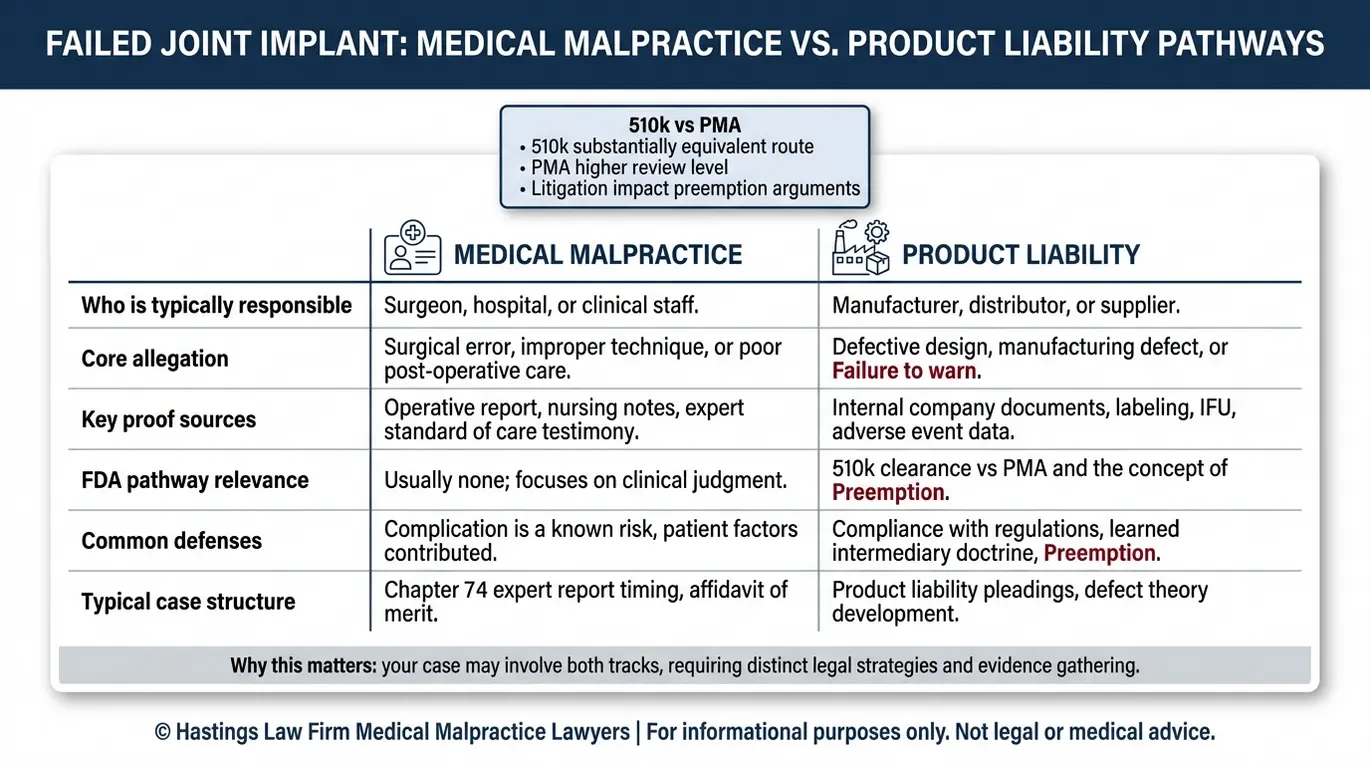
Defective joint replacement claims typically fall under product liability law, alleging that manufacturers designed, manufactured, or marketed an unsafe device. This is a critical distinction. While medical malpractice focuses on whether a doctor made an error during surgery or follow-up care, product liability targets the company that put the device on the market.
A defective joint replacement attorney needs to understand both areas of law because these cases often overlap. The surgeon may have performed the procedure correctly, but the implant itself may have been poorly designed or made from materials prone to early failure. In other cases, the device and the surgical technique both contributed to the injury. We handle the complexity of both medical malpractice and product liability claims. Our team includes in-house medical professionals and former defense attorneys who evaluate the clinical and manufacturing evidence side by side.
Product liability claims against device manufacturers generally rely on one or more of the following theories:
- Defective design: The implant’s fundamental design made it unreasonably dangerous, even when manufactured correctly. Metal-on-metal hip replacements (MoM), devices where both the ball and socket components are made of metal alloys, are a common example. Their design caused metal surfaces to grind together, releasing harmful debris into the body.
- Manufacturing defect: The design may have been acceptable, but an error during production, such as improper machining or contamination, created a flawed product.
- Failure to warn: The manufacturer knew or should have known about specific risks, like corrosion, the gradual breakdown of metal components due to chemical reactions in the body, but did not adequately warn surgeons or patients.
Each of these theories creates a separate basis for holding the manufacturer accountable, and a Texas joint implant lawyer will often pursue more than one in the same case.
The Impact of the FDA 510(k) Process on Litigation
A key issue in many defective implant cases is how the device reached the market in the first place. The FDA uses two main pathways to clear or approve medical devices.
The first is the 510(k) premarket notification process (U.S. Food and Drug Administration), a fast-track system that allows manufacturers to sell a new device without rigorous human clinical trials. To qualify, the manufacturer only needs to show that its product is “substantially equivalent” to a device already on the market. Many metal-on-metal hip systems entered the market this way, bypassing the kind of safety testing most patients would expect. This premarket notification pathway is frequently cited in litigation following an FDA recall of a cleared device.
The second pathway is Premarket Approval (PMA), a far more demanding process that requires clinical data proving the device is safe and effective. Devices cleared through PMA receive stronger legal protection because of a doctrine called federal preemption, which can shield manufacturers from certain state-law claims. The argument is that Congress intended the PMA process to set the safety standard, and state courts should not second-guess it.
Devices that entered the market through the less rigorous 510(k) pathway generally do not receive this same protection. This difference matters for litigation strategy because it determines which legal arguments are available to you and how aggressively a manufacturer can defend itself.
Recognizing the Signs of Implant Failure and Metallosis
Metallosis is a type of metal poisoning caused by the friction of metal components shedding tiny particles, called metal ions, into the bloodstream and surrounding tissue. If you have a metal-on-metal hip replacement and are experiencing worsening symptoms years after surgery, understanding metallosis is essential to protecting both your health and your legal rights.
How Metal-on-Metal Devices Fail
The failure of a metal-on-metal device often begins with two related processes that involve physical wear. Fretting occurs when metal components that are fitted together experience repeated micro-movements at their junction points, grinding away material at the surface. Corrosion happens when the body’s chemistry reacts with the exposed metal, accelerating the breakdown.
Together, these processes release cobalt and chromium ions into the fluid surrounding the joint. From there, the ions can enter the bloodstream and spread throughout the body. According to the U.S. Food and Drug Administration’s guidance on metal-on-metal hip implants, this can lead to both localized tissue damage and systemic health effects.
Systemic Toxicity
Systemic toxicity occurs when harmful metal ions spread from the joint into the bloodstream and throughout the body. Neurological problems, a condition caused by elevated cobalt ion levels in the blood, can produce symptoms that extend well beyond the hip or knee. Patients may experience cognitive difficulty, vision or hearing changes, depression, and nerve pain in the hands and feet. Because these symptoms seem unrelated to a joint implant, they are frequently misattributed to other conditions, delaying both diagnosis and legal action.
Elevated chromium levels carry their own health risks, including potential damage to the kidneys and other organs over time.
Local Tissue Damage
Local tissue damage refers to the harm caused directly to the area around the implant site. Tissue necrosis, the death of muscle, ligament, and bone tissue surrounding the device, can destroy the very structures the implant was designed to support. Patients may also develop pseudotumors, inflammatory masses of damaged tissue and fluid that form around the joint in response to metal debris. These are not cancerous, but they can grow large enough to cause significant pain and further tissue destruction.
This local damage is especially concerning because it complicates any future revision surgery. The less healthy bone and tissue a surgeon has to work with, the harder it becomes to secure a new implant successfully.
Symptoms to Watch For
If you have a metal-on-metal implant, be aware of these potential warning signs:
- Increasing hip or groin pain that was not present shortly after surgery
- Swelling, warmth, or a feeling of instability around the joint
- A grinding or clicking sensation during movement
- Skin rashes or discoloration near the implant site
- Unexplained fatigue, headaches, or difficulty concentrating
- Changes in vision or hearing
- Numbness or tingling in the extremities
- Elevated cobalt or chromium levels on a blood test
If you recognize any of these symptoms, a lawyer for defective joint replacement cases can help you connect the medical evidence to the legal claim. Recognizing these signs early is important for both your health and your legal case. Our team at Hastings Law Firm includes in-house medical staff who can review your records and coordinate with your treating physicians as part of the investigation. A joint replacement failure attorney should be consulted early, before the statute of limitations becomes an issue.
The Hastings Law Firm Difference
Results matter, but what truly sets us apart is how we achieve them. Every verdict, every settlement, and every Texas courtroom victory comes from one guiding promise: To treat each client’s fight for justice as if it were our own.
This balance of skill, experience, and empathy reflects our core philosophy that justice should not only compensate the injured, but also make health care safer nationwide.

High-Risk Devices: Recalls and Litigation Updates
Several major manufacturers, including DePuy, Zimmer, and Stryker, have faced massive litigation over the premature failure of specific hip and knee models. If your implant is on this list, or if you are experiencing unexplained symptoms, speaking with a Texas defective joint replacement lawyer to discuss revision surgery is a practical first step.
The table below summarizes some of the most frequently litigated devices. Fretting, the mechanical wear caused by micro-movements between connected metal parts, and pseudotumors, inflammatory tissue masses that develop in response to metal debris, are common failure patterns across many of these systems.
| Manufacturer | Device Name | Common Failure Mode | Recall / Market Status |
|---|---|---|---|
| DePuy (Johnson & Johnson) | ASR Hip System | Metallosis, high revision rates, loosening | Recalled in 2010 |
| DePuy (Johnson & Johnson) | Pinnacle Hip Replacement (MoM liner) | Metallosis, cobalt/chromium toxicity | MoM liner voluntarily withdrawn; significant jury verdicts |
| Stryker | Rejuvenate / ABG II | Fretting and corrosion at neck-stem junction | Recalled in 2012 |
| Zimmer Biomet | Durom Cup (Acetabular System) | Loosening, failure to bond with bone | FDA Class II recall in 2008 |
| Wright Medical | Conserve, Dynasty, Profemur | Metallosis, elevated metal ions, component fracture | Subject to MDL litigation |
| Exactech | Various knee, hip, and ankle systems | Premature polyethylene wear from packaging defect | Recalled in 2021-2022; manufacturer filed for bankruptcy |
DePuy ASR and Pinnacle
The DePuy ASR hip system was one of the most widely publicized failures in orthopedic device history. Its acetabular system, the cup-shaped component that replaces the hip socket, had abnormally high failure rates, leading to a global recall in 2010. DePuy’s parent company, Johnson & Johnson, has paid billions in settlements.
The Pinnacle hip replacement system faced separate litigation focused on its metal-on-metal liner option. Juries awarded substantial verdicts after evidence showed the manufacturer had data suggesting elevated metal ion levels in patients but continued selling the product.
Stryker Rejuvenate and ABG II
Stryker recalled its Rejuvenate and ABG II modular-neck hip stems in 2012. These modular devices featured a separate femoral neck component that connected to the femoral stem (the component inserted into the thighbone), allowing surgeons to customize fit. However, the devices experienced severe fretting and corrosion at the neck-stem junction. This released metal debris directly into the hip joint, causing tissue damage that often required urgent revision surgery.
Zimmer Durom Cup
The Zimmer Durom Cup was subject to an FDA Class II recall in 2008 after reports of premature loosening. Zimmer initially framed the action as a temporary suspension of marketing and distribution while it updated surgical technique instructions, but the FDA classified it as a formal recall. In legal terms, the way a manufacturer characterizes its market action can be just as significant as the regulatory classification itself. Manufacturers sometimes downplay the scope of a market withdrawal to avoid triggering the same level of public attention that a formal FDA medical device recall would generate.
The FDA’s guidance on recalls, corrections, and removals outlines the difference between these categories. For patients and their implant defect counsel seeking joint replacement claim help, understanding whether a device was recalled, withdrawn, or simply discontinued can shape the litigation strategy significantly.
Wright Medical and Exactech
Wright Medical hips have been the subject of ongoing litigation alleging elevated metal ion levels and early device failure. Exactech’s situation is more recent and more complex because a packaging defect allowed oxygen to degrade the plastic liner in knee, hip, and ankle implants, leading to a broad recall. Exactech then filed for bankruptcy, which affects how patients with joint replacement claims can seek compensation, a topic covered in more detail below.
The Reality of Revision Surgery: Damages and Recovery
Revision surgery is more complex, risky, and painful than the original joint replacement, often resulting in longer recovery times and permanent loss of mobility. For patients whose implants failed because of a defective device, the physical and financial toll of a second surgery can be devastating.
Why Revision Surgery Is Harder
The primary hip replacement surgery is performed on healthy bone and intact soft tissue. By the time a revision is needed, the picture has often changed dramatically. Revision surgery is more complex because the surgeon may encounter tissue necrosis, the death of bone, muscle, or ligament tissue caused by metal debris or chronic inflammation. The surgeon may also find pseudotumors or areas of significant bone loss, leaving less healthy material to anchor a new device.
This means the revision procedure typically takes longer, requires more specialized hardware, and carries a higher risk of complications such as infection, dislocation, and nerve damage. Some patients need multiple revisions over their lifetime, each one more difficult than the last.
What Damages Can Be Recovered
A lawsuit for joint revision surgery seeks to recover compensation for the full scope of harm caused by the defective device. Recoverable damages generally include both economic damages and non-economic damages:
- Past and future medical expenses: The cost of revision surgery, hospital stays, rehabilitation, imaging, medications, and any future procedures related to the implant failure.
- Lost wages and earning capacity: Income lost during extended recovery periods, as well as reduced future earning potential if the injury limits your ability to work.
- Physical pain and suffering: Compensation for the ongoing pain associated with the failed implant, the revision surgery, and long-term physical limitations.
- Mental anguish: The emotional toll of living with a device failure, including anxiety about future surgeries, depression, and the loss of independence.
- Loss of enjoyment of life: Reduced ability to participate in activities, hobbies, and daily routines that the original surgery was supposed to restore.
- Permanent disability: If the implant failure results in lasting impairment, such as a permanent limp, restricted range of motion, or the inability to bear weight normally.
Each of these compensation categories reflects a real cost that the patient and their family bear through no fault of their own. A Texas joint replacement attorney can work with medical experts and economists to document these losses and present them clearly, whether during settlement negotiations or at trial.
Navigating Complex Litigation: MDL vs. Class Action
Most defective device cases are handled as individual lawsuits consolidated into Multidistrict Litigation (MDL), not class actions, allowing each person to recover damages based on their specific injuries. Understanding the difference matters because it directly affects how your case is managed, how long it takes, and what your potential recovery looks like.
Why MDL Instead of a Class Action
In a class action, one lawsuit represents an entire group of people, and the outcome applies equally to everyone in the class. That structure works when injuries are similar across the board, but it is a poor fit for defective joint replacement cases. One patient may have mild pain managed with medication. Another may have undergone two revision surgeries and developed cobalt poisoning. Lumping those patients into the same case with the same result would not reflect the reality of their injuries.
MDL solves this problem. Under 28 U.S. Code § 1407, a special federal judicial panel can transfer individual lawsuits involving common questions of fact to a single federal court for coordinated pretrial proceedings, including discovery, expert challenges, and procedural motions. But each case remains a separate lawsuit. When it is time for trial or settlement, the individual facts of each patient’s injury determine the outcome.
| Feature | Class Action | Multidistrict Litigation (MDL) |
|---|---|---|
| :— | :— | :— |
| Who is Sued | One entity sued by a group | One entity sued by many individuals |
| Case Structure | One representative lawsuit | Many individual lawsuits consolidated |
| Outcome | One verdict/settlement for all | Individual verdicts/settlements |
| Suitability | Identical injuries | Varied injuries (e.g., joint failure) |
How Bellwether Trials Set the Tone
Within an MDL, the court typically selects a small number of representative cases, called bellwether trials, to go to a jury first. These early trials test the strength of the plaintiffs’ evidence and the manufacturer’s defenses. The verdicts do not bind other plaintiffs, but they send a strong signal about case value.
A large plaintiff verdict in a bellwether trial often motivates the manufacturer to negotiate a global settlement framework. A defense verdict may lead to revised litigation strategies or adjusted expectations. For a defective joint replacement lawyer in Texas, understanding bellwether dynamics is essential to advising clients on whether to accept early settlement offers or wait for more favorable terms.
When Bankruptcy Complicates the Process
Some manufacturers, like Exactech, have filed for bankruptcy after facing large-scale product liability litigation. Bankruptcy triggers an automatic stay, a legal pause that halts all pending lawsuits against the company. This does not eliminate your claim, but it changes the process.
Instead of proceeding through the normal court system, claims may be channeled through a bankruptcy trust set up to compensate injured patients. The timeline can stretch significantly, and the procedures for filing a claim through the trust differ from standard litigation. An MDL attorney for joint implants can help you understand whether your case is affected by a bankruptcy filing and what steps are required to protect your right to compensation.

Texas Statute of Limitations and The Discovery Rule
In Texas, the statute of limitations for personal injury is generally two years, but the discovery rule may extend this deadline if the defect could not have been discovered right away. For patients with defective implants, this distinction can determine whether a claim survives or is barred entirely.
The General Rule
Texas law sets a two-year deadline to file a personal injury lawsuit, measured from the date the injury occurred. In Texas, the statute of limitations is the legal deadline for filing a lawsuit. In a standard accident case, that date is usually obvious. With a defective joint replacement, it is not.
The Problem: Delayed Discovery
Many patients live with a failing implant for years before symptoms appear or before a doctor identifies the device as the source of their problems. Metal ion levels can rise gradually. Tissue damage can develop silently. A patient who received an implant in 2017 might not learn it has failed until 2023. If the two-year clock started on the date of the original surgery, the deadline would have already passed before the patient had any reason to suspect a problem.
The Discovery Rule
Texas courts recognize this reality through the Discovery Rule, which allows the statute of limitations to begin when the patient knew or should have known about the injury and its connection to the device. This is not an automatic extension. You would need to show that a reasonable person in your situation would not have discovered the defect sooner. A Texas defective joint replacement lawyer can evaluate your timeline and determine which date the court is likely to use.
The Statute of Repose
Even with the Discovery Rule, Texas imposes an outer boundary. The statute of repose for product liability cases generally sets an absolute deadline of 15 years from the date the product was first sold. After that point, claims are typically barred regardless of when the injury was discovered.
Chapter 74 Considerations
If your case involves claims against both the device manufacturer and the surgeon who implanted it, two different legal frameworks may apply. Product liability claims follow general tort law. But claims against the doctor fall under Texas Civil Practice and Remedies Code § 74.351, which governs expert report requirements for health care liability claims in Texas.
Chapter 74 imposes additional requirements, including a mandatory expert report that must be served within 120 days of the defendant healthcare provider’s original answer. Missing this deadline can result in dismissal of the medical malpractice portion of your case, even if the product liability claim remains viable.
Critical Deadlines to Keep in Mind:
- 2 years from the date of injury (or discovery) to file a personal injury claim
- 15 years from the date of sale as the outer limit under the statute of repose
- 120 days after the defendant doctor’s answer to serve an expert report under Chapter 74
- Discovery Rule may shift the start of the clock, but must be supported by evidence
- Bankruptcy stays may pause litigation timelines but do not eliminate your claim
Because these deadlines interact in ways that can be difficult to track on your own, early legal consultation is one of the most effective steps you can take.

Contact the Texas Medical Device Attorneys at Hastings Law Firm Today for Help
Living with the consequences of a defective implant is a burden you should not have to carry alone, especially when the device was supposed to give you your life back. You deserve answers about what went wrong, and you deserve to know whether the manufacturer or your medical providers can be held accountable.
At Hastings Law Firm, we have focused exclusively on medical negligence and product liability for nearly two decades. Our team includes former defense attorneys and in-house medical professionals who evaluate cases from every angle. Our founder, Tommy Hastings, is a board-certified trial lawyer dedicated to helping patients find the answers they deserve.
There is no fee unless we recover compensation for you. Contact us today for a free, confidential case evaluation. Let us help you find the answers you deserve.
Frequently Asked Questions About Defective Joint Replacement in Texas


This content was researched and written by the Hastings Law Firm editorial team, which includes attorneys, medical professionals, and experienced researchers. Our writing is informed by internal knowledge and practical experience, and we cross-check critical details against authoritative sources cited throughout. Every piece undergoes human-led fact-checking and legal review. Because legal and medical information can change, if you spot an error, please contact us. Learn more about our content standards and review process on our editorial policy page.

Gabe Sassin has focused exclusively on medical malpractice law since 2007. After spending more than a decade as a malpractice defense attorney, he knows exactly how the other side works. He has seen firsthand how healthcare providers, insurers, corporate defendants, and their legal teams think, prepare, and build their defense against claims. That knowledge works for the people who need it most today, injured patients and their families. His unique experience shapes everything he writes, giving readers a look at how these cases actually work from someone who has handled them from both sides.
