


Houston Forcep & Vacuum Birth Injury Lawyer
Forceps and vacuum extraction can be necessary tools in difficult deliveries, but improper use can cause serious and lasting harm to a newborn. Families often face uncertainty about whether the risks were avoidable and whether warning signs were missed during labor. Concerns commonly involve excessive traction, repeated attempts, delayed escalation to a cesarean delivery, or the use of more than one instrument. Understanding what happened often depends on careful review of delivery records and fetal monitoring. If your child suffered harm due to forceps or vacuum birth injuries in Houston, Texas, contact Hastings Law Firm for a free, confidential case review.

Last Updated: July 27, 2026
Trusted Medical Attorneys in Houston for Labor and Delivery Instrument Injuries
When your child is injured during birth, the shock and confusion can feel paralyzing. You may suspect that something went wrong during a forceps delivery, where metal instruments are applied to a baby’s head to guide them through the birth canal. You might also have concerns about vacuum extraction, which uses a soft suction cup attached to the baby’s scalp to assist delivery. These are moments that should have been safe, and the weight of that broken trust is something we take seriously.
At Hastings Law Firm, we focus exclusively on medical malpractice, including cases involving injuries from labor and delivery instruments. As a Houston forcep and vacuum birth injury lawyer team, we combine in-house medical expertise with trial-ready legal preparation to help families understand what happened and pursue accountability.
If your child was hurt during an assisted delivery, we welcome the chance to review your situation in a free, confidential consultation.

Common Birth Injuries Caused by Forceps and Vacuum Extractors
Forceps and vacuum extractors can cause serious injuries such as skull fractures, cerebral palsy, and facial nerve damage when used with excessive force or improper technique. While these instruments have a legitimate role in assisted vaginal delivery, the risks increase significantly when they are applied incorrectly or under the wrong circumstances.
The types of harm differ based on the instrument used. Forceps injuries tend to result from direct compression and traction forces on the baby’s head. The rigid metal blades can fracture the skull, bruise facial tissue, or damage the facial nerve, a condition known as facial nerve palsy that can cause partial or complete paralysis on one side of the face. In more severe cases, improper forceps use can contribute to intracranial hemorrhage or lasting brain injury.
Vacuum extraction injuries are typically caused by excessive suction or pulling force on the scalp. Common physical trauma includes cephalohematoma, a collection of blood under the scalp, or the more dangerous subgaleal hemorrhage. Subgaleal hemorrhage is a condition where bleeding occurs between the skull’s periosteum and the scalp’s connective tissue, allowing blood to spread across a large area. According to a study published in the National Library of Medicine (PubMed Central), subgaleal hemorrhage is a potentially life-threatening emergency that requires immediate recognition and intervention.
A vacuum cup that detaches, or “pops off,” and is then reapplied can compound the risk of this and other scalp injuries.
Both instruments carry the potential for neurological harm. When excessive force leads to oxygen deprivation, or hypoxia, the result can be lasting brain damage. This includes conditions such as cerebral palsy, which affects movement and muscle coordination, or brachial plexus injuries like Erb’s palsy, caused by stretching or tearing of the nerves controlling the arm and shoulder.
Families seeking a forceps injury attorney or guidance from a vacuum extraction lawyer often need access to their child’s full medical history to understand the extent of harm. If you need a vacuum extraction lawyer to investigate suction injuries or broad birth injury legal help, getting these records is the first step. Under federal law, the U.S. Department of Health and Human Services (HHS) guarantees individuals the right to access their own health information, which includes delivery records and neonatal charts.
| Injury Type | Mechanism of Injury | Long-Term Impact |
|---|---|---|
| Skull fracture | Excessive compression from forceps blades | Potential brain damage, developmental delays |
| Subgaleal hemorrhage | Vacuum suction causing bleeding beneath the scalp | Risk of hemorrhagic shock, neurological issues |
| Facial nerve palsy | Forceps pressure on the facial nerve | Partial or full facial paralysis |
| Cerebral palsy | Oxygen deprivation from prolonged or traumatic extraction | Lifelong motor and cognitive impairment |
| Erb’s palsy | Excessive lateral traction on the head and neck | Weakness or paralysis of the affected arm |
A birth injury attorney experienced in these cases can help connect the type of instrument used to the specific harm your child suffered.

Recognizing Medical Negligence in Assisted Deliveries
Medical negligence occurs if a physician proceeds with an assisted delivery despite contraindications, such as a fetus that is too large or not properly positioned in the birth canal. The decision to use forceps or a vacuum extractor is governed by established clinical standards, such as ACOG guidelines, and deviating from those standards can form the basis of a claim for negligence in assisted delivery.
An obstetrician considering an assisted vaginal delivery is expected to evaluate several factors first. These include the fetal head station, which refers to how far the baby has descended into the pelvis, and whether cephalopelvic disproportion (CPD) exists, meaning the baby’s head may be too large to pass safely through the mother’s pelvic opening. Ignoring these assessments can turn a manageable delivery into a dangerous one.
According to the National Center for Biotechnology Information (NCBI Bookshelf), vacuum extraction should only be attempted when specific clinical criteria are met, including confirmed fetal position, adequate cervical dilation, and ruptured membranes. Proceeding without meeting these prerequisites can constitute a standard of care deviation.
One of the most significant decisions in any difficult delivery is when to abandon the assisted approach and move to a C-section. If an instrument is not achieving safe progress, continuing to pull or reapply carries escalating risk. A Houston birth injury attorney evaluates whether the treating physician recognized the signs of distress and responded appropriately, or whether they persisted beyond what was medically reasonable. A qualified medical malpractice lawyer knows that persistence in the face of failure often signals negligence in assisted delivery.
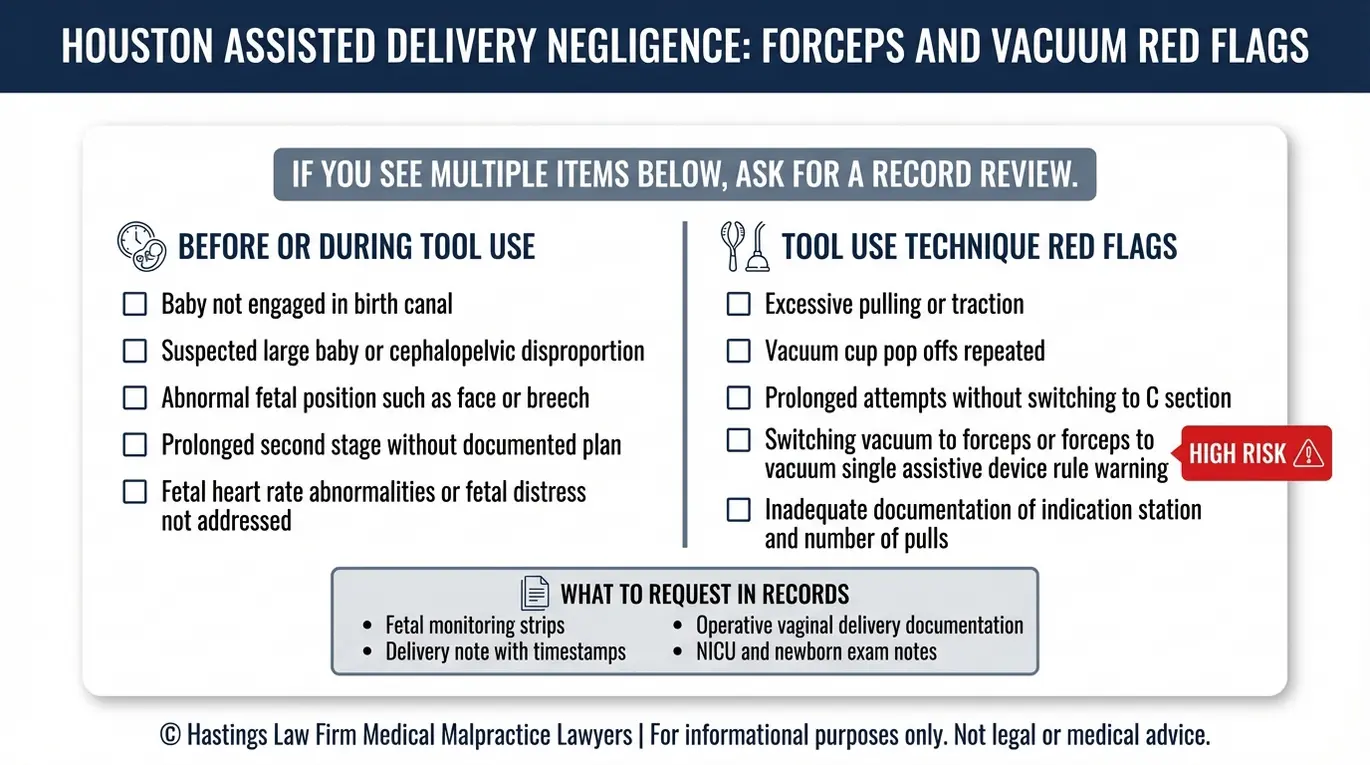
Here are red flags our medical malpractice lawyer team looks for when reviewing negligence in assisted delivery cases:
- The physician proceeded with extraction despite signs of fetal distress
- A vacuum or forceps was applied before full cervical dilation
- Multiple attempts were made with excessive traction force
- The baby’s position or station was not confirmed before instrument use
- CPD was suspected but not addressed before attempting vaginal delivery
- A C-section was delayed or not offered after failed instrument attempts
- Sequential instruments were used (see below)
ACOG Guidelines & The “Single Assistive Device” Rule
The American College of Obstetricians and Gynecologists (ACOG) provides the safety standards doctors must follow when using delivery tools. They have issued clear guidance warning against sequential instrument delivery, which means switching from a vacuum to forceps (or vice versa) after the first device fails. This practice dramatically increases the risk of serious injury to the newborn.
When a vacuum cup detaches from the baby’s scalp, commonly called a vacuum cup “pop-off,” it may indicate that the device is not achieving adequate traction for safe delivery. Rather than switching to forceps and adding compressive force on top of suction-related trauma, the standard of care typically calls for moving to a cesarean delivery.
Medical records that show both instruments were used in the same delivery are something our team examines closely. Sequential use is one of the strongest indicators that the delivery constituted a standard of care deviation.
The Hastings Law Firm Difference
Results matter, but what truly sets us apart is how we achieve them. Every verdict, every settlement, and every Houston courtroom victory comes from one guiding promise: To treat each client’s fight for justice as if it were our own.
This balance of skill, experience, and empathy reflects our core philosophy that justice should not only compensate the injured, but also make health care safer nationwide.

How We Prove Fault in Birth Trauma Lawsuits
We prove fault by securing expert testimony to demonstrate that the obstetrician deviated from the accepted standard of care and directly caused the injury through improper use of extraction tools. Proving fault in a birth trauma lawsuit involves a thorough legal and medical investigation to establish liability.
The Investigation
Our medical team reviews every detail of the labor logs and monitoring data to understand what happened. The process begins with obtaining the complete labor and delivery record, including the fetal heart rate monitoring strip, also called a cardiotocography (CTG) tracing. This provides a continuous record of the baby’s heart rate and the mother’s contractions throughout labor. Signs of fetal distress, such as prolonged heart rate decelerations or loss of variability, are often visible on these strips long before delivery. We also review nursing notes, physician orders, operative reports, and any documentation of conversations about the delivery plan.
The Experts
Expert witnesses are independent medical professionals who review the facts of the case to determine if negligence occurred. Once our in-house medical staff, which includes nurse practitioners and Board Certified Patient Advocates, completes an initial records analysis, we engage our national network of medical experts. An expert witness provides independent opinions on whether the care met or fell below the standard expected of a reasonably competent physician. Their testimony is central to proving birth injury fault in court.
The Insider Edge
Our attorneys use their past experience as defense counsel to anticipate how hospitals will respond to your claim. Our legal team includes former defense counsel who previously represented hospitals in cases like these. That background gives us a clear understanding of how medical facilities document and later justify clinical decisions. We know what to look for in charting inconsistencies and how to counter defense tactics before they are raised.
Texas Statute of Limitations & The Discovery Rule
The statute of limitations is the legal deadline for filing a claim, which varies based on when the injury was found. Texas law generally requires medical malpractice claims to be filed within two years of the date of the negligent act. However, the discovery rule may extend this deadline in cases where the injury was not immediately apparent at birth. Some birth injuries, like developmental delays or neurological conditions, may not become obvious until months or even years later.
Families should also be aware of the statute of repose, which sets an absolute deadline regardless of discovery. For claims involving minors, additional protections may apply. Because these deadlines are strict, early consultation with a birth injury lawyer helps preserve both your legal rights and the medical evidence needed to support the case.

Compensation and Damages for Birth Injuries in Texas
Compensation in Texas birth injury cases covers past and future medical expenses, pain and suffering, and the long-term cost of care for a disabled child. These cases often involve significant financial demands because the injuries can affect a child for their entire life.
Texas law divides recoverable damages into two categories: economic and non-economic.
Economic damages are designed to cover the measurable financial costs of the injury. They include:
- Past and future medical expenses (surgeries, hospitalizations, medications)
- Rehabilitation and physical, occupational, or speech therapy
- Special education and adaptive equipment
- In-home nursing or attendant care
- Lost earning capacity over the child’s lifetime
Under the Texas Civil Practice and Remedies Code § 74.301, there is no cap on economic damages in medical malpractice cases. This means the full cost of your child’s lifetime care can be recovered if liability is established.
Non-economic damages cover the less tangible harms, including physical pain, mental anguish, disfigurement, and loss of quality of life. Texas does impose caps on non-economic damages in medical malpractice claims: up to $250,000 for all individual physicians or healthcare providers and $500,000 total for all healthcare institutions.
A critical part of any birth injury compensation claim is the life care plan. This is a detailed financial projection, typically prepared by a qualified life care planner, that calculates every anticipated cost of raising and supporting a child with conditions like cerebral palsy or brain damage over a full lifetime. According to the Centers for Disease Control and Prevention (CDC), cerebral palsy is one of the most common childhood motor disabilities, and the associated costs of medical care, therapy, and support services are substantial.
A settlement for forceps injury or vacuum-related birth trauma should account for every one of these categories. Our team works to build a damages in medical malpractice case that reflects not just today’s expenses, but decades of future need.
Why Choose Hastings Law Firm for Your Family’s Fight
Hastings Law Firm offers a unique combination of board-certified trial experience and in-house medical expertise, ensuring your case is handled with both legal aggression and clinical precision. We are not a general practice firm that takes the occasional birth injury case. Medical malpractice is all we do.
Our founder, Tommy Hastings, is board certified in Personal Injury Trial Law by the Texas Board of Legal Specialization, a distinction held by fewer than 2% of Texas attorneys. He is a 2025 inductee into the American Board of Trial Advocates (ABOTA) and has been named a Texas Super Lawyer every year since 2013. His Tommy Hastings birth injury advocacy is built on years of experience handling high-stakes medical negligence cases across Texas.
What sets us apart as a Houston medical malpractice firm is how we prepare. Every case is built from day one as though it will go before a jury. We strive to be the best birth injury lawyer team for your family by employing former defense attorneys who once represented hospitals. This gives us direct insight into how the other side thinks and prepares.
Our in-house medical staff, including nurse practitioners and patient advocates, review your records with the same clinical eye that a treating physician would.
We also understand that this is about more than money. Many of the families we represent want answers. They want to know what happened during their child’s delivery and whether it could have been prevented. Tommy Hastings has built this firm around the belief that accountability today can protect another family tomorrow.
There is no financial risk to get started. We work on a contingency fee basis, which means you pay no attorney fees or costs unless we recover compensation on your behalf. Your consultation is free and confidential.
Contact the Houston Birth Injury Attorneys at Hastings Law Firm Today for Help
Medical evidence in birth injury cases can degrade or become harder to access over time. Fetal monitoring strips, delivery room records, and nursing notes are all time-sensitive, and early action gives your legal team the best opportunity to preserve what matters most.
At Hastings Law Firm, you are not a case number. You are a partner in the process, and we treat your family’s experience with the care and respect it deserves. Our team of Houston birth injury attorneys combines medical knowledge with courtroom preparation to pursue accountability on your behalf.
Contact us today to schedule your free, confidential consultation. There is no fee unless we win.
Frequently Asked Questions About Forcep & Vacuum Birth Injury in Houston


This content was researched and written by the Hastings Law Firm editorial team, which includes attorneys, medical professionals, and experienced researchers. Our writing is informed by internal knowledge and practical experience, and we cross-check critical details against authoritative sources cited throughout. Every piece undergoes human-led fact-checking and legal review. Because legal and medical information can change, if you spot an error, please contact us. Learn more about our content standards and review process on our editorial policy page.

Tommy Hastings, founder of Hastings Law Firm, is a board-certified personal injury trial lawyer dedicated exclusively to healthcare injury cases. Since 2001, he has represented injured patients and families in litigation against major hospital systems, pharmaceutical companies, and negligent healthcare providers nationwide. He has handled numerous high-profile cases that have drawn national media attention and resulted in multi-million dollar recoveries. He draws on that experience in his writing, helping readers understand how these cases work and what options may be available to them.
