


Houston C Section Malpractice Lawyer
Negligent C section care can leave a mother or baby facing lasting harm, unanswered questions, and a difficult recovery. This topic involves preventable errors tied to timing, surgical technique, anesthesia management, monitoring, and infection control, along with disputes over whether a complication was an accepted risk or a deviation from the standard of care. The long term impact can involve chronic pain, loss of fertility, psychological trauma, or severe injury to a child that requires lifelong support. If you or a loved one were harmed or worse due to C section malpractice in Houston, Texas, contact Hastings Law Firm for a free, confidential case review.
Last Updated: July 27, 2026
Houston Medical Attorneys for Negligent C-Section Complications
A Cesarean section is one of the most common surgical procedures in the United States. When performed correctly and at the right time, it can be lifesaving for both mother and child. But when medical professionals make preventable errors before, during, or after the procedure, the consequences can be devastating and permanent.
If you or your baby suffered harm during a C-section delivery in Houston, you may be dealing with physical pain, emotional distress, and questions that no one at the hospital has been willing to answer. You deserve to know what happened and whether the care you received fell below the standard your medical team was required to meet.
As a Houston C Section Injury Lawyer team that focuses exclusively on medical malpractice, Hastings Law Firm can review your records, identify what went wrong, and explain your legal options. Founded by Tommy Hastings, a board-certified trial lawyer, we provide specialized advocacy for families in crisis. Contact us for a free, confidential case evaluation.

Identifying Negligence: Common Causes of C-Section Injuries
Medical negligence during a C-section occurs when a healthcare provider deviates from the accepted standard of care, the level of treatment a reasonably competent professional would have provided under similar circumstances, resulting in preventable harm to the mother or child. Identifying these causes is the first step in determining if the care you received met medical standards. These cases often involve surgical errors, failure to monitor warning signs, or delayed decision-making at critical moments.
Not every complication means malpractice occurred. Childbirth carries inherent risks. But when a preventable error causes injury, families have the right to seek legal help for cesarean injuries and hold the responsible parties accountable.
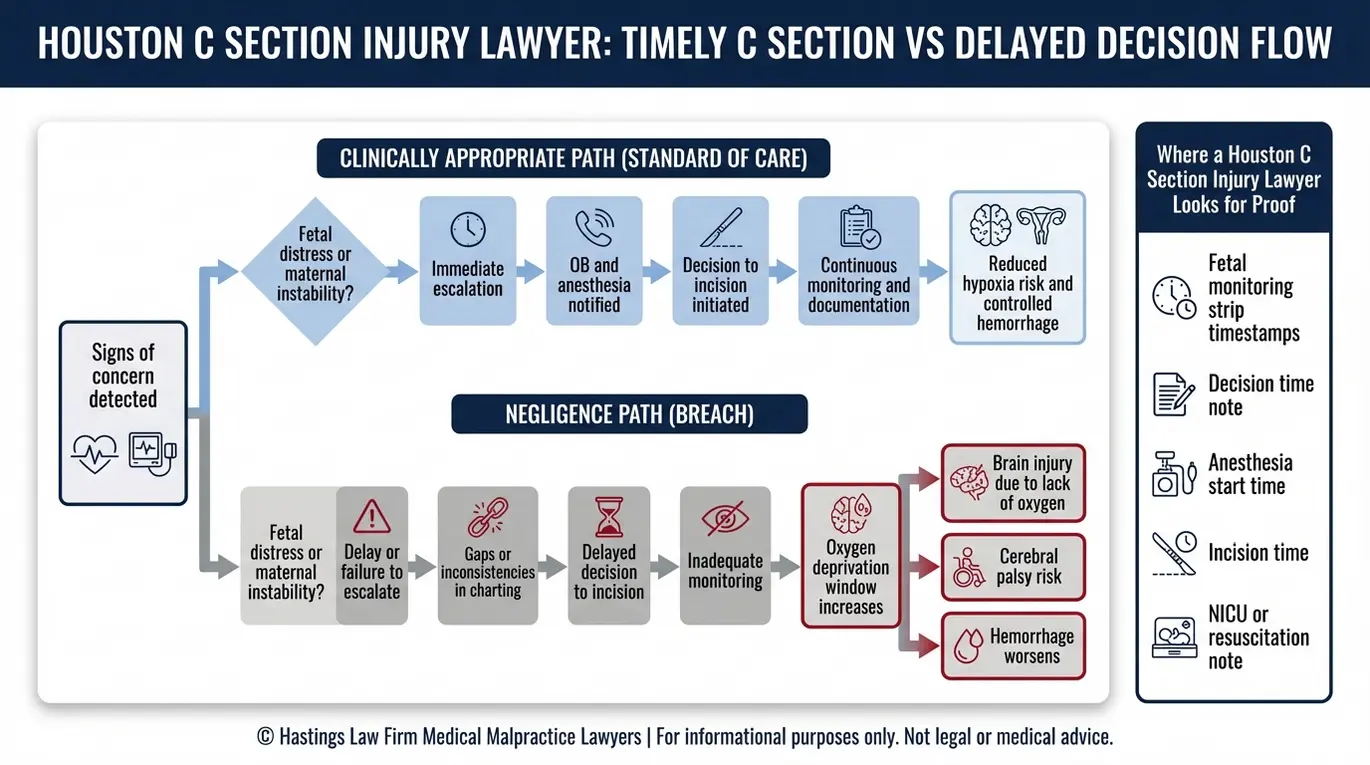
Failure to perform a timely C-section is one of the most common causes of birth injuries we investigate. When a baby is in distress and oxygen supply is compromised, every minute matters. The decision-to-incision interval, the time between the medical team’s decision to perform a C-section and the first surgical cut, is a recognized benchmark in obstetric care.
A study published in PubMed Central on decision-to-incision intervals confirms that delays beyond accepted timeframes significantly increase the risk of fetal harm, including hypoxia and cerebral palsy.
Other common causes of C-section injuries include:
- Surgical technique errors: Mistakes during the incision or extraction process, such as lacerations to the uterus or surrounding tissue, or improper handling of the infant during delivery.
- Failure to monitor: Ignoring or misreading signs of fetal distress on electronic fetal monitoring strips, or failing to respond to maternal hemorrhage.
- Uterine rupture mismanagement: Uterine rupture, a tear in the wall of the uterus, is a life-threatening emergency. When prior surgical history or labor patterns increase this risk, the standard of care typically requires close monitoring and rapid intervention.
A C-section injury attorney can help determine whether the medical team’s actions, or inactions, crossed the line from an accepted risk into negligence. Our team, which includes in-house nurses and former defense attorneys, examines fetal monitoring strips, operative notes, and nursing logs to reconstruct a minute-by-minute timeline of what happened. As a Houston malpractice lawyer team built for these cases, we know exactly where to look.
Surgical Errors and Complications Requiring Legal Action
Actionable surgical errors often involve accidental lacerations to nearby organs, improper suturing that leads to hemorrhage, or the retention of foreign objects inside the patient’s body. Surgical errors refer to preventable physical injuries occurring during the operation that fall outside the expected risks of surgery. These are not “known risks” that a patient simply accepts; they are preventable mistakes that fall below the standard of care.
The uterus sits in close proximity to several vital structures. When a surgeon is careless or rushed, significant organ damage can occur, leading to life-altering complications. We investigate whether these errors stemmed from fatigue, lack of training, or a failure to visualize the surgical field properly.
Bladder and bowel injuries are among the most common organ-related complications of a C-section. A bladder injury, a laceration occurring when the surgical instrument cuts or tears the bladder wall, typically happens near the lower uterine segment. A bowel injury, accidental damage to the intestines sometimes caused by adhesions from prior surgeries or by errors in technique, can be even more dangerous if undetected.
Research on risk factors for bladder injuries during cesarean sections (PubMed) identifies multiple preventable causes, including failure to properly identify anatomical landmarks and inadequate surgical technique. These injuries can require additional surgeries, prolonged hospital stays, and long-term complications.
| Injury Type | How It Occurs | Potential Consequences |
|---|---|---|
| Bladder injury | Laceration during uterine incision or adhesion dissection | Urinary complications, additional surgery, chronic pain |
| Bowel injury | Accidental perforation during entry or closure | Infection, sepsis, colostomy, extended hospitalization |
| Nerve damage | Compression or severing of femoral or ilioinguinal nerves by retractors or incision placement | Numbness, chronic pain, difficulty walking |
| Vascular injury | Damage to uterine or pelvic blood vessels | Postpartum hemorrhage, blood clots, emergency transfusion |
Vascular injuries during a C-section can lead to uncontrolled bleeding that requires emergency intervention. When a surgical team fails to manage hemorrhage promptly, blood loss can become life-threatening. This type of postpartum hemorrhage is one of the leading causes of maternal death in the United States.
Nerve damage is another injury we evaluate in C-section cases. Femoral or ilioinguinal nerve injuries can result from improper retractor placement or an incision that extends beyond the intended surgical field. These injuries may cause lasting numbness, weakness, or chronic pain.
If you experienced any of these complications, a C-section injury lawyer at our firm can review the operative report and determine whether a cesarean section malpractice attorney consultation is your right next step. A surgical error lawyer with experience in obstetric cases understands how to connect these injuries to specific deviations in technique.

The Hastings Law Firm Difference
Results matter, but what truly sets us apart is how we achieve them. Every verdict, every settlement, and every Houston courtroom victory comes from one guiding promise: To treat each client’s fight for justice as if it were our own.
This balance of skill, experience, and empathy reflects our core philosophy that justice should not only compensate the injured, but also make health care safer nationwide.

Anesthesia Malpractice During Cesarean Deliveries
Anesthesia errors during childbirth can lead to permanent brain damage, aspiration pneumonia, or spinal cord injuries if the anesthesiologist fails to calculate dosages correctly or monitor vital signs throughout the procedure. Anesthesia malpractice involves mistakes in administering numbing medications or monitoring the patient’s vitals during the procedure.
Most C-sections are performed under regional anesthesia. A spinal block, a single injection of anesthetic into the spinal fluid, or epidural anesthesia, medication delivered through a catheter placed in the epidural space near the spinal cord, is designed to numb the lower body while the mother remains conscious. When these procedures are performed incorrectly, resulting in epidural errors or spinal complications, the results can be catastrophic.
Dosage errors are a frequent source of harm. Too much medication can suppress the mother’s breathing or cause a dangerous drop in blood pressure. Too little may leave the patient partially aware during surgery, causing severe psychological trauma. Either scenario can also affect the baby’s heart rate and oxygen supply.
Intubation errors occur when general anesthesia is required and the breathing tube is mistakenly placed in the esophagus instead of the trachea. This can cut off the mother’s oxygen supply within minutes, leading to brain injury due to lack of oxygen.
Monitoring failures round out many anesthesia injury claims. An anesthesiologist is responsible for continuously tracking blood pressure, heart rate, and oxygen levels. A failure to react to rapid changes, particularly sudden drops in blood pressure after a spinal block, can cause lasting harm to both mother and baby.
If you believe an anesthesia error contributed to your injury, an anesthesia injury lawyer at our team works with anesthesia experts to evaluate whether the standard of care was met. As a malpractice attorney team in Houston, we understand the technical details these cases require.
Liability for Postoperative Infections and Sepsis
Hospitals and staff may be liable for infections if they failed to maintain sterile fields, used unsterilized equipment, or ignored early signs of infection that progressed to life-threatening sepsis. Postoperative infections involve the entry of harmful bacteria into the body due to failures in sterile protocol.
A surgical site infection, or SSI, an infection that develops at or near the incision after surgery, requires immediate attention. While some infection risk exists with any procedure, the standard of care requires strict sterile protocols before, during, and after a C-section to minimize that risk. When those protocols break down, the results can be dangerous.
Sterilization failures are among the most preventable causes of postoperative infection. Contaminated surgical instruments or a breach in the sterile field can introduce bacteria directly into the surgical wound or abdominal cavity. Deep tissue infections and necrotizing fasciitis, a rapidly spreading infection that destroys soft tissue, can develop when these failures go unrecognized.
Post-operative care negligence is equally important. Nursing staff are responsible for monitoring vital signs, changing dressings, and watching for early indicators of infection. Guidelines from Overlake Medical Center on recovering after a C-section outline standard post-operative care protocols, including incision monitoring and temperature tracking. When these steps are missed, a localized infection can escalate.
Sepsis, a condition where the body’s response to infection becomes systemic, potentially causing organ failure and death, is a medical emergency. Delayed diagnosis of sepsis is a common basis for a hospital negligence lawyer to pursue a claim.
Warning signs that may indicate a postoperative infection requiring immediate medical attention:
- Fever above 100.4°F, especially within the first few days after delivery
- Increasing redness, swelling, or warmth around the incision
- Foul-smelling drainage from the wound
- Worsening abdominal pain not explained by normal recovery
- Rapid heart rate or difficulty breathing
- Confusion or disorientation
If your medical team failed to recognize or respond to these symptoms, an infection injury attorney at our firm can evaluate whether that delay constituted negligence.

Long-Term Impacts: Why Compensation Must Cover Lifetime Care
C-section injuries often result in chronic pain, infertility, or psychological trauma, requiring compensation that accounts for decades of future medical treatment and therapy. Future care needs often include ongoing physical therapy, medications, and specialized support for long-term recovery. A case evaluation that only considers current medical bills will almost always undervalue the true scope of harm.
Physical permanence is a reality for many mothers injured during a C-section. Adhesions, bands of scar tissue that form between abdominal organs after surgery, can cause chronic pain, bowel obstruction, and complications in future pregnancies. In the most severe cases, surgical errors lead to an emergency hysterectomy, permanently ending a woman’s ability to have children. These are losses that extend far beyond the operating room.
Psychological trauma is an often overlooked but significant consequence of a traumatic birth. A study published in PubMed on postpartum PTSD following emergency cesarean sections found that mothers who experienced emergency C-sections had elevated rates of postpartum post-traumatic stress disorder, a condition marked by flashbacks, anxiety, emotional numbness, and difficulty bonding with their newborn.
The psychological impacts of such an event can be debilitating. Depression, panic disorders, and fear of future pregnancies are also common. These conditions require specialized treatment, sometimes for years.
When the child is also injured, the financial picture changes dramatically. Babies who suffer brain injury due to lack of oxygen during delivery may be diagnosed with cerebral palsy, a condition requiring lifelong physical therapy, adaptive equipment, and round-the-clock care. Erb’s palsy and other brachial plexus injuries can limit arm function and require multiple surgeries. As a Houston birth injury lawyer team, we work with life care planners and economists to calculate the full cost of a child’s future needs.
A long-term disability attorney assessment should include both the mother’s and child’s projected care costs, therapy, lost earning capacity, and the emotional toll on the entire family.
Liability in Houston Hospitals: Suing Doctors vs. Facilities
Liability can extend to the attending obstetrician for surgical errors, the hospital for corporate negligence regarding staffing or policies, and nurses for failure to monitor the patient. In Texas, legal liability depends on whether the injury was caused by the doctor, the hospital staff, or institutional policies. Identifying the correct defendants is one of the most important steps in building a strong case.
- The doctor is often the first person families think about when considering a lawsuit. However, a critical legal distinction in Texas is whether the physician is a hospital employee or an independent contractor. Many obstetricians maintain independent practices and hold privileges at a hospital without being employed by it.
This distinction affects vicarious liability, determining whether the hospital can be held responsible for the doctor’s actions. A medical liability lawyer experienced in Texas medical malpractice cases will investigate these employment relationships early.
- The hospital can be held separately liable under a theory of corporate negligence. This applies when the facility itself created unsafe conditions, such as inadequate nurse-to-patient ratios, failure to enforce safety protocols, defective equipment, or failure to properly credential its physicians. Suing a hospital in Houston requires demonstrating that institutional decisions, not just individual mistakes, contributed to the injury. We investigate hospital & facility negligence to ensure no responsible party is overlooked.
- The nurses may also bear individual liability in some cases. If a nurse failed to escalate concerns about a patient’s deteriorating condition, administered the wrong medication, or did not properly document changes in maternal or fetal status, that failure can be an independent basis for a claim.
In many C-section malpractice cases, multiple defendants share responsibility. A doctor malpractice attorney at our firm works alongside our in-house medical staff to trace each failure to the responsible party, whether that is an individual provider, the hospital system, or both.
Calculated Damages: Recovering Financial and Non-Economic Losses
Patients who have been harmed by C-section malpractice may recover economic damages for medical bills and lost wages, as well as non-economic damages for pain, suffering, and physical impairment. Damages are the legal method for compensating a patient for both financial and non-economic losses stemming from medical errors. Understanding the full scope of recoverable losses is essential to protecting your family’s future.
The concept of “two plaintiffs” is something many families do not realize at first. In a C-section injury case, both the mother and the child may have separate, independent legal claims. The mother’s claim may cover her surgical injuries, emotional distress, lost income, and loss of fertility. The child’s claim, if the baby was also harmed, may cover brain injury treatment, developmental therapy, adaptive care, and diminished earning capacity over a lifetime. A Houston injury lawyer experienced in birth injury cases will evaluate both claims together to ensure nothing is overlooked.
Economic damages include measurable financial losses:
- Past and future medical expenses, including surgeries, rehabilitation, and ongoing therapy
- Lost wages and diminished earning capacity
- Home modifications or assistive equipment for a disabled child
- Cost of in-home nursing or professional caregiving
Non-economic damages compensate for losses that do not carry a specific price tag but are deeply felt:
- Physical pain and suffering
- Mental anguish and emotional distress
- Disfigurement or physical impairment
- Loss of consortium, the impact on the relationship between spouses
- Loss of enjoyment of life
In rare cases involving egregious conduct, punitive damages may also be available. These are designed not to compensate but to deter similar behavior in the future.
Calculating fair compensation for c-section injury claims requires careful analysis by medical experts, economists, and life care planners. A medical malpractice settlement should reflect the true cost of what happened, not just the bills that have already arrived.
The Litigation Process: From Investigation to Trial in Harris County
The process begins with a thorough record review by medical experts, followed by filing a lawsuit, engaging in discovery and depositions, and proceeding to trial if a fair settlement is not offered. We handle every phase of the legal procedure, from the initial medical review through the final resolution in court.
Here is how a C-section lawsuit process typically unfolds at Hastings Law Firm:
- Free case evaluation. Our patient advocates conduct a confidential screening to understand what happened and gather your medical records. This initial step costs you nothing and helps us determine whether your case meets the legal threshold for negligence.
- Medical investigation. Once we accept a case, our in-house nursing staff and outside medical experts conduct a detailed review of all records, including fetal monitoring strips, operative notes, anesthesia logs, and nursing charts. We build a minute-by-minute timeline to identify where the standard of care was breached.
- Expert report and filing. Texas law imposes specific requirements before a medical malpractice lawsuit can proceed. Under Texas Civil Practice and Remedies Code, Section 74.351, a plaintiff must serve a qualified expert report within 120 days of the defendant’s original answer being filed, often referred to in other jurisdictions as an affidavit of merit, detailing the standard of care, the breach, and how it caused the injury. Meeting this requirement is non-negotiable, and our team prepares these reports with precision.
- Discovery and depositions. Both sides exchange evidence, take sworn testimony from witnesses, and retain expert witnesses. In this phase, our former defense attorneys provide a distinct advantage; they know the strategies hospitals use and how to counter them effectively.
- Settlement negotiation or trial. We prepare every case as if it will go before a jury. This trial-ready approach puts us in the strongest possible position during settlement discussions. If the other side does not offer fair compensation, we are fully prepared to present your case at trial in Harris County.
As a medical malpractice trial lawyer team, we handle every step so you can focus on your family’s recovery.
Contact the Houston Birth Injury Attorneys at Hastings Law Firm Today for Help
Bringing a C-section injury claim is about more than compensation. It is about finding out what happened, holding the responsible parties accountable, and helping prevent the same mistakes from affecting another family.
At Hastings Law Firm, our entire team, including board-certified trial attorneys, in-house nurses, and former defense counsel, is dedicated exclusively to medical malpractice cases. We understand the medical details, the legal requirements, and the emotional weight of what you are going through.
We work on a contingency fee basis, which means you pay no attorney fees or costs unless we recover compensation for you. There is no financial risk in reaching out.
If you or your child were harmed during a C-section in Houston, contact us for a free, confidential case evaluation. Let us review your records, explain your options, and help you take the first step forward.
Frequently Asked Questions About C-Section Malpractice in Houston


This content was researched and written by the Hastings Law Firm editorial team, which includes attorneys, medical professionals, and experienced researchers. Our writing is informed by internal knowledge and practical experience, and we cross-check critical details against authoritative sources cited throughout. Every piece undergoes human-led fact-checking and legal review. Because legal and medical information can change, if you spot an error, please contact us. Learn more about our content standards and review process on our editorial policy page.

Tommy Hastings, founder of Hastings Law Firm, is a board-certified personal injury trial lawyer dedicated exclusively to healthcare injury cases. Since 2001, he has represented injured patients and families in litigation against major hospital systems, pharmaceutical companies, and negligent healthcare providers nationwide. He has handled numerous high-profile cases that have drawn national media attention and resulted in multi-million dollar recoveries. He draws on that experience in his writing, helping readers understand how these cases work and what options may be available to them.
