


Texas Rh Incompatibility Birth Injury Lawyer
Written by: Hastings Law Firm | Reviewed by: Tommy Hastings | Updated: July 27, 2026
Rh incompatibility is a pregnancy related risk that is often preventable when providers screen early and respond with timely treatment. When screening is missed, results are ignored, or preventative medication is not given, a baby can suffer severe injury that may lead to lifelong complications or worse. Families may also face confusion when Rh issues are mistaken for other blood group incompatibilities, delaying appropriate monitoring and care. If you or a loved one were harmed or worse due to Rh incompatibility birth injury in Texas, contact Hastings Law Firm for a free, confidential case review.

Top Rated Medical Malpractice Attorneys for Preventable Rh Disease Injuries
What You Should Know About Infant Rh Disease Claims in Texas:
- Lifelong harm can result when Rh related risks are missed during pregnancy because preventable sensitization can progress to severe newborn injury.
- Accountability can turn on whether prenatal blood type screening was performed and acted on because missed or ignored results can leave a preventable risk untreated.
- Severe outcomes can follow when preventative medication is not given at key points because the window to prevent antibody formation can close.
- Catastrophic newborn injury can develop when rising bilirubin is not treated promptly because toxic levels can cause permanent brain damage.
- Treatment options can narrow when severe fetal anemia is not detected because delayed intervention can lead to heart failure and oxygen deprivation.
- Disputes may focus on whether the correct medication dose was given because under dosing can occur when fetomaternal hemorrhage is not properly assessed.
- Options for recovery can be limited by Texas timing rules because missed filing windows can reduce or eliminate available claims.
- Proof often depends on complete prenatal and delivery records because lab results and clinical notes can show missed screening or delayed response.

A Healthcare Focused Law Firm
When a baby is harmed by a condition that should have been caught and treated during pregnancy, the emotional weight can feel crushing. Rh incompatibility is one of those conditions. With proper screening and a simple injection, the most severe outcomes are almost entirely preventable. If your child suffered a birth injury because a provider missed or ignored Rh-related risks, you are not imagining what went wrong, and you are not alone in wanting answers.
As a Texas Rh incompatibility birth injury lawyer, Tommy Hastings and the medical-legal team at Hastings Law Firm focus exclusively on cases like these. Our in-house nurse consultants and former defense attorneys know how to examine prenatal records, identify gaps in care, and build a case that holds the responsible provider accountable. If you believe your child’s injury could have been prevented, we welcome the chance to review what happened and explain your options in a free, confidential consultation.
Understanding Rh Incompatibility and Medical Liability in Texas
Rh incompatibility becomes medical malpractice when a healthcare provider fails to screen for blood type differences between mother and fetus or neglects to administer preventative treatment, leading to severe injury.
Rh incompatibility occurs when a mother’s blood type does not match her baby’s. The Rh factor, a protein called the Rhesus D antigen found on the surface of red blood cells, determines whether a person’s blood type is Rh-positive or Rh-negative.
When an Rh-negative mother carries an Rh-positive baby, her immune system may recognize the baby’s blood cells as foreign and begin producing antibodies against them. This process, known as Rh sensitization (or maternal alloimmunization), can cause those maternal antibodies to cross the placenta and attack the baby’s red blood cells, leading to hemolytic disease of the newborn.
Identifying this risk is a fundamental part of prenatal care. A simple blood test early in pregnancy reveals whether the mother is Rh-negative. If she is, her provider should take steps to prevent sensitization before it causes harm. When that screening is missed or the results are ignored, the consequences can be devastating.
We also distinguish Rh incompatibility from a related but typically milder condition. A Texas birth injury lawyer for Rh incompatibility may also evaluate whether ABO blood group differences contributed to a baby’s injury:
- Rh incompatibility occurs when the mother is Rh-negative and the baby is Rh-positive. It often worsens with each subsequent pregnancy if untreated and can cause severe hemolytic disease.
- ABO incompatibility involves differences in the A, B, or O blood groups between mother and baby. It is generally milder and can appear in a first pregnancy, but it still requires monitoring to prevent complications such as jaundice.
Both conditions demand proper screening and timely response. When providers fail to meet that standard, families have the right to seek accountability.

Failure to Administer RhoGAM and Establishing Negligence
Negligence is often established by proving the provider failed to administer Rh immune-globulin (RhoGAM) at 28 weeks, within 72 hours of delivery, or following abdominal trauma.
Medical standards require specific testing to identify blood protein differences early in pregnancy. The U.S. Preventive Services Task Force recommends that all pregnant women be screened for Rh(D) blood type early in pregnancy.
For Rh-negative mothers carrying an Rh-positive baby, the standard of care generally requires a RhoGAM injection at 28 weeks of gestation and again within 72 hours after delivery. This medication prevents the mother’s immune system from producing antibodies that could harm the baby in the current or future pregnancies.
An Rh incompatibility lawyer in Texas will typically look for missed opportunities at specific points during the pregnancy and delivery. These are the most common breakdowns we evaluate:
- No blood testing or type screening performed at the initial prenatal visit
- RhoGAM not administered at 28 weeks of gestation
- RhoGAM not given within 72 hours of delivery
- No injection after a sensitizing event such as amniocentesis, chorionic villus sampling, or abdominal trauma
- No injection following vaginal bleeding, miscarriage, or ectopic pregnancy
- Failure to screen in surrogacy or assisted reproduction cases where the carrier’s Rh status may be overlooked
Each of these represents a point where the standard of care required action. When the provider’s records show the step was skipped, that gap becomes central to the negligence analysis and may constitute medical malpractice.
An indirect Coombs test, also called an antibody screen or antibody titer, is used to detect whether the mother has already developed Rh antibodies. If a provider fails to order this test or fails to act on elevated results, the window for prevention may close.
Diagnostic Failures and the Kleihauer-Betke Test
In some cases, the failure is not just about whether RhoGAM was given, but whether the correct dose was administered. The Kleihauer-Betke test measures the volume of fetal blood that has entered the mother’s circulation, a condition called fetomaternal hemorrhage. This test helps determine if a standard dose of RhoGAM is sufficient or if additional doses are needed.
When providers skip this test after a traumatic event or significant bleeding, they risk under-dosing the medication. That can leave the mother partially unprotected, allowing sensitization to occur despite receiving some treatment, potentially causing severe anemia that necessitates a blood transfusion. We examine lab records and clinical notes closely to determine whether this screening step was missed or its results were ignored.

The Hastings Law Firm Difference
Results matter, but what truly sets us apart is how we achieve them. Every verdict, every settlement, and every Texas courtroom victory comes from one guiding promise: To treat each client’s fight for justice as if it were our own.
This balance of skill, experience, and empathy reflects our core philosophy that justice should not only compensate the injured, but also make healthcare safer nationwide.

Severe Birth Injuries Caused by Untreated Rh Disease
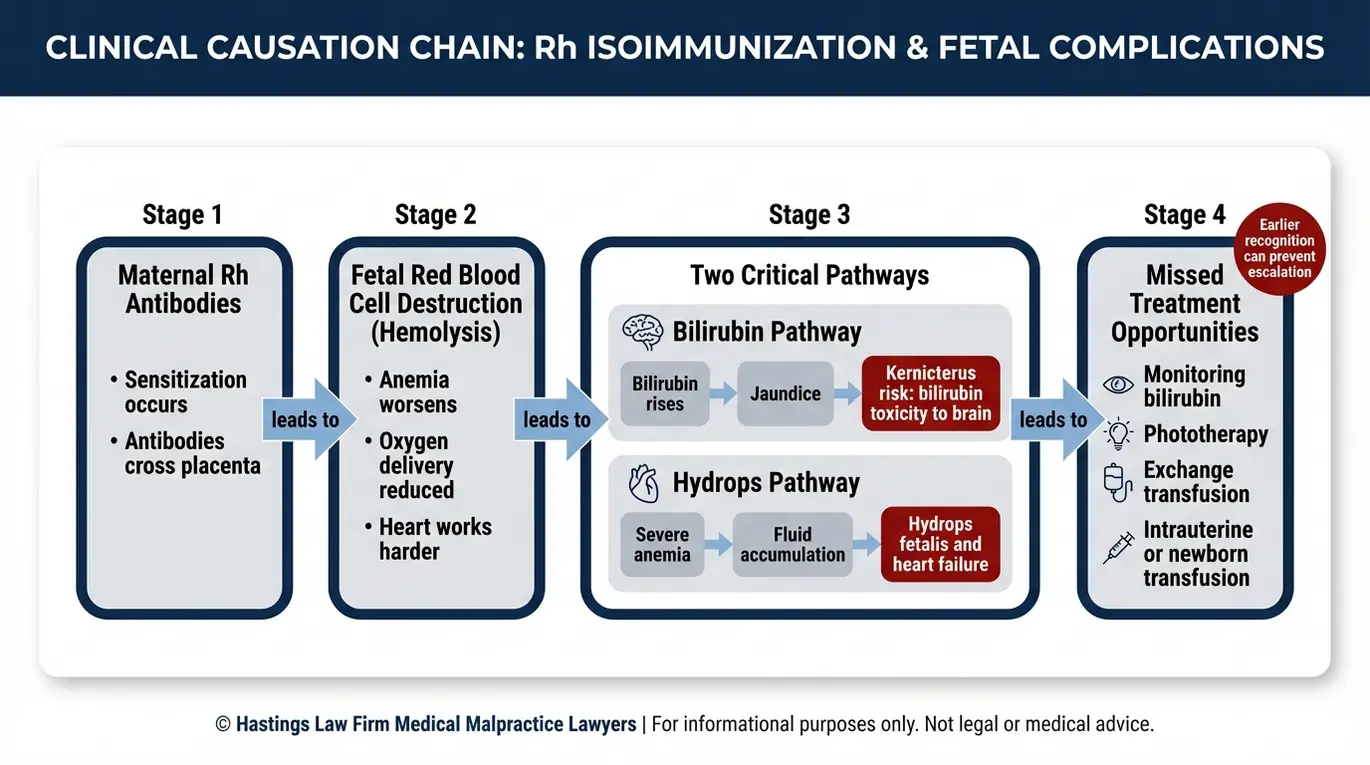
Untreated Rh disease can escalate to hemolytic disease of the newborn, causing severe anemia, heart failure, and permanent brain damage known as kernicterus due to toxic bilirubin levels.
Jaundice is the yellowing of skin and eyes caused by high bilirubin levels. When maternal antibodies destroy the baby’s red blood cells, those cells release a substance called bilirubin. In small amounts, bilirubin is processed naturally.
But when red blood cells are being destroyed faster than the baby’s body can clear the bilirubin, it builds up to dangerous levels, a condition called hyperbilirubinemia. The first visible sign is usually jaundice, a yellowing of the skin and eyes.
If jaundice is not treated promptly with phototherapy or, in more severe cases, an exchange blood transfusion, bilirubin can cross into the brain. The result is kernicterus, a form of permanent brain damage that can cause hearing loss, movement disorders, intellectual disability, and cerebral palsy. Kernicterus is preventable when providers recognize rising bilirubin levels and act quickly.
In the most severe cases, untreated Rh disease leads to hydrops fetalis, a life-threatening condition in which fluid accumulates in the baby’s tissues and organs. The baby’s heart is forced to work harder to compensate for severe fetal alloimmune hemolytic anemia, often leading to heart failure and oxygen deprivation. Without intervention, hydrops fetalis can be fatal.
| Stage | Condition | What Happens |
|---|---|---|
| Early | Jaundice / Hyperbilirubinemia | Bilirubin rises as red blood cells are destroyed faster than the body can process |
| Progressing | Severe Anemia | The baby lacks enough healthy red blood cells to carry oxygen |
| Advanced | Kernicterus | Excess bilirubin crosses the blood-brain barrier, causing permanent brain damage |
| Critical | Hydrops Fetalis | Fluid accumulates in organs and tissues; heart failure and oxygen deprivation follow |
At each stage, there are treatment options that can reduce or prevent further harm. An Rh birth injury attorney evaluates whether the provider identified these warning signs and responded appropriately, or whether missed monitoring and delayed treatment allowed a treatable condition to become catastrophic.
Contact the Texas Birth Injury Attorneys at Hastings Law Firm Today for Help
Rh incompatibility injuries are among the most preventable birth injuries in modern medicine. A blood test and a well-timed injection are often all it takes to protect both mother and baby. When that basic standard is not met, families deserve to know why.
If your child suffered harm that you believe was caused by missed Rh screening or a failure to administer RhoGAM, Tommy Hastings and his team are ready to listen. Our in-house medical staff reviews your records, identifies where the standard of care may have been breached, and works with qualified experts to build a clear picture of what happened.
As a Texas Rh incompatibility birth injury lawyer, Tommy Hastings has spent over two decades holding negligent providers accountable and helping families secure the resources their children need going forward. There is no fee unless we recover compensation for you. Contact Hastings Law Firm today for a free, confidential case evaluation.
Frequently Asked Questions About Rh Incompatibility Birth Injury in Texas


This content was researched and written by the Hastings Law Firm editorial team, which includes attorneys, medical professionals, and experienced researchers. Our writing is informed by internal knowledge and practical experience, and we cross-check critical details against authoritative sources cited throughout. Every piece undergoes human-led fact-checking and legal review. Because legal and medical information can change, if you spot an error, please contact us. Learn more about our content standards and review process on our editorial policy page.

Tommy Hastings, founder of Hastings Law Firm, is a board-certified personal injury trial lawyer dedicated exclusively to healthcare injury cases. Since 2001, he has represented injured patients and families in litigation against major hospital systems, pharmaceutical companies, and negligent healthcare providers nationwide. He has handled numerous high-profile cases that have drawn national media attention and resulted in multi-million dollar recoveries. He draws on that experience in his writing, helping readers understand how these cases work and what options may be available to them.
