


Fort Worth Pediatric Malpractice Lawyer
Written by: Hastings Law Firm | Reviewed by: Gabe Sassin | Updated: July 27, 2026
Pediatric medical malpractice claims often involve complex questions about whether a child received age appropriate care in diagnosis, dosing, monitoring, or treatment. Because children process medications differently and can show warning signs in different ways than adults, errors can lead to lasting injury, developmental delays, or fatal outcomes. Responsibility may involve individual clinicians, hospitals, or broader system failures such as staffing and communication breakdowns. Texas rules on proof, damages, and timing can also shape what recovery is possible. If your child suffered harm due to pediatric medical malpractice in Fort Worth, Texas, contact Hastings Law Firm for a free, confidential case review.

Trusted Fort Worth Medical Attorneys for Pediatric Negligence Claims
What You Should Know About Pediatrician Negligence Claims in Fort Worth:
- Long term harm can result when pediatric care fails to account for age specific physiology in diagnosis, dosing, and monitoring.
- Permanent developmental impacts can follow delayed diagnosis because early treatment windows can close before an error is recognized.
- Severe outcomes can occur from pediatric medication dosing mistakes because children are more susceptible to toxicity.
- Liability can extend beyond a pediatrician to hospitals, nurses, and pharmacists when staffing, protocols, or dispensing errors contribute to harm.
- Recovery can be limited for non economic losses in Texas even when a child has significant pain, suffering, or impairment.
- Options can narrow if timing rules are missed because some parts of a family recovery can be barred even when a minor claim remains viable.
- Case viability can turn on contested causation because defenses often attribute injury to genetics, complications, or disease progression.
- Accountability can depend on whether clinical documentation shows missed warning signs such as abnormal fetal monitoring or age specific vital sign cues.

A Healthcare Focused Law Firm
When you or a loved one has a child who has been harmed by the people you trusted to help them, the confusion and grief can feel paralyzing. You may not know exactly what went wrong, but you know something did, and you deserve answers. At Hastings Law Firm, we focus exclusively on medical malpractice, and we understand the unique medical and legal challenges that arise when a child is the one who was hurt. Our team of attorneys, nurse consultants, and medical staff works together to uncover the truth and protect your family’s future.
If you or a loved one has a child who was injured by negligent medical care, a Fort Worth Pediatric Malpractice Lawyer at our firm can review what happened and explain your options during a free, confidential case evaluation.
Defining Pediatric Medical Malpractice in Texas Courts
Pediatric medical malpractice occurs when a healthcare provider deviates from the accepted standard of care for a child, directly causing injury or worsening a condition. Under the Civil Practice and Remedies Code Chapter 74, a medical malpractice claim in Texas requires proof of negligence. You must show the provider failed to meet the level of care a reasonably competent professional would have delivered under similar circumstances. This legal standard is rigorous. It requires demonstrating that the actions taken were not just unsuccessful, but were actions that no prudent doctor would have taken given the information available at the time.
For children, that standard carries additional weight. A child’s body is not simply a smaller version of an adult’s. Pediatric pharmacokinetics, the way a child’s body absorbs, distributes, and metabolizes medication, differs significantly from adult physiology.
Because a child’s drug metabolism rates can differ substantially from an adult’s and their developing organ systems may respond differently to medications, they are more susceptible to toxicity from incorrect medication dosages. A standard of care breach typically involves failing to recognize these distinct physiological needs. Organ systems are still developing, and vital signs operate in different ranges. These biological realities mean that health care professionals treating children are expected to account for age-specific factors in every clinical decision, from diagnosis to dosing to monitoring.
The legal threshold for medical negligence requires showing that a provider breached this duty and that the breach directly caused harm. It is not enough that a bad outcome occurred. The question is whether the care fell below what a qualified pediatric professional should have provided.
For many families, the hardest part is reconciling the trust they placed in their child’s doctor with the reality of negligent care. When parents bring a sick child to a hospital, they hand over total control to the medical team. This vulnerability makes negligence devastating.
Parents rely on physicians to act in their child’s best interest. When that trust is violated, the emotional toll compounds the physical injury. Our Fort Worth pediatric malpractice attorneys understand both the medical details and the human impact, and we investigate every case with that dual focus.
Common Medical Errors That Harm Children
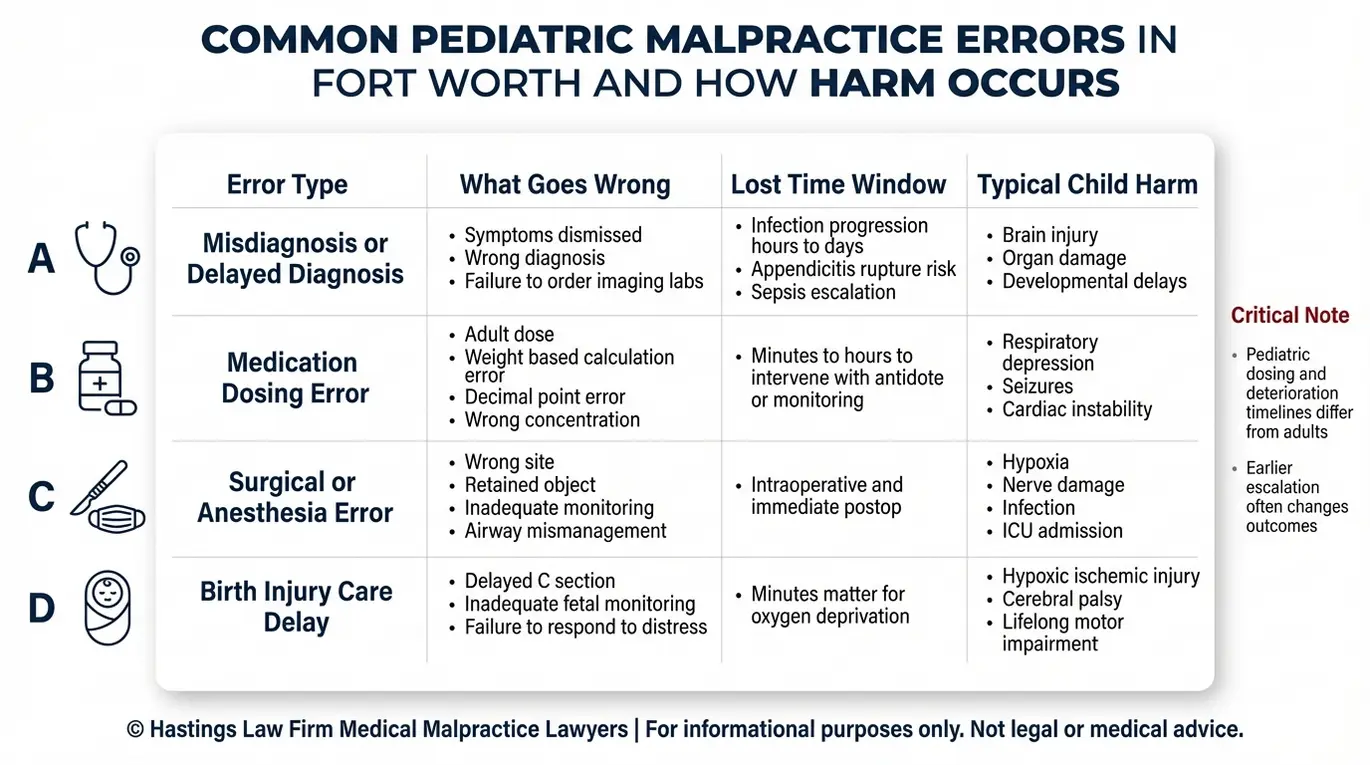
Common pediatric errors include medication mistakes due to incorrect dosing, failure to diagnose critical conditions like meningitis or appendicitis, and birth injuries resulting in cerebral palsy. These errors often stem from the same root problem: a failure to account for the fact that children require specialized medical attention at every stage of treatment.
The most frequent categories of pediatric medical malpractice include:
- Misdiagnosis and delayed diagnosis: Children often present symptoms differently than adults. Conditions like sepsis, meningitis, appendicitis, and even cancer can be missed or misidentified when a provider fails to consider age-specific presentations. For instance, meningitis may manifest as simple lethargy rather than the classic stiff neck seen in adults. Pediatricians must be vigilant in ruling out these life-threatening possibilities immediately. Every hour of delay can narrow the window for effective treatment.
- Medication errors: Children depend on weight-based dosing (calculated in milligrams per kilogram of body weight) for safe administration of nearly every drug. Prescribing an adult dose, miscalculating weight, or selecting the wrong concentration can cause organ damage, overdose, or death. Even a decimal point error in calculation can result in a tenfold overdose, overwhelming a child’s liver or kidneys. The ECRI and ISMP 2025 KIDs List specifically warns about high-alert medication mistakes that pose the greatest risk to pediatric patients.
- Surgical errors: Anesthesia complications are more common in younger patients, and wrong-site procedures, while rare, carry devastating consequences for a developing body.
- Birth injuries: Delayed emergency C-sections, improper use of vacuum extractors or forceps, and failure to respond to signs of fetal distress can lead to hypoxic-ischemic encephalopathy (HIE), a type of brain damage caused by oxygen deprivation. HIE is a common cause of cerebral palsy.
Under Texas Civil Practice and Remedies Code Chapter 74, these errors can form the basis of a malpractice claim when they represent a clear departure from the standard of care. As a pediatric malpractice lawyer in Fort Worth, our role is to reconstruct the timeline of your child’s care, identify where the breakdown occurred, and connect that failure to the harm your child suffered.
The Impact of Delayed Diagnosis on Child Development
A delayed diagnosis can do more than prolong suffering; it can permanently alter a child’s developmental trajectory. Conditions that are treatable in early stages may become irreversible once the window for intervention closes, resulting in permanent injury.
A child’s brain and body are developing rapidly, and the impact of an untreated infection, undetected tumor, or missed metabolic disorder compounds over time. Developmental delays, which refer to a significant lag in reaching physical or cognitive milestones, can emerge weeks or months after the initial error. This timeline can make causation harder to prove but no less real.
This is one reason our team pays close attention to age-specific vital sign ranges, the normal parameters for heart rate, respiratory rate, and blood pressure that shift as a child grows. A reading that looks normal for an adult may signal a serious problem in a toddler. When providers miss these cues, and a condition progresses unchecked, the consequences can reshape a child’s entire future.
The Hastings Law Firm Difference
Results matter, but what truly sets us apart is how we achieve them. Every verdict, every settlement, and every Fort Worth courtroom victory comes from one guiding promise: To treat each client’s fight for justice as if it were our own.
This balance of skill, experience, and empathy reflects our core philosophy that justice should not only compensate the injured, but also make healthcare safer nationwide.

Identifying Liability in Fort Worth Pediatric Cases
Liability can extend beyond the individual pediatrician to include hospitals for inadequate staffing, nurses for medication errors, and pharmacists for dispensing mistakes. Determining who is legally responsible requires a careful review of every person and system involved in your child’s care. Liability in a legal sense refers to the responsibility one party has for the harm caused to another.
One of the first distinctions we examine is whether the treating physician was a direct employee of the hospital or an independent contractor. This matters because hospitals may try to distance themselves from a doctor’s error by arguing the physician was not their employee. Texas law, however, also recognizes a concept called corporate negligence, which holds hospitals accountable for system failure like unsafe nurse-to-patient ratios, broken communication protocols, or inadequate training of staff.
Our legal team includes former defense attorneys and experienced hospital nurses who previously worked for the systems they now challenge. This background provides a strategic advantage in identifying hospital protocols that were not followed. In Tarrant County, several major hospital systems operate pediatric units and emergency departments. When those institutions fail to maintain safe staffing levels or enforce medication protocols, the liability belongs to the institution itself.
Our Fort Worth pediatric malpractice law firm investigates liability at every level. We review staffing logs, hospital policies, credentialing records, and communication chains to determine whether a systemic breakdown contributed to your child’s injury.
We look for warning signs like a nonreassuring fetal heart rate (FHR) tracing or an abnormal heart rhythm pattern indicating distress. We also evaluate the Apgar score, which is a quick test performed at 1 and 5 minutes after birth. These metrics are critical for holding health care professionals accountable. Resources like the CMS Care Compare Doctors and Clinicians Initiative can also help identify provider background information.
Key areas we evaluate when identifying liable parties:
- Whether the treating physician held proper credentials and privileges at the facility
- Whether nursing staff followed the five rights of medication administration
- Whether hospital protocols for escalation and emergency response were followed
- Whether staffing levels met safe patient care standards on the date of the incident
- Whether any equipment or device failures contributed to the injury
Proving Negligence With Expert Testimony
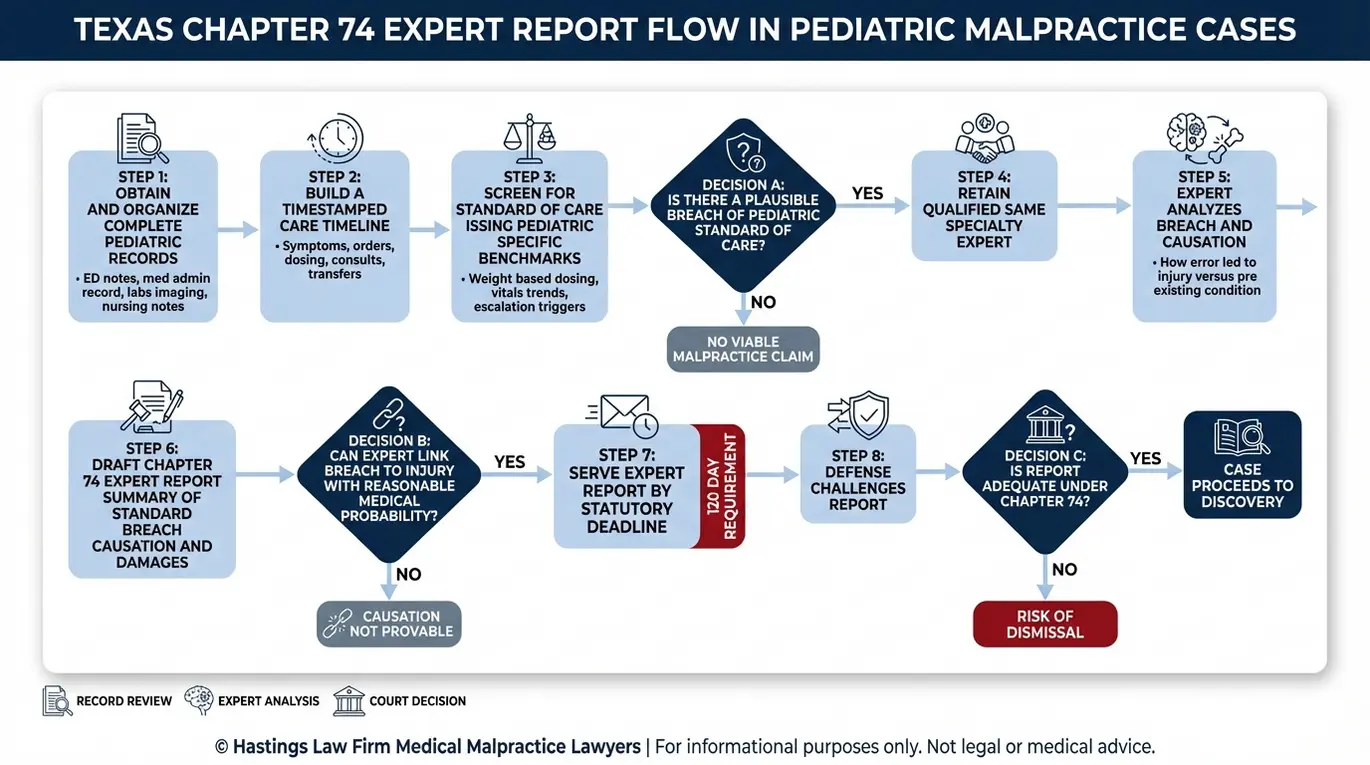
Texas law requires an expert report from a qualified physician in the same field to validate that the injury was caused by a breach of the standard of care. Tommy Hastings is a board-certified trial lawyer with over two decades of experience handling these cases. This requirement, codified in Texas Civil Practice and Remedies Code § 74.351, is one of the most significant hurdles in any malpractice claim.
Under Chapter 74, the person filing the claim must serve an expert report within 120 days after the date each defendant’s original answer is filed. The report must identify the applicable standard of care. It should explain how the provider breached it and establish causation, showing how the breach directly led to the child’s injury.
Our experts also evaluate whether staff adhered to the Five Rights of medication administration: the right patient, the right drug, the right dose, the right route, and the right time. Deviating from these core safety protocols is often indefensible. If the report is not served on time, or if it does not meet the statutory requirements, the court can dismiss the case entirely.
Causation is often the most contested element. Defense attorneys regularly argue that the child’s condition was caused by a pre-existing genetic issue, an unavoidable complication, or a natural disease process rather than any error in treatment. At this stage, the case often becomes a contest between competing expert witnesses, each presenting a different interpretation of the clinical evidence.
Our legal team includes former defense attorneys who understand exactly how the other side builds these arguments. Combined with our in-house nursing staff and a national network of pediatric specialists, we develop expert testimony grounded in the specific medical facts of each case. We identify qualified experts who practice in the same specialty as the provider at issue, giving our reports the credibility Texas courts demand.
Calculating Lifetime Damages for Injured Children
Recoverable damages include current and future medical expenses, the child’s loss of future earning capacity, and non-economic damages for pain, suffering, and physical impairment. Because children may live with the consequences of medical negligence for decades, the financial scope of these cases is often substantial.
Future care costs are typically the largest component. For a child diagnosed with cerebral palsy or a permanent brain injury, a life care plan outlines every anticipated medical need: therapies, surgeries, adaptive equipment, home modifications, attendant care, and medications. According to the Centers for Disease Control and Prevention’s data on cerebral palsy, the condition is among the most common motor disabilities in childhood, and lifetime care costs can reach into the millions.
Loss of earning capacity presents a unique challenge in pediatric cases. The child has no work history, so forensic economists must project what the child would have earned over a lifetime but for the injury. These projections account for education levels, regional earning data, and the specific limitations the injury imposes.
| Damage Category | Examples | Cap Under Texas Law |
|---|---|---|
| Economic Damages | Medical bills, future care costs, lost earning capacity, rehabilitation | No cap |
| Non-Economic Damages | Pain and suffering, physical impairment, loss of enjoyment of life | $250,000 for all physicians/providers combined; $250,000 per hospital, up to $500,000 for all hospitals combined |
Texas does cap non-economic damages in medical malpractice cases. Pain and suffering awards are limited to $250,000 total against all individual physicians and healthcare providers, and $250,000 per hospital, with a combined cap of $500,000 for all hospitals. There is no cap on economic damages, which is why thorough documentation of lifetime care needs and lost earning potential is so important.
As Fort Worth pediatric malpractice lawyers, we work with life care planners, vocational experts, and economists to build a complete picture of what your child will need, both now and for the rest of their life. A settlement or compensation should reflect the full reality of that future, not just the bills that have arrived so far.
Texas Statute of Limitations for Minors
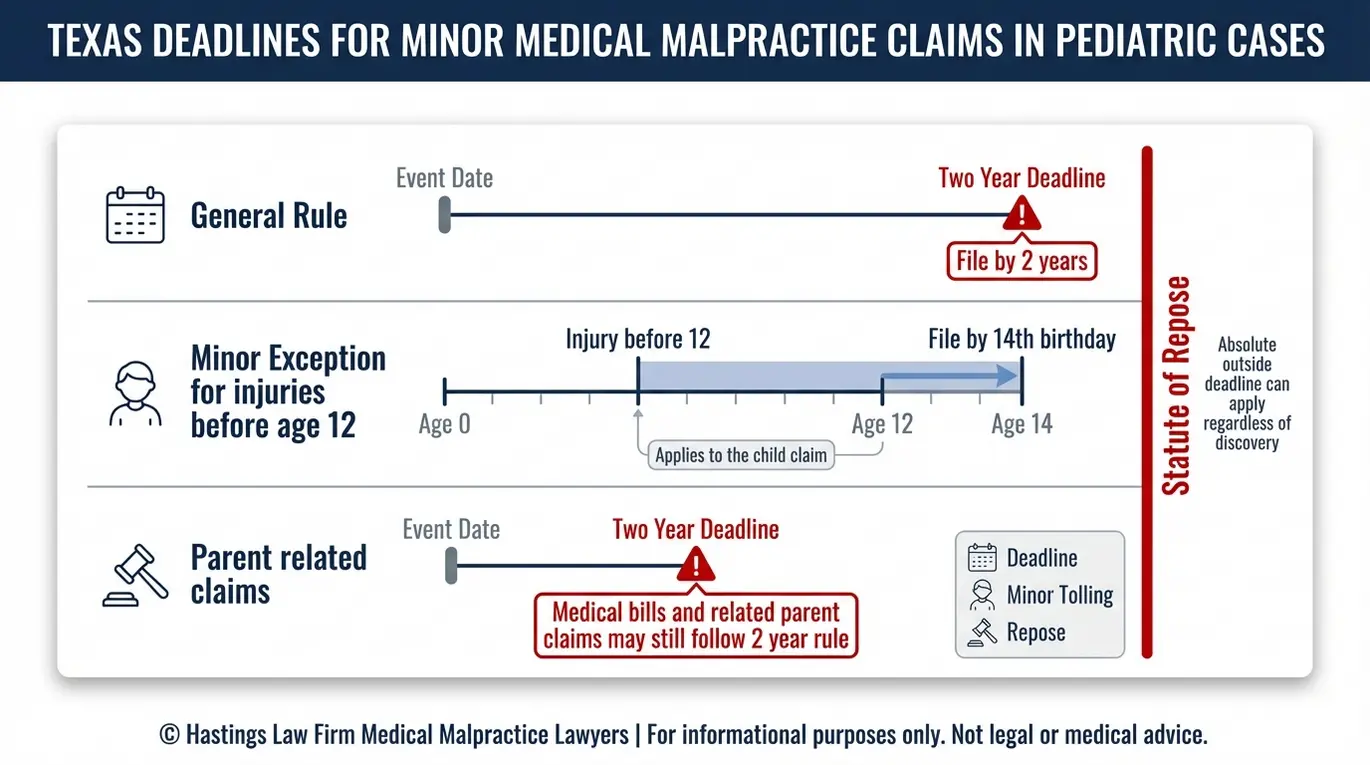
While the standard deadline is two years, Texas allows minors to file a malpractice claim up until their 14th birthday for injuries occurring before age 12, though parents’ claims for medical bills often remain subject to the two-year rule. The statute of limitations is the time window during which you or a loved one can legally file a lawsuit. For injuries occurring after age 12, the standard two-year deadline applies.
There is an important distinction that catches many families off guard. While the child’s claim may benefit from tolling, a parent’s separate claim for medical expenses already incurred often remains subject to the standard two-year rule. Missing that legal deadline can eliminate part of your family’s recovery even if the claim for a minor child is still viable.
Texas also imposes a statute of repose: an absolute 10-year outer boundary that applies regardless of when the injury was discovered. After 10 years from the date of the negligent act, the right to file is extinguished, with very limited exceptions. This means even if you did not know the injury was caused by negligence until age 13, if the error happened at birth, the 10-year repose period may bar the claim.
Because these deadlines interact in ways that are not always obvious, early legal consultation protects your family’s options. Evidence degrades over time, witnesses become harder to locate, and medical records retention policies vary by facility.
Contact the Fort Worth Doctor Malpractice Attorneys at Hastings Law Firm Today for Help
Your child deserves a legal team that will pursue the truth about what happened and fight to protect their future. At Hastings Law Firm, that is the only work we do. Every attorney, nurse consultant, and patient advocate on our team is dedicated to one thing: holding health care professionals accountable when their negligence harms the people who trusted them most.
As a Fort Worth Pediatric Malpractice Lawyer, Tommy Hastings and his team bring former defense experience, in-house medical expertise, and a trial-ready approach to every case we accept. We prepare from day one as though your case will go before a jury, because that preparation is what drives fair results.
There is no fee unless we recover for you. Contact us today for a free, confidential case evaluation, and let us help your family find the answers you deserve.
Frequently Asked Questions About Pediatric Malpractice in Fort Worth


This content was researched and written by the Hastings Law Firm editorial team, which includes attorneys, medical professionals, and experienced researchers. Our writing is informed by internal knowledge and practical experience, and we cross-check critical details against authoritative sources cited throughout. Every piece undergoes human-led fact-checking and legal review. Because legal and medical information can change, if you spot an error, please contact us. Learn more about our content standards and review process on our editorial policy page.

Gabe Sassin has focused exclusively on medical malpractice law since 2007. After spending more than a decade as a malpractice defense attorney, he knows exactly how the other side works. He has seen firsthand how healthcare providers, insurers, corporate defendants, and their legal teams think, prepare, and build their defense against claims. That knowledge works for the people who need it most today, injured patients and their families. His unique experience shapes everything he writes, giving readers a look at how these cases actually work from someone who has handled them from both sides.
