


Austin Nursing Home Fall Lawyer
A preventable fall in a nursing home or assisted living facility can leave a family facing sudden injury, fear, and a painful loss of trust. These incidents are often tied to avoidable safety breakdowns such as poor supervision, missed fall risk planning, unsafe transfers, or medication related dizziness. Serious falls can trigger lasting physical harm and a rapid decline, along with emotional distress that affects mobility and well being. If your loved one was harmed or worse due to a nursing home fall in Austin, Texas, contact Hastings Law Firm for a free, confidential case review.
Last Updated: July 27, 2026
Trusted Austin Injury Attorneys for Nursing Home Negligence Claims
When a loved one is hurt in a nursing home or assisted living facility, a residential care setting that provides help with daily activities like bathing, meals, and medication management, the emotional weight can be overwhelming. You trusted a facility to keep them safe. Learning that a preventable fall may have caused serious harm can leave you feeling betrayed, angry, and unsure of what to do next.
You are not powerless, and you do not have to figure this out alone. As an Austin nursing home fall lawyer team that focuses exclusively on medical malpractice, we understand both the medical details and the human toll behind these cases. Our firm, founded by board-certified trial attorney Tommy Hastings, includes in-house nurses and former defense attorneys who know how facilities operate from the inside. Since 2005, we have dedicated our practice to medical negligence to ensure patients receive the attention they deserve.
If your family member was injured in a fall at a care facility, we can review what happened and explain your options at no cost.

Common Causes of Preventable Falls in Elderly Care Facilities
Preventable falls in nursing homes typically result from facility negligence, including understaffing, failure to perform accurate fall-risk assessments, or medication errors that cause dizziness. Because these are not random accidents, families often need legal help for facility falls to uncover the pattern of systemic failure that made the injury foreseeable.
A fall-risk assessment, a structured evaluation that measures a resident’s likelihood of falling based on factors like medication use and cognitive status, must dictate safeguards. When assisted living facilities skip this, they lose the ability to protect residents. Research published through the National Library of Medicine on staffing levels and injurious falls confirms that short-staffing leaves residents to attempt transfers, the process of moving from bed to chair, without help.
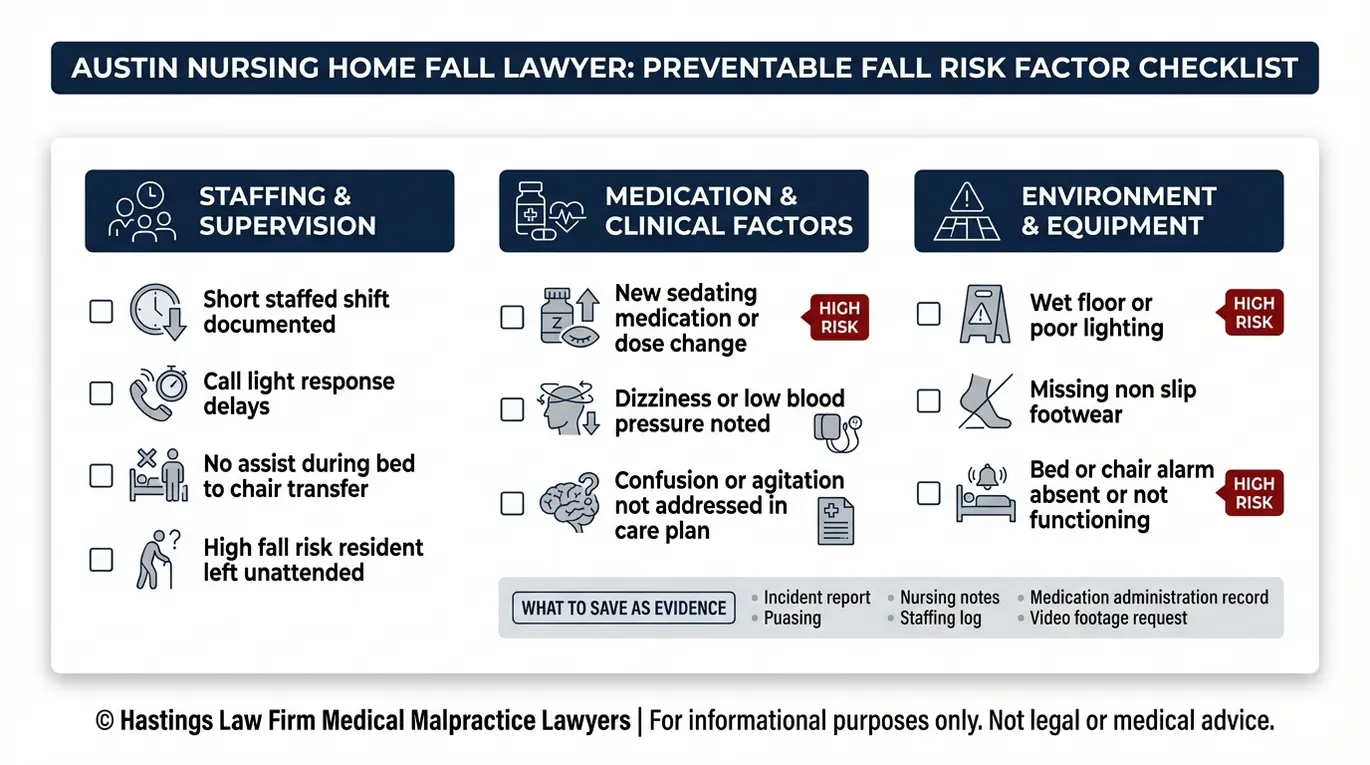
Here are the risk factors families should watch for:
- Understaffing: High turnover leads to inadequate supervision and delays.
- Unnecessary medications: Drugs that impair balance or cause over-sedation.
- Hazardous conditions: The National Institute on Aging’s fall prevention guidance outlines environmental dangers like wet floors.
- Negligent transfer: Residents left to move unassisted.
The Paradox of Fear and Mobility
Residents in care facilities may develop a fear of falling, a recognized clinical condition where anxiety about another fall causes them to avoid movement. This psychological impact accelerates decline. Facilities must provide mobility support to prevent muscle atrophy. A nursing home fall attorney can investigate if this care was neglected.
Catastrophic Injuries Sustained by Austin Residents
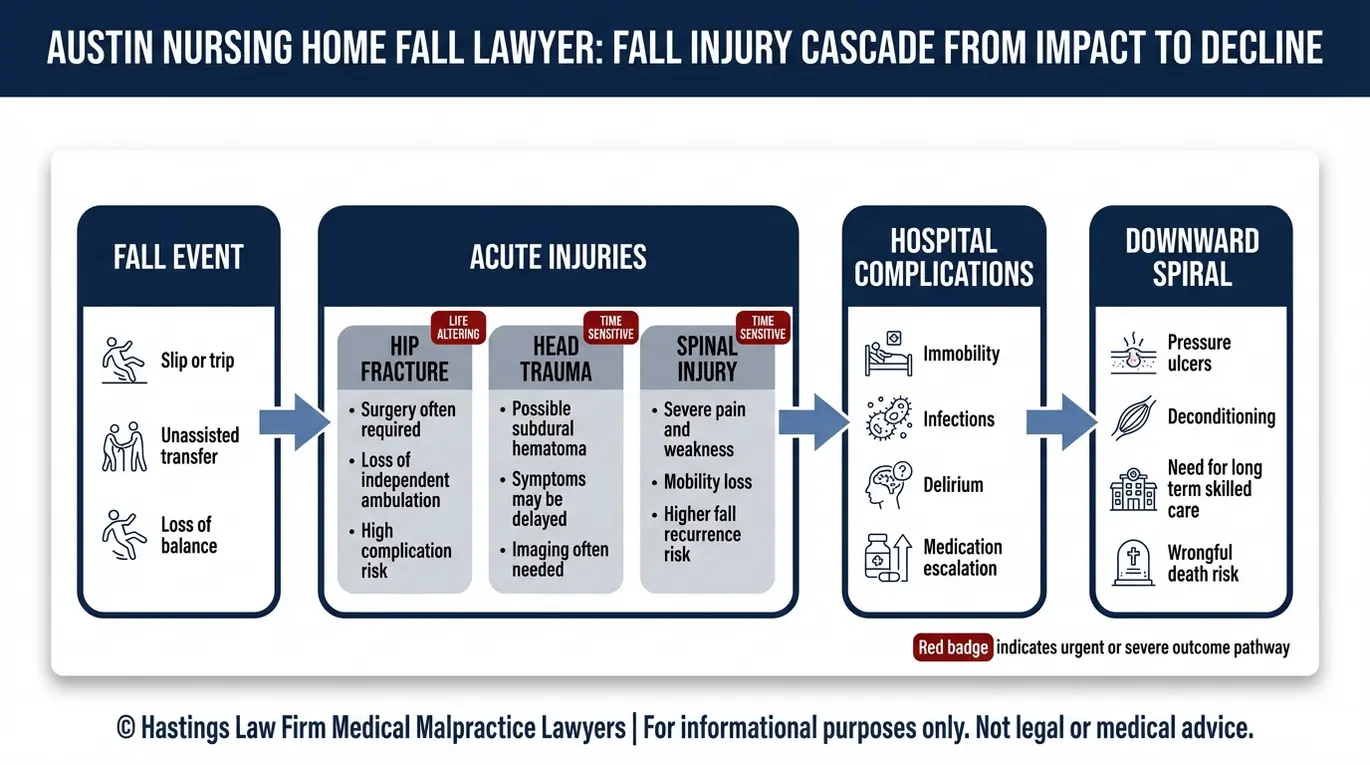
Elderly residents are highly susceptible to life-altering injuries from falls, including hip fractures, subdural hematomas, and spinal cord trauma that often lead to a rapid decline in overall health. These catastrophic injuries often involve broken bones, head trauma, or traumatic brain injuries.
A hip fracture, a break in the upper portion of the femur, is dangerous. Research published in Frontiers in Surgery on geriatric hip fracture mortality shows mortality rates remain elevated for years following the injury. A subdural hematoma, bleeding between the brain and its outer covering, can develop slowly and go undetected.
For families, the most devastating pattern is the “downward spiral,” a chain of health complications that often follow a major fall:
| Injury | Immediate Effect | Long-Term Consequence |
|---|---|---|
| Hip fracture | Surgical intervention, immobility | Muscle wasting, blood clots, infection |
| Subdural hematoma | Cognitive decline, confusion | Permanent brain damage, wrongful death |
| Spinal injury | Loss of mobility or sensation | Paralysis, dependence on full-time care |
| Soft tissue injuries | Pain, immobility | Pressure ulcers (bedsores), sepsis |
An elderly fall injury lawyer understands how to connect these medical consequences back to negligence.
The Hastings Law Firm Difference
Results matter, but what truly sets us apart is how we achieve them. Every verdict, every settlement, and every Austin courtroom victory comes from one guiding promise: To treat each client’s fight for justice as if it were our own.
This balance of skill, experience, and empathy reflects our core philosophy that justice should not only compensate the injured, but also make health care safer nationwide.

Proving Negligence and The Concept of Never Events
To prove negligence, a plaintiff must demonstrate that the facility breached the standard of care by failing to implement reasonable fall prevention protocols that could have stopped the “never event” from occurring. The standard of care refers to what a competent facility would have done to protect a resident.
The Centers for Medicare & Medicaid Services (CMS) classifies certain falls as a CMS “never event”, errors that should effectively never happen with proper safety. A nursing home negligence attorney uses this framework to prove a breach of duty.
We examine documentation to determine whether an individualized fall-prevention care plan, a written protocol tailored to a specific resident’s risk factors, was followed. An Austin nursing home fall lawyer identifies medical malpractice in these gaps.
How Our Trial Lawyers Litigate Fall Cases
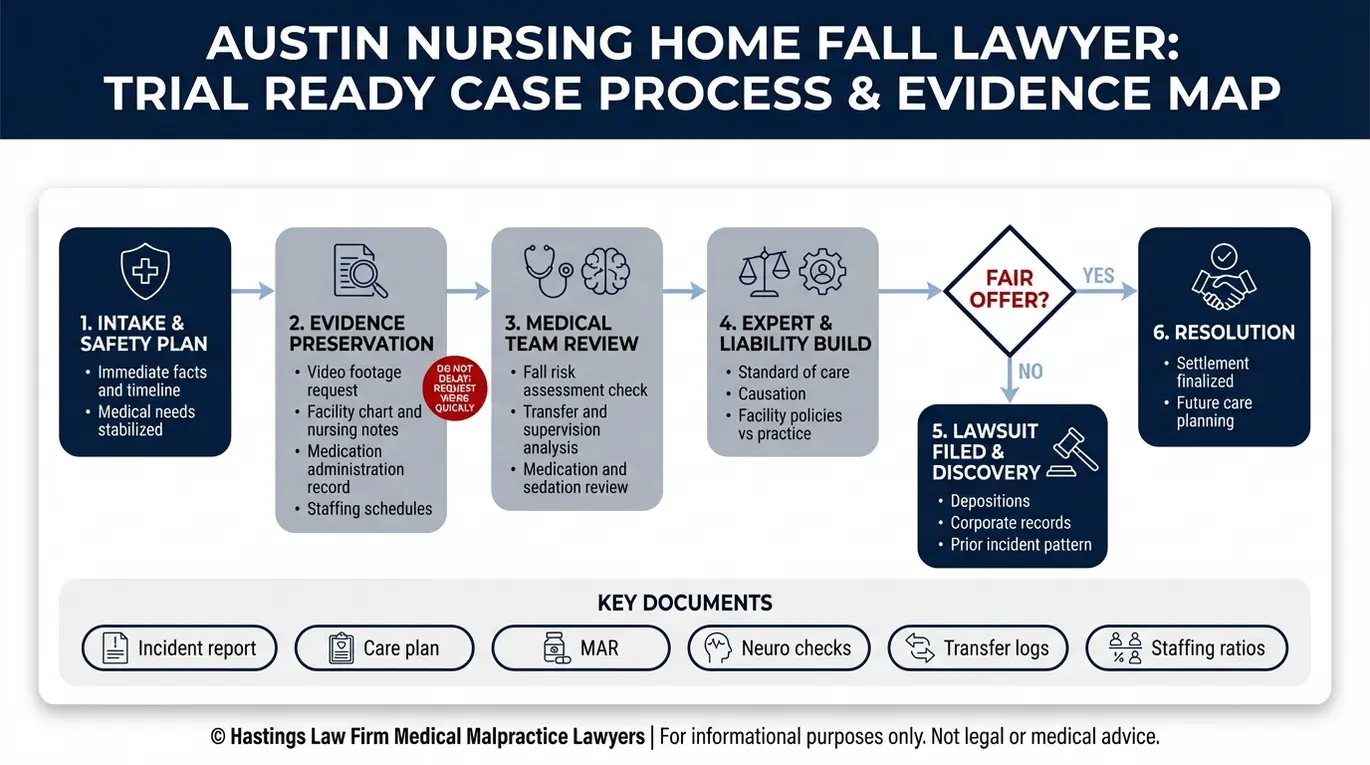
We approach every nursing home fall case with a trial-ready philosophy, conducting immediate medical investigations and preparing for a jury verdict to maximize settlement leverage against insurance carriers.
Our process for nursing home lawsuit representation includes:
- Immediate evidence preservation: We secure surveillance footage and records quickly.
- In-house medical review: Our team identifies where the standard of care broke down.
- Expert consultation: We work with geriatric experts who can explain the failure to a jury.
- Firm litigation posture: If fair compensation is not offered, we take legal action in Travis County courts.
As an Austin nursing home fall lawyer team with former defense attorneys on staff, we anticipate the arguments the other side will make.
Contact the Austin Nursing Home Attorneys at Hastings Law Firm Today for Help
Your family placed trust in a facility to provide safe, attentive care. If that trust was broken by negligence, you deserve answers. You also deserve a legal team that will treat your family’s situation with the seriousness and respect it warrants.
At Hastings Law Firm, our mission is to restore that trust. We hold facilities accountable not only to secure fair compensation for your family, but to help prevent the same failure from harming someone else. Our Austin nursing home fall law firm handles cases throughout Texas, including Austin, The Woodlands, Houston, and Dallas.
There is no cost to speak with one of our patient advocates. We work on a contingency fee basis, meaning you pay nothing unless we recover compensation for your family. Call us today, or complete a confidential case evaluation online, and let us help you understand what happened and what comes next.
Frequently Asked Questions About Nursing Home Fall in Austin


This content was researched and written by the Hastings Law Firm editorial team, which includes attorneys, medical professionals, and experienced researchers. Our writing is informed by internal knowledge and practical experience, and we cross-check critical details against authoritative sources cited throughout. Every piece undergoes human-led fact-checking and legal review. Because legal and medical information can change, if you spot an error, please contact us. Learn more about our content standards and review process on our editorial policy page.

Gabe Sassin has focused exclusively on medical malpractice law since 2007. After spending more than a decade as a malpractice defense attorney, he knows exactly how the other side works. He has seen firsthand how healthcare providers, insurers, corporate defendants, and their legal teams think, prepare, and build their defense against claims. That knowledge works for the people who need it most today, injured patients and their families. His unique experience shapes everything he writes, giving readers a look at how these cases actually work from someone who has handled them from both sides.
