


Texas Medical Burn Lawyer
Written by: Hastings Law Firm | Reviewed by: Brady D. Williams | Updated: July 27, 2026
Surgical and procedural burns can cause severe pain, scarring, disfigurement, and lasting emotional trauma, especially when a preventable operating room fire or equipment problem is involved. These injuries often raise concerns about whether the surgical team managed ignition sources, oxygen delivery, and flammable materials safely and whether key safety checks were performed. Burns can also stem from defective medical devices, which can complicate responsibility for the harm. If you or a loved one were harmed or worse due to medical burn injuries in Texas, contact Hastings Law Firm for a free, confidential case review.

Trusted Texas Medical Attorneys for Surgical Burn Injury Claims
What You Should Know About Surgical Burn Injury Malpractice Claims in Texas:
- Long term harm can follow a medical burn, including permanent scarring, disfigurement, restricted mobility, and psychological trauma.
- Liability can turn on whether operating room fire risks were controlled, including the interaction of ignition sources, oxygen, and flammable materials.
- Accountability can depend on whether the surgical team deviated from accepted safety practices, including communication of fire risk during a pre surgical time out.
- Responsibility may extend beyond clinicians when a malfunctioning device contributes to a burn injury.
- Recovery can be shaped by the cost and duration of burn care, which may involve painful wound management, grafting, and reconstructive procedures.
- Compensation options in Texas can be limited for non economic harms, even when pain, disfigurement, and emotional distress are severe.
- Options can be lost if legal time limits are missed, which makes timing a practical constraint after a suspected medical burn.
- Disputes can hinge on what operative reports, anesthesia records, nursing notes, and equipment logs show about how the burn occurred.
- Non traditional documentation can be central to showing day to day impact, including therapy logs and personal journals.
- Recovery can be reduced or barred if fault is assigned to the injured person under Texas proportionate responsibility rules.

A Healthcare Focused Law Firm
A burn sustained during a medical procedure can leave you with painful injuries, lasting scars, and a deep sense of betrayal. You trusted your care team to keep you safe, and when that trust is broken, the path forward can feel overwhelming. You deserve to know what happened and whether the care you received fell below acceptable medical standards.
At Hastings Law Firm, we focus exclusively on medical malpractice. Led by board-certified trial lawyer Tommy Hastings, our firm includes former defense lawyers who understand how insurers respond to surgical burn claims. As a Texas medical burn lawyer team, we investigate every detail of what went wrong in the operating room, the equipment used, the safety protocols in place, and the decisions made by every member of the surgical team.
If you or a loved one suffered a burn injury during a medical procedure, we can review what happened and explain your options in a free, confidential consultation.
Common Causes of Operating Room Burn Injuries
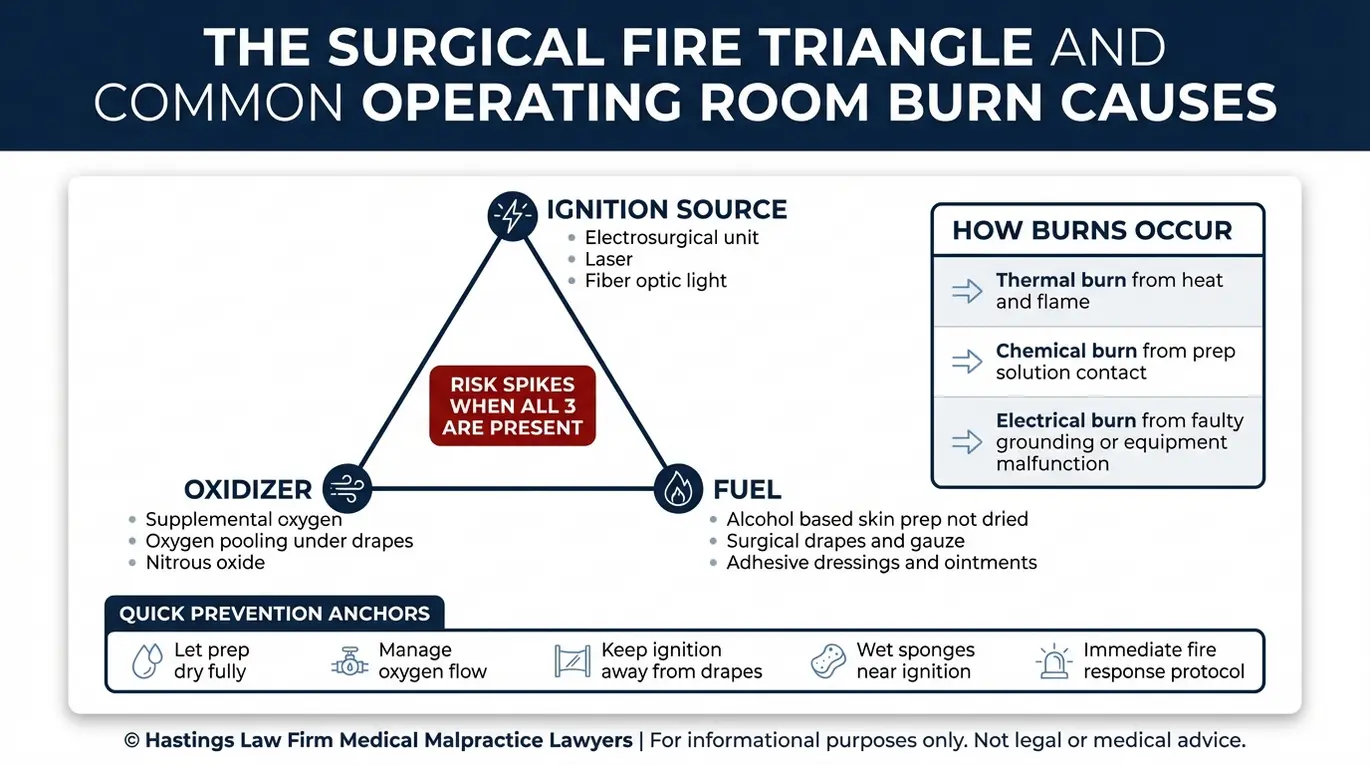
Operating room burns are frequently caused by the mismanagement of the “fire triangle,” involving an ignition source like electrosurgical units or lasers, an oxidizer such as pooled oxygen under drapes, and fuel sources like surgical gauze or alcohol-based prep solutions. When any member of the care team fails to control one of these three elements, a patient may sustain a serious, preventable burn injury.
Understanding how these burns happen is the first step toward determining whether negligence occurred. A Texas medical burn lawyer examines the specific mechanism of injury to identify which protocols were violated and who was responsible. Our Texas medical burn attorneys know how to analyze the evidence to determine if a preventable error occurred.
The most common types of operating room burns include:
- Thermal burns: These result from improper use of cauterizing tools, surgical lasers, or warming blankets. An electrosurgical unit (ESU), a device that uses electrical current to cut tissue and control bleeding, is one of the most frequent ignition sources in surgical fires.
- Chemical burns: These occur when alcohol-based surgical skin prep solutions, the antiseptic liquids applied to the skin before incision, are not allowed adequate time to dry before the patient is draped. The trapped vapors can ignite when an energy source is activated nearby.
- Electrical burns: Malfunctioning equipment or improperly placed grounding pads can direct electrical current through unintended pathways in the patient’s body, causing deep tissue damage.
The American Society of Anesthesiologists reports that operating room fires remain a persistent patient safety concern, with hundreds of incidents reported each year. Most are preventable when the surgical team follows established protocols.
The Fire Triangle in Surgical Settings
The fire triangle is a medical safety model used to explain how surgical fires occur. It describes the three components that must be present for a fire to start: an ignition source, fuel, and an oxidizer. In the operating room, all three are routinely present at the same time.
Ignition sources include ESUs, lasers, and fiber-optic light cables. Fuel sources range from surgical drapes and gauze to the patient’s own hair and body tissues. The oxidizer is almost always supplemental oxygen.
Mismanagement of gas delivery can lead to oxygen pooling beneath surgical drapes, creating an oxygen-rich environment. This is a concentrated pocket of oxygen that dramatically increases the speed and intensity of ignition. Texas medical burn attorneys investigate whether the surgical team took proper steps to separate these elements, including managing oxygen flow during the use of energy-based devices.
Establishing Negligence in Surgical Fire Cases
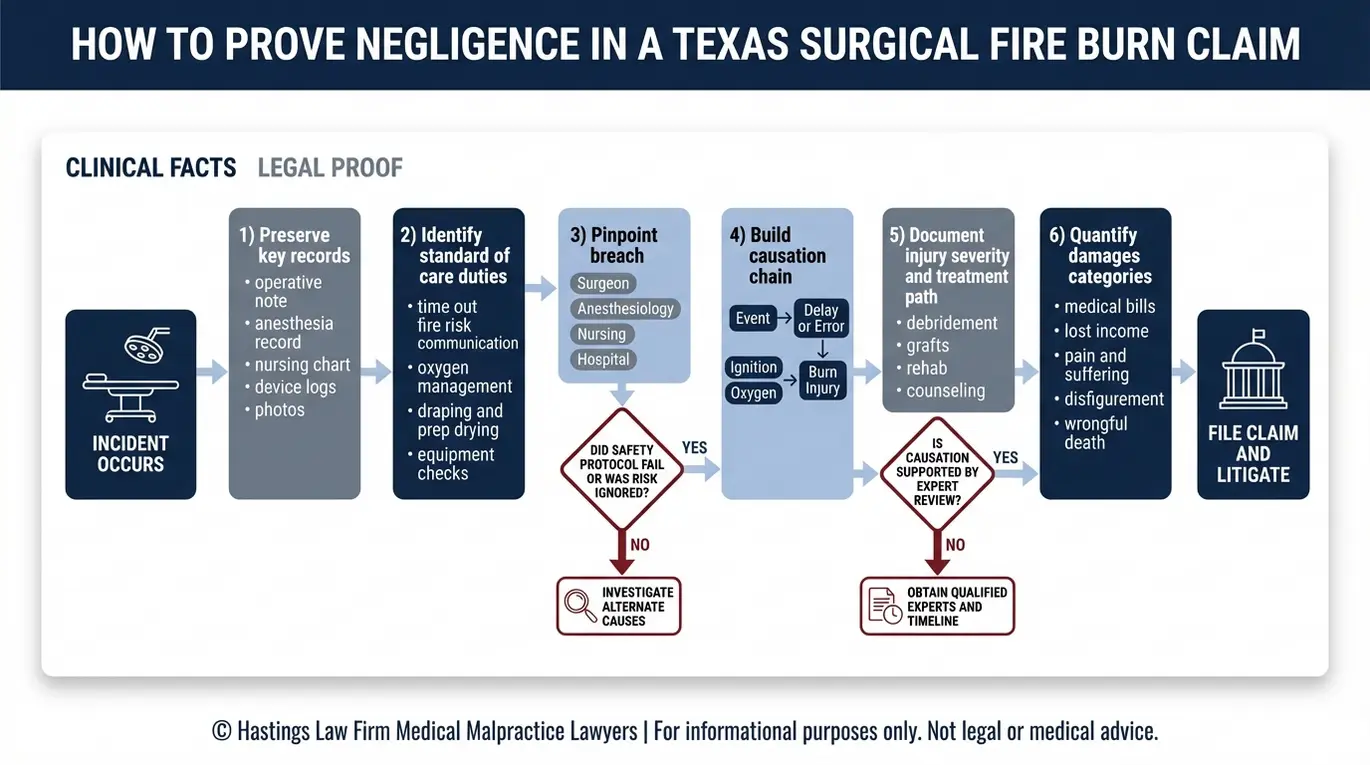
Proving negligence requires demonstrating that the surgical team deviated from the accepted standard of care, such as failing to communicate fire risks during a “time out” or mishandling oxygen in the presence of ignition sources. The standard of care represents the level of treatment a reasonably competent healthcare professional would provide under similar conditions.
One of the first things we examine is whether a proper pre-surgical “time out” was conducted. This is a mandatory pause before the first incision where the team is supposed to verbally confirm the procedure, the patient’s identity, and any specific risks, including fire risk. If fire hazards were not discussed during this safety check, that failure can be strong evidence of a breach in the standard of care. This “time out” is critical because it forces the surgeon, anesthesiologist, and nurses to agree on the plan to manage the fire triangle before any tools are activated.
We also look at whether oxygen administration was properly managed. Anesthesiologists have a specific responsibility to control oxygen concentration near the surgical site, especially when energy-based devices like lasers or ESUs are being used. As outlined in the Defense Health Agency’s Surgical and Procedural Patient Safety Practices, surgical teams are expected to follow layered safety protocols. When high concentrations of oxygen are necessary, the surgeon must be alerted so they can modify their use of ignition sources.
The surgeon, anesthesiologist, and nursing staff each have distinct roles in fire prevention. When we investigate a surgical burn case as a Texas Medical Burn Lawyer team, we review operative reports, anesthesia records, nursing notes, and equipment logs to build a minute-by-minute timeline. Our in-house medical staff, which includes experienced nurses who previously worked in hospital settings, can identify charting inconsistencies and protocol gaps that might otherwise go unnoticed.
Medical malpractice claims involving surgical errors require not just proof that a burn occurred, but proof that the burn resulted directly from a specific failure in care. That connection between the breach and the injury is what separates a bad outcome from actionable negligence or even wrongful death. We meticulously analyze the power settings used on electrosurgical pencils and the drying time recorded for prep solutions to find the exact moment safety was compromised.
The Hastings Law Firm Difference
Results matter, but what truly sets us apart is how we achieve them. Every verdict, every settlement, and every Texas courtroom victory comes from one guiding promise: To treat each client’s fight for justice as if it were our own.
This balance of skill, experience, and empathy reflects our core philosophy that justice should not only compensate the injured, but also make healthcare safer nationwide.

Liability for Burns Caused by Defective Medical Products
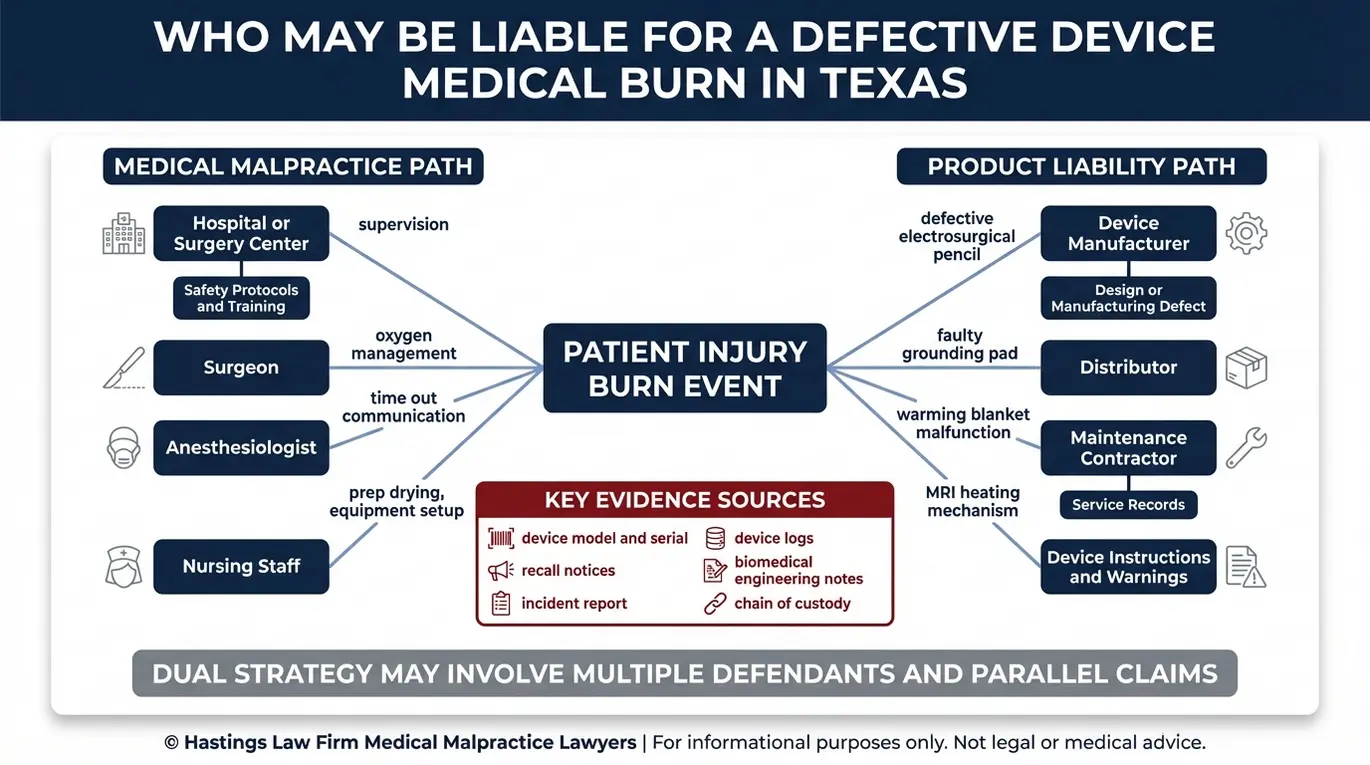
When a burn is caused by malfunctioning equipment rather than human error, liability may extend to the device manufacturer under product liability laws, often requiring a dual-strategy lawsuit addressing both medical malpractice and defective design. Product liability law ensures that manufacturers are held responsible when a defective medical device causes a patient injury.
Under Texas Civil Practice and Remedies Code Section 82.001, a “products liability action” covers claims for harm caused by a defective product, whether the defect is in its design, manufacturing, or the adequacy of its warnings. As a texas medical burn lawyer team, we evaluate whether the device itself was the problem, whether the provider used it incorrectly, or whether both contributed. We also check for any product recalls affecting the equipment.
Common medical devices involved in burn injuries include:
- Defective electrosurgical pencils or grounding pads: A grounding pad, also called a dispersive or return electrode, is designed to safely route electrical current back through the ESU. If the pad is defective or improperly applied, the current can concentrate at the contact site and cause a deep electrical burn.
- Malfunctioning warming blankets: Forced-air warming blankets, which circulate heated air through a blanket to maintain patient body temperature, can cause contact burns if temperature controls fail.
- MRI-induced burns: An MRI machine can cause burns through several mechanisms related to the powerful electromagnetic fields generated during a scan.
A medical device injury attorney must be prepared to work with both medical and engineering experts to trace the cause of a burn back to its source. This involves determining if the injury resulted from a provider’s hands or a manufacturer’s product line.
MRI Machine Burn Mechanisms
MRI burns are a distinct category of medical burn injury. Magnetic resonance imaging (MRI) uses strong magnetic fields to create detailed images of the body. An MRI radiofrequency (RF) burn can occur when the MRI machine transmits energy that is absorbed unevenly by the patient’s body or by conductive materials in contact with the skin.
A conductive loop, which forms when a patient’s skin touches itself or when cables and wires create a closed circuit on or near the body, can concentrate RF energy and cause a localized burn. Contact burns can also result from direct contact with the inner walls of the MRI bore or from heating of metallic implants due to energy transmitted currents.
The FDA’s MAUDE database contains adverse event reports documenting MRI-related burns. These reports reinforce that such incidents are both known and preventable when proper screening and positioning protocols are followed.
The High Cost of Medical Treatment for Severe Burns
Treating severe surgical burns often involves expensive, multi-stage medical interventions such as skin grafts, debridement, and reconstructive surgery, necessitating a legal strategy that accurately forecasts these future medical costs. Forecasted costs help ensure a settlement covers long-term care needs for second, third, or fourth-degree burns.
Burn severity is classified by depth and tissue damage. First-degree burns affect only the outer layer of skin. Second-degree burns extend into the underlying tissue and often require specialized wound care. Third-degree burns destroy the full thickness of the skin, and fourth-degree burns reach muscle, tendon, or bone.
The deeper and more extensive the burn, the more complex and costly the treatment. Burn units are among the most expensive hospital wards. This is due to the specialized isolation and intensive nursing care required to prevent infection in large open wounds.
Debridement, the medical removal of damaged or dead tissue from a wound, is often one of the first and most painful steps in burn treatment. It may need to be repeated multiple times to ensure a viable bed for healing. A skin graft, a procedure where healthy skin is transplanted from another part of the body to cover the burn site, is frequently necessary for severe burns. In some cases, patients may require allografts (donor skin) before their own skin is healthy enough for an autograft.
Recovery rarely ends with surgery. Long-term physical therapy is often needed to restore range of motion in areas where scarring has tightened the skin and underlying tissue. This therapy involves stretching tight, healing skin to prevent permanent immobility. Many patients require multiple rounds of reconstructive surgery over months or years to release contractures or improve cosmetic appearance.
As a Texas medical burn lawyer team and burn injury malpractice lawyer firm, we work with medical experts and life care planners to document the full scope of anticipated treatment costs. This includes not just what has already been spent, but what will be needed in the years ahead. We aim to ensure any recovery reflects the true financial impact of the injury.
Impact of Long-Term Physical and Psychological Burn Effects
Beyond immediate physical pain, patients who suffer medical burns often face permanent disfigurement and psychological trauma, including post-traumatic stress disorder (PTSD), which must be quantified using both traditional medical records and non-traditional evidence like therapy logs. Non-economic damages address the human experience of an injury, including psychological trauma and lifestyle changes.
Scarring and disfigurement from burn injuries can profoundly affect a person’s self-image, relationships, and ability to function in daily life. Burn scar contracture, a condition where healing scar tissue tightens and restricts movement across a joint or limb, can limit mobility and require additional surgeries. Visible scarring on the face, hands, or other exposed areas may cause lasting emotional distress that affects employment and social interaction. Many burn survivors report feeling socially isolated due to their appearance.
The psychological effects of a traumatic surgical burn can be just as disabling as the physical injuries. Symptoms of PTSD, including flashbacks, severe anxiety, sleep disturbances, and avoidance of medical settings, are common among burn patients. Many also develop depression or generalized anxiety that requires ongoing psychological counseling.
The trauma of waking up from surgery with a new, painful injury can shatter a patient’s trust in medical providers. Some patients with severe burns need home modifications or assistive devices to manage daily tasks, particularly when mobility has been significantly impaired. A medical burn attorney in Texas understands that these non-physical injuries are real and measurable.
Using Non-Traditional Evidence
Non-traditional evidence includes personal accounts that demonstrate the daily impact of an injury. Therapy logs, personal journals, and daily activity records can provide powerful documentation of how a burn injury has changed a person’s life. These non-traditional medical records and forms of evidence help establish the severity and persistence of pain and suffering.
We work with treating psychologists and counselors to compile a detailed record of emotional distress. A Texas medical burn lawyer who understands how to present this type of evidence can help ensure that the true extent of your damages is reflected in any settlement or verdict.
Recoverable Damages for Medical Burn Injuries in Texas
Patients who suffer medical burns in Texas can pursue economic damages for medical bills and lost wages, as well as non-economic damages for pain and suffering, subject to state-specific caps and statutory limits. Economic and non-economic damages are the two primary types of compensation available to a patient in a malpractice case.
Economic damages cover the measurable financial losses caused by the injury. These include past and future medical expenses, hospitalization costs, rehabilitation expenses, and lost wages or loss of earning capacity. Because severe burns often require years of follow-up care, accurately projecting future economic damages is a critical part of any Texas burn malpractice lawyer‘s case strategy.
We ensure every anticipated cost, from bandage supplies to future surgeries, is accounted for. Non-economic damages compensate for losses that do not carry a specific price tag, such as physical pain, mental anguish, disfigurement, and the loss of enjoyment of life. Under Texas medical malpractice law, non-economic damages are subject to statutory caps.
Punitive damages may be available in rare cases involving gross negligence. This occurs where the provider’s conduct was so far below the standard of care that it demonstrated a conscious disregard for the patient’s safety.
In cases where a burn injury results in wrongful death, surviving family members may pursue damages for loss of companionship, loss of financial support, and funeral expenses. A Texas Medical Burn Lawyer can evaluate which categories of damages apply to your situation and build a case that accounts for every element of harm.
Contact the Texas Healthcare Malpractice Attorneys at Hastings Law Firm Today for Help
If you or a loved one suffered a preventable burn injury during a medical procedure, Hastings Law Firm is here to help you understand what happened and what your legal options may be. Our team of board-certified attorneys and in-house medical professionals will investigate the cause of the fire, chemical exposure, or equipment failure and build a case designed to hold the responsible parties accountable.
We operate on a contingency fee basis, which means you pay no attorney fees or costs unless we recover compensation on your behalf. Your initial consultation is free and confidential.
You do not have to carry this burden alone. Contact a Texas Medical Burn Lawyer at Hastings Law Firm today to take the first step toward answers and accountability.
Frequently Asked Questions About Medical Burn in Texas


This content was researched and written by the Hastings Law Firm editorial team, which includes attorneys, medical professionals, and experienced researchers. Our writing is informed by internal knowledge and practical experience, and we cross-check critical details against authoritative sources cited throughout. Every piece undergoes human-led fact-checking and legal review. Because legal and medical information can change, if you spot an error, please contact us. Learn more about our content standards and review process on our editorial policy page.

Brady D. Williams is a nationally recognized medical malpractice attorney who has spent his career handling high-stakes litigation for injured patients and families across the country. Licensed in both Texas and California, Brady draws on experience from hundreds of resolved medical cases to break down complex legal and medical topics for the people who need that information most. His writing reflects the same attention to detail and commitment to clarity that he brings to every case he handles.
