


Texas LASIK Center Malpractice Lawyer
Written by: Hastings Law Firm | Reviewed by: Brady D. Williams | Updated: July 27, 2026
LASIK is often presented as a simple elective procedure, but negligent care can leave lasting vision changes, chronic pain, and limits on daily activities such as driving at night. Problems may arise when clinics approve unsafe candidates, rush preoperative screening, delegate key decisions to unqualified staff, or fail to provide meaningful informed consent. Harm can also follow surgical errors, poorly maintained equipment, or delayed response to serious postoperative warning signs. If you or a loved one were harmed or worse due to LASIK center malpractice in Texas, contact Hastings Law Firm for a free, confidential case review.
Trusted Legal Representation for LASIK Negligence in Texas
What You Should Know About LASIK Surgery Negligence Claims in Texas:
- Long term vision damage and loss of independence can follow when LASIK care falls below accepted medical standards.
- Options can turn on whether a clinic approved surgery despite contraindications, since improper patient selection is a recurring liability theme.
- Accountability can increase when informed consent was not handled by the surgeon, since a signed waiver alone may not protect a clinic.
- A claim may be stronger when severe permanent symptoms are tied to a deviation from the standard of care rather than a temporary side effect.
- Serious harm can be linked to surgical mistakes such as wrong prescription programming or misaligned laser treatment.
- Preventable injuries can be associated with poor equipment maintenance, since calibration, sanitation, and service practices affect patient safety.
- Delayed treatment can worsen outcomes when postoperative complaints are dismissed, especially with warning signs of infection or flap displacement.
- Safety can be compromised at high volume chains when sales driven practices compress screening and follow up.
- Recovery for non economic harm can be limited in Texas, while economic losses such as lost wages and future medical bills are not capped.
- Key evidence can come from preoperative screening records and device maintenance documentation, since these materials may show what the clinic knew and did.

A Healthcare Focused Law Firm
LASIK surgery is often marketed as a quick, life-changing fix for vision problems. When it goes wrong, the results can be anything but simple. Permanent vision changes, chronic pain, and the inability to perform everyday tasks like driving at night can upend your life in ways you never expected from an elective procedure.
If you or a loved one suffered serious harm after laser eye surgery at a Texas clinic, you deserve answers about whether the care you received fell below accepted medical standards. As a Texas LASIK Center Malpractice Lawyer, Hastings Law Firm focuses exclusively on medical negligence cases. Founded by Tommy Hastings, a board-certified trial lawyer with over 20 years of experience, our team includes in-house medical professionals who understand both the clinical and legal sides of these injuries. We know that vision loss affects every aspect of your daily existence and we are dedicated to securing the justice you need to move forward.
We can review what happened and explain your options during a free, confidential consultation.
Liability in Refractive Surgery: When Texas LASIK Centers Fail
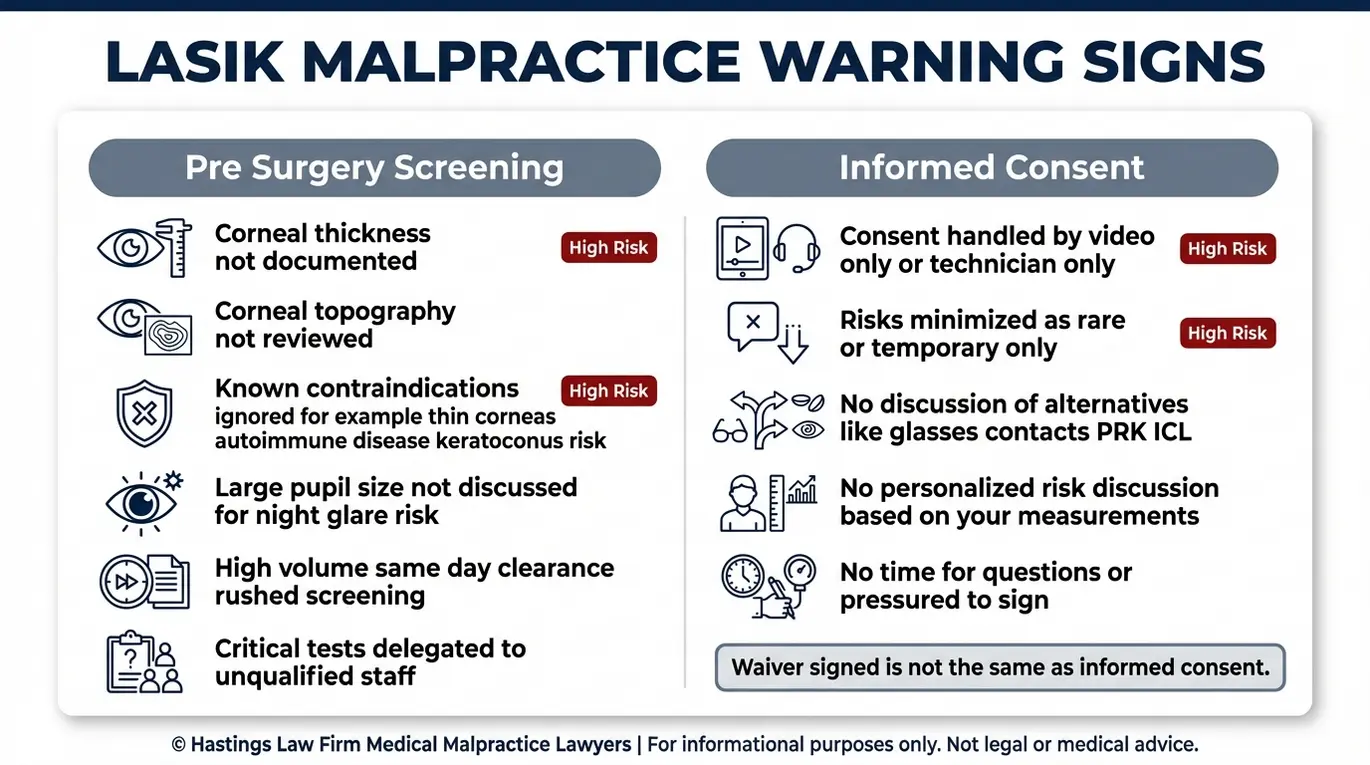
Liability in LASIK surgery often stems from improper patient selection, where a clinic operates on a candidate with contraindications like thin corneas or autoimmune diseases, prioritizing revenue over patient safety. In many claims, we look for improper patient selection, which occurs when a clinic clears someone for surgery despite contraindications. Contraindications are medical reasons that make a specific treatment or procedure inadvisable for a patient.
The “Candidate” Myth. Not everyone is a good candidate for LASIK. A thorough pre-operative screening should include corneal topography, which is detailed mapping of the cornea’s shape and curvature, along with pachymetry, a measurement of corneal thickness. These tests help an ophthalmologist determine whether the procedure can be performed safely and meet the standard of care. When clinics skip these evaluations, patients with disqualifying conditions may be approved for surgery. Research from the National Center for Biotechnology Information details the diagnostic role these measurements serve in identifying at-risk candidates.
Systemic Concerns at High-Volume Clinics. Some high-volume centers process a large number of patients daily. In that environment, critical screening exams may be delegated to staff who lack specialized training. A study on adverse events in femtosecond-assisted LASIK documented device-related complications that can result from procedural shortcuts. When a Texas LASIK attorney investigates laser eye surgery negligence, we examine these operational patterns to determine if they affected your care.
Informed Consent Is More Than a Signature. Signing a waiver does not protect a clinic if the patient was never given a genuine opportunity to understand the specific risks tied to their individual anatomy. Under Texas law, the duty to obtain informed consent cannot be handed off to a technician.
Non-Delegable Duty of Informed Consent
Informed consent means the surgeon personally ensures the patient understands the specific risks, including corneal ectasia, which is a progressive thinning and bulging of the cornea. The surgeon bears this duty of informed consent directly. A medical malpractice claim is a legal action taken when healthcare providers fail to meet the standard of care.
If a patient can show that a reasonable person would have declined the procedure, a failure of informed consent may support a legal claim.
Red Flags That May Indicate Screening or Consent Failures:
- You were not given a corneal topography or pachymetry exam before surgery
- Your pre-operative evaluation lasted only a few minutes
- A technician or sales coordinator, not the surgeon, explained the risks
- You were told “everyone is a candidate” or “complications are extremely rare”
- You were pressured to schedule surgery on the same day as your consultation
- The surgeon did not review your medical history or current medications with you
- You were not informed about specific risks related to your eye anatomy
Common Forms of Negligence in Texas LASIK Clinics
Negligence can manifest as surgical errors during the flap creation, equipment failure due to poor maintenance, or failure to diagnose and treat post-operative complications like infection or flap dislocation. A LASIK malpractice lawyer evaluates each phase of care to identify where the standard of care may have been breached. The standard of care is the level of care a competent medical professional would provide under similar circumstances.
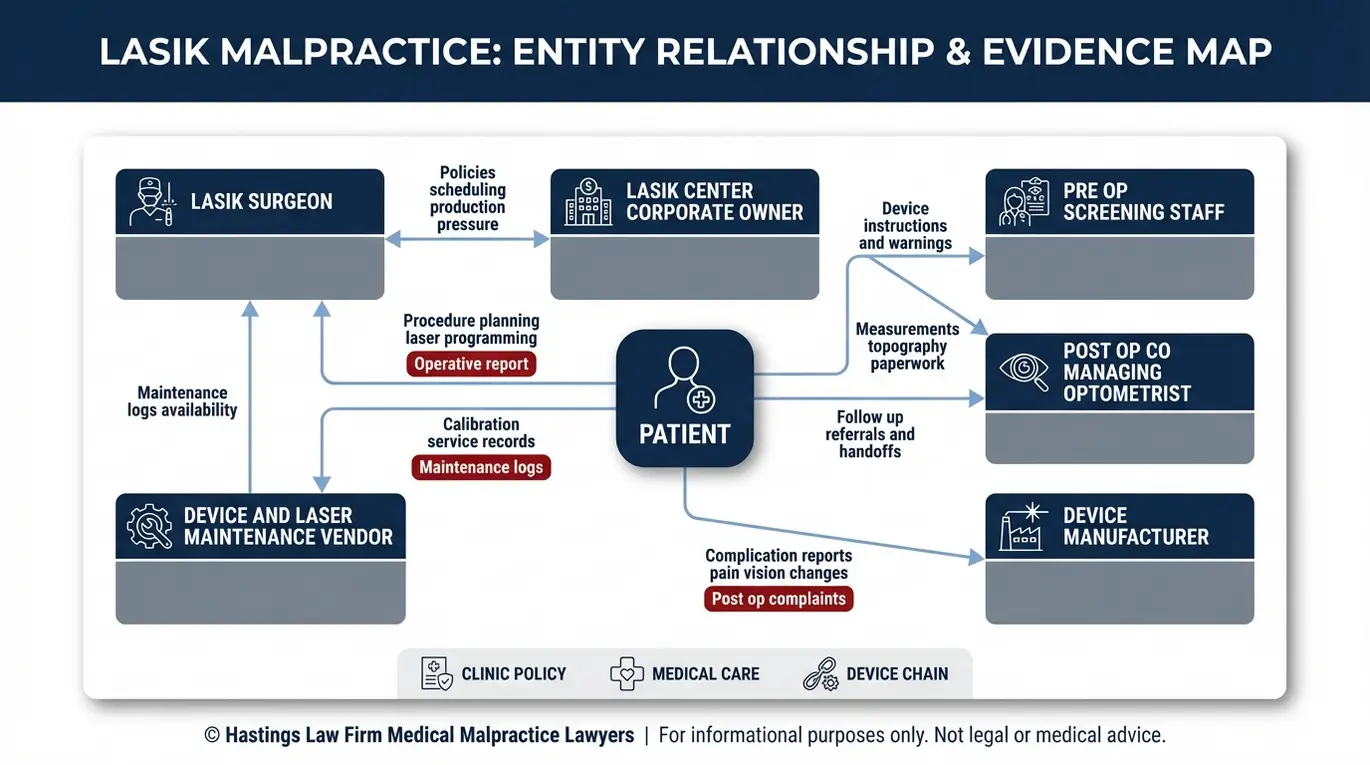
Surgical Errors. During LASIK, a thin flap is created on the surface of the cornea using either a microkeratome, a precision mechanical blade, or a femtosecond laser, which uses rapid light pulses to create the flap without a blade. A surgeon error or eye surgery error can occur if the laser is programmed with the wrong prescription or if the laser treatment is misaligned. These errors can cause irregular astigmatism and permanent visual distortion.
Equipment Failure. LASIK equipment requires regular calibration, maintenance, and sanitation. When a clinic fails to keep devices in proper working order, the consequences fall on the patient. We investigate maintenance logs, service records, and calibration data to determine whether equipment contributed to the injury.
Post-Operative Negligence. The post-operative care a patient receives after surgery matters as much as the procedure itself. Some of the most harmful outcomes develop when a clinic dismisses complaints of worsening pain or sudden vision changes as “normal healing.” These symptoms can indicate serious problems like infection or flap dislocation that require immediate intervention.
Common forms of negligence we evaluate include:
- Entering incorrect prescription data into the laser system
- Flap complications from improperly maintained or operated equipment
- Failure to calibrate or service laser devices on schedule
- Dismissing post-operative symptoms that indicate infection or flap displacement
- Inadequate follow-up protocols or failure to schedule timely post-op exams
- Delegating post-surgical monitoring to providers who lack the training to identify complications
The Hastings Law Firm Difference
Results matter, but what truly sets us apart is how we achieve them. Every verdict, every settlement, and every Texas courtroom victory comes from one guiding promise: To treat each client’s fight for justice as if it were our own.
This balance of skill, experience, and empathy reflects our core philosophy that justice should not only compensate the injured, but also make healthcare safer nationwide.

Distinguishing Known Risks from Actionable Malpractice
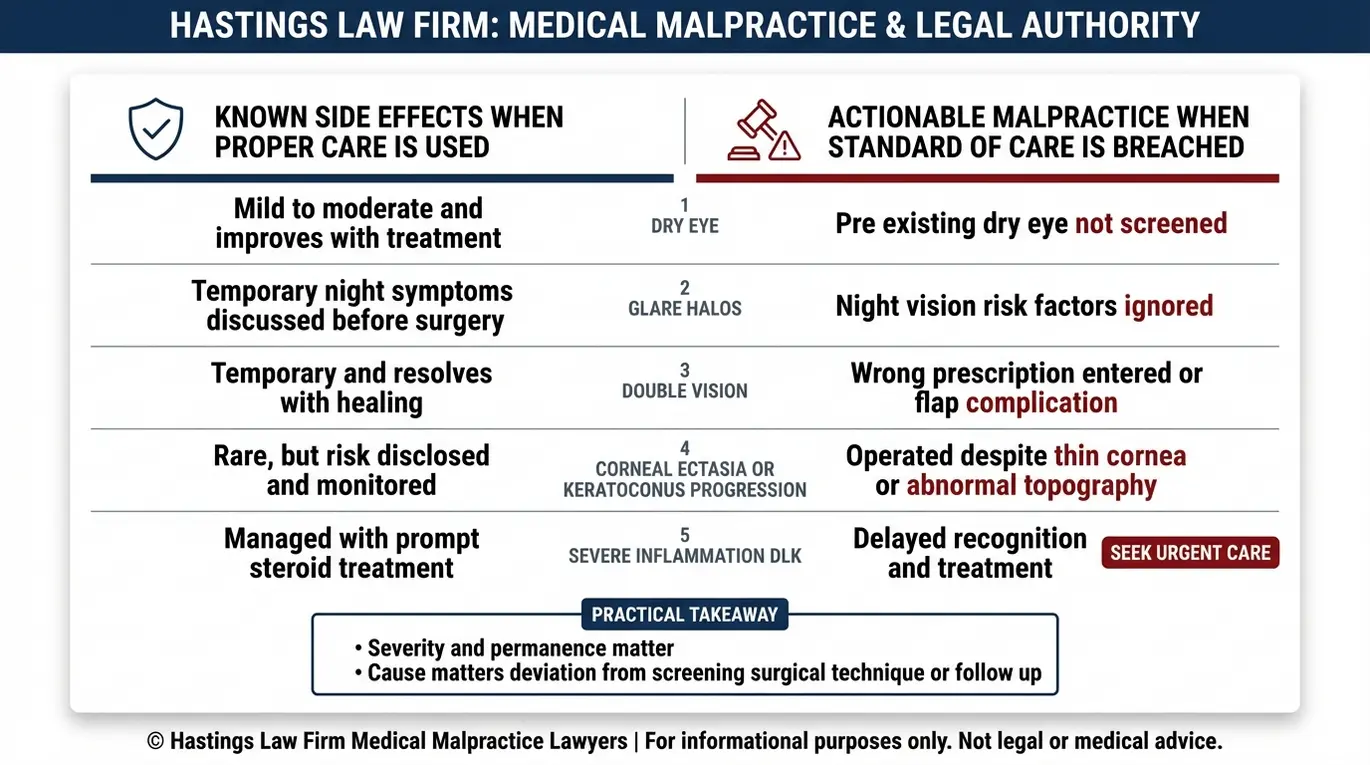
While dry eyes or halos can be temporary side effects, actionable malpractice occurs when these conditions are permanent, severe, and result from a deviation from the standard of care, such as operating on a patient with pre-existing keratoconus. A LASIK injury attorney examines pre-operative records to determine whether the clinic had the data to identify these risk factors and proceeded anyway. Keratoconus is an eye condition where the cornea thins and bulges into a cone shape.
Corneal Ectasia. Post-LASIK ectasia is a progressive condition where the cornea thins and bulges outward, distorting vision severely. It is one of the most devastating complications of refractive surgery, and it is often preventable. Operating on a patient with pre-existing keratoconus, an already-weakened corneal structure, or corneas that are too thin for safe reshaping can directly cause this condition.
Diffuse Lamellar Keratitis (DLK). DLK is a serious inflammatory response beneath the corneal flap. Without prompt treatment, it can cause permanent scarring and vision loss. When a clinic fails to recognize or treat DLK in its early stages, that delay can form the basis of a negligence claim.
Debilitating Visual Artifacts. When permanent glare, halos, starbursts, or double vision are severe enough to prevent a person from driving at night or working, the consequences go far beyond a “known risk.” If these outcomes resulted from a failure to screen properly or a surgical error, a legal claim may be warranted.
| Known Risk (Not Malpractice) | Potential Malpractice | |
|---|---|---|
| Dry Eye | Mild, temporary dryness that resolves with drops | Permanent, debilitating dryness in a patient with pre-existing dry eye syndrome who was never screened |
| Glare/Halos | Minor visual disturbances that fade over weeks | Severe, permanent artifacts caused by decentered ablation or operating on large pupils without disclosure |
| Corneal Changes | Minor, stable refractive shift | Progressive ectasia from operating on thin corneas or undiagnosed keratoconus |
| Inflammation | Mild, controlled with standard post-op drops | Untreated DLK leading to scarring and permanent vision loss |
Deceptive Practices and High-Volume Chains
Some high-volume LASIK chains engage in deceptive advertising or “bait-and-switch” pricing to attract patients, potentially compromising safety protocols to maximize surgical throughput. These business practices can directly affect the quality of care you receive.
The “Sale” Mentality. LASIK is sometimes marketed more like a consumer product than a surgical procedure. Promotional pricing, countdown timers on websites, and high-pressure sales consultations can push patients toward quick decisions at a high-volume clinic. When a clinic focuses on high patient turnover, important safety steps may be compressed or skipped entirely. Federal consumer protection law prohibits unfair or deceptive acts in commerce, and violations of advertising guidelines can serve as evidence of negligence.
Co-Management Concerns. In some chain operations, the surgeon who performs your procedure is someone you meet only minutes before surgery. Post-operative follow-up is then handed off to an outside optometrist through a co-management arrangement. If that provider lacks the specialized training to detect complications like early ectasia or DLK, the result can be a dangerous delay in treatment.
Night vision disturbances, including halos, glare, and starbursts that interfere with driving, are among the complications that may go unaddressed when follow-up care is fragmented. Night vision disturbances occur when the eye cannot properly process light in low-visibility settings. If deceptive medical advertising drew you to a clinic that then failed to provide safe care, those business practices become part of the legal picture. Our team examines advertising materials, intake procedures, and co-management agreements to build a clear record of how the clinic operated.
Contact the Texas Healthcare Malpractice Attorneys at Hastings Law Firm Today for Help
If a LASIK procedure permanently damaged your vision or quality of life, you need a legal team that understands both the medicine and the law behind these cases. Hastings Law Firm is not a general practice firm. Every attorney, nurse consultant, and patient advocate on our team is dedicated to medical malpractice, and we have the in-house medical knowledge to evaluate what went wrong and why.
We charge no fees unless we recover compensation for you. Our team, which includes former defense attorneys and experienced hospital nurses, is prepared to investigate your case thoroughly. We use a trial-ready approach, preparing every case from day one as if it will go before a jury. We know that surgical negligence can rob you of your independence, and we are here to help secure the resources you need to manage your future eye care.
Contact us today for a free, confidential case evaluation. Let us help you find the answers you deserve and understand your path forward.
Frequently Asked Questions About LASIK Center Malpractice in Texas


This content was researched and written by the Hastings Law Firm editorial team, which includes attorneys, medical professionals, and experienced researchers. Our writing is informed by internal knowledge and practical experience, and we cross-check critical details against authoritative sources cited throughout. Every piece undergoes human-led fact-checking and legal review. Because legal and medical information can change, if you spot an error, please contact us. Learn more about our content standards and review process on our editorial policy page.

Brady D. Williams is a nationally recognized medical malpractice attorney who has spent his career handling high-stakes litigation for injured patients and families across the country. Licensed in both Texas and California, Brady draws on experience from hundreds of resolved medical cases to break down complex legal and medical topics for the people who need that information most. His writing reflects the same attention to detail and commitment to clarity that he brings to every case he handles.
